Digital Appendix: A ‘Big Data’ Approach to Mapping the Australian Twittersphere

The images below present higher-resolution versions of the graphs contained in the chapter “A ‘Big Data’ Approach to Mapping the Australian Twittersphere” by Axel Bruns, Jean Burgess, and Tim Highfield in the collection Repurposing the Digital Humanities, edited by Paul Arthur and Katherine Bode, which will be published by Palgrave Macmillan in 2014. We are posting them here as a digital appendix to the chapter. For higher-resolution versions, please click on the images below.


Twitter Maps for Digital Humanities book

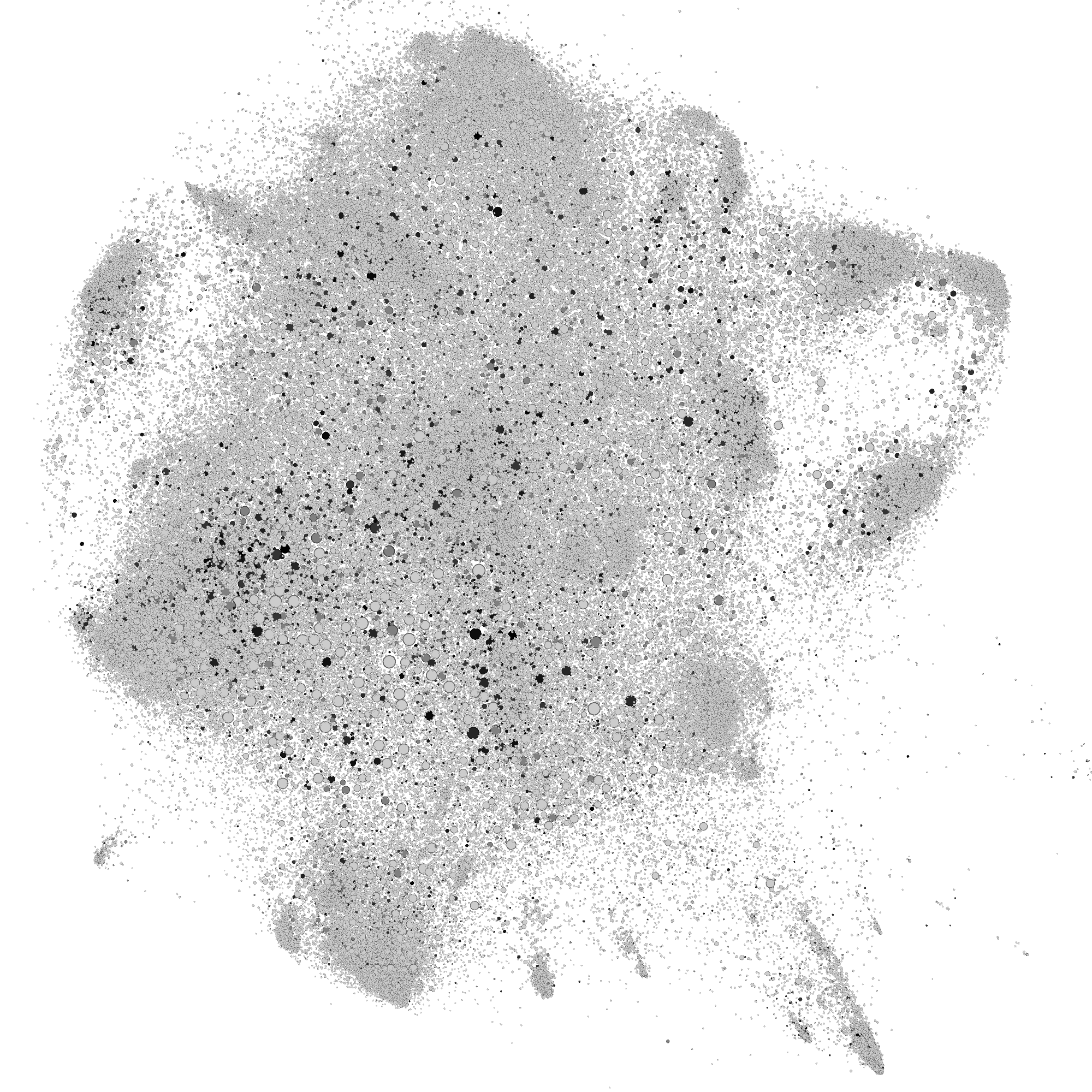
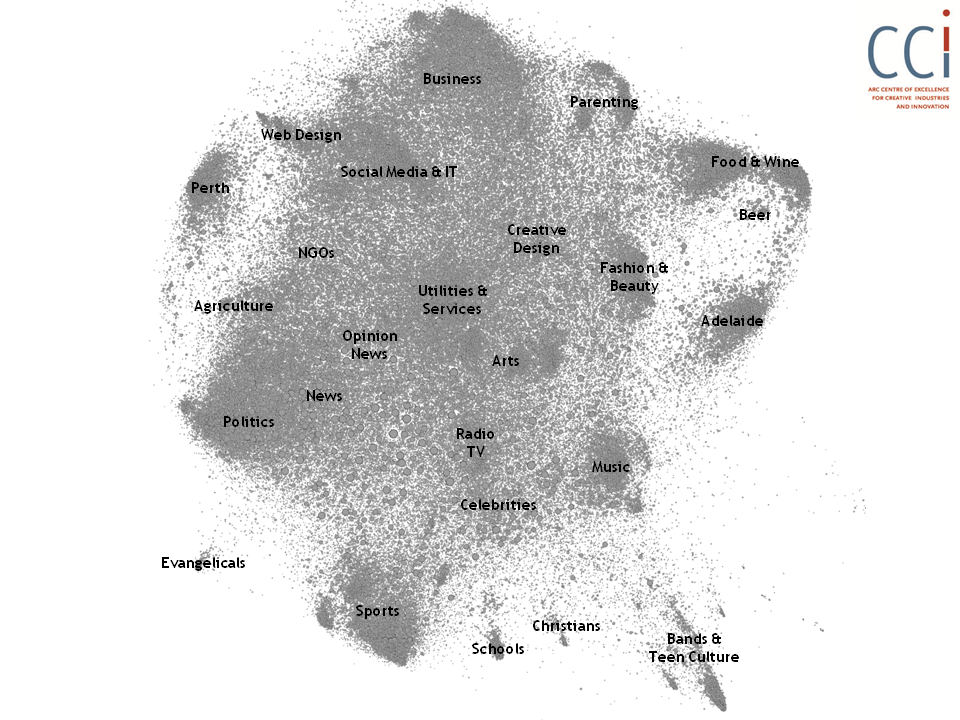
Figure 1: Thematic Clusters in the Australian Twittersphere. Based on network information for the 120,000 most connected users in the overall network.


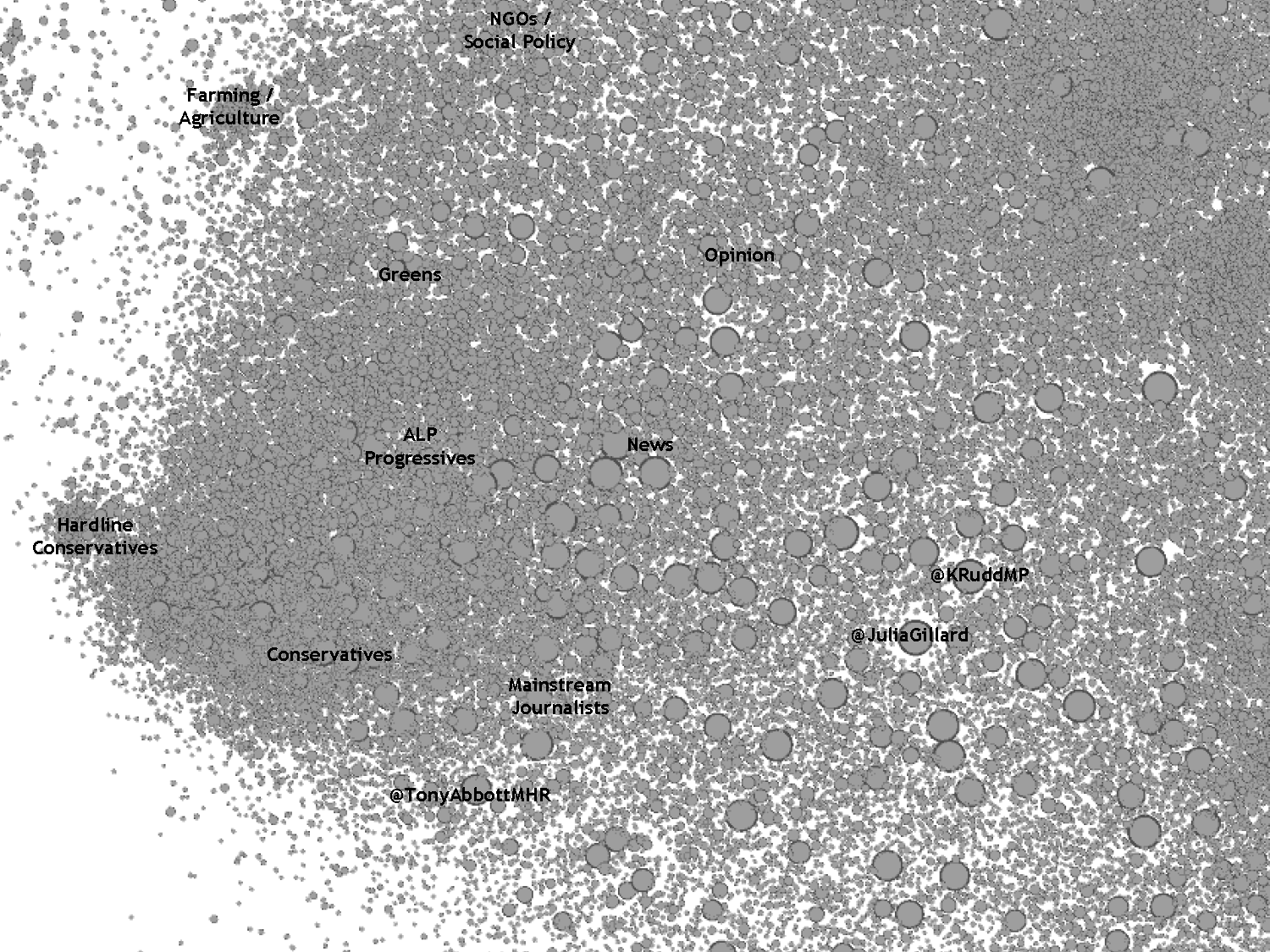
Twitter Maps for Digital Humanities book - zoom

Figure 2: Subdivisions within the politics cluster of the overall network map.


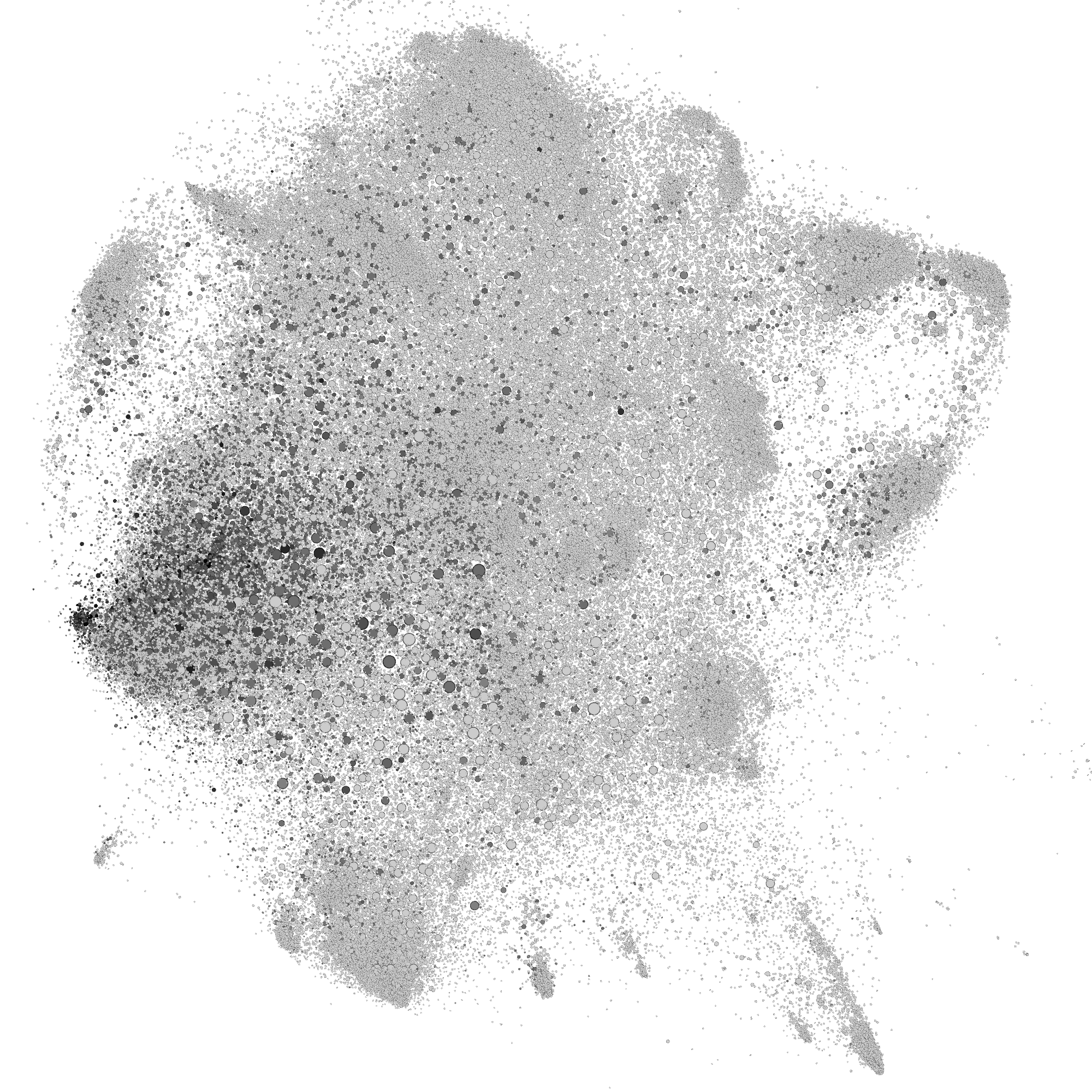
Map #auspol, greyMap #ausvotes, grey

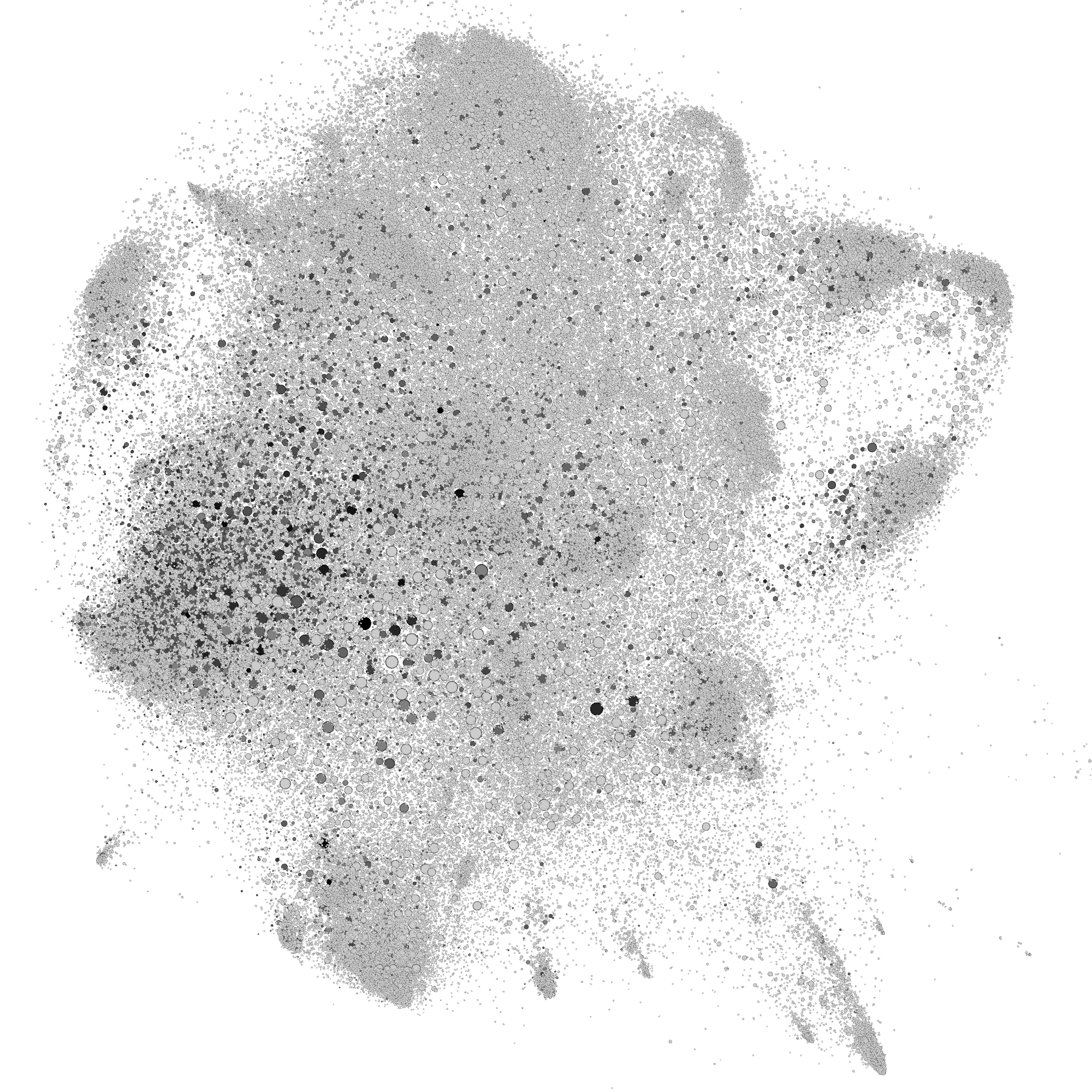
Figure. 3: Participation by Australian users in the hashtags #auspol (left) and #ausvotes (2010; right)


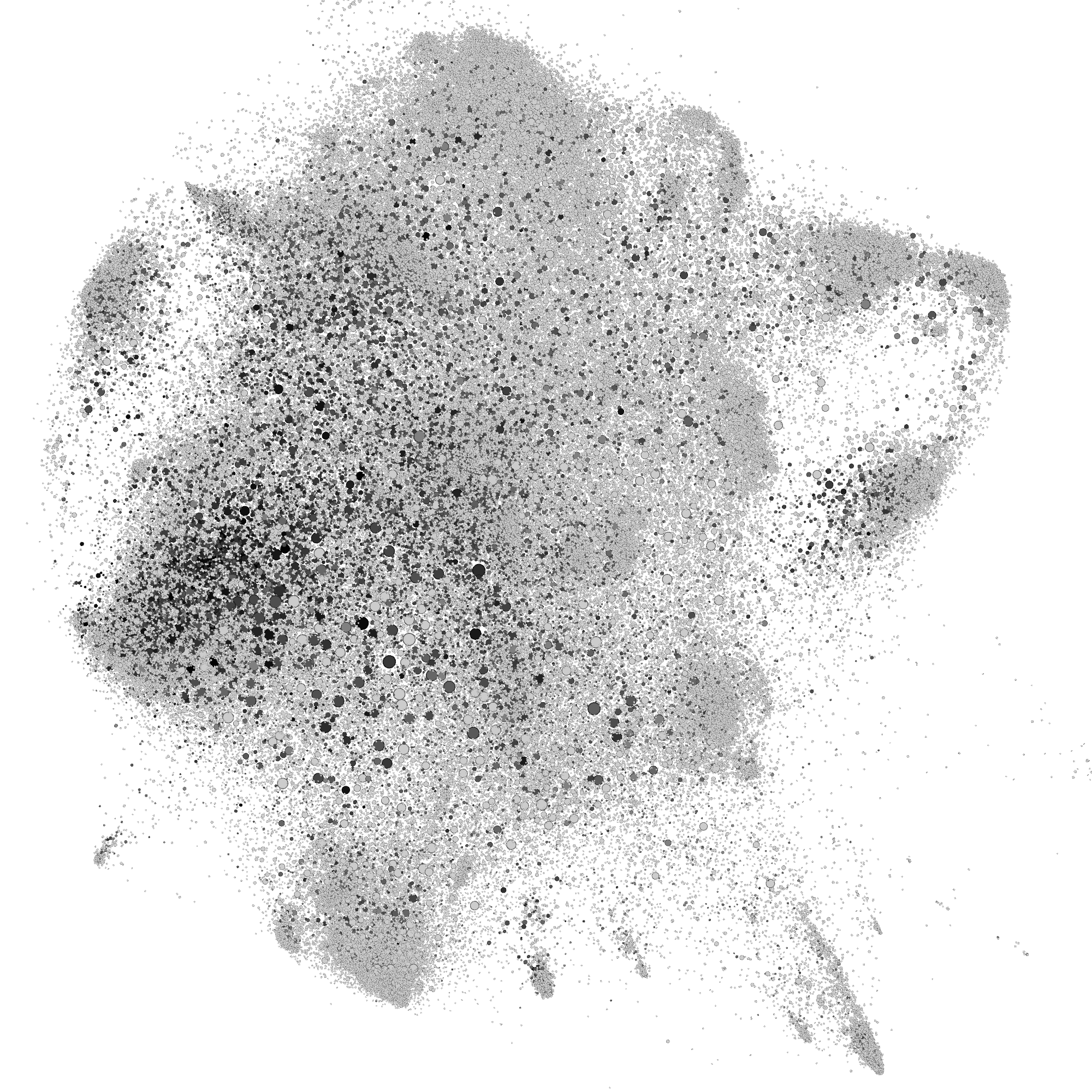
Map #masterchef, greyMap #royalwedding, grey

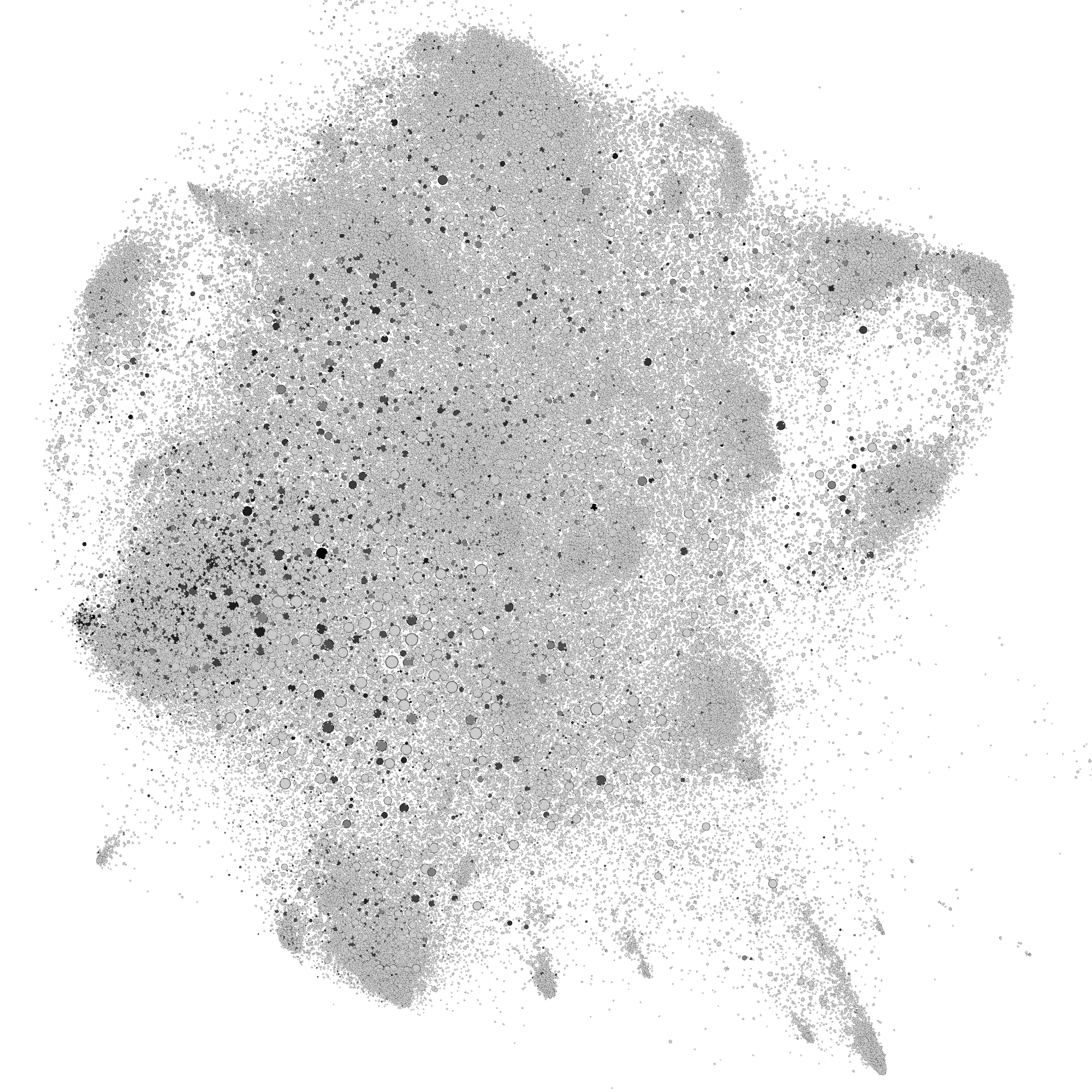
Figure 4: Participation by Australian users in the hashtags #masterchef (left) and #royalwedding (right)


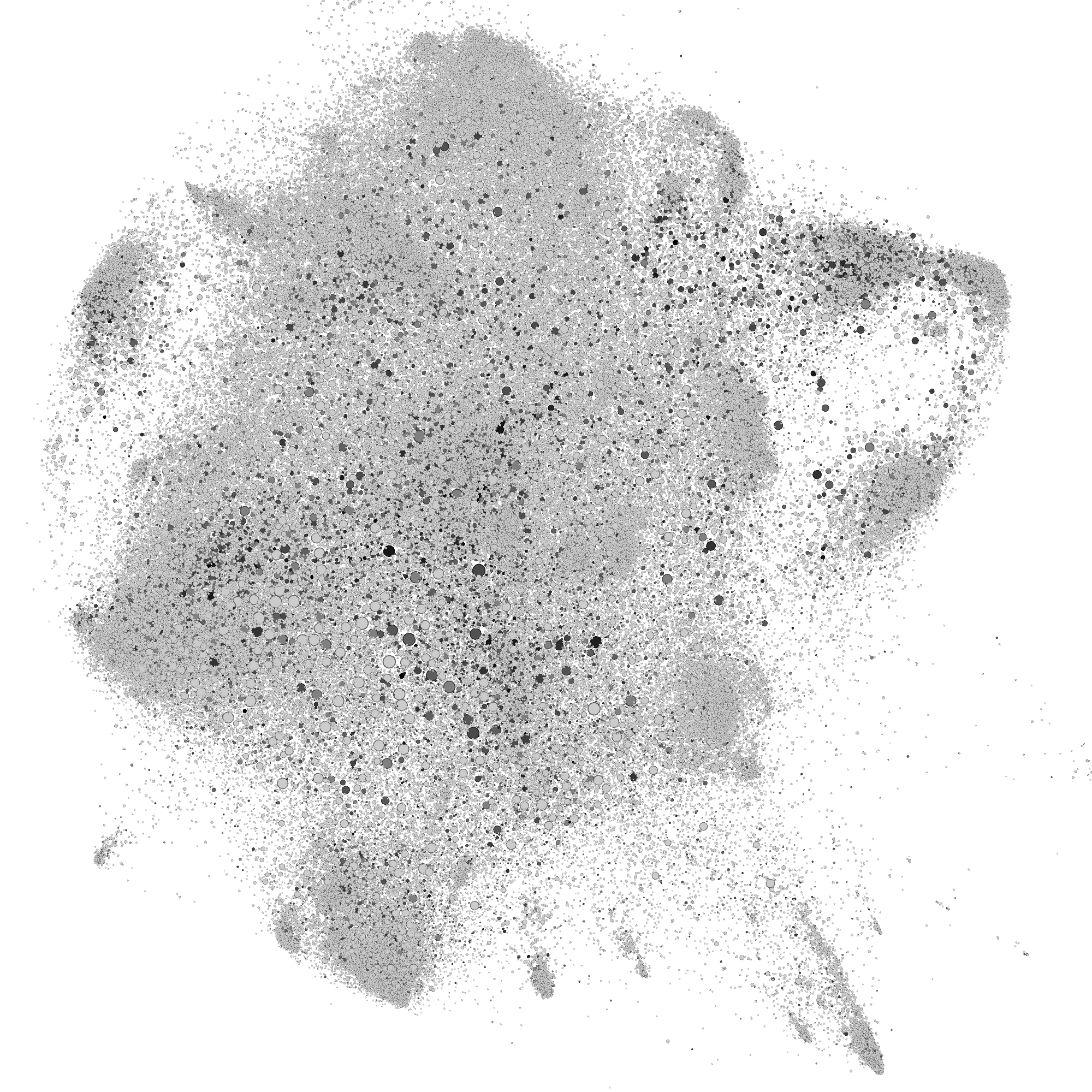
Map ABC Links Feb. 2013, greyMap news.com.au Links Feb. 2013, grey

Figure 5: Sharing of links to ABC News and news.com.au by Australian users

New Users in Times of Crisis (and Revolution)

As part of our recent work investigating the Twitter Userbase, we have collected data on accounts registered around the 2011 triad of natural disasters; the Queensland Floods (January), Christchurch Earthquake (22 February) and Tokyo Earthquake & Tsunami (11 March). By looking at new accounts registered between 1 January 2011 and 30 April 2011, we are beginning to investigate whether such disasters were a driver of new Twitter registrations, or whether the use of Twitter was simply among those already utilising the platform. While processing this data, we realised we had also captured the Egyptian Revolution,  which showed a very similar pattern. And that pattern, as it turned out, was clear:

Total Registrations:

Let’s start by looking at the total registrations over the time period in question, a couple of different ways. The two charts below show both the average ID registered on the day (i.e. where in the Twitter ID range the users are), as well as the number of users who registered their account on each of those days.


As you can see, there are two dates where the pattern looks odd, namely 1 February and 18 February. Taking a closer look at the first of these, and registrations on a per-minute basis, we see a rather odd pattern that appears to show re-occurring outages:

We have yet to discover if this is an error with our data, or represents periods where twitter was either down or overloaded, but it does not appear to impact directly on the analysis that follows.

Registrations during Queensland Floods:

Let’s begin our detailed analysis with a closer look at the Queensland floods. There are a few different ways of attempting to locate users on Twitter, the most obvious being geolocation, although we didn’t attempt that for this analysis as it is well established that the percentage of users with geolocation on is historically around 1%. Another approach is to look for users with “Brisbane” (or similar) in their location field, while it is also possible to look at the time zone a Twitter user has set for their account, and at the UTC offset applied to their account. Let’s start with the location field and UTC offset:


It is immediately clear that “Brisbane” in the location field is not a good proxy. Even allowing for other cities and regions where the +36000 offset is applicable, the difference between 220 registrations and over 1200 is obvious. Both charts however show a spike around the time of the floods (which peaked in Brisbane on 13 January), while the UTC offset chart also shows a peak around the time of the NZ earthquake, and the recovery that followed. Drilling deeper than the UTC offset, and not quite as deep as matching text in the location, is the time zone field, so let’s take a look at that:

Here, again, we see large spikes for Brisbane, Melbourne and Sydney during the floods, and spikes particularly for Sydney and Melbourne around the NZ earthquake. So it appears clear that for the floods, not only was Twitter a source of information on the floods, but the floods were a driver of new registrations for Twitter, from users seeking to obtain that information and possibly contribute to the discussion.

Registrations during Christchurch Earthquake:

So, how about the Christchurch earthquake, which hit on 22 February? Well, we see a similar pattern. A spike in the +43200 UTC time offset, and in both the Auckland and Wellington time zones, shows the natural disaster was a clear driver of new registrations to Twitter. The second spike shown here, on 11 March, coincides with the Tokyo Earthquake & Tsunami, which posed a potential Tsunami threat to New Zealand.


Given that Twitter does not have a “Christchurch” specific location field, I repeated the text matching experiment here. But, while the spikes are obvious, the numbers are too low for this to be considered a reliable method of user identification.

Registrations during Tokyo Earthquake & Tsunami:

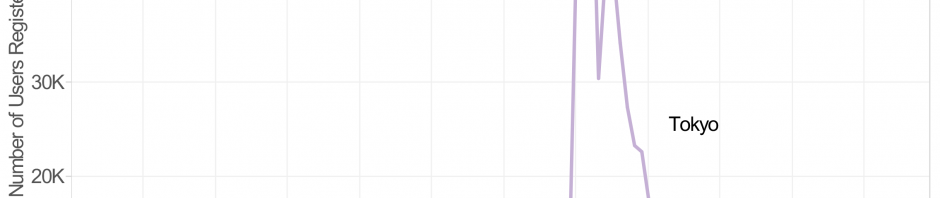
So, on to the Tsunami, and a familiar pattern is visible, albeit one much greater in magnitude most likely due to the sheer population in and around Tokyo:

As you can see from the above chart, the rise in new registrations as a result of the earthquake and tsunami was clearly extended here substantially into the recovery period, with increased numbers of registrations evident right through to the end of March. We already identified a spike in New Zealand registrations during this period, but the effect was also felt in other regions that may have potentially been impacted by the tsunami, as seen below:

Registrations during the Egyptian Revolution.

Finally, given that we had the data, it made sense to look at Cairo and Egypt, around the time of the Egyptian revolution on 25 January. Just as with the natural disasters above, the revolution proved to drive users to Twitter, as highlighted in the graphs below:


We will continue to work on data from around time time of these events in order to establish the longer-term effect, and to measure the significance of any residual increased publicity following the spikes, however it is evident from these graphs that not only is Twitter an important source of information during natural disasters, but the increased awareness around the platform, and its importance during the crisis events, leads to a substantial increase in new user registrations.

Announcing Twitter and Society

Much of the focus of this site in recent years has been on Twitter research, often in collaboration with our various colleagues and friends around the world. We’ve tried our best to help along the development of Twitter research methods and approaches by exploring the uses of Twitter, contributing to methodological innovation in the field, and documenting our approaches and findings in order to enable others to replicate our studies and test our results. In this context it’s been especially exciting for us to be able to launch our new book Twitter and Society, edited by Katrin Weller, Axel Bruns, Jean Burgess, Merja Mahrt, and Cornelius Puschmann, at the Association of Internet Researchers conference in Denver a few days ago. The book is now available in paperback and hardcover from Amazon and the Peter Lang Website, and an eBook version will also become available shortly.

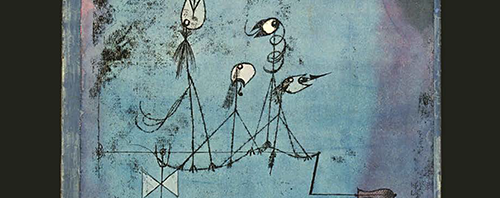
The book is a 450-page anthology of the very best of current Twitter research, providing a comprehensive overview of research methods, concepts, challenges, and applications. It features some 31 chapters, a foreword by the University of Amsterdam’s Richard Rogers – and we’re particularly proud to have been able to use the painting Die Zwitschermaschine (The Twittering Machine) by Paul Klee as the book cover. Many, many thanks to our 45 contributors for their fabulous contributions. A full list of chapters is below – and you can also follow further updates about the book at @twitsocbook!

Table of Contents

Foreword: Debanalising Twitter: The Transformation of an Object of Study
Richard Rogers

Twitter and Society: An Introduction
Katrin Weller, Axel Bruns, Jean Burgess, Merja Mahrt, & Cornelius Puschmann

Part I: Concepts and Methods

CONCEPTS

1 Twitter and the Rise of Personal Publics
Jan-Hinrik Schmidt

2 Structural Layers of Communication on Twitter
Axel Bruns & Hallvard Moe

3 Structure of Twitter: Social and Technical
Alexander Halavais

4 The Politics of Twitter Data
Cornelius Puschmann & Jean Burgess

METHODS

5 Data Collection on Twitter
Devin Gaffney & Cornelius Puschmann

6 Metrics for Understanding Communication on Twitter
Axel Bruns & Stefan Stieglitz

7 Sentiment Analysis and Time Series with Twitter
Mike Thelwall

8 Computer-Assisted Content Analysis of Twitter Data
Jessica Einspänner, Mark Dang-Anh, & Caja Thimm

9 Ethnographic and Qualitative Research on Twitter
Alice E. Marwick

10 Legal Questions of Twitter Research
Michael Beurskens

Part II: Perspectives and Practices

PERSPECTIVES

11 From #FollowFriday to YOLO: Exploring the Cultural Salience of Twitter Memes
Alex Leavitt

12 Twitter and Geographical Location
Rowan Wilken

13 Privacy on Twitter, Twitter on Privacy
Michael Zimmer & Nicholas Proferes

14 Automated Twitter Accounts
Miranda Mowbray

15 Information Retrieval for Twitter Data
Ke Tao, Claudia Hauff, Fabian Abel, & Geert-Jan Houben

16 Documenting Contemporary Society by Preserving Relevant Information from Twitter
Thomas Risse, Wim Peters, Pierre Senellart, & Diana Maynard

PRACTICES

Popular Culture

17 The Perils and Pleasures of Tweeting with Fans
Nancy Baym

18 Tweeting about the Telly: Live TV, Audiences, and Social Media
Stephen Harrington

19 Following the Yellow Jersey: Tweeting the Tour de France
Tim Highfield

20 Twitter and Sports: Football Fandom in Emerging and Established Markets
Axel Bruns, Katrin Weller, & Stephen Harrington

Brand Communication

21 Public Enterprise-Related Communication and Its Impact on Social Media Issue Management
Stefan Stieglitz & Nina Krüger

22 Twitter, Brands, and User Engagement
Tanya Nitins & Jean Burgess

Politics and Activism

23 Political Discourses on Twitter: Networking Topics, Objects, and People
Axel Maireder & Julian Ausserhofer

24 Twitter in Politics and Elections: Insights from Scandinavia
Anders Olof Larsson & Hallvard Moe

25 The Gift of the Gab: Retweet Cartels and Gift Economies on Twitter
Johannes Paßmann, Thomas Boeschoten, & Mirko Tobias Schäfer

Journalism

26 The Use of Twitter by Professional Journalists: Results of a Newsroom Survey in Germany
Christoph Neuberger, Hanna Jo vom Hofe, & Christian Nuernbergk

27 Twitter as an Ambient News Network
Alfred Hermida

Crisis Communication

28 Crisis Communication in Natural Disasters
Axel Bruns & Jean Burgess

29 Twitpic-ing the Riots: Analysing Images Shared on Twitter during the 2011 U.K. Riots
Farida Vis, Simon Faulkner, Katy Parry, Yana Manyukhina, & Lisa Evans

Twitter in Academia

30 Twitter in Scholarly Communication
Merja Mahrt, Katrin Weller, & Isabella Peters

31 How Useful Is Twitter for Learning in Massive Communities? An Analysis of Two MOOCs
Timo van Treeck & Martin Ebner

Epilogue: Why Study Twitter?
Cornelius Puschmann, Axel Bruns, Merja Mahrt, Katrin Weller, and Jean Burgess

Sporting Twitter Analytics: Comparing the Australian Grand Finals

Over the past fortnight, both of the major Australian winter sporting codes (AFL – Australian Football League & NRL – National Rugby League) played their showpiece occasions, the grand final. Without getting into the technicalities of Australia’s version of the playoff system, these events saw teams competing for the ultimate prize in their respective sports. Using our new ‘Twitter Machine’, we tracked a number of keywords for both finals to get a picture of how they unfolded on Twitter. I should also mention at this stage thanks to Troy Sadkowsky who set up an extra server for data collection (our primary one often being overloaded by US TV shows currently), and Katie Prowd who helped with keywords for the tracker (given that your author is by no means a fan of either sport, being much more at home with ‘real’ Football — Go Spurs!).

aflgf_wide

The AFL Grand Final took place on 28 September, and activity on Twitter peaked between 2 and 6pm Brisbane time. What is immediately evident from the above graph however is that a portion of these tweets were attributable to the two major spikes above, with the scale needed to show them also hiding much of the detail of the overall graph. These massive spikes were largely not caused by fans of the sport, but instead by One Direction fans re-tweeting messages of support (in the first instance) and congratulations (in the second) from members of the band:


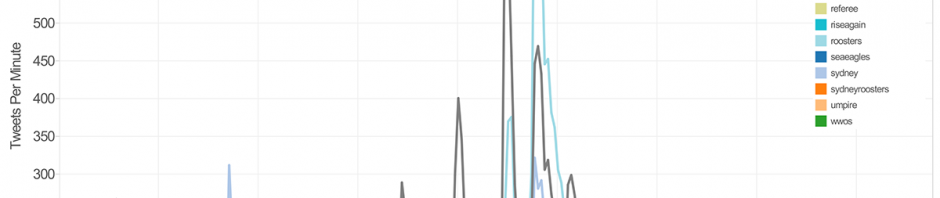
As it proved, the NRL Grand Final data set on 6 October had a similar occurrence, with a One Direction concert in Sydney that day artificially inflating totals for both the keyword ‘Sydney’, the hometown ‘Roosters’ (for whom the band proclaimed support) and the Grand Final overall, as can be seen in the below graph:

nrlgf_wide

So, before conducting any further analysis we removed as much of the ‘contamination’ from the data as possible, specifically excluding tweets which mentioned either @NiallOfficial or fellow band member @Harry_Styles. As a result, we were left with 80,587 tweets for the AFL Grand Final, and 77,665 for the NRL. Ghosts of key events during the match are evident in the overall graphs below, with clear spikes for the match beginning and the end of each quarter in the AFL, and spikes around the start, half-time and the full-time whistle in the NRL final:

aflgf_zoomtotal


nrlgf_zoomtotal


At this stage it was also possible to compare the audience for both Finals, and we recorded tweets from 35,712 unique users for the NRL, and 34,374 for the AFL. Perhaps most interesting though is that only 3968 users tweeted about both finals, or about 11% of the individual total for each final. Overall, we found a ratio of 2.17 tweets per person for the NRL, and 2.34 tweets per person for the AFL, which is right in line with the average observed in Nielsen’s data of US Sporting Events:

SportsEvents

Taking a closer look at the Australian finals, we were able to break these total tweets down by keyword, which shows clear spikes for the Hawks as they took control and won the AFL Grand Final, and a spike in mentions of the official account @HawthornFC, as their Grand Final win was confirmed. One caveat here is that while we were tracking both “fremantle_fc” and “dockers”, hindsight shows that “Freo” was the term of choice for at least some fans on Twitter, so we will avoid directly comparing the two fanbases in the AFL Final. One further note is that you may notice that the total tweets (above) are less than the sum of their parts (below); this is because in many cases multiple keywords are mentioned in the same tweet, e.g. a tweet saying “Congrats to the Hawks on winning the AFLGF” would be captured as both “Hawks” and “AFLGF”, but only counted once towards the total.

aflgf_zoom

In the NRL, we are reasonably confident that we captured both teams’ commonly used terms. Both Manly and Sydney tracked significantly during the Final (although, again, Sydney may still be slightly artificially inflated by One Direction fans), as well as ‘Roosters’ . The #RiseAgain hashtag promoted by the NRL & Roosters, however, fell flat, peaking at just 109 tweets at the same time as ‘Roosters’ was being used by over 750. For Manly, traffic was lower than Sydney, but Manly tracked reasonably well while the promoted “#GoManly” fell flat. Nine’s “#wwos” hashtag barely warranted a mention.

nrlgf_zoom

While commentators on both matches were keen to point out their broadcasts were going around the world, Twitter can help us work out who was watching, at least with the caveat that barely 1% of tweets contain geographical information. Indeed, both finals did show a worldwide audience, as can be seen on the two graphs below. Interesting, perhaps, that the AFL Grand Final seems to have more tweets from the United States, while the NRL finds more resonance in the United Kingdom (who do, of course, play Rugby League), though again – in both cases – I am cautious about drawing firm conclusions due to the risk of stray tweets from those pesky One Direction fans. That said, taking a quick glance through the 150-or-so geocoded tweets for the United States during the AFL Grand Final indicates the vast majority appear genuine.

aflgf_worldmap

nrlgf_worldmap

We can look at how the finals resonated with an Australian audience. Here, the (perhaps obvious) conclusion is that Victoria seems rather more interested in the AFL than the NRL, with more than 4 times as many geo-coded tweets within Victoria for the AFL final as the NRL. The reverse appears to be the case for New South Wales, with over 4 times as many for the NRL as the AFL. In Queensland, the ratio wasn’t as significant, but there were still double the geocoded tweets for the NRL Grand Final as seen a week previously for the AFL. In WA, we saw nearly 6 times as many geocoded tweets for the AFL as for the NRL. The NT barely registered (4 tweets for each final), SA saw 87 for AFL and 35 for NRL, and Tasmania 16 NRL vs. 55 for the AFL:aflgf_anznrlgf_anz

Tweeting the A-League: The Success Story So Far

Now that the AFL and NRL Grand Finals are over, Australia turns its attention again towards real football: the A-League season 2013/14 starts this Friday. That’s a good enough reason to review how the game has used Twitter to build its support base over the past couple of seasons.

A-League clubs have been active on Twitter for some time, and Twitter, Inc., too, has increasingly focussed on Australian sports as a way to build its userbase in the country; late in 2012, a high-profile delegation from the company visited Australia to boost its presence here and meet with representatives of the major sporting codes. By that time, the A-League’s teams had already developed their Twitter presences and gained a substantial follower base on the network (click to enlarge):

A-League Accession

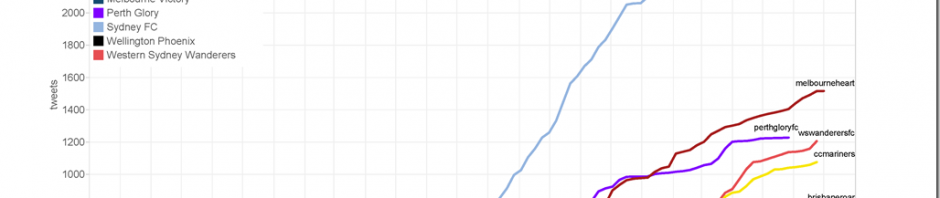
For most of the early history of the A-League and its Twitter accounts, it’s the Melbourne Victory whose account has had the most success in attracting followers. Repeat champions Brisbane Roar also put in a strong showing: by the end of the 2011/12 season, they are the second most follower club in the country. All this changes with the 2012/13 season: suddenly, Sydney FC takes off, boosted by a substantial influx of followers after its signing of marquee player Alessandro del Piero. I’ll wager that a significant percentage of these new followers will be del Piero fans from outside Australia, actually. A strong follower growth is also recorded for new league entrants (and eventual grand finalists) Western Sydney Wanderers, who conclude the season as one of the most-followed football clubs in Australia. (My thanks to my CCI colleagues Darryl Woodford and Troy Sadkowsky for their help with the follower data.)

In addition to these patterns of organic growth in follower numbers, there’s also a significant anomaly here: the lowly Newcastle Jets’ follower number suddenly jumps from just over 6,000 at the start of September 2013 to more than 30,000 only a month later. Unlike Sydney FC’s rapid follower growth following news of the del Piero signing, this is an abrupt jump – the first 5,000 new followers arrive literally on the same day, on 6 September 2013. This is deeply suspicious, and I’ll get back to it at the end of this post.

This recent oddity aside, though, the previous 2012/13 marked another substantial step beyond the 2011/12 season in the A-League’s Twitter activities. Here’s an overview of the tweets per week which @mentioned each of the teams’ Twitter accounts:

@mentions

Take the respective Grand Final weeks, for example: in 2011/12, the Brisbane Roar and Perth Glory accounts received a combined 5,000 @mentions as they met for the final game of the season. In 2012/13, that number more than doubled: the Western Sydney Wanderers and Central Coast Mariners accounts were mentioned almost 12,000 times during the corresponding period.

And the other teams also gained substantially from one season to the next. None more so, however, than Sydney FC, mostly on the back of its marquee player Alessandro del Piero, who brought an international Twitter following with him. Especially in the early weeks of the 2012/13 season, del Piero’s old club Juventus Turin as well as his Italian fans mentioned him and his team frequently in their own tweets, though this decreased gradually as Sydney FC dropped out of contention for the premiership.

Cumulatively, their support meant that Sydney FC’s account was mentioned over the past two seasons more than twice as frequently that the majority of its rivals:

@mentions (c)

Perhaps the greatest success story of the 2012/13 season, though, are newcomers and eventual runners-up Western Sydney Wanderers. As their fortunes on the field increased, so did the Twitter attention – in the end, WSW received as many mentions in one season as 2011/12 and 2012/13 premiers Brisbane Roar and Central Coast Mariners managed in two. A very strong new entry into the competition, in more ways than one.

The growing Twitter response to their accounts, and the continuing strength of the code in Australia, also seem to have inspired the clubs to further increase their Twitter activities. Again, it is Sydney FC which has been most active here, buoyed no doubt by the strong resonance to del Piero’s signing, but the rate of many other clubs’ Twitter efforts also ticks up notably as the 2012/13 season gets underway:

tweets (c)

And once again the Western Sydney Wanderers put in a very strong showing in their premiere season, responding strongly to the challenge of building an online presence and fanbase for the new club. By contrast, in season 2011/12 it was Gold Coast United which tweeted most strongly, even in spite of the significant organisational problems which eventually led to the club’s disappearance from the A-League – this is a phenomenon we’ve also seen in other, more established leagues, where clubs threatened with relegation to a lower division tweet especially much, perhaps in an attempt to maintain their fans’ loyalty.

(Sadly, a strange problem with the Twitter API prevented us from gathering the tweets sent by the Newcastle Jets account – they are missing from the graph above, therefore.)

Finally, although only a very small percentage of tweets ever contain geolocation information, the geographical mapping of those @mentions that do nonetheless offers some useful insights into the distribution of fans in Australia, New Zealand, and the world. Domestically, there are signs of a strong tribalism – Brisbane Roar fans are centred on Brisbane, Perth Glory fans on Perth, etc. This is unsurprising.

Internationally, some other patterns emerge. Of course there are plenty of Italians @mentioning del Piero’s Sydney FC – but the concentration of Melbourne Heart fans in the United States New England region, of Central Coast Mariners supporters in Texas, and of Brisbane Roar fans on the West Coast seems less obviously explicable. There also is a sizeable A-League fanbase in Indonesia (something we’ve seen in similar data for the German Bundesliga, too – international football is big in Indonesia, and I have a feeling Indonesians are more likely to keep geolocation turned on in their tweets). And it’s good to see that plenty of Australian ex-pats in the UK have remained faithful to the A-League, as an antidote to the clearly inferior English Premier League.

@mentions (geo)

Again, the geo-data are based on fairly small numbers, so it would be inappropriate to read too much into them. Beyond the geo-tagged tweets, however, the overall picture for Twitter activity around the A-League is positive, and the efforts which teams, the FFA, and Twitter, Inc. itself have made to promote the game through social media in Australia appear to be paying off. The Socceroos’ third World Cup qualification in a row doesn’t hurt, either.

This season, one A-League match will be broadcast on free-to-air television each week, of course – I would strongly expect this to provide a substantial further boost to these numbers, as more fans tweet along the live broadcast. We’ll be there to track the numbers.

Debunking the Newcastle Jets Follower Numbers

Finally, then, let me get back for a moment to the Newcastle Jets follower numbers. Following the methods outlined in previous posts, here is an overview of the account ages of the Jets’ followers, highlighting the suspicious 24,000-odd followers who joined since 6 September 2013:

Newcastle Jets Follower Growth

What we’re seeing here isn’t as clear-cut as the case of Tony Abbott’s fake followers, which we’ve covered previously. There is, however, a marked difference in the account age patterns between the first 6,000, non-suspicious followers and the more recent, suspicious group. Account ages amongst the latter appear centred around a period from May 2011 to May 2012 (where the red colouring is thickest), or a few months either side of May 2010 for the most recent 4,000 followers. The regularity of these patterns provides us with a first cause for doubt – we rarely if ever see this in genuine, organic growth patterns since there is no reason why a group of Twitter users who created their own accounts around the same time should all choose to follow one target account, and to follow that target account at precisely the same time, at that.

Spot-checks of the follower group between 6,000 and 26,000 also reveal a very high proportion of (apparently, at least) Russian accounts – users with account descriptions and past tweets predominantly in Cyrillic letters. I can see no logical explanation for why the Jets would suddenly have become a popular team in Russia during September 2013.

The only sensible explanation I can see is that these accounts constitute fake followers, similar to what we’ve encountered previously in the Tony Abbott case. And similar to that case, it remains very difficult to explain the motivations for this: the overnight boost in followers is so obviously suspicious that it is difficult to believe someone at the Newcastle Jets themselves would have decided to buy the club’s account some followers – it would be an extremely clumsy attempt to claim greater Twitter popularity. Contrary to the Abbott case, I also can’t think of anyone who would want to embarrass the Jets enough to buy fake followers in such a way (and as far as I’m aware, there hasn’t been any major media coverage of this increase, again contrary to what happened with Abbott).

So, perhaps in this case the most believable explanation is that a fake account farm decided to give their accounts some more apparent legitimacy by following a genuine sporting account. Why they chose the Newcastle Jets, though, rather than some of the more prominent A-League teams, I cannot explain.

(This research is part of a larger study about the uses of social media in football fandom in Australia, Germany and the UK, conducted with colleagues at Heinrich-Heine-Universität Düsseldorf and the GESIS Leibniz Institute for the Social Sciences, Köln. More on this soon…)


#ausvotes: The Australian Federal Election on Twitter, Final Week

The 2013 Australian federal election campaign is (finally) over – and as the final vote counts in tightly contested seats conclude, the incoming Abbott government will presumably be sworn into office any week now, after a surprisingly low-key start to the post-election period. Time, then, to explore how the final week of the campaign unfolded on Twitter, and indeed to look back over the entire campaign period to chart the parties’ and candidates’ uses of Twitter and the response from the Twitter audience. This first overview will also form the basis for further, more detailed research which we’ll publish in the months to come of course, and for comparative analyses of the Australian (7 Sep.), Norwegian (9 Sep.) and German (22 Sep.) social media election campaigns in partnership with our overseas colleagues.

First, the obligatory reminder about what we’re examining here: we are tracking all tweets by and @mentions of sitting members and candidates in the 2013 federal election. As more (especially minor party) candidates have become known, we’ve progressively extended our list as far as possible. My previous posts with week-by week analyses of the Twitter activity patterns are also available here (week 1, week 2, week 3, week 4), and there are a few more posts on the networks of @mention and retweet interaction and two posts on the electorate-by-electorate distribution of Twitter activity.

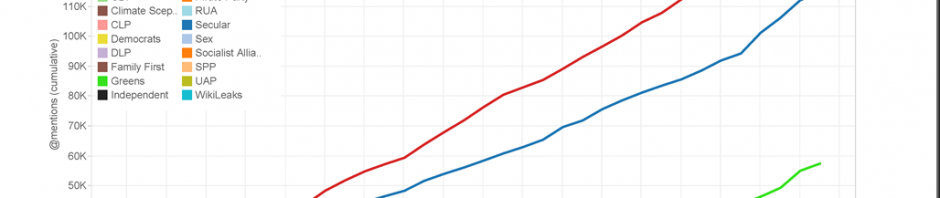
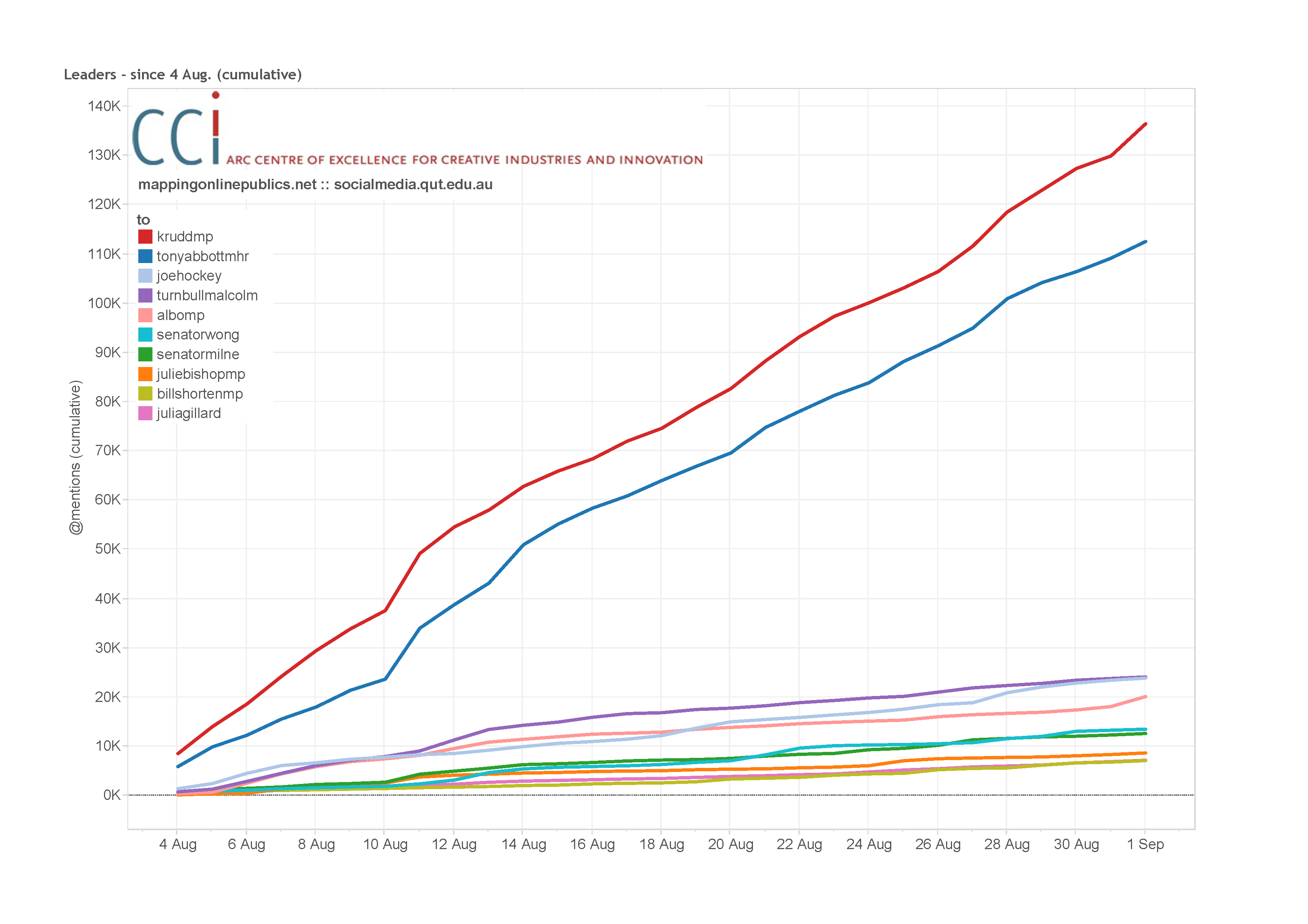
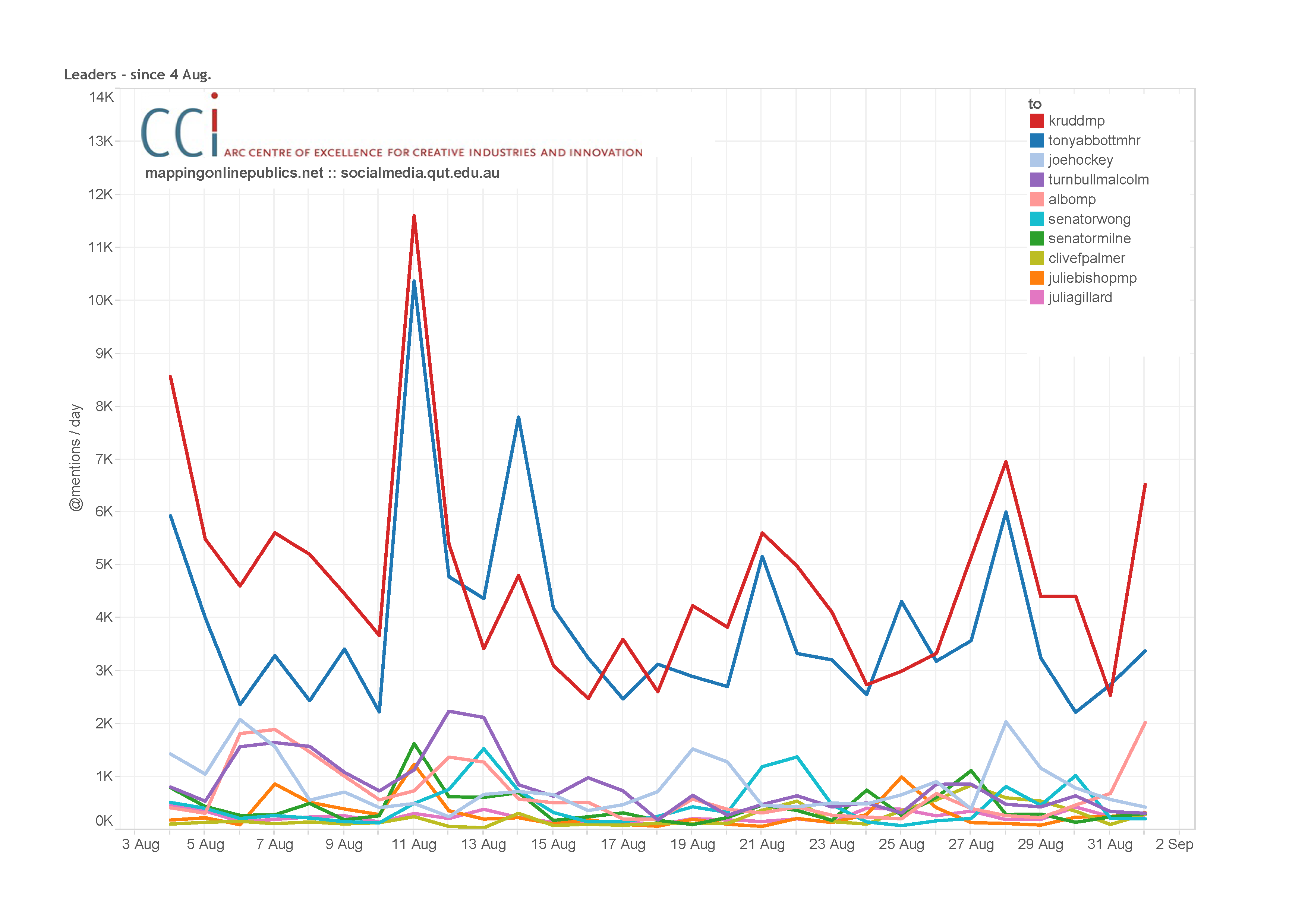
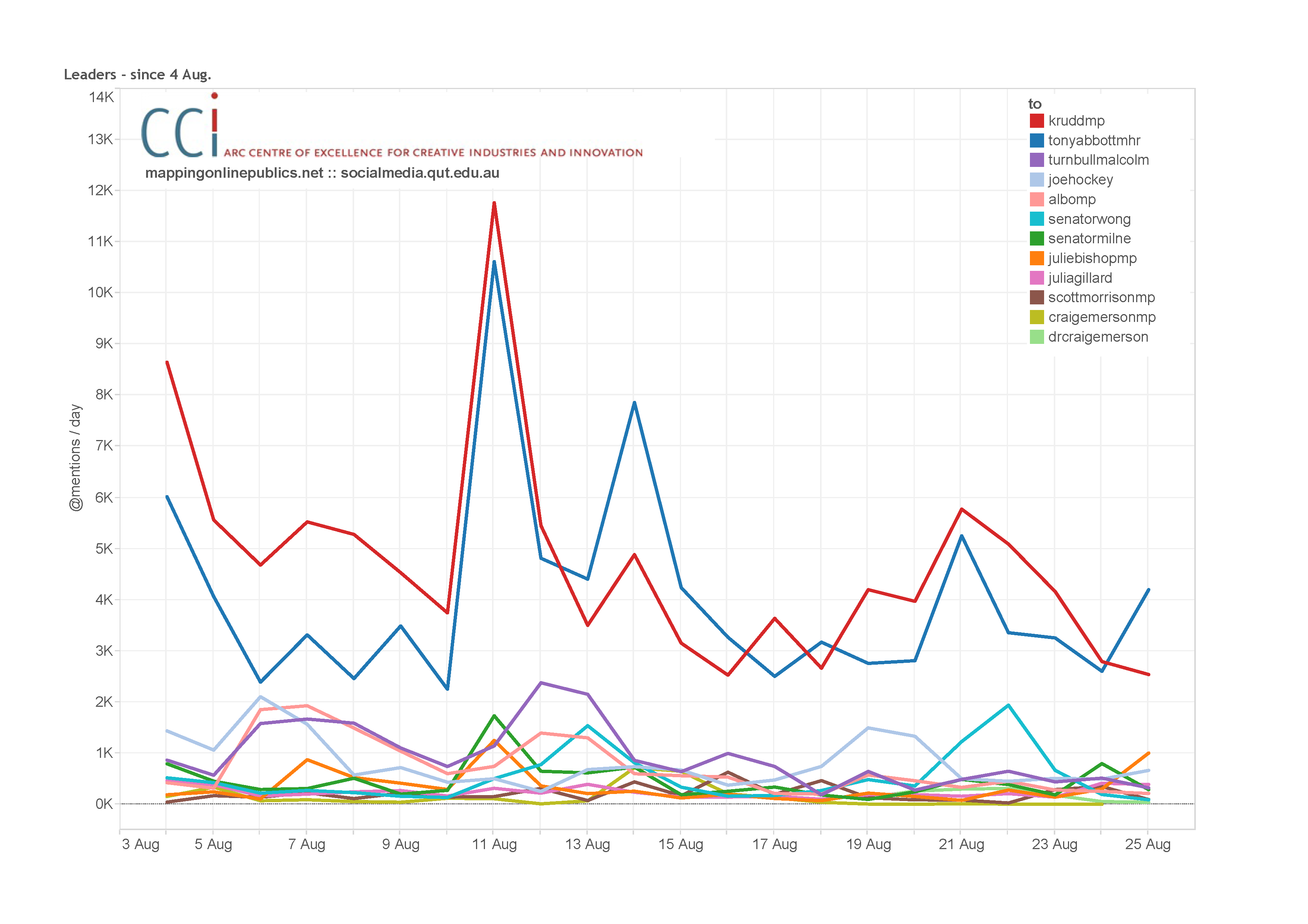
Let’s begin this week’s analysis with another look at the @mentions directed at the key political leaders, now covering the entire campaign from the official declaration of the election on Sunday 4 Aug. to the Sunday following the election day on 7 Sep. As in previous weeks, a clear two-class system is evident: the two candidates for the Prime Ministership, incumbent Kevin Rudd and (successful) challenger Tony Abbott, are well ahead of their various party colleagues and the minor party leaders. Rudd, in turn, is well ahead of Abbott in the total number of @mentions he received over the course of the election campaign, although it should be noted that after the first week of the campaign the two leaders tracked one another very closely, and Abbott even pulled ahead of Rudd in week-by-week mentions for a while in mid-August. Perhaps, unsurprisingly, as it became clear that he would be the next Prime Minister of Australia Abbott also received significantly more mentions than Rudd on the election weekend itself. (As always, click the graphs to see a larger version.)

Leaders since 4 Aug. (c)

It’s tempting to read more into these figures, but we simply don’t yet have the comparative evidence that would support such interpretations. For example, Abbott’s @mentions increased especially strongly in mid-campaign as he was fending off some criticism for a number of controversial and ill-advised statements, so we might speculate that on balance, a greater volume of @mentions is actually an indication of voter disenchantment rather than  support; Rudd pulled ahead again in @mentions during the final week of the campaign just as his standing in the polls dropped. More detailed semantic analysis of @mentions will be required at a later date to examine the overall tenor of these tweets (and with automated sentiment detection still very, very unreliable, this will mainly need to be manual), so it’s impossible to make any firm claims about this at this stage.

The increase in @mentions of Abbott’s account during the election weekend, at any rate, is related to his success in the election, of course, as Twitter users are coming to terms with the change of government, congratulate the winner or warn him not to abuse his mandate, and tweet at Abbott to call for action on a broad range of policy issues. Interestingly, at the same time former PM Julia Gillard’s @mentions also increase notably again: this is almost entirely due to the fact that she broke her campaign-long Twitter silence on election night and tweeted her commiserations to the Labor election team, resulting in a substantial number of retweets and @replies.

The day-to-day figures show some of these trends in some more detail. We see Rudd and Abbott track each other quite closely for most of the campaign, with synchronised spikes in the @mentions of both leaders especially on the days of the three televised debates. Rudd receives a strong boost in numbers (if not necessarily in electoral support) in the days following the Labor campaign “launch” on 1 September (and Deputy PM Anthony Albanese also spikes briefly as he plays a leading role during the event), but it’s Abbott who wins the election weekend and to whom the focus shifts especially dramatically on the post-election Sunday. Minor party leader Clive Palmer also receives substantial @mentions on election day as reports emerge of his likely win in his own electorate of Fisher.

Leaders since 4 Aug

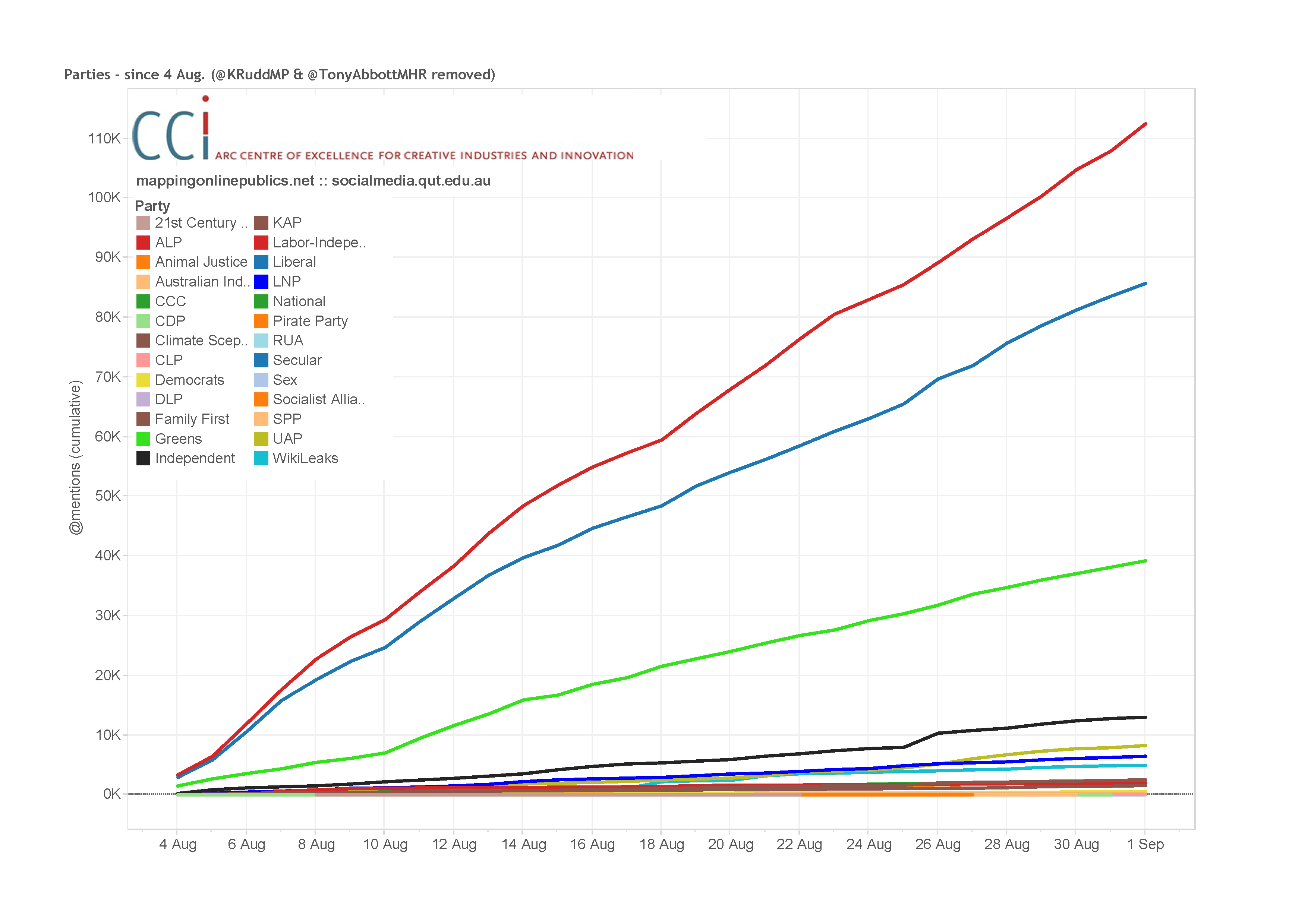
Interestingly, though, while PM-elect Abbott is the clear frontrunner in @mentions during the election weekend, his party’s other candidates don’t fare anywhere near as well. In the following graph, we’ve added up @mentions of all party candidates except for Abbott and Rudd (who are clearly in a league of their own), and it becomes evident that Labor candidates are mentioned significantly more often than their Liberal counterparts during the campaign as a whole, and even more frequently on the election weekend itself.

Again, it is all too tempting – but, in the absence of content and sentiment analyses, premature – to read too much into this. Possibly, Twitter users are simply lining up to say “good riddance” to a range of MPs who’ve just lost their seats – but just as possibly, they’re commiserating with them, thanking them for the past six years of government, or expressing their views about how the Labor Party should reposition itself for the future as it seeks to regain government in coming elections.

For the moment, my reading of the dramatic boost in @mentions for Labor politicians during the election weekend (and especially also on the post-election Sunday) tends towards the positive rather than negative: my sense is that it shows that, while they’ve removed it from government, voters (or at least those voters who are active on Twitter) haven’t completely tuned out the ALP, but are in fact very actively tweeting at its politicians to influence the party’s future direction. But that’s no more than an inkling for now – future research will need to explore this in more detail.

Parties since 4 Aug. (KR & TA removed)

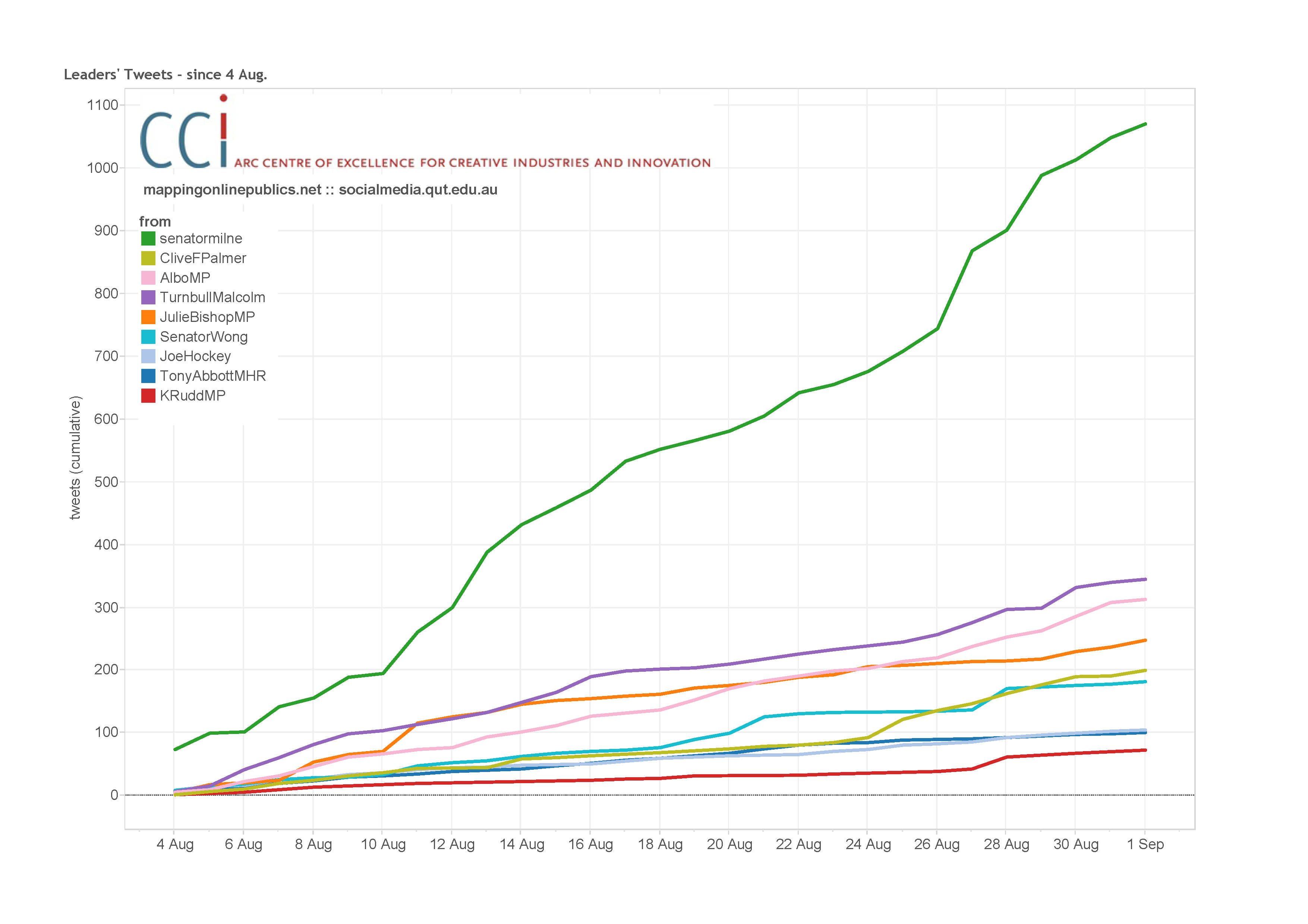
But let’s shift our attention from the activities of rank-and-file Twitter users to those of politicians themselves. It’s worth repeating an observation we’ve made throughout the campaign: for the most part, the volume of @mentions of the political leaders has very little to do with how much those leaders themselves have tweeted. If it did, we should expect to see Greens leader Christine Milne well ahead of everyone else, since she (assisted by her campaign team, presumably) has been the most active of all major politicians throughout the campaign. Another minor party leader, Clive Palmer, is also well represented here: encouraged perhaps by the social media response to some of his more notorious campaign stunts, his Twitter activity took off from about mid-campaign onwards.

More generally, it is notable that (where they did tweet at all) the major party frontbenchers have tended to be rather more active on Twitter than their leaders: Albanese, Turnbull, Bishop, and Wong have tweeted considerably more than Rudd or Abbott, and a number of them have also shown an upward trajectory in activity over the last week or so of the campaign. Bishop was especially active on election day itself, while it’s again all too tempting to suggest that Albanese’s increased activity might also be a first step in his tilt at the leadership of a post-Rudd ALP.

Rudd’s and Abbott’s far more restrained activity, by contrast, looks to me to be part of a deliberate attempt to be active throughout the campaign, but not to be so active as to overwhelm their followers with constant tweets (as Milne’s high-volume tweeting may have done to her less committed followers, for example). By comparison, though, my sense is that the apparently so social media-savvy Rudd and his team might have underdone it a little – especially as the underdog in the campaign, I would have thought he’d use Twitter and other social media more forcefully (and that also means more frequently) to argue his case for re-election. Perhaps his greater volume of tweets during the second half of the campaign is an acknowledgment of this shortcoming, in fact – it’s as if in late August they suddenly discovered that they needed to do more on Twitter.

Leaders' Tweets snce 4 Aug. (c)

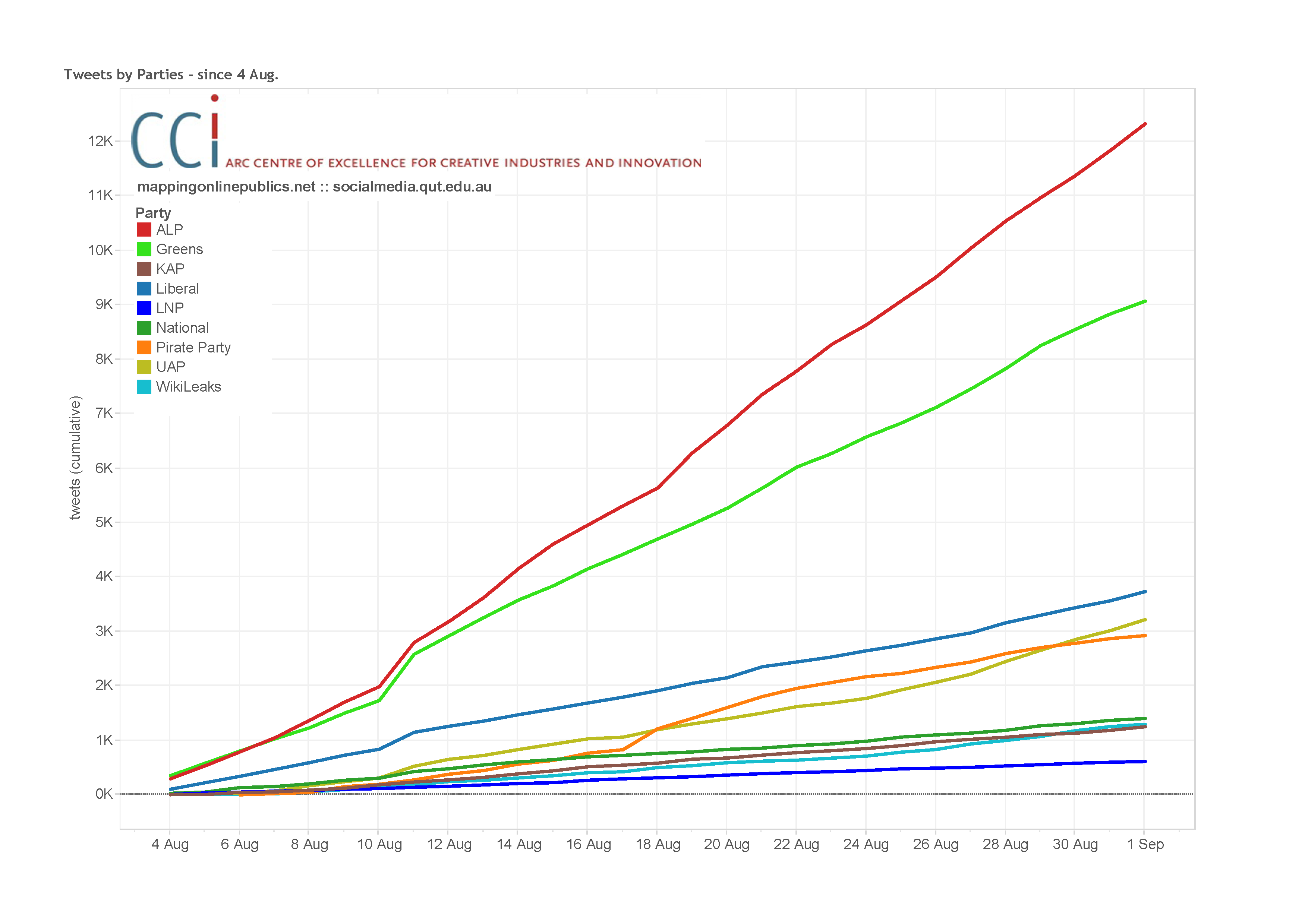
But yet again, the leaders’ activity provides only a very incomplete picture of the total volume of tweets originating from the various parties’ candidates. In aggregate, Labor politicians tweeted significantly more than their counterparts in any other party, even if their leader’s social media activities remained surprisingly restrained: ALP candidates tweeted even more than their colleagues from the Greens (though it should be acknowledged that, representing a minor party, the total number of tweeting Greens candidates was also smaller).

Tweets by Parties since 4 Aug. (c)

This reflects the greater need for Labor to utilise social as well as all other forms of media to get its electoral message across, compared to its major rivals in the Coalition parties, and ties in well with perceptions of a “small target” campaign pursued by the Coalition: better to keep Coalition candidates from engaging with social media than to risk any negative repercussions from potential gaffes (indeed, at least for less experienced Coalition candidates this strategy appears to have extended to mainstream media engagements as well).

Overall, then (and excluding its leader’s own Twitter activity), Labor’s approach to social media seems to have resembled that of a minor party seeking any kind of media exposure more than that of a major party using social media merely as an add-on to mainstream media coverage – like the Greens, the Pirates and Clive Palmer’s United Australia Party (with the latter two running considerably fewer tweeting candidates, however), Labor appears to have encouraged its candidates to tweet, and tweet a lot.

As we now know, this didn’t change the eventual outcome of the election, of course (and neither should we expect any one medium to do so in the contemporary, multi-channel media landscape, barring any especially major gaffe). Whether local Labor candidates’ social media performance helped to limit the losses by highlighting local contests over the Rudd/Abbott battle for the Prime Ministership, though, that’s a very different question – and one which will require a great deal of further analysis beyond the Twitter data themselves.

#ausvotes: Twitter Activity by Electorate

For my last post about the Twitter activity around Australian politicians before tomorrow’s election, I’m once again looking at the distribution of Twitter activity across Australia’s 150 electorates (this is excluding Senate candidates by default, therefore). We’ve done this once before during this campaign, a few weeks back – this post covers the period from 4 August to 1 September (i.e. the full campaign except for the final week, which hasn’t finished yet).

Once again, a reminder about our approach here: we are tracking all tweets by and @mentions of sitting members and candidates in the 2013 federal election. As more (especially minor party) candidates have become known, we’ve progressively extended our list as far as possible.

This post covers the two sides of the equation: first, I’ll provide an overview of which local candidates are receiving especially much attention on Twitter; further down, I’ll explore which candidates are particularly active in their own use of Twitter.

@mentions of Candidates

We’ll begin with the @mentions of local candidates. Just to make this absolutely clear: those @mentions may be coming from anywhere in Australia, and even in the world, not just from the electorate itself. So, if an electorate flares up in red in the maps below, it’s because its local candidate or candidates are @mentioned especially frequently on Twitternot (necessarily) because Twitter users who are based in the electorate are highly active. (And as always, zoom in to enlarge.)
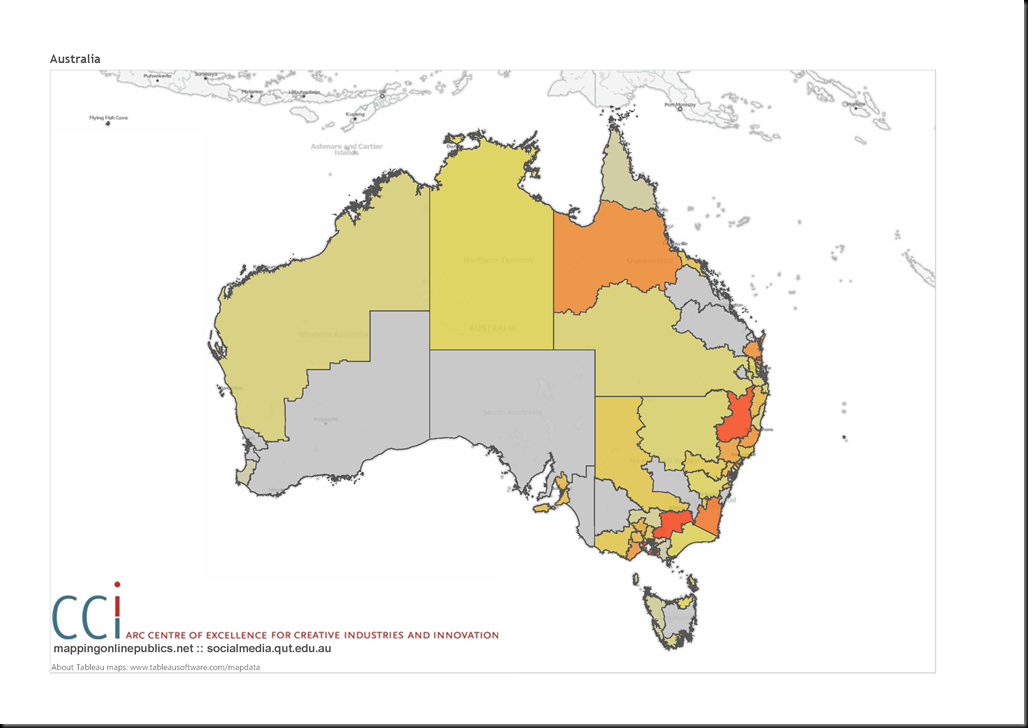
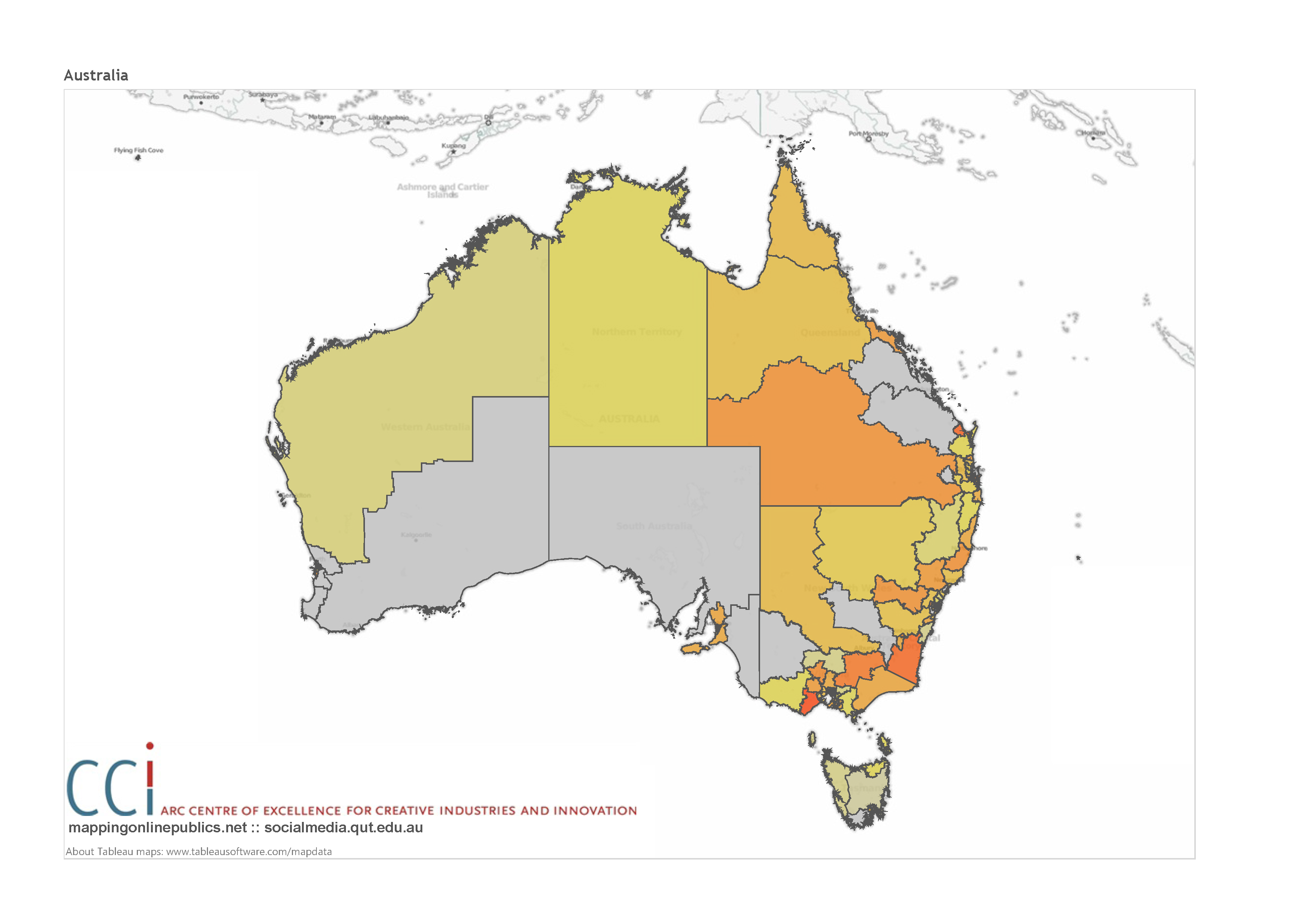
Australia - mentions

The national map points to some of the rural and regional electorates whose candidates have been especially frequently @mentioned on Twitter. In northert Queensland, Bob Katter’s seat of Kennedy gets considerable attention; in northern NSW, retiring Independent Tony Windsor remains a point of focus in New England; and in northeastern Victoria, Sophie Mirabella’s struggles to hang on to Indi have been a focal point for some time.
Brisbane - mentions

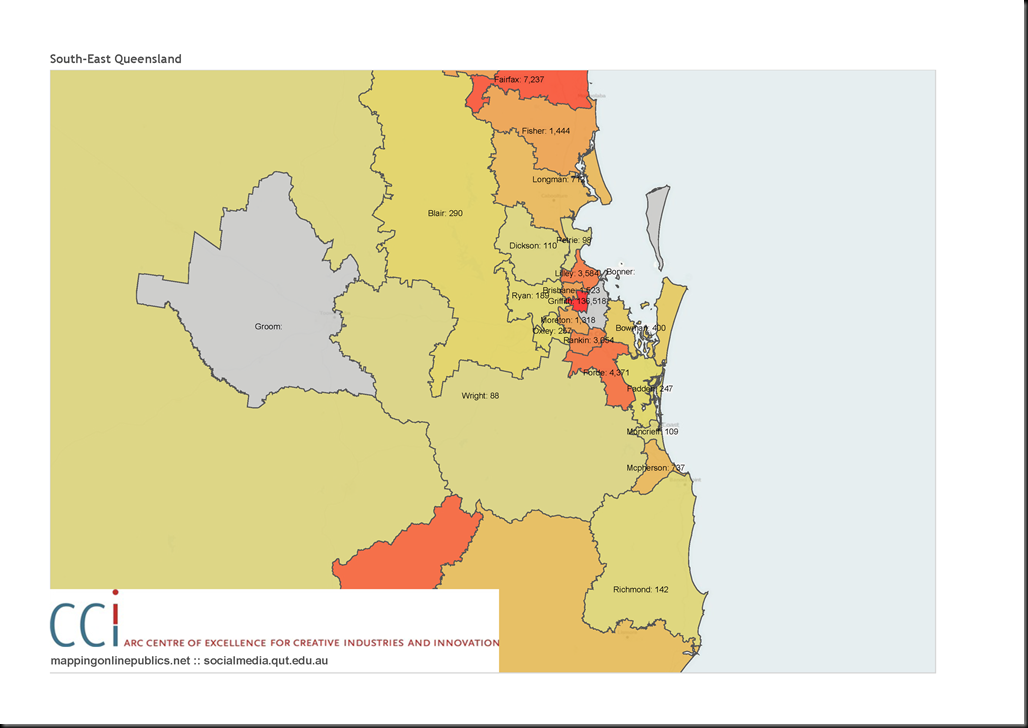
In and around Brisbane, Kevin Rudd’s seat of Griffith is featured strongly for obvious reasons. High profile draftee Peter Beattie lights up Forde, while former Treasurer Wayne Swan may be in trouble in Lilley. On the Sunshine Coast, neighbouring electorates Fairfax (where United Australia Party leader Clive Palmer is running) and Fisher (where the bitter feud between former Speaker Peter Slipper and LNP candidate Mal Brough continues) are also highly active.
Sydney - mentions

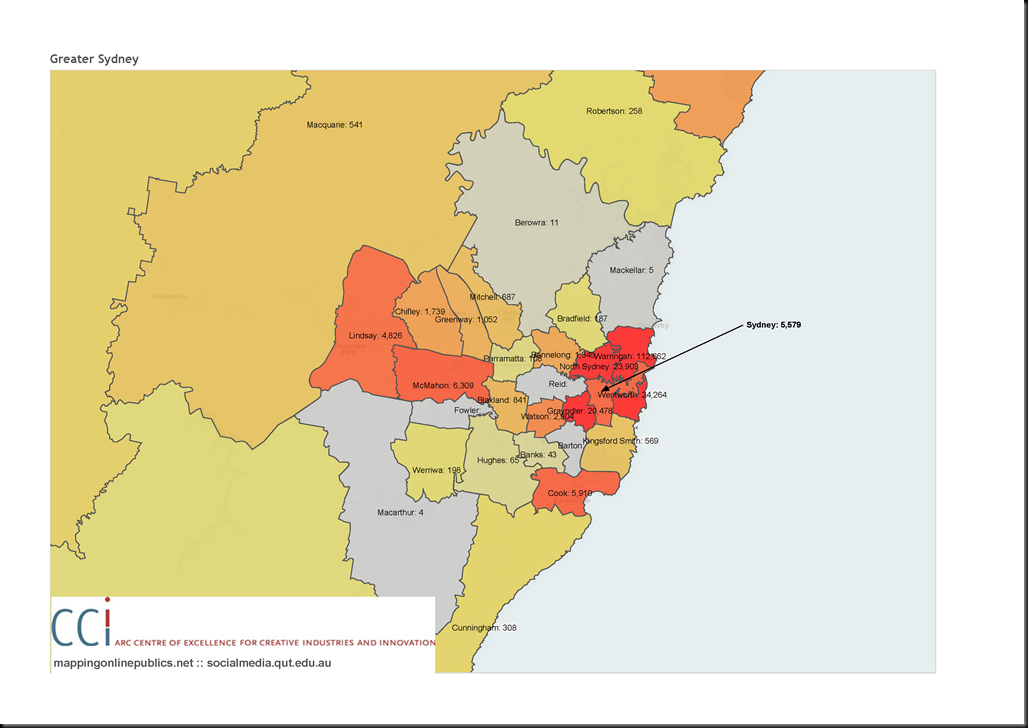
In Sydney, Tony Abbott’s Warringah, Malcolm Turnbull’s Wentworth, and Joe Hockey’s North Sydney are featured even more prominently than Anthony Albanese’s Grayndler, Tanya Plibersek’s Sydney, Scott Morrison’s Cook, Chris Bowen’s McMahon, David Bradbury’s Lindsay, or Tony Burke’s Watson. Here, the high level of activity serves in the first place as a reminder of how much the frontbenches of both sides of politics are populated by politicians from a single city.
Melbourne - mentions

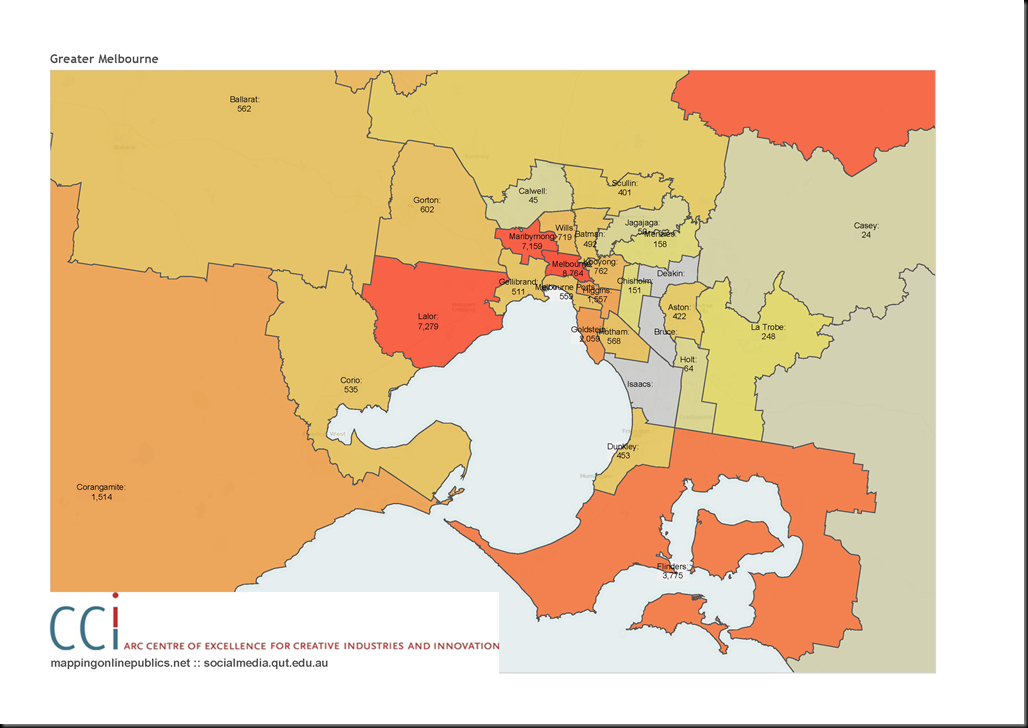
By comparison, Melbourne gets a much smaller share of the action. Sole Greens MP Adam Bandt’s seat of Melbourne leads the way, followed by Lalor (where retiring member and former PM Julia Gillard still receives her fair share of @mentions, even though she has been virtually absent from the campaign itself), and Bill Shorten’s Maribyrnong isn’t far behind. Flinders (where opposition climate spokesman Greg Hunt is standing) is somewhat less active, while Corangamite may be prominent mainly for the disendorsement of its Palmer’s United Australia Party candidate Buddy Rojek. Up in the northeast, rural Indi (at close to 6,000 tweets) leaves many a suburban seat behind.
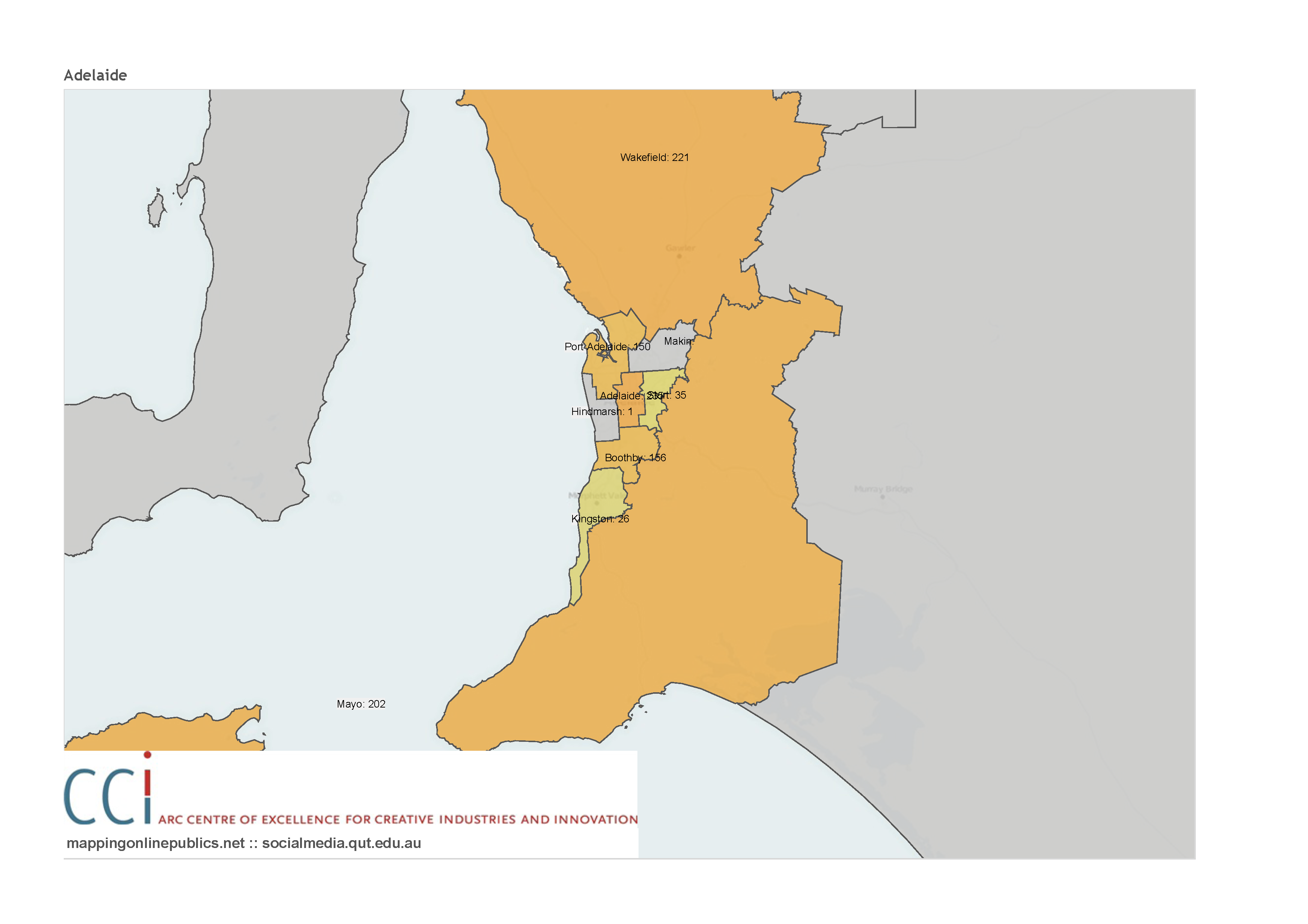
Adelaide - mentions

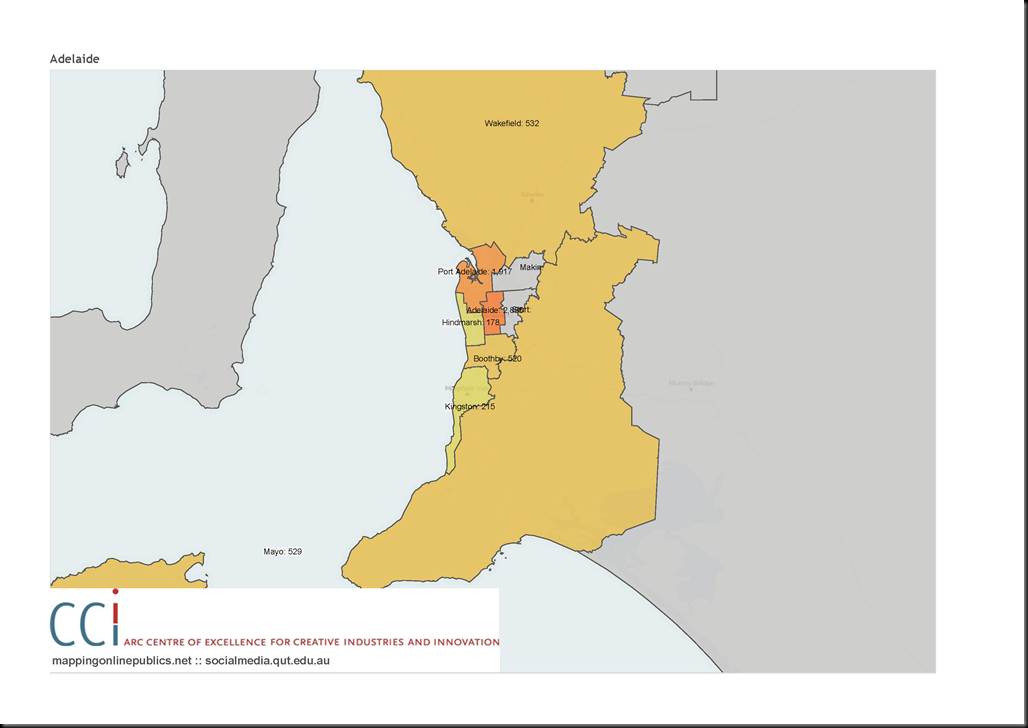
In Adelaide, things are quieter still. Only Kate Ellis in the seat of Adelaide, and Mark Butler in Port Adelaide, have generate any real activity over the course of the campaign to date.
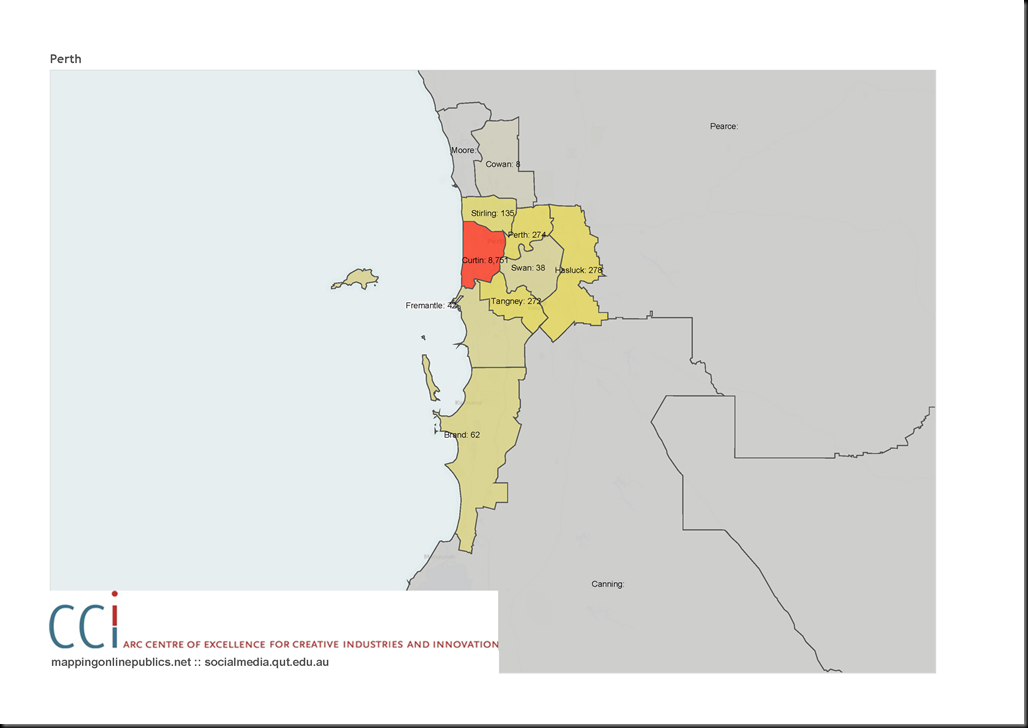
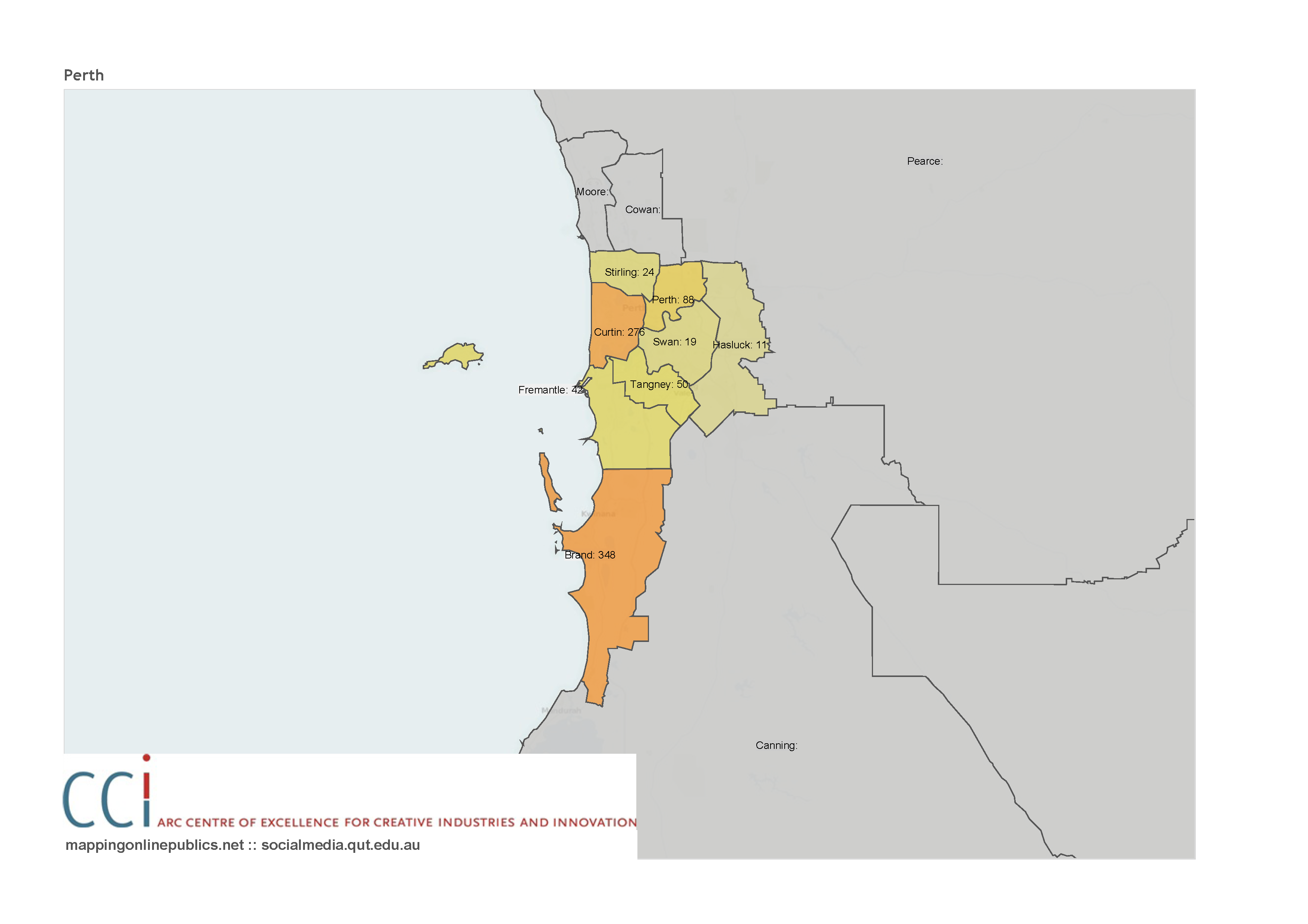
Perth - mentions

Meanwhile, the obvious star candidate in Perth – and perhaps the only Western Australian politician on Twitter who has a truly national profile – is Coalition foreign policy spokeswoman Julie Bishop.
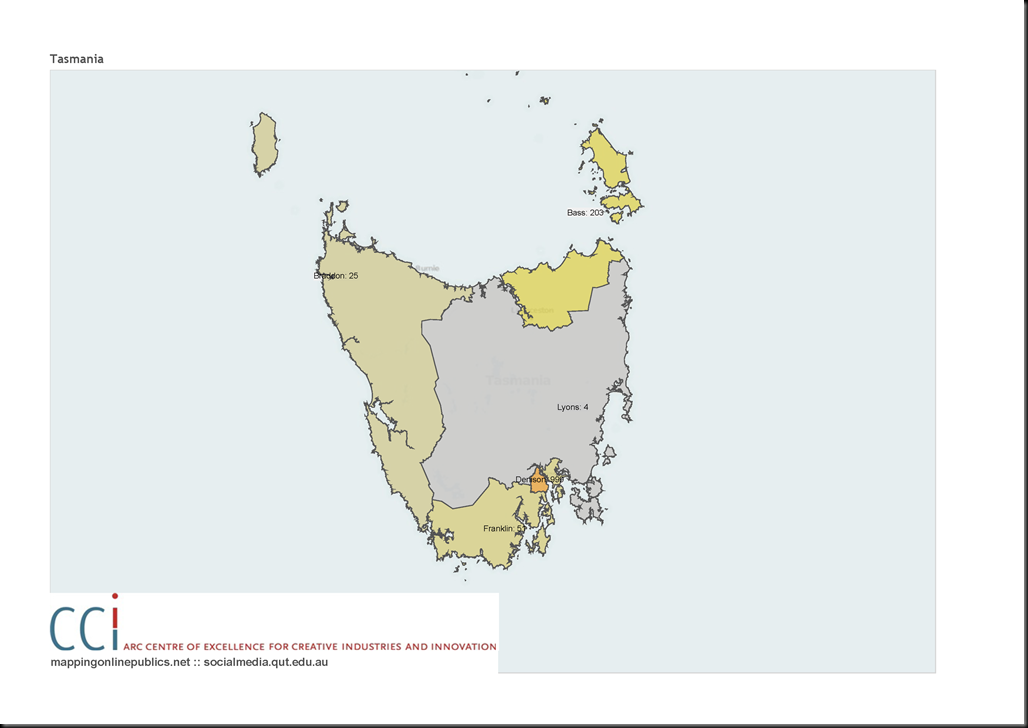
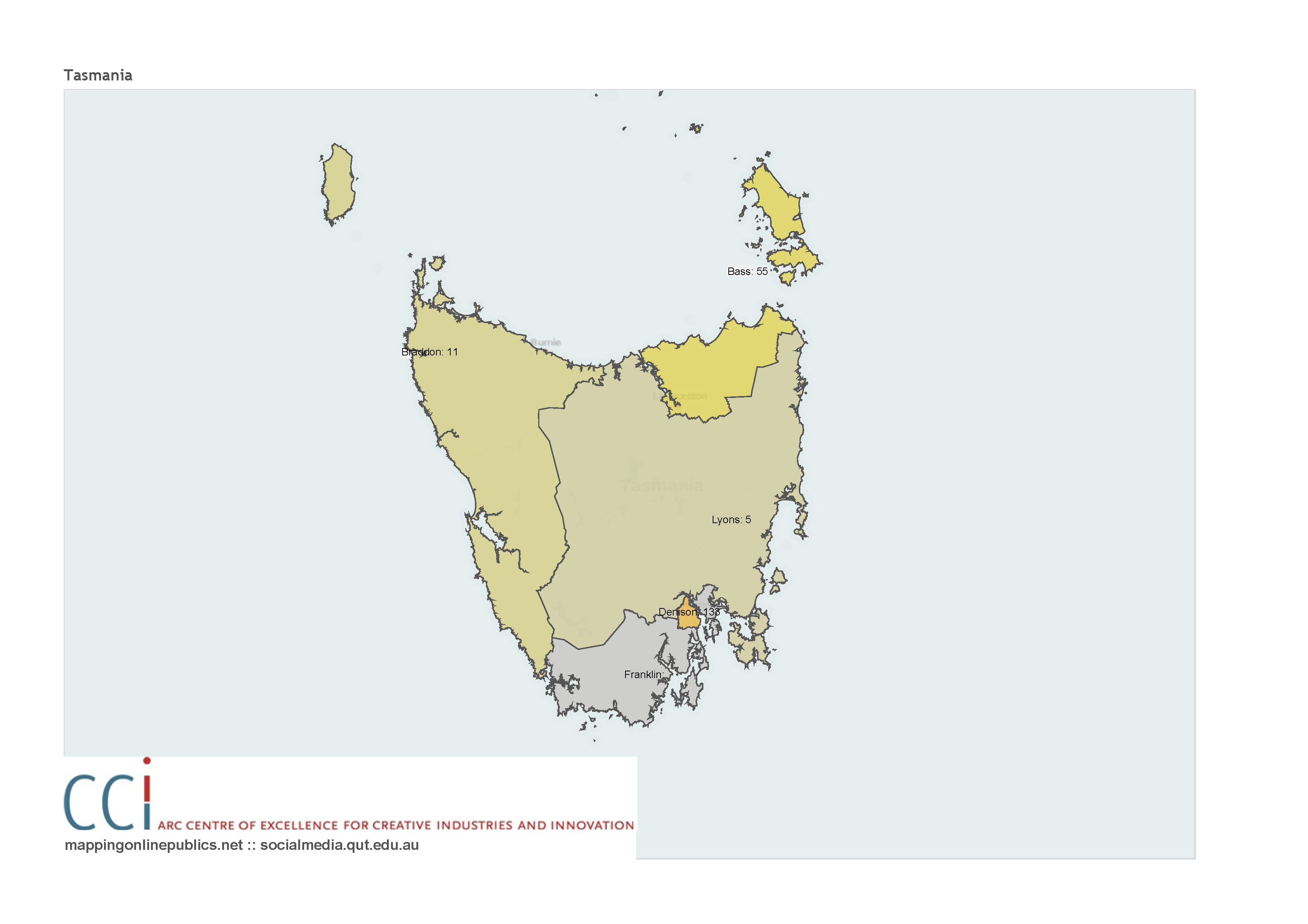
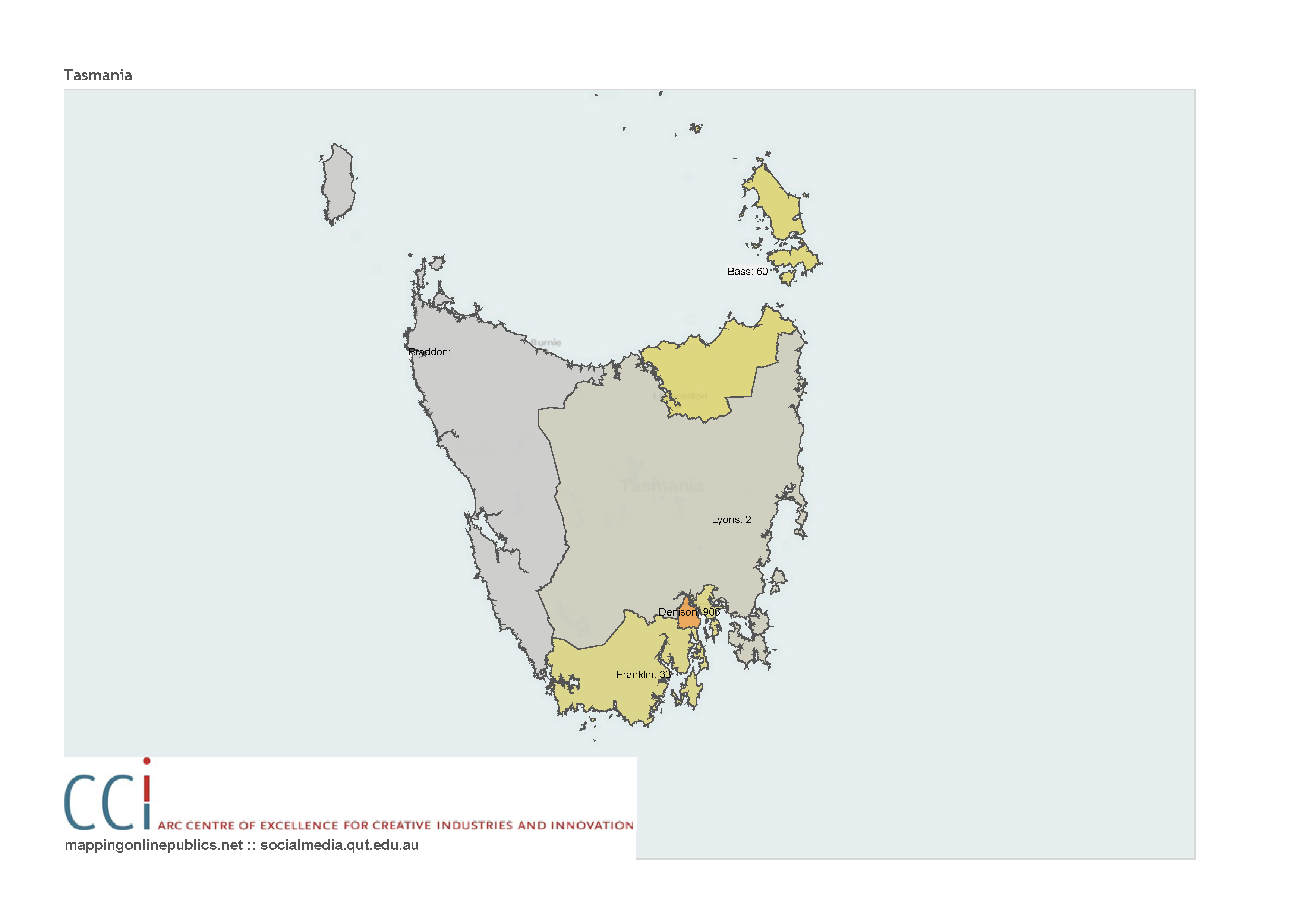
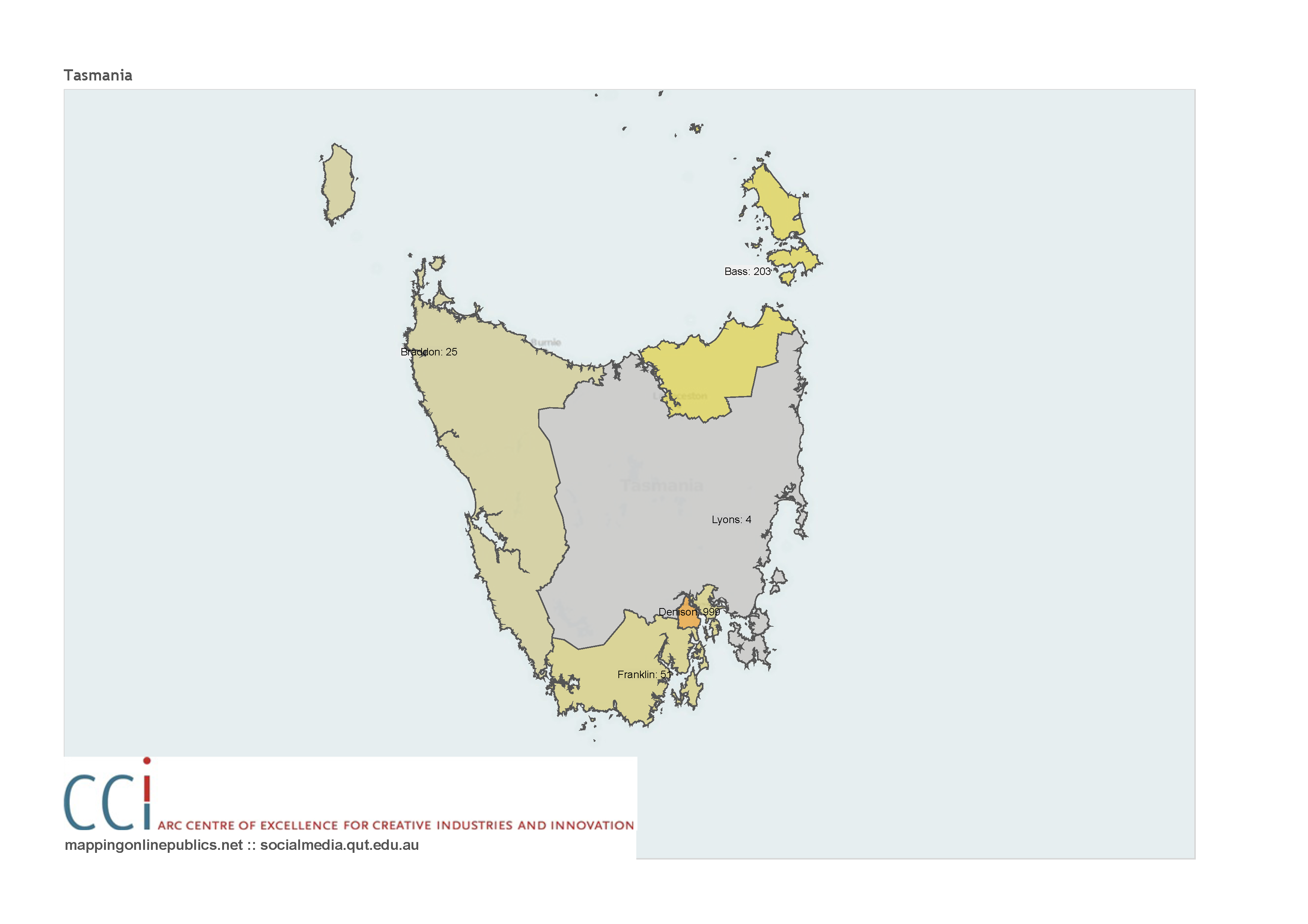
Tasmania - mentions

In Tasmania, it looks like Twitter activity also reflects population density – and here, too, the only politician with a national profile, Independent Andrew Wilkie, is the main reason that Denison (taking in Hobart) is the state’s most prominent electorate.
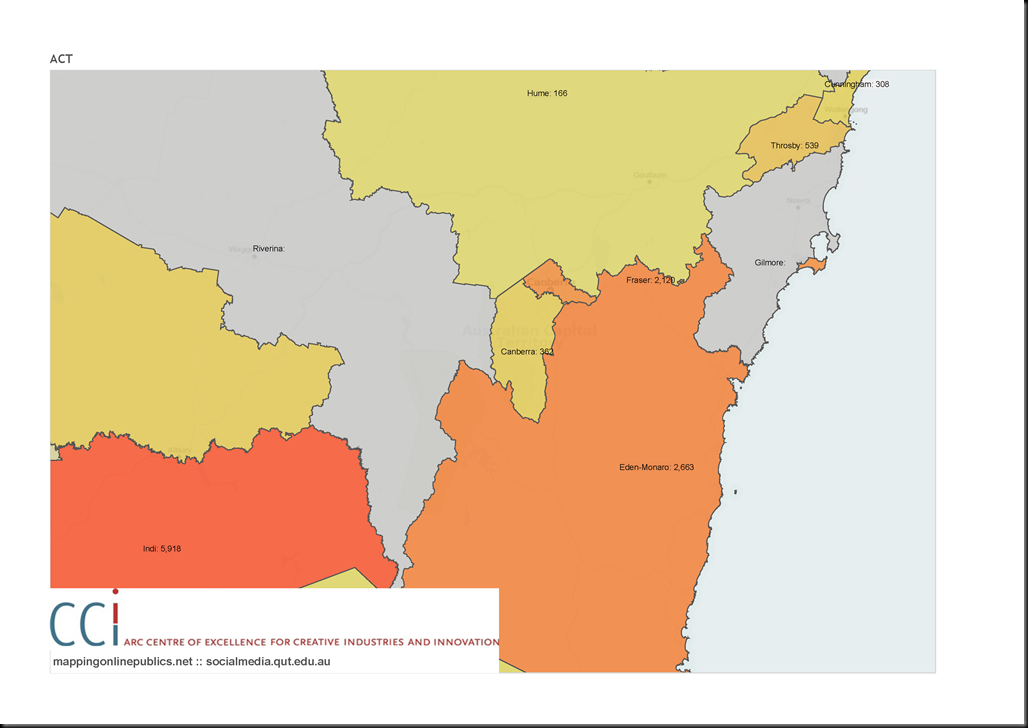
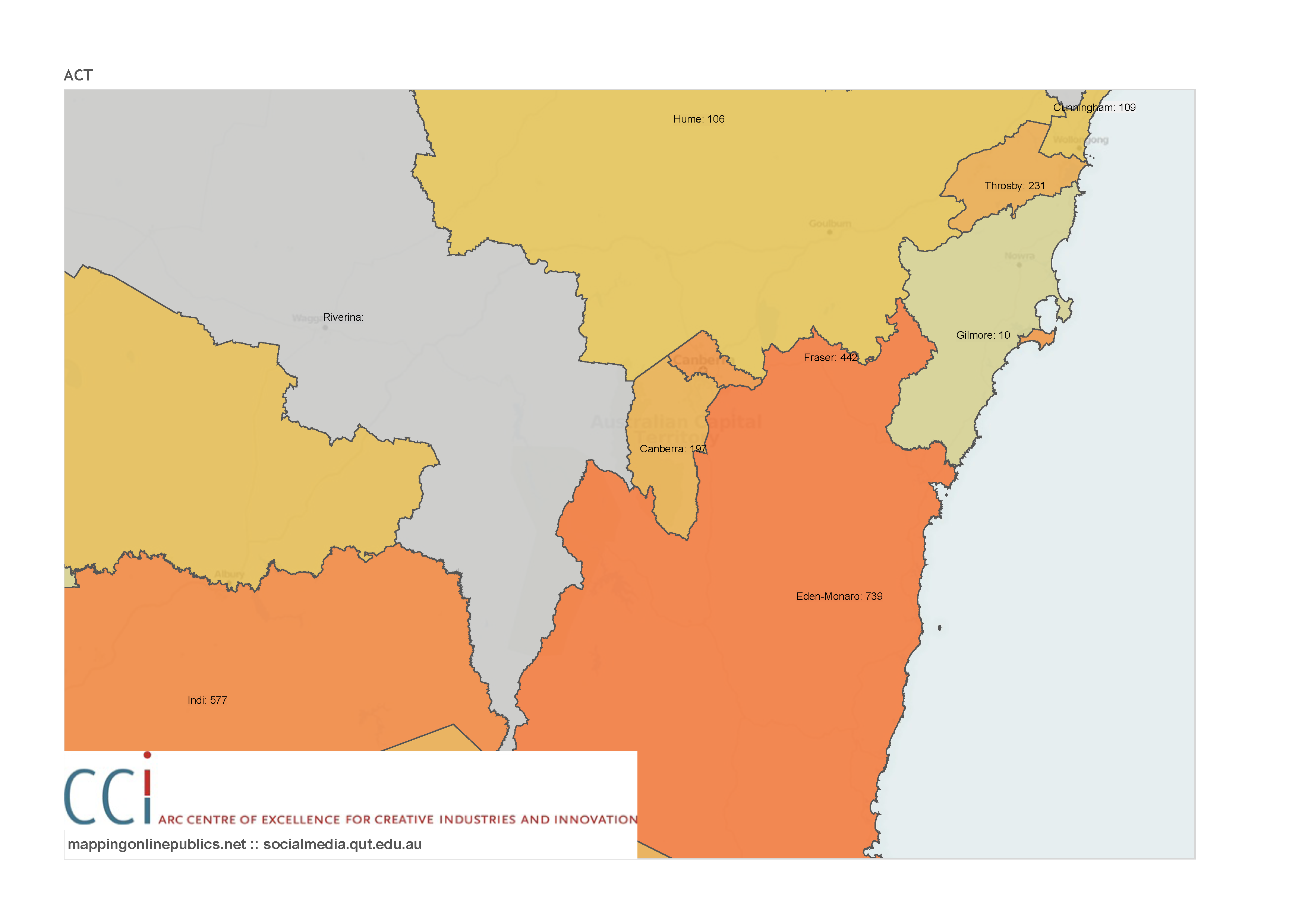
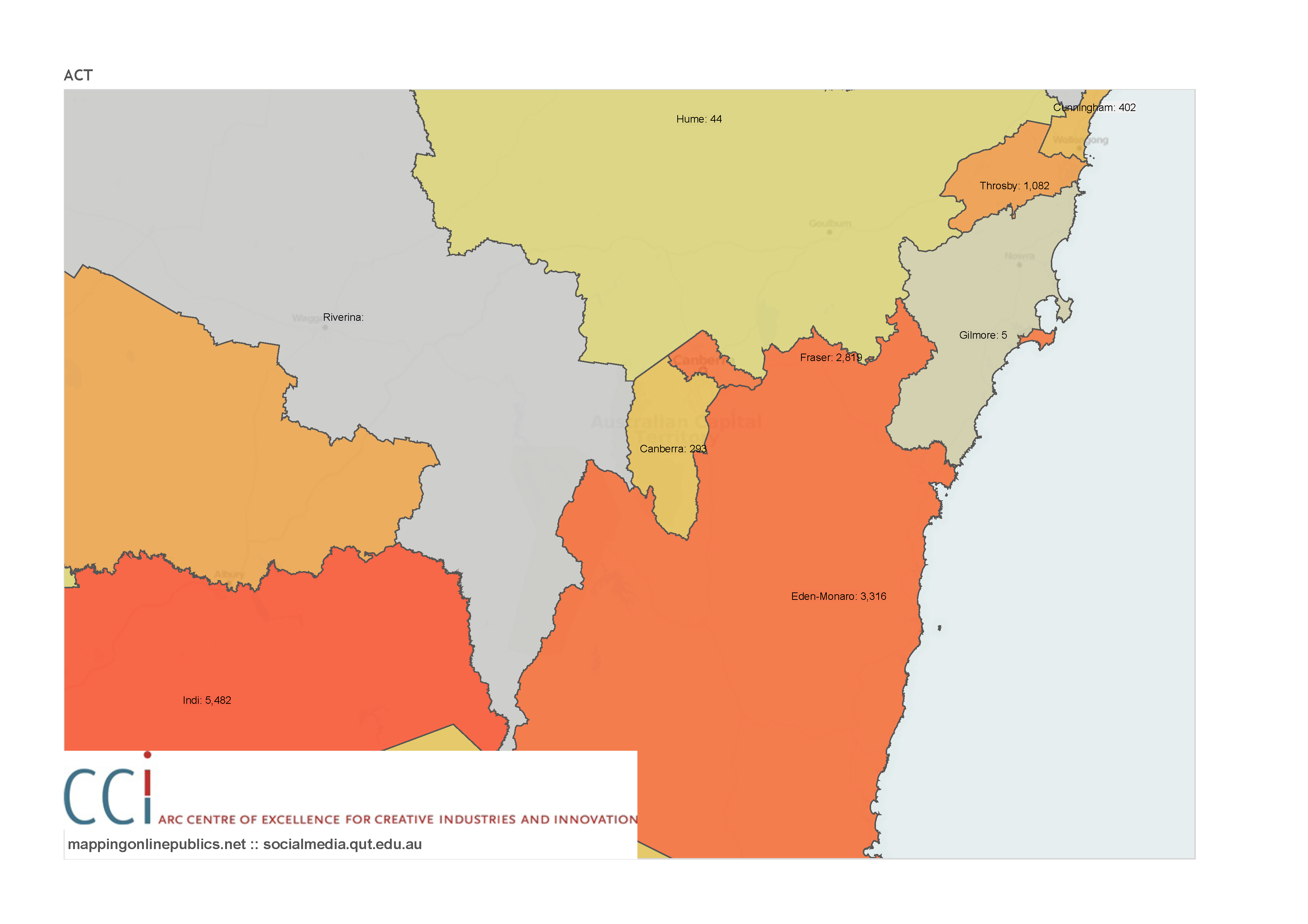
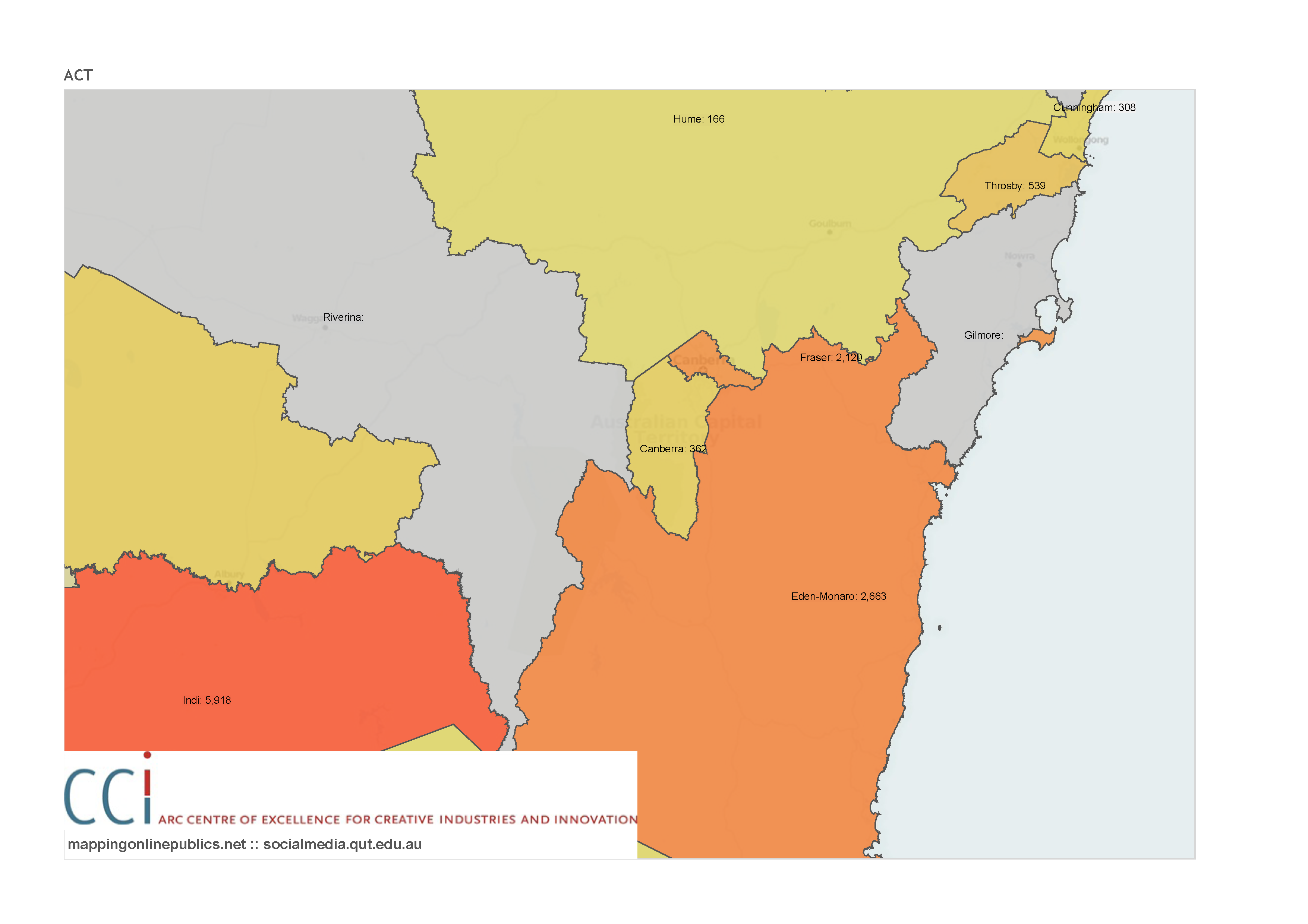
ACT - mentions

The ACT is surrounded by interesting electorates – Indi, and the “bellwether” seat Eden-Monaro – but itself remains more subdued. Canberra itself is quiet, while Fraser (with its coastal exclave Jervis Bay), where Andrew Leigh is standing, is slightly more prominent.
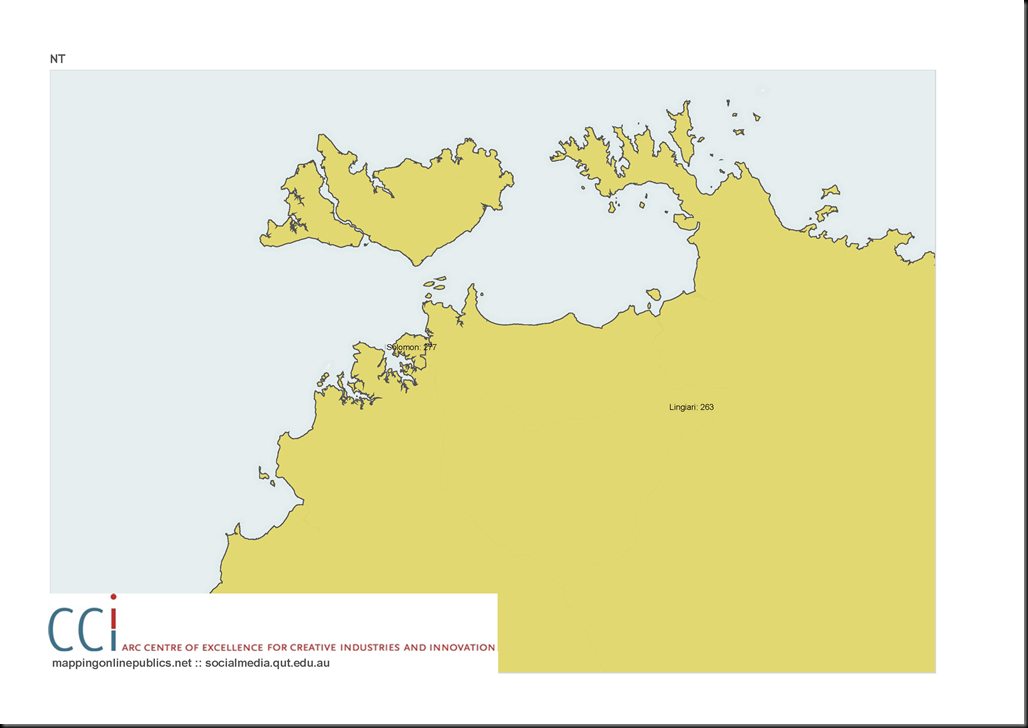
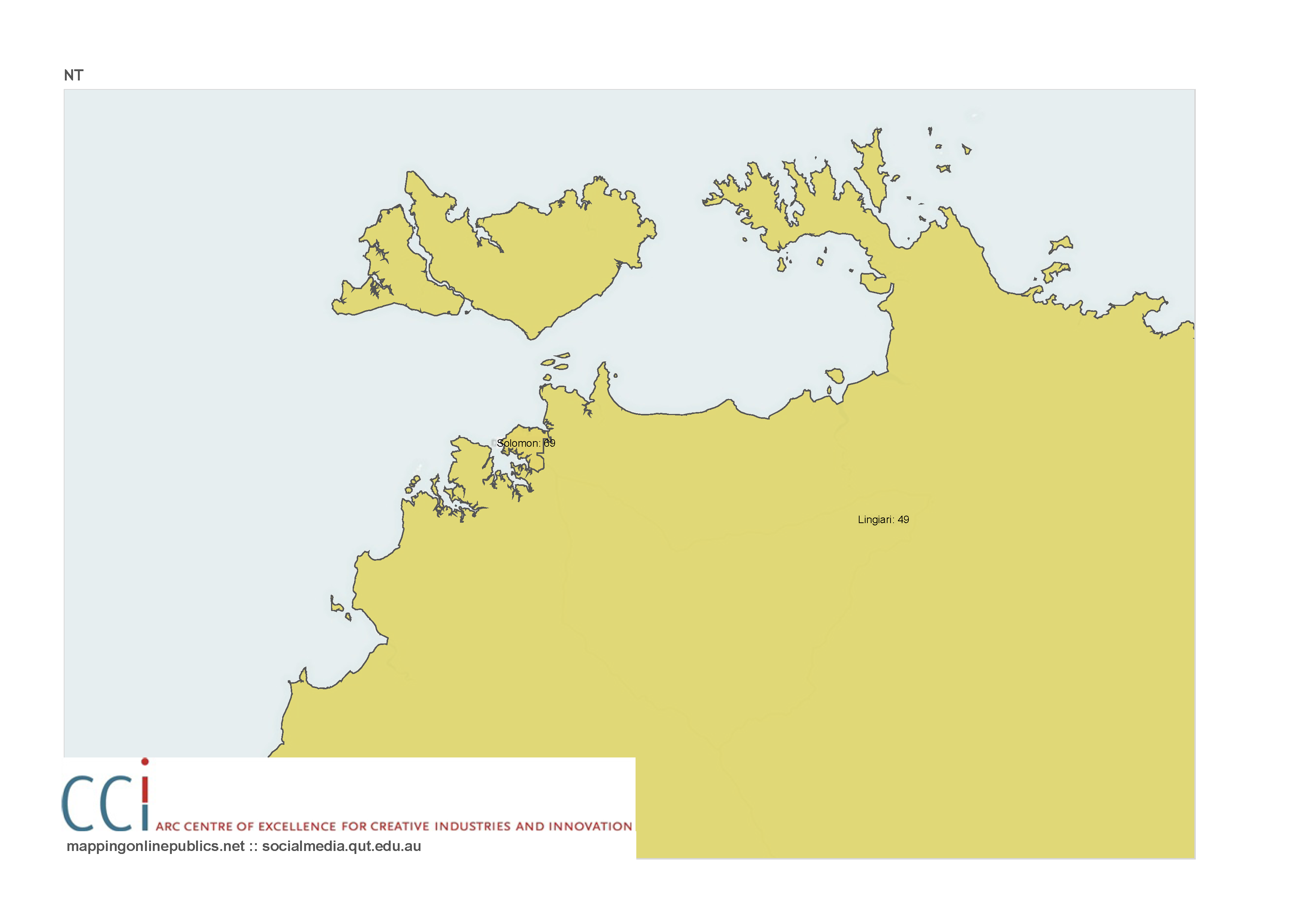
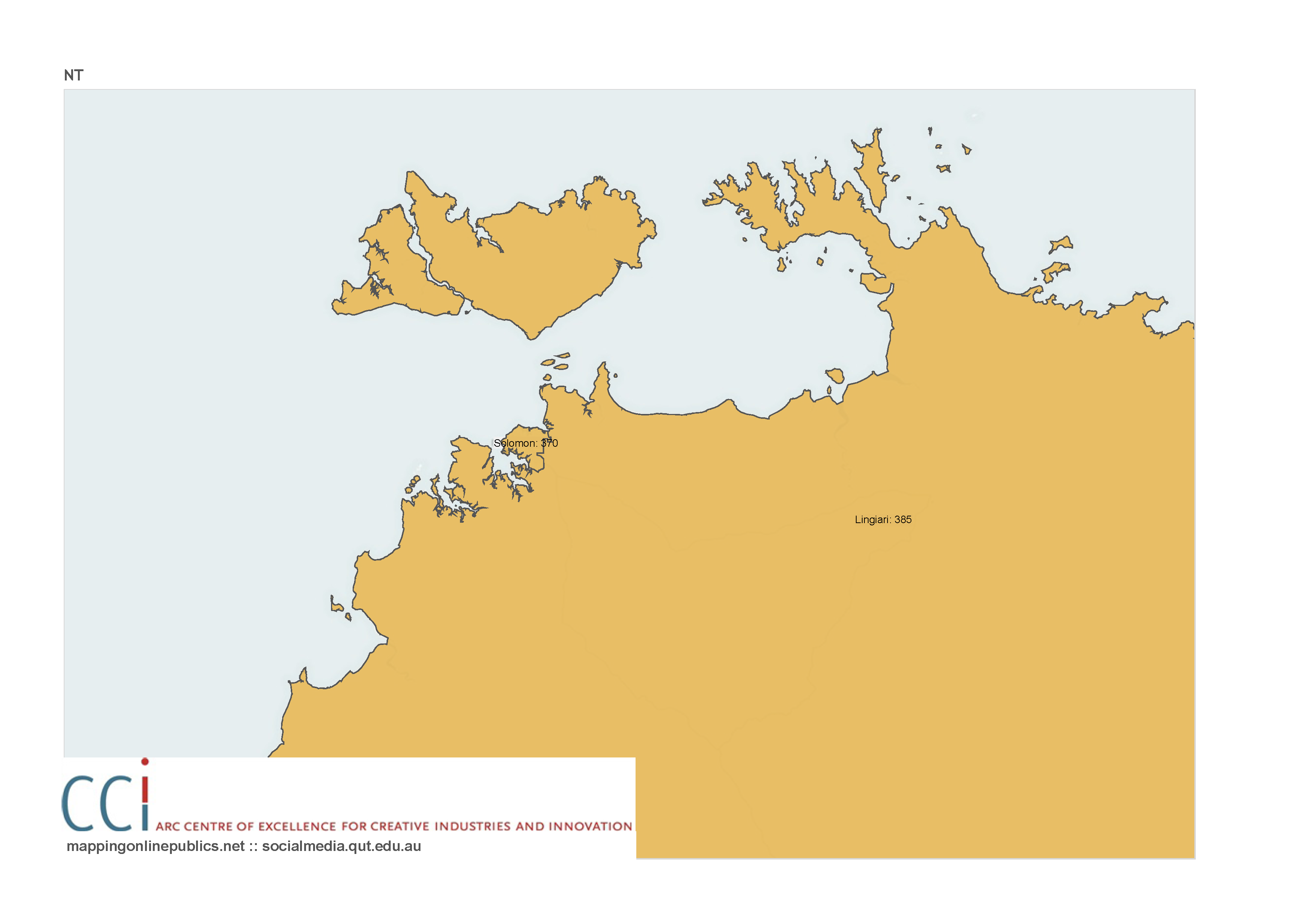
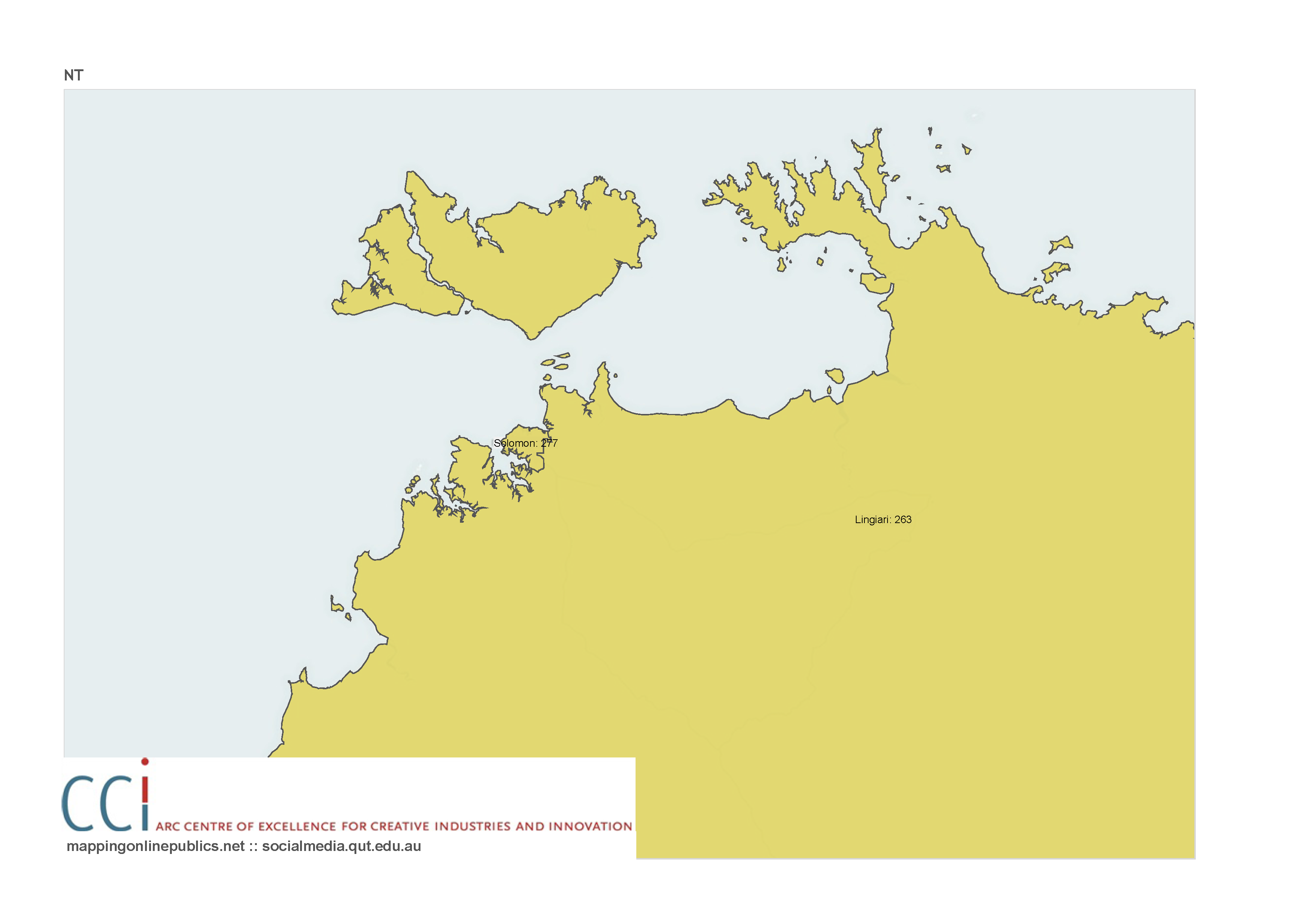
NT - mentions

And finally, nothing much to see in either of the two federal electorates covering the Northern Territory.

Tweets by Candidates

As we’ve seen in previous analyses, the volume of @mentions received by the candidates usually doesn’t correlate much at all with their own tweeting efforts; this is the case especially for the most prominent leaders, who’ll be @mentioned at significant volume even if they don’t tweet at all. So, it’s worth examining which local candidates have actively taken to Twitter across the nation.
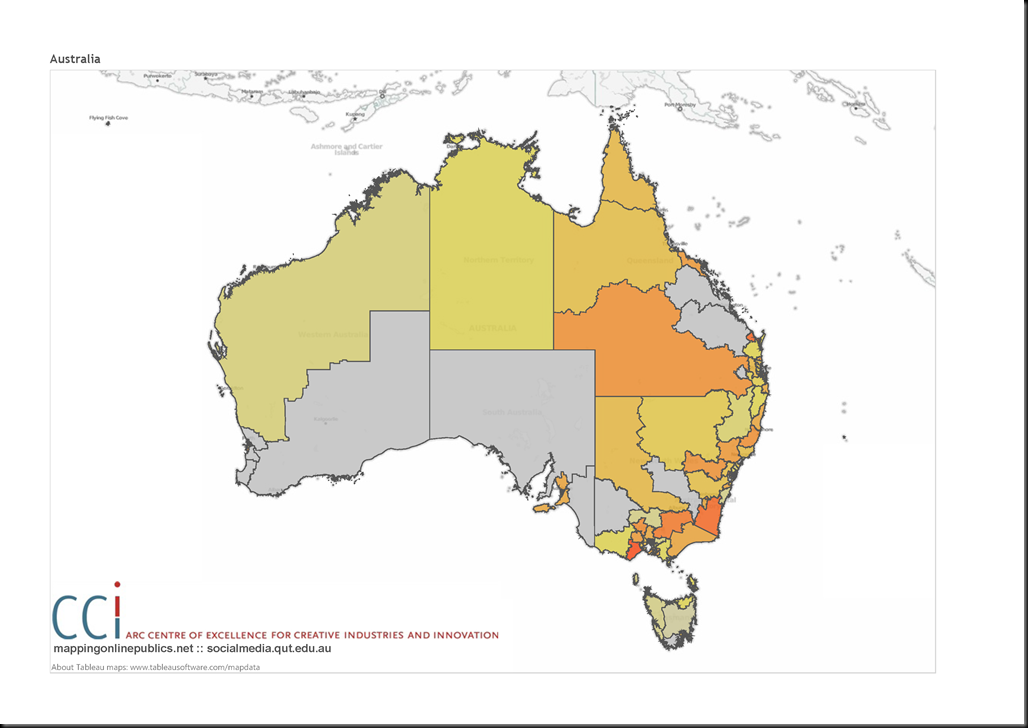
Australia - tweets

The national map of tweeting candidates shows a few new hotspots. In Queensland, the highly active @MaranoaGreens account of Grant Newson lights up the southwest Queensland electorate of Maranoa, and his party colleague Jonathon Dykyj is similarly active in Dawson, half-way up the Queensland coast. Eden-Monaro and Indi again appear prominently in NSW and Victoria, while Tony Windsor’s would-be successors in New England (in northeastern NSW) haven’t generated a great deal of activity of their own. Corangamite southwest of Melbourne also flares up, due to the high volume of tweets from ex-Palmer candidate Buddy Rojek.
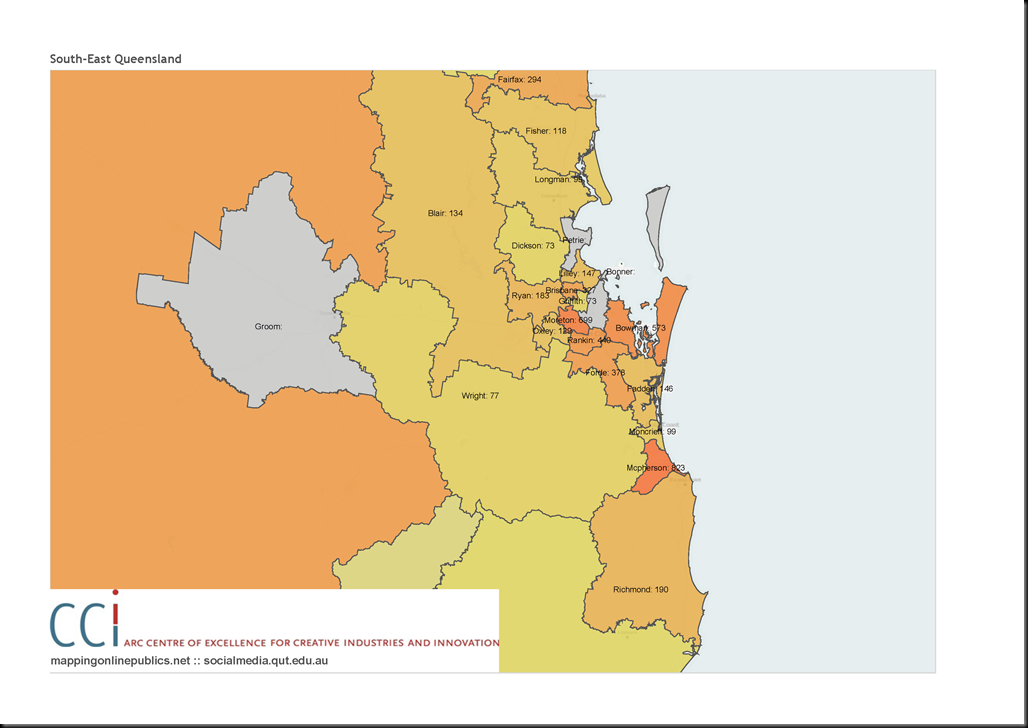
Brisbane - tweets

In Queensland, Kevin Rudd in Griffith and Wayne Swan in Lilley aren’t actually especially active, despite their high profiles. They’re outdone by their party colleagues Gayle Hislop in McPherson and Graham Perrett in Moreton (where the LNP’s Malcolm Cole and the Greens’ Elissa Jenkins are also fairly active). To the west, by the way, we see the eastern edge of Maranoa, which stretches from here to the state border.
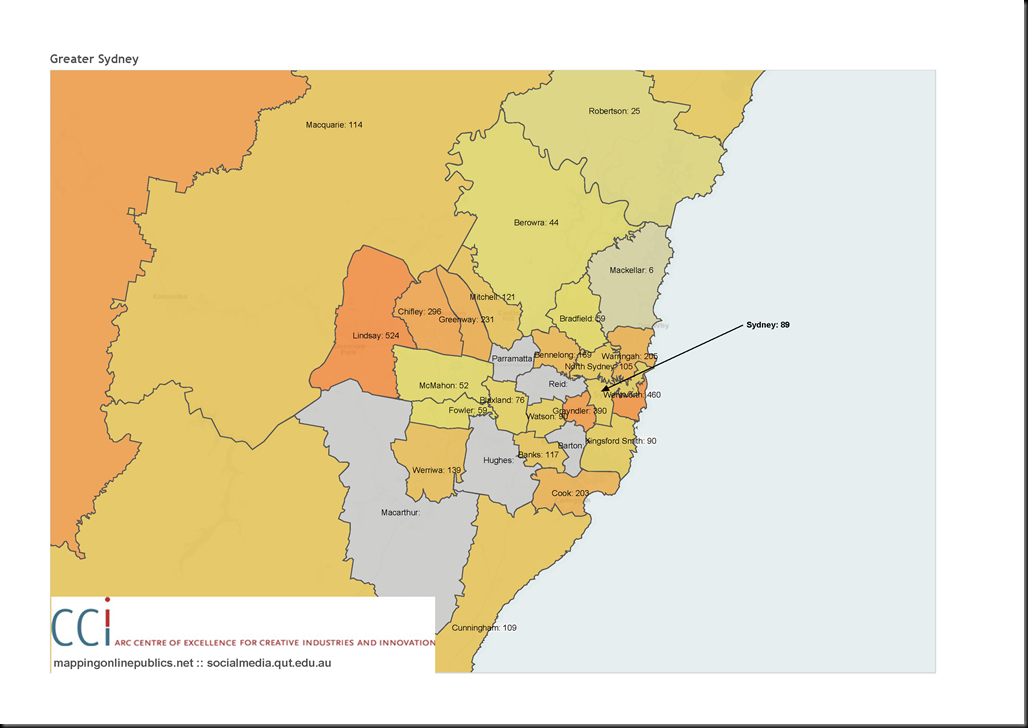
Sydney - tweets

In Sydney, the difference between the @mentions and tweets maps is even starker. Coalition and Labor leaders are active on Twitter, but not all that much; in Wentworth and Grayndler, sitting members Malcolm Turnbull and Anthony Albanese are also facing Twitter competition from Labor’s Di Smith and the Greens’ Hall Greenland, respectively. Further out west, Lindsay Labor MP David Bradbury is well outdone on Twitter by Palmer candidate Andrew Wilcox.
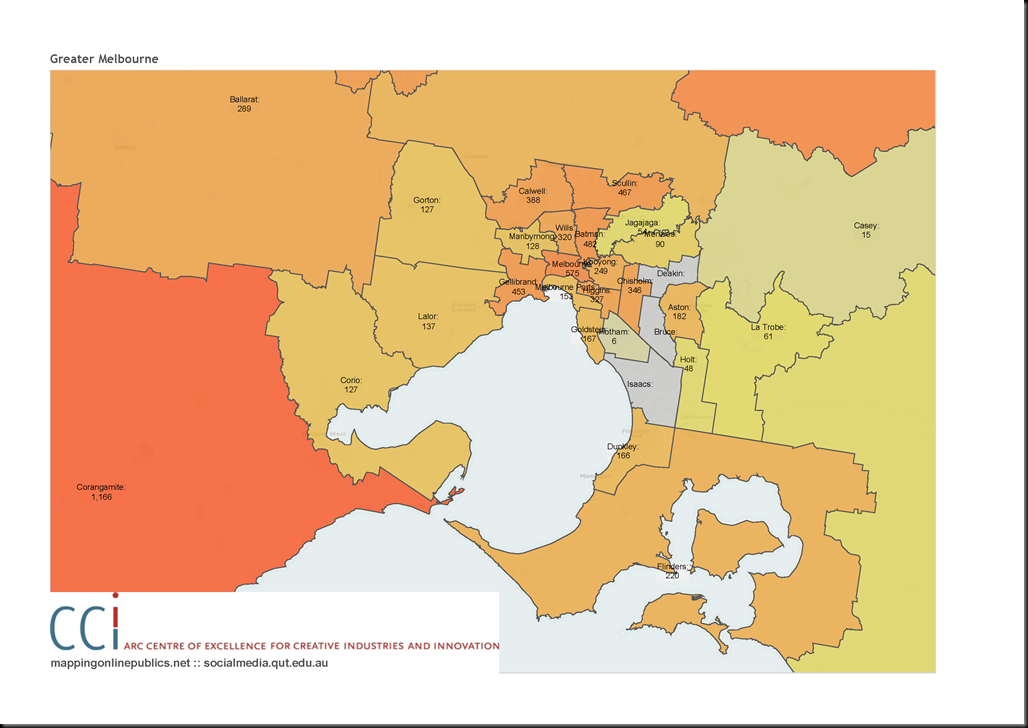
Melbourne - tweets

In Melbourne, by comparison, the inner city shows some more signs of life – perhaps precisely because the local candidates don’t also hold prominent frontbench positions. Greens MP Adam Bandt is being outdone by Labor’s Cath Bowtell in the set of Melbourne, while significant local Twitter battles also rage in Batman, Scullin, Gellibrand, and Calwell, to name but a few. In Corangamite, as I’ve noted before, disendorsed Palmer candidate Buddy Rojek is tweeting up a storm in spite of his newly found status as an Independent.
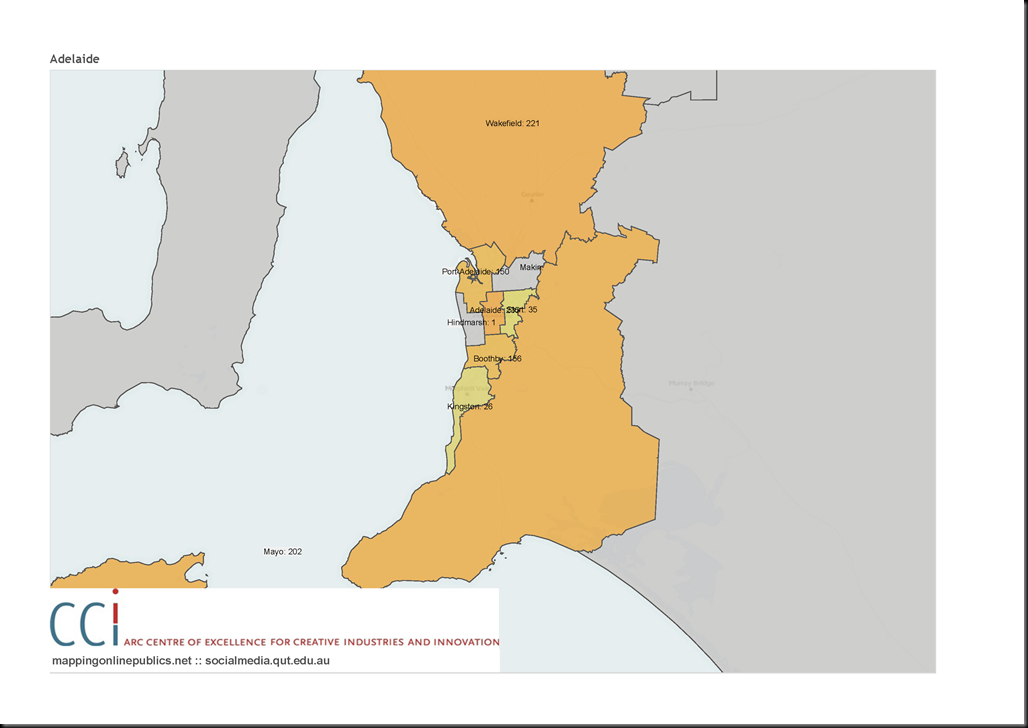
Adelaide - tweets

There’s less to say about Adelaide. Here, the sitting members in the outer electorates of Wakefield and Mayo – Labor’s Nick Champion and the Liberals’ Jamie Briggs, respectively – generate only some limited action, more or less unopposed.
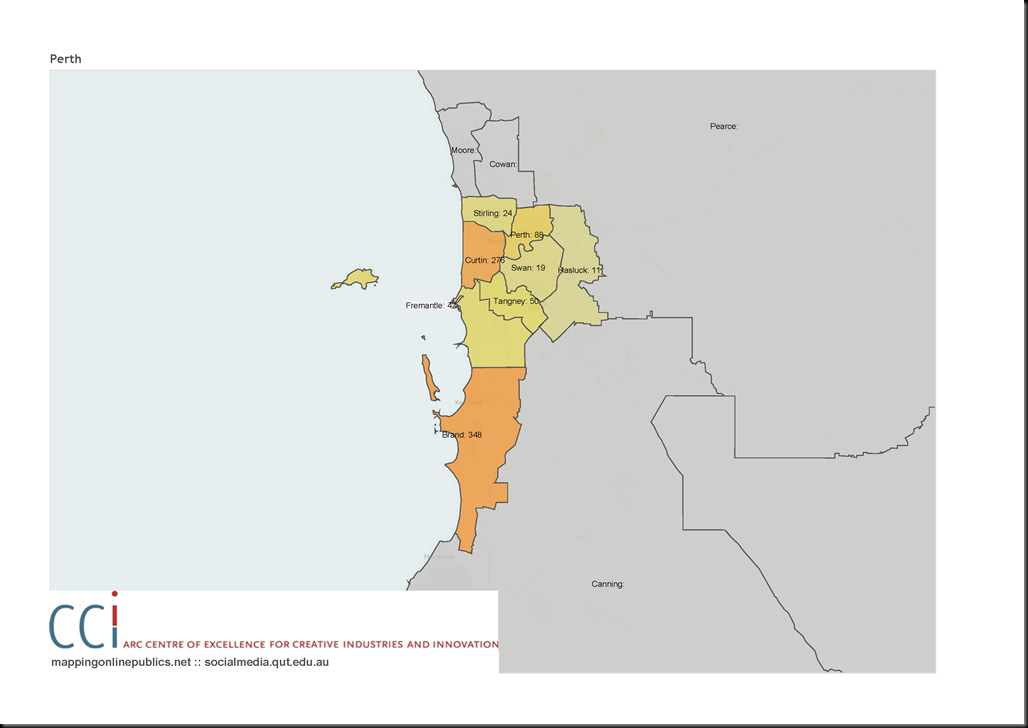
Perth - tweets

In Perth, Julie Bishop isn’t only the recipient of a substantial number of @mentions, but also tweets out relatively frequently. She’s outdone, however, by the Greens’ Dawn Jecks in the southern electorate of Brand, who claims the crown as Western Australia’s most active tweeting candidate.
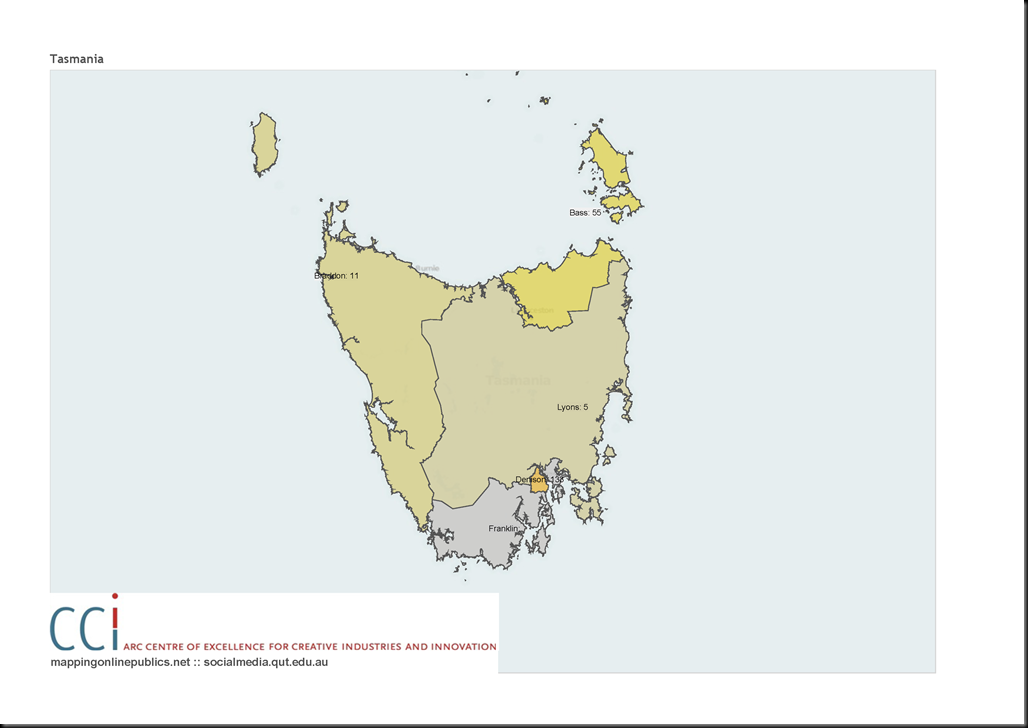
Tasmania - tweets

In Tasmania, tweets sent mirrors @mentions received remarkably closely. Once again, Andrew Wilkie’s Hobart-area seat of Denison leads the way, but Twitter by candidates in the seat is fairly evenly split between Palmer candidate Debra Thurley, Wilkie himself, the ALP’s Jane Austin, and the Greens’ Anna Reyno. Liberal candidate Tanya Denison’s fabulously-named @Denison4Denison account has not tweeted since 17 July.
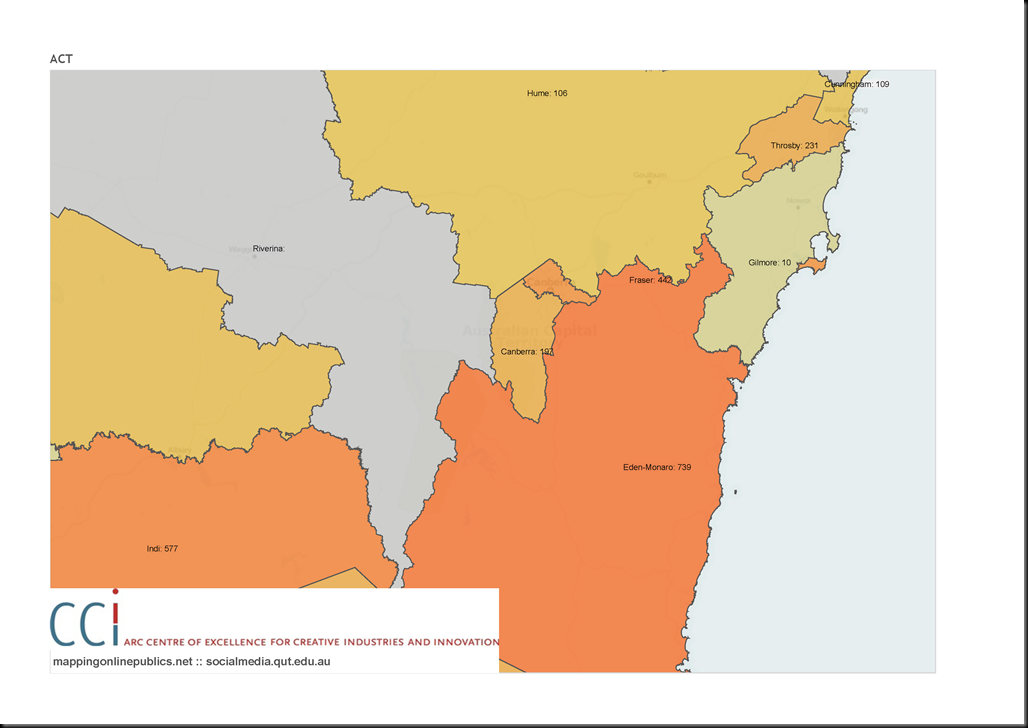
ACT - tweets

The same goes for the ACT – as with the @mentions, we see limited activity from Canberra candidates Gai Brodtmann (Labor) and Julie Melrose (Greens), while in Fraser, active Twitter user Andrew Leigh (Labor) is some way ahead of the Greens’ Adam Verwey. Other parties’ candidates don’t seem to figure much here. Next door in Eden-Monaro, by the way, Labor’s Mike Kelly has taken to Twitter with some aplomb, while Palmer candidate Dean Lynch also puts in a strong showing.
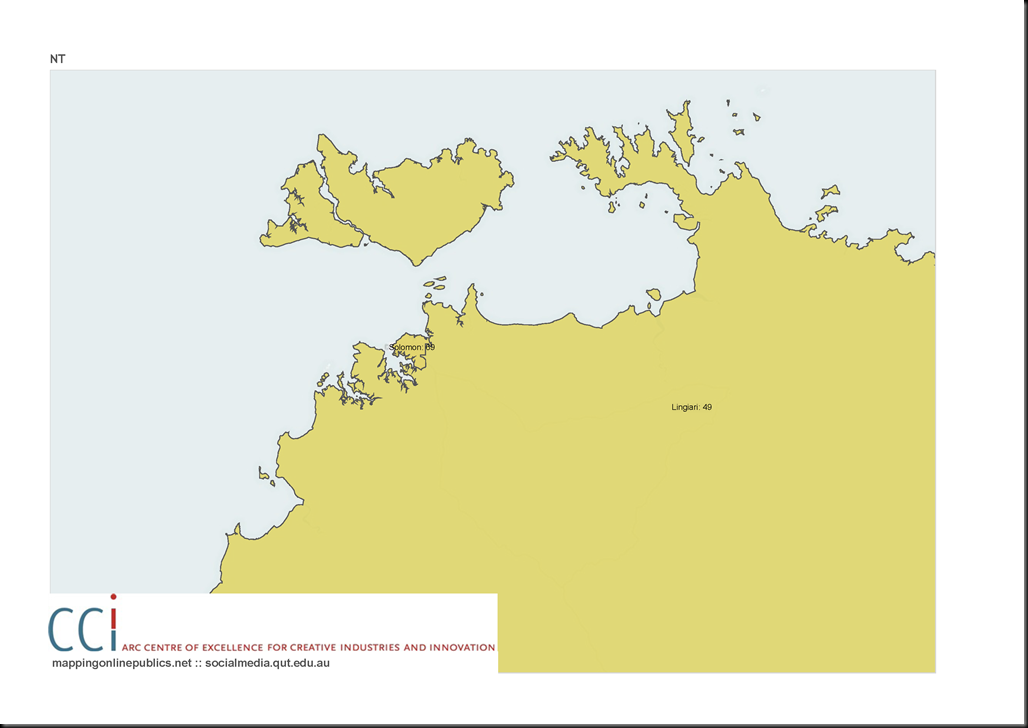
NT - tweets

Finally, Northern Territory candidates have s far failed to set Twitter alight. Perhaps there’s a chicken-and-egg situation here: seeing as they receive very few mentions, they may see little reason to tweet themselves; on the other hand, since they don’t tweet much, they don’t receive many @mentions. At any rate, it’s very quiet in the Top End.
#ausvotes: The Australian Federal Election on Twitter, Week 4

We’re on the home stretch: Australia goes to the polls this Saturday (though quite a few Australians appear to have cast their votes early already). Here’s a final pre-election update on how the election has unfolded on Twitter from the 4 August campaign start through to last Sunday, then – with another look at the activity per electorate to follow tomorrow, if all goes well, and there will be a final round-up in the coming week. My earlier posts are here: week 1, a network of interactions, week 2, week3, and a per-electorate update.

A reminder about what we’re examining here: we are tracking all tweets by and @mentions of sitting members and candidates in the 2013 federal election. As more (especially minor party) candidates have become known, we’ve progressively extended our list as far as possible. In particular, this week a few more Pirate Party, WikiLeaks, and Palmer’s United Australia Party members make their entry into the mix.

We begin as usual with the overall volume of @mentions of the most prominent candidates. This week, Julie Bishop and Bill Shorten appear again in the top ten, due to a greater level of activity around their Twitter accounts in the past few weeks; at the top, though, Kevin Rudd and Tony Abbott continue to operate in a league of their own.

Leaders since 4 Aug. (c)

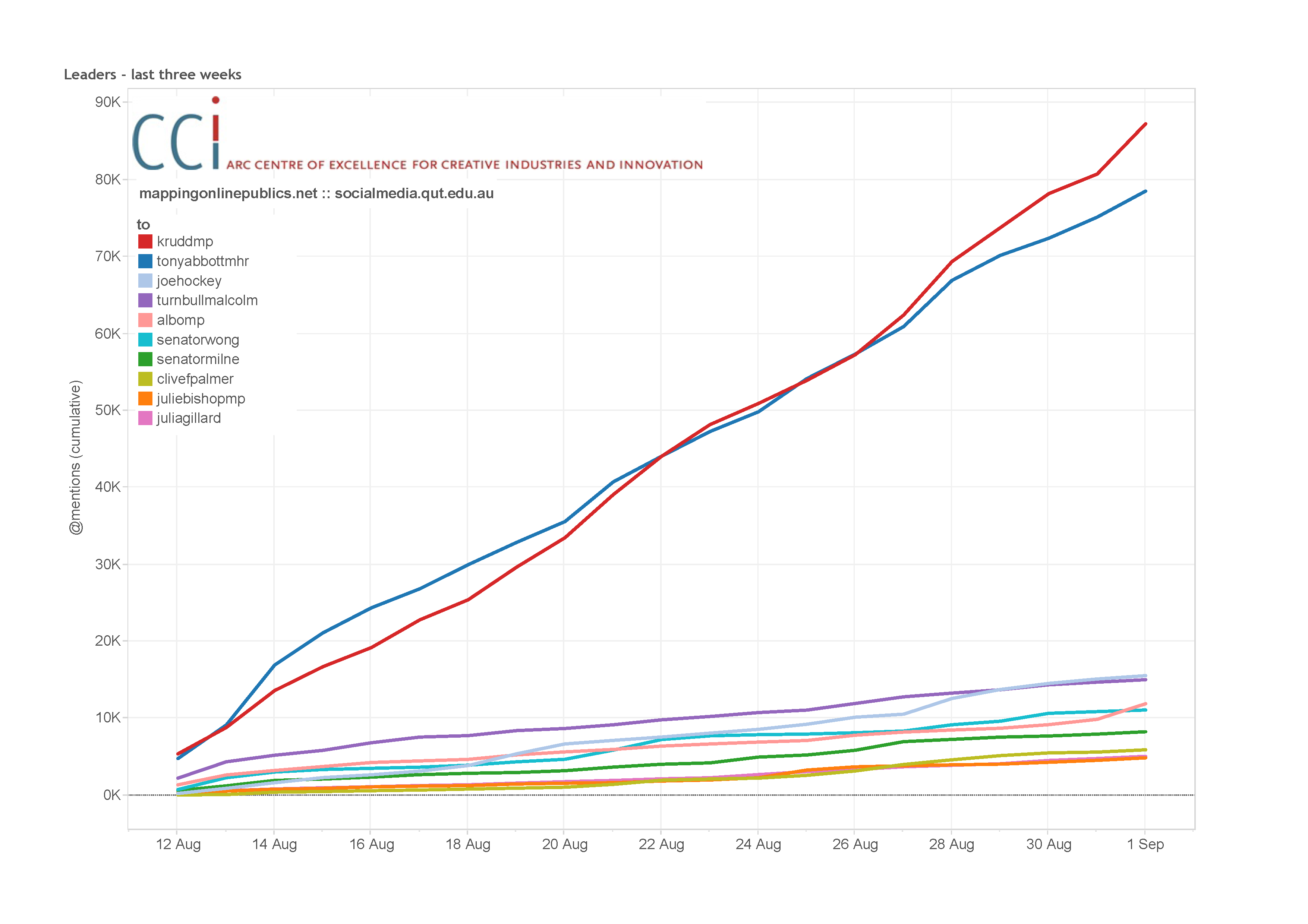
While Rudd continues to carry a substantial lead in his total number of @mentions from the first week of the campaign, the past three weeks have been a considerably tighter affair. From mid-August onwards, we’ve seen Abbott pick up a larger number of @mentions than Rudd, due to some controversial remarks on the campaign trail; more recently, however, Rudd has caught up with Abbott again (partly due to some controversy of his own), and has now opened up an @mentions lead over Abbott once again. This is aided in part by the Labor Party’s campaign “launch” on 1 September, which saw an especially strong increase in @mentions for Rudd. Also new in this top group is Clive Palmer, leader of the United Australia Party, whose colourful campaign in recent weeks has attracted increased Twitter attention.

Leaders - last three weeks

The boost for Rudd over the final days of last week is especially notable from the day-to-day figures – unsurprisingly, both he and Deputy PM Albanese receive unusually many @mentions during the Labor campaign “launch”. Both Rudd’s and Abbott’s @mentions also spike during the final leaders’ debate on Wednesday 28 August.

Leaders since 4 Aug.

As we’ve seen throughout the campaign, however, these @mentions of the political leaders have very little to do with the leaders’ own Twitter activities. If we took their own tweeting efforts as a yardstick, Greens leader Christine Milne, Coalition communications spokesman Malcolm Turnbull, and Deputy Prime Minister Anthony Albanese should be the most @mentioned Australian political leaders: each of the three has added a substantial number of tweets to their tally over the past week, with Milne’s Twitter campaign in particular shifting up another gear.

Leaders' tweets since 4 Aug. (c)

To find the most active Australian politicians on Twitter, however, we need to look yet further afield. As Milne’s performance already shows, some of the minor parties have worked especially hard to make up for the much more limited air time and column inches they receive in the mainstream media by taking to social media platforms to promote their agendas. Of the candidates we track, then, accounts like the Pirate Party’s NSW Senate hopeful Brendan Molloy (@piecritic), his Climate Sceptics Party colleague Bill Koutalianos (@NoDirectAction), and former Palmer’s United Australia Party candidate for Corangamite Buddy Rojek (@Buddy4Coranga) – whose Twitter profile still lists him as an Independent, strangely who was disendorsed by his party for promising an extravagant election night party – all out-tweet their more illustrious competitors. Another Pirate, Senate candidate Mel Thomas (@photogramel), and WikiLeaks candidate Kellie Tranter, also feature prominently. It’s not surprising that especially the particularly Web-affine parties (Pirates and WikiLeaks) should appear here, of course.

Most active politicians since 4 Aug. (c)

In terms of total activity by their candidates, these smaller parties which tend to focus mainly on the Senate and a handful of promising local electorates cannot compete with the nationwide campaign activities of the major parties, however. If we aggregate the total volume of tweets by candidates of the various parties, Labor and the Greens show substantially more activity than any of the other parties. This supports the perception that – even in spite of a closer electoral race between Rudd and Abbott than there would have been between Gillard and Abbott – the Coalition continues to run something of a ‘small target’ strategy in its Twitter activities: limited activity by its candidates except for the key frontbenchers, and limited engagement with the electorate through this medium. Conversely, Labor and the Greens may see Twitter as a more useful medium for reaching their supporters, assuming perhaps that the Australian Twittersphere skews slightly to the left – though frankly I’ve seen very little hard evidence for this claim to date. (Note that the graph below shows Liberals, Nationals, and LNP separately – but even in combination the three Coalition parties wouldn’t reach the tweeting levels of Greens or Labor.)
Tweets by parties since 4 Aug. (c)

Again, the aggregate volume of tweets directed at the various parties’ candidates tells a very different story, however. In the graph below we have excluded leaders Kevin Rudd and Tony Abbott from the count, in order to get a better sense of the extent to which Twitter users address any of the other political candidates at all – it shows a strong focus on Labor and Coalition candidates even though the latter aren’t especially active at tweeting themselves. It’s tempting to see Labor’s lead over the Coalition here as a result of Labor candidates’ greater levels of Twitter activity; however, the fact that Labor candidates represent the current government, and a party which is struggling in the polls and is therefore receiving substantial attention, provides an equally valid explanation.

Parties since 4 Aug. (KR & TA removed)

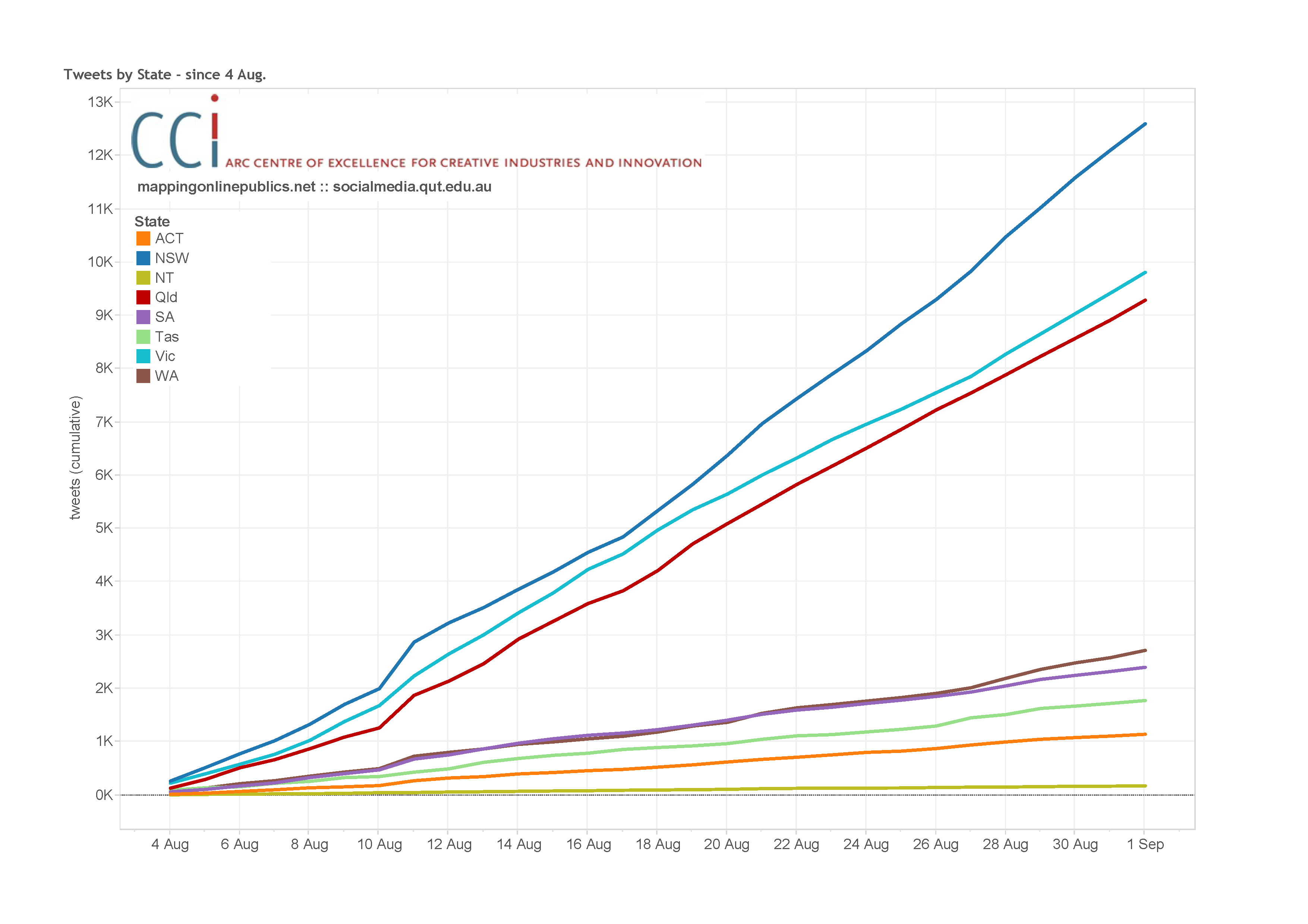
Finally, a brief look at the state-by-state activity. First, an overview of which state’s politicians are most active in their own tweeting efforts seems to broadly follow the distribution of the Australian population across the states – naturally, the more populous states are home to a greater number of local electorates, and are therefore also blessed (ahem) with a greater number of politicians. As a result, we see significant Twitter activity by politicians especially in New South Wales, Victoria, and Queensland.

Tweets by state since 4 Aug. (c)

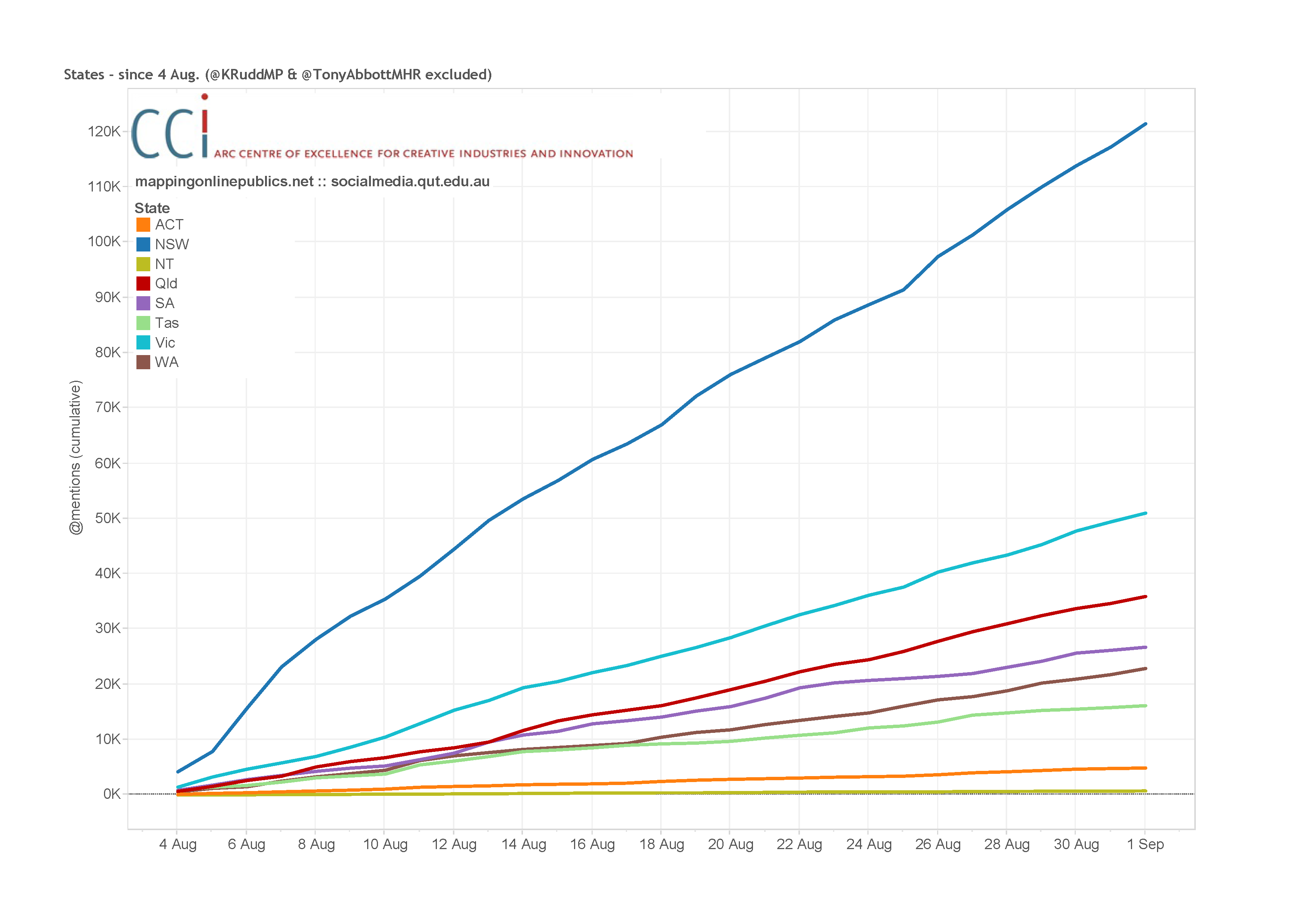
But once again this does not translate in a similar distribution of attention from the Twitter userbase. For the graph below we’ve once again removed the major @mention magnets Kevin Rudd and Tony Abbott, in order to highlight Twitter activity around the other candidates – and doing so has brought New South Wales right to the fore. This reflects the fact that many of both major parties’ frontbenchers represent NSW electorates, and perhaps also supports the suggestion that a substantial part of the election is being fought in Western Sydney; additionally, it’s probably quite simply also a sign that Sydneysiders – representing Australia’s largest population centre – are especially well-represented on Twitter.
States since 4 Aug. (KR & TA removed)

And that’s it for the moment. We’ll follow up again with an electorate-by-electorate breakdown of activity tomorrow – other than that, happy (?) voting!

#ausvotes: The Australian Federal Election on Twitter, Week 3

Well. Another week of the Australian federal election campaign has just, um, flown by – time, then, to take another look at how things played out on Twitter. I’ve taken slightly different approaches for my various updates so far, and this week we’ll look at yet another aspect of the social media campaign: the different parties’ attempts to encourage their supporters to retweet their messages.

But first, another look at the headline figures – and just as a reminder, as I’ve explained in the previous posts, what we’re doing in our election research is to track all tweets by and @mentions of sitting members and candidates in the 2013 federal election. As more (especially minor party) candidates have become known, we’ve progressively extended our list as far as possible.

Based on this approach, last week we saw a substantial shift in attention towards Opposition Leader Tony Abbott: over the course of the week, he was @mentioned more than 4,000 times more often than his opponent, Prime Minister Kevin Rudd. This week, the pendulum has swung back in Rudd’s favour, by almost exactly the same margin. Here are the leading politicians’ @mentions over the three weeks since the election was called on 4 August – Rudd leads Abbott in @mentions on every day except for Sunday (the day of the Coalition’s official campaign ‘launch’):

Leaders - since 4 Aug.

It’s tempting to draw the parallels between these ups and downs and the movement of the latest polls, which have also generated some more positive news for Rudd (one recent poll even has the parties at an even 50:50). However, things are rarely that simple. We already saw that the previous week’s boost in @mentions for Abbott was generated in part by (often critical) commentary about his comments about marriage equality and the “sex appeal” of a Liberal candidate; this week, Rudd’s more feisty performance in the second leaders’ debate, and in particular his response to Tony Abbott’s question “does this guy ever shut up?”, but also the subsequent rumours about his treatment of one of the make-up staff, all contribute to his greater number of @mentions. As with Abbott during the previous week, the volume of @mentions is far from implying universal support, then.
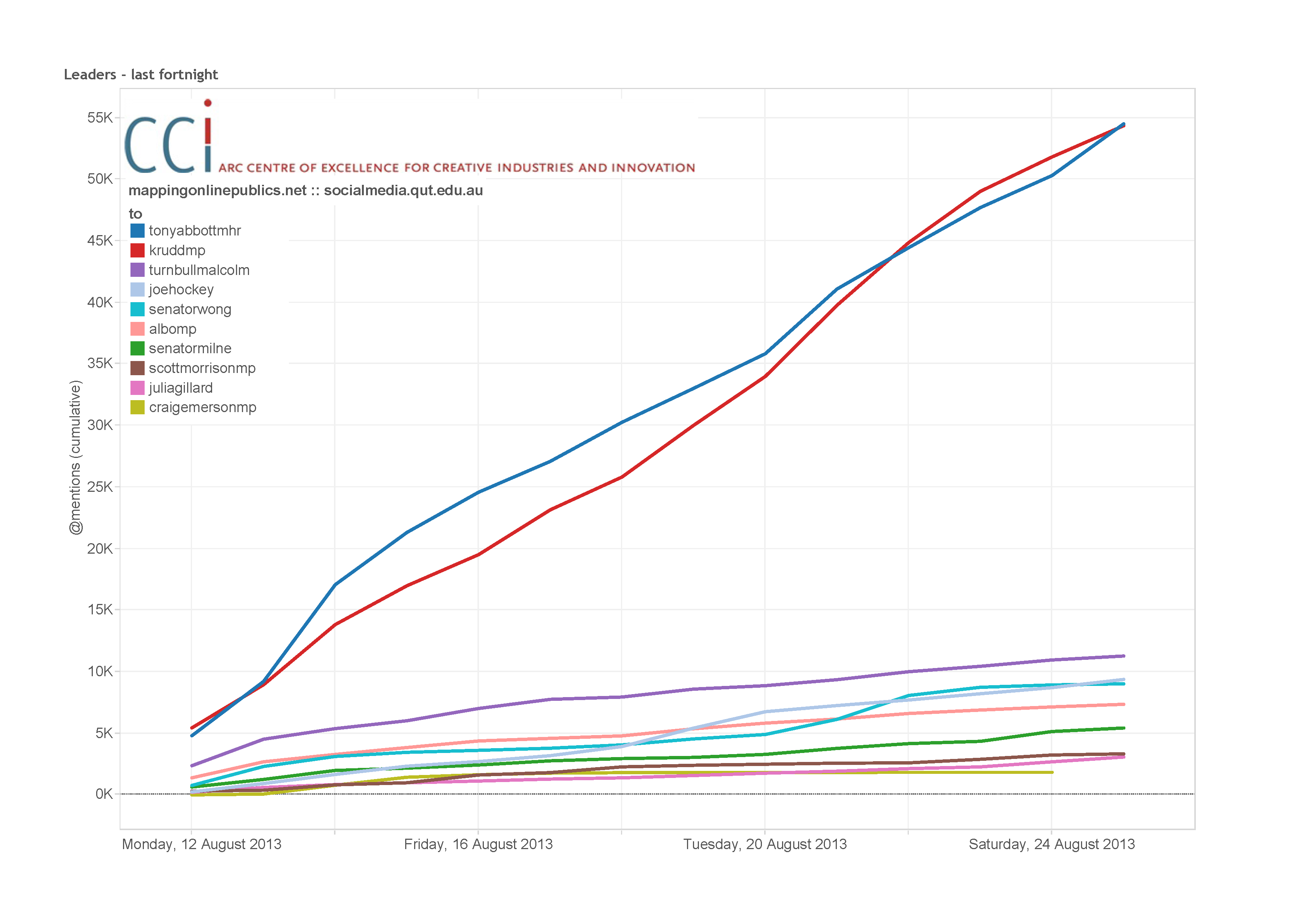
Leaders - last fortnight

Overall, then, the past fortnight leaves the two major party leaders virtually inseparable – only the late surge of @mentions during the Liberal party campaign ‘launch’ pushes Tony Abbott into the top spot, by fewer than 150 @mentions over a two-week period in which Rudd and Abbott were each mentioned about 55,000 times, according to our data. If there is one major take-away from all this, it’s the fact that the election remains close – the Twitter audience hasn’t switched off from paying attention to either leader or his party yet.

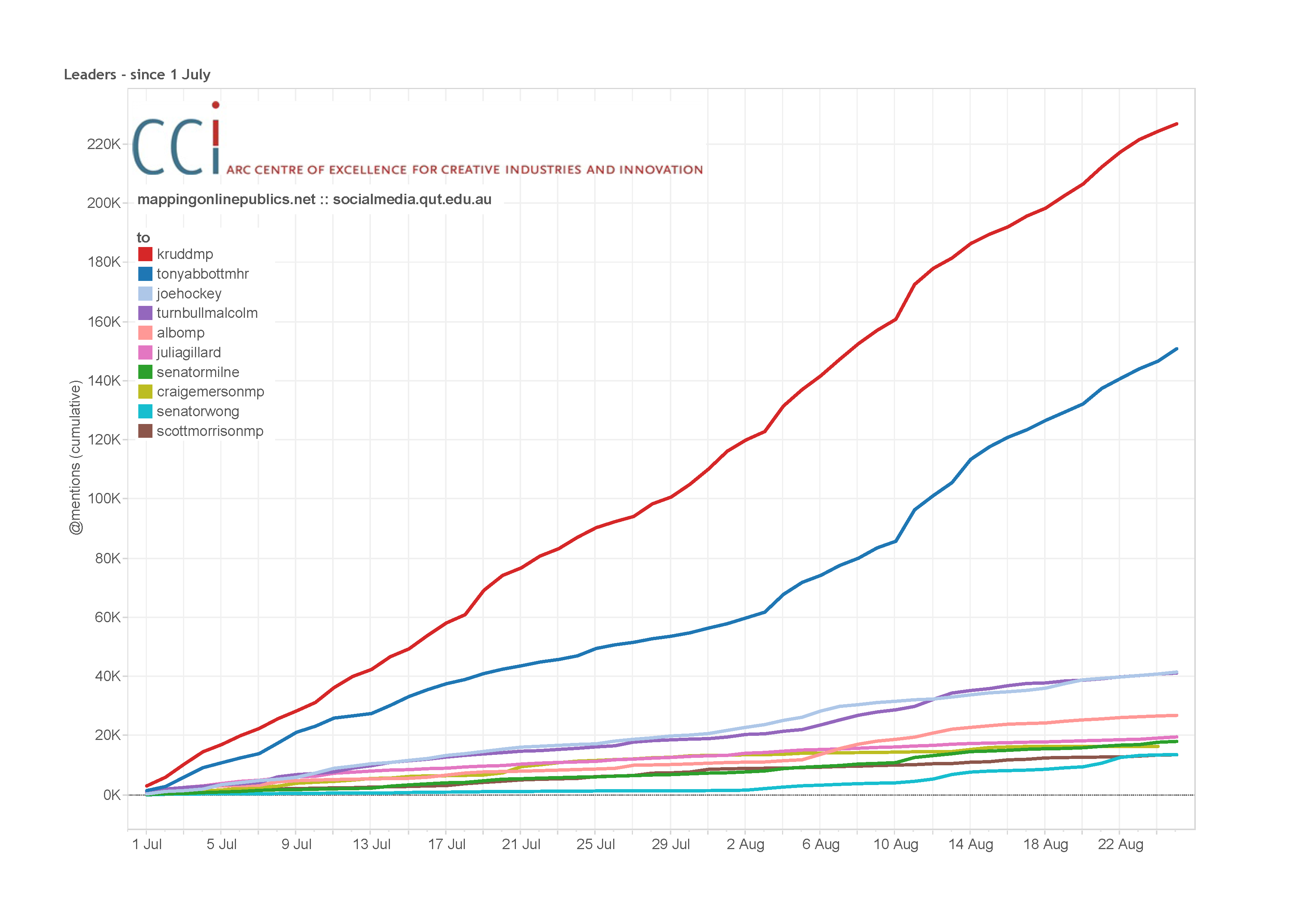
In this light, the fact that Rudd maintains a handy lead in @mentions over the longer term (for our purposes here, from 1 July onwards) becomes somewhat immaterial. As I’ve noted before, the flurry of government activity after Rudd’s return to the Prime Ministership, and the weeks of speculation about the eventual election date, have contributed their share to the substantially greater number of @mentions the PM has received over this time. Since 4 August, and especially over the last weeks, though, the two leaders’ trajectories have tracked each other closely.

Leaders - since 1 July

What the longer-term trajectories do show, however, is that it’s Abbott whose Twitter prominence has improved. Rudd’s trajectory is largely steady; with slight upward or downward aberrations, he’s added some 26,000 @mentions to his count each week, and that rate has increased only slightly since the election proper was called on 4 August. Looking at Rudd’s trajectory alone, you’d be hard-pressed to identify the start date of the campaign. For Abbott, that’s a different matter: before the start of the campaign, he was averaging some 12,000 @mentions per week; since then, he’s adding a Rudd-like 26,000 @mentions to his tally. That, in a graph, is the difference between being merely the Opposition Leader, and being a key contender for the Prime Ministership.

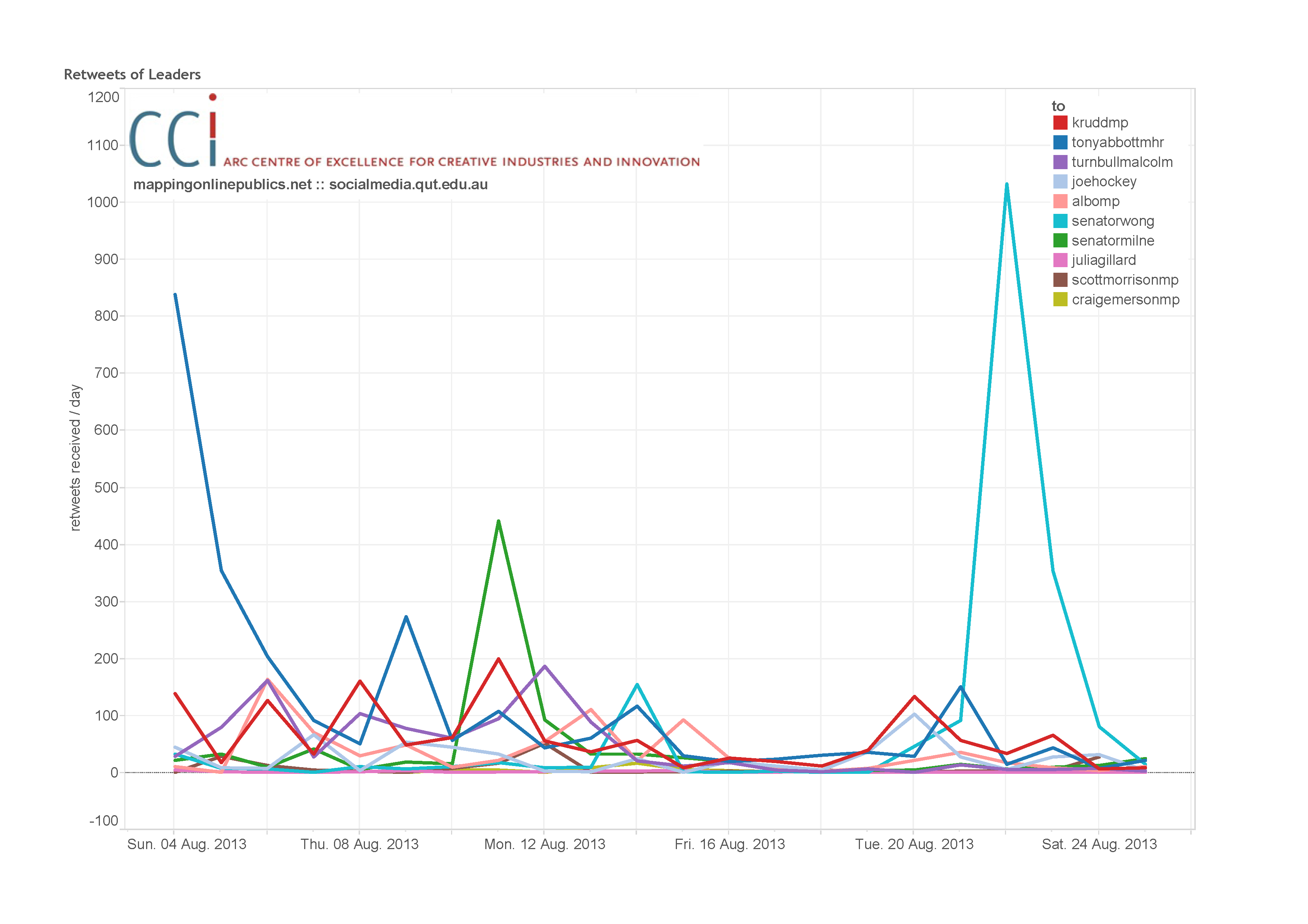
Close observers might have noticed already that we have a new entrant amongst the other leading (that is, most @mentioned) politicians this week: Finance Minister Penny Wong (@SenatorWong). From a slow start to the campaign, she’s recently caught up with Scott Morrison in the number of @mentions received. Indeed, on at least one count, Wong enters in first place with a bullet: last Thursday, she received the most retweets on a single day of any political leader during the campaign to date.

Time, then, to take a closer look at retweets during the campaign so far. The first and most obvious observation is that retweets of politicians’ messages make up only a minute part of all the @mentions these accounts have received to date; even the two major party leaders have only received a few thousand retweets in total during the three weeks of the campaign so far.

Retweets of Leaders

This makes some sense, of course. Twitter users may not see the point in retweeting already well-known politicians: with his 1.38 million followers, for example, what additional visibility does Kevin Rudd gain from being retweeted by you or me? If we are retweeting any of them, then, it would have to be because we want to explicitly endorse one of their messages – so with this in mind, here’s a quick tour through the most retweeted messages by the leading politicians to date.

The field is led by Penny Wong, whose stinging reply to a clichéd comment about marriage equality (from an account which has since been renamed or deleted) earnt her more than 1,000 (manual as well as button) retweets on Thursday alone:


Tony Abbott, by contrast, made the early running, but has since failed to pick up any further large numbers of retweets. His tweet on the night of 4 August, immediately following the begin of the election period, was a US-style call to the Coalition faithful, complete with presidential photo, to show their support by retweeting.

This was preceded by another widely retweeted message, designed to show off Abbott the family man as he retweeted and responded to a message by daughter Bridget:

(Daughters Bridget and Frances also feature in Abbott’s smaller spike on 9 August as he retweets their messages from a family afternoon at the Brisbane Ekka, and other users retweet his retweets.)

Meanwhile, Greens Leader Christine Milne’s best day came during the first televised leaders’ debate, from which she was excluded – several of her tweets were passed along by Greens supporters during the debate, following a public encouragement from the collective @GreensMPs account and individual party colleagues to do so. Here’s a flavour – if this tweet is representative, the Greens social media team still need to work on framing their shots effectively, though:

By contrast, in spite of a steady but limited flow of day-to-day retweets, Prime Minister Kevin Rudd hasn’t yet managed to generate a substantial spike in retweets during the campaign – perhaps it’s time for a sneaky selfie again? He came closest perhaps with this – also very US-style – tweet ahead of the first debate, combining both semi-formal publicity shot with some light-hearted text:

Again, Rudd’s comparatively massive follower base on Twitter means that he is least dependent of all Australian politicians on getting his messages retweeted – and indeed, that Twitter users may be least likely to feel a need to retweet him. That said, however, like any campaign team the Labor camp would surely be interested in encouraging retweets from the faithful to show that there is good grassroots support for the party and its leader – so I wouldn’t be at all surprised if we saw some more US-style, image-heavy posts that are designed to be retweeted from Kevin Rudd’s account.

#ausvotes: Twitter Activity across the Electorates

Following on from yesterday’s update of overall Twitter activity patterns around Australian federal politicians’ and candidates’ accounts, here’s a slightly different look at the same data – and before I forget again, I want to say my sincere thanks to CCI researchers Darryl Woodford and Andrew Quodling for their work in pulling together and formatting the data for the purposes of visualisation. After the election, I hope we’ll follow up with some more methodological discussion of how we’re using Tableau to create these geographic maps.

As I’ve explained in the previous posts, what we’re doing in our election research is to track all tweets by and @mentions of sitting members and candidates in the 2013 federal election. As more (especially minor party) candidates have become known, we’ve progressively extended our list as far as possible.

In this post, we’re relating such activity to the electorates in which the candidates are standing (this necessarily excludes Senators and Senate candidates, therefore, who don’t have local electorates). The resulting maps show the local electoral races which have received especially much attention on Twitter, because of local issues or because of the national prominence of their local candidates. They also make for interesting reading alongside Guardian Australia’s map of where the leaders have been making campaign stops so far.

In the maps which follow, we’ve shown Twitter activity since the start of July. The stronger the red colouring of an electorate, the more @mentions its candidates have received – and just to make this absolutely clear, that Twitter attention may have come from anywhere in the country (and even from overseas), not just from Twitter users who are actually based in the local electorate itself. (Incidentally, for those of you who are interested in such things: colouring is applied on a logarithmic scale – otherwise only Rudd’s and Abbott’s electorates would show up in bright red.) As usual, click to enlarge!

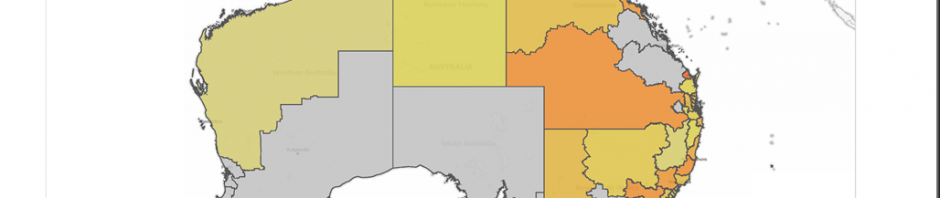
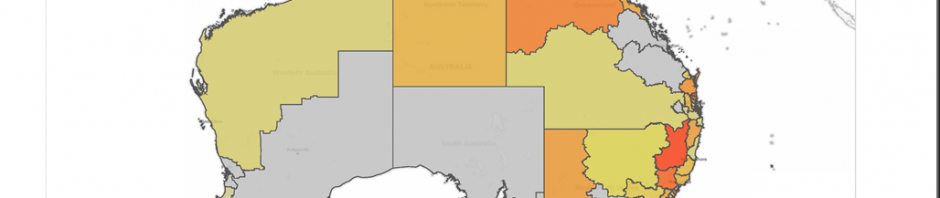
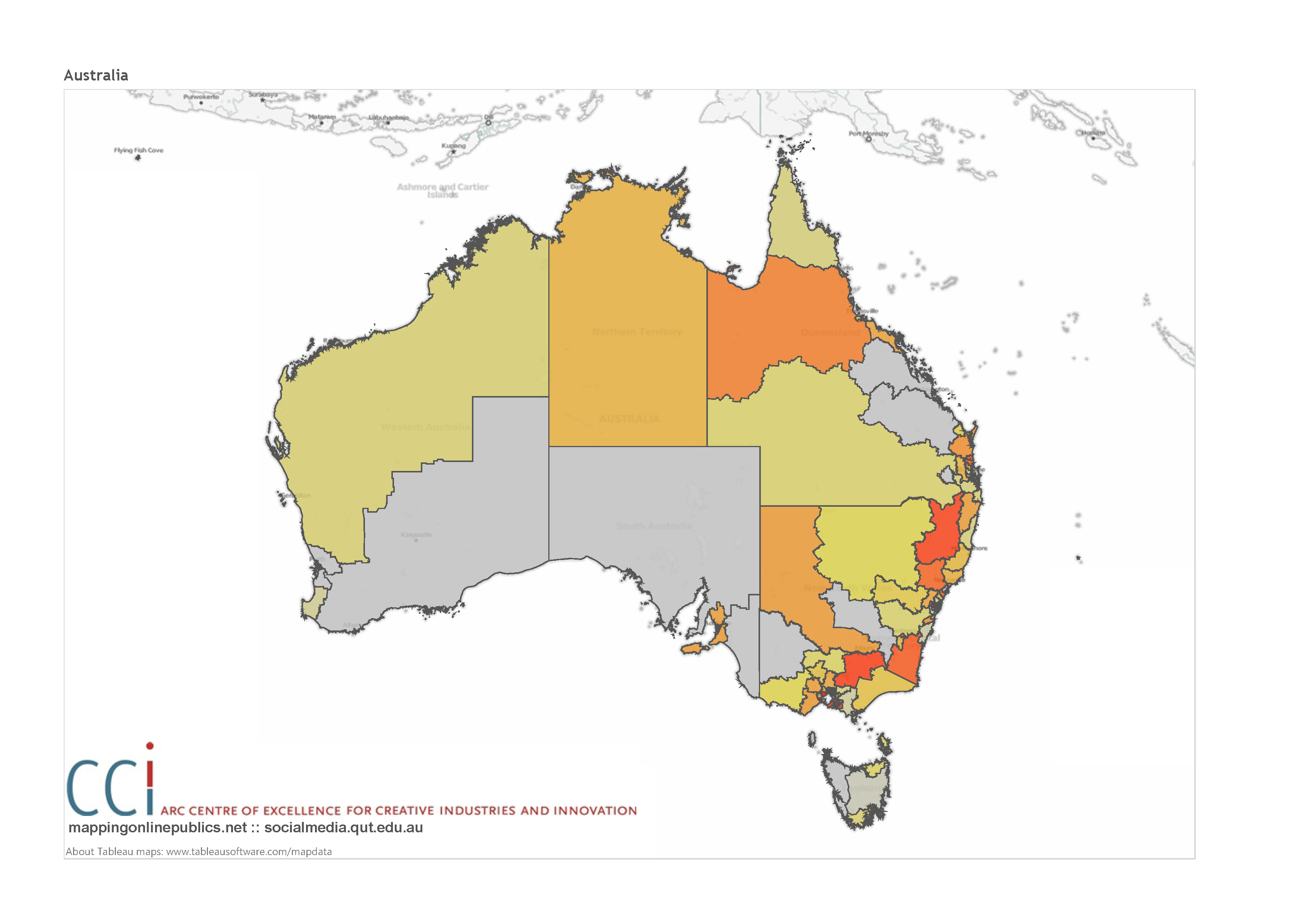
Australia

First, then, here’s a national overview, which largely reflects where the major population centres are: there’s more activity in the Sydney, Melbourne, and Brisbane / Gold Coast regions than anywhere else in the country. However, a few outliers appear even from this way out – Bob Katter’s north Queensland seat of Kennedy is more active because Katter has received significant national attention (or notoriety, take your pick)  as the leader of a fledgling political party. Similarly, the northern and central NSW seats of retiring Independents Tony Windsor and Rob Oakeshott are receiving attention because both of them have been such important figures in Australian politics over the past legislative period, with further attention on New England (just south of the Queensland border) because LNP Senator Barnaby Joyce is now a National Party candidate for that seat.

Further south in NSW there’s also the famous bellwether seat of Eden-Monaro, held by comparatively active Twitter user and Labor minister Mike Kelly – and across the border to Victoria, the seat of Indi, held by controversial Liberal member Sophie Mirabella is also receiving substantial attention. This may be related to recent reports suggesting that Mirabella is faced with a credible challenge from her Independent opponent Cathy McGowan this time around.

Also notable on this overall map, however, are the mostly rural and remote electorates in which Twitter does not yet play any role at all (in grey) – these are electorates whose candidates either don’t have Twitter accounts, or haven’t yet received a single @mention since July. This also provides a reflection on where the use of Twitter may have an impact during the campaign of course.

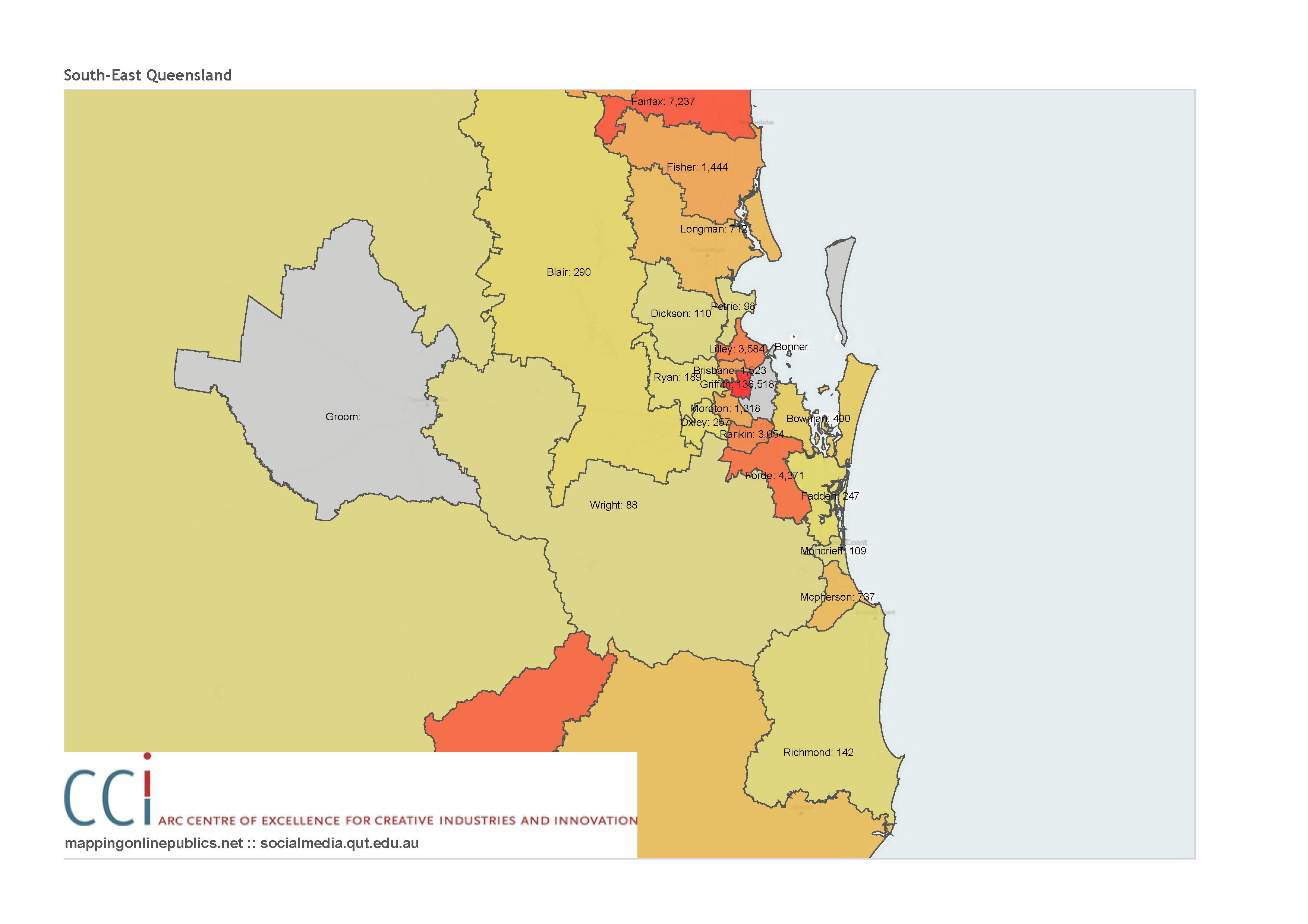
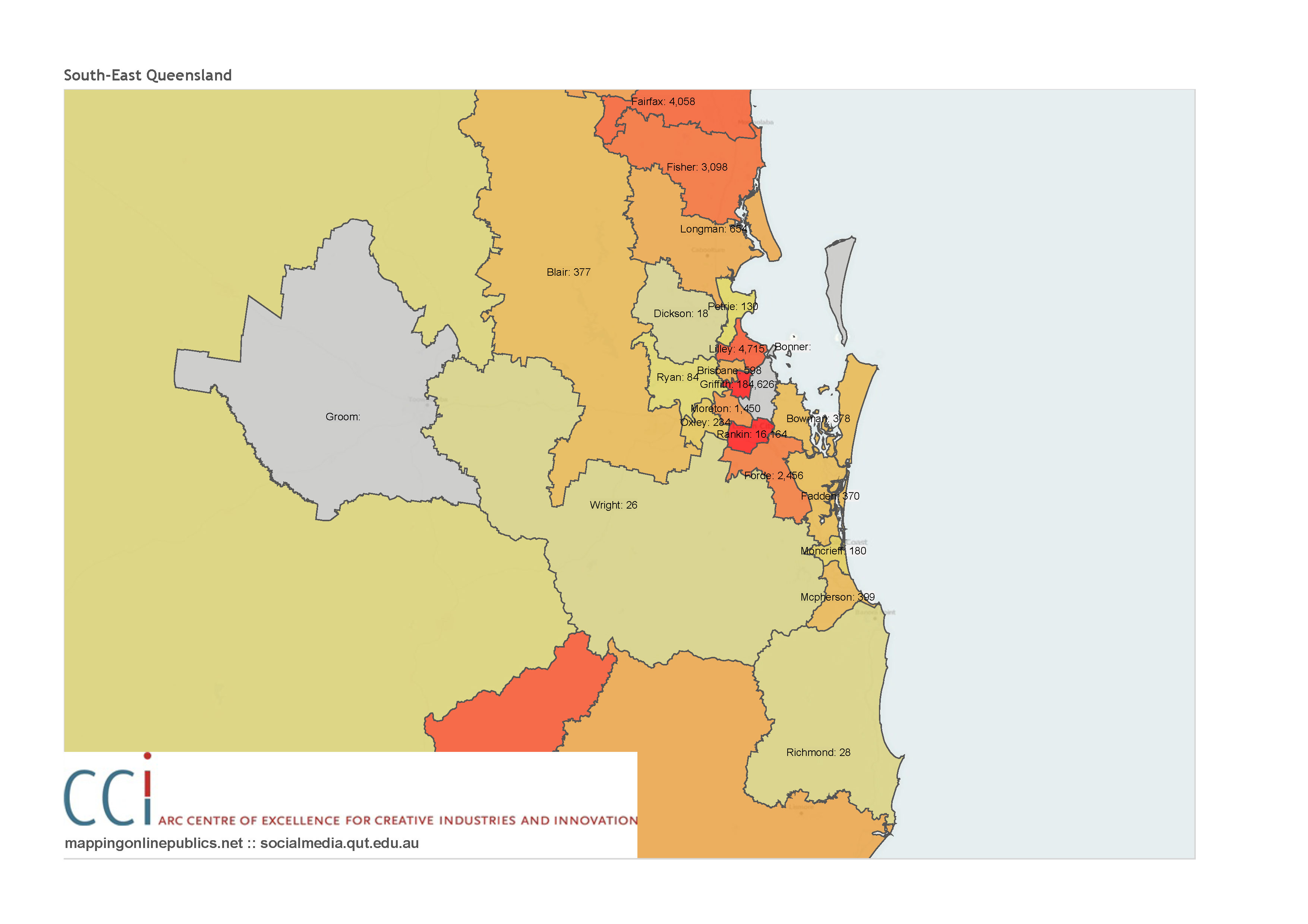
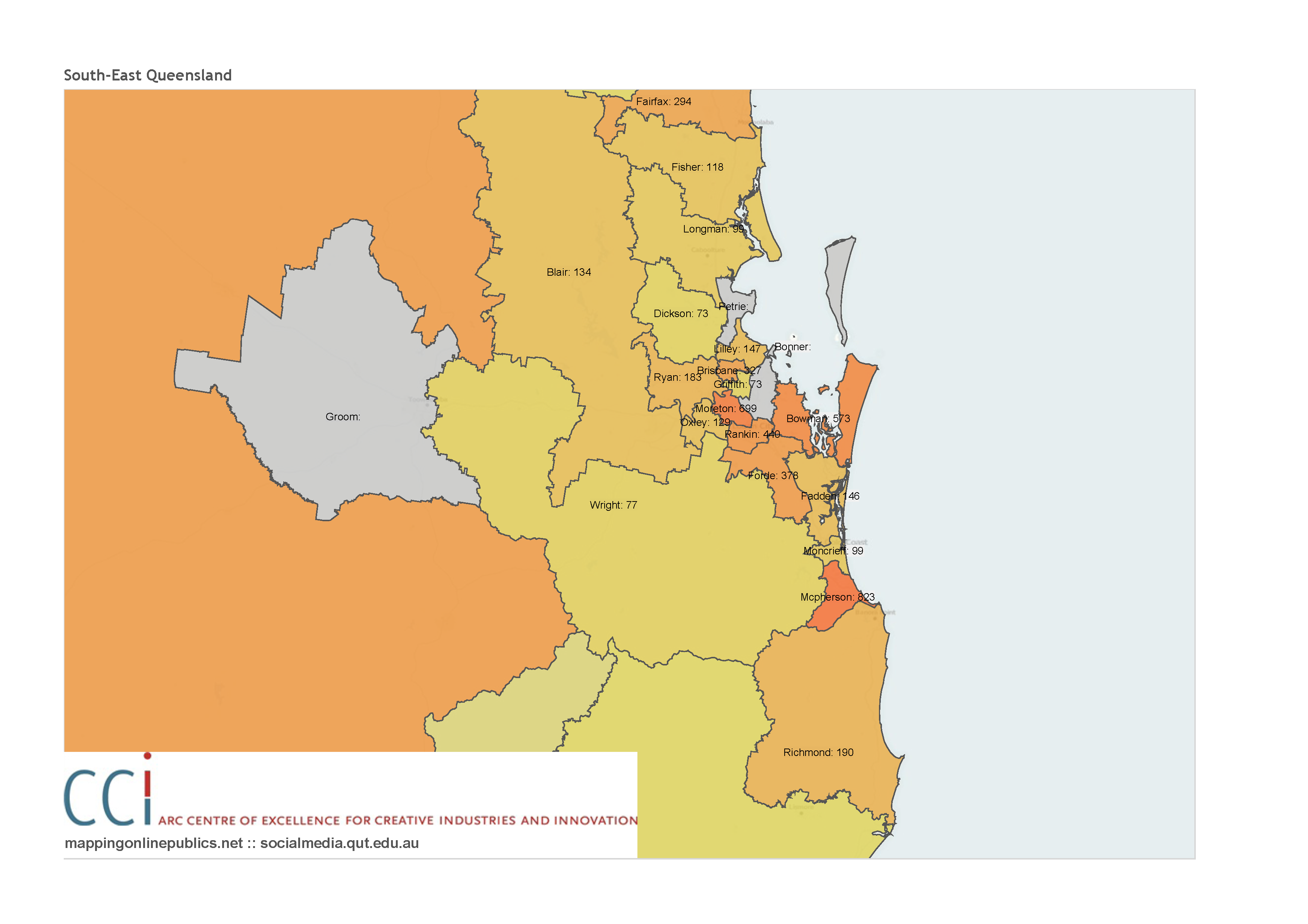
Most of the major centres are difficult to make out from a distance, however – time, then, to zoom in for a closer look at the various state capitals and surrounding areas. (The numbers behind each electorate name indicate the combined number of @mentions its candidates have received since the start of July.) In Queensland, the electorate of Griffith (home to PM Kevin Rudd) necessarily leads the way, but a number of other interesting flashpoints also emerge. These include Rankin, where retiring MP Craig Emerson has chosen to go out with a bang rather than a whimper; Forde, where former state Premier Peter Beattie has been recruited to reclaim the seat for Labor; as well as Lilley, held by Deputy PM-turned-backbencher Wayne Swan. On the Sunshine Coast, former Speaker Peter Slipper’s seat of Fisher is as hotly contested on Twitter as it is elsewhere – and just to the north of it, billionaire Clive Palmer is making his well-publicised run for parliament.

South-East Queensland

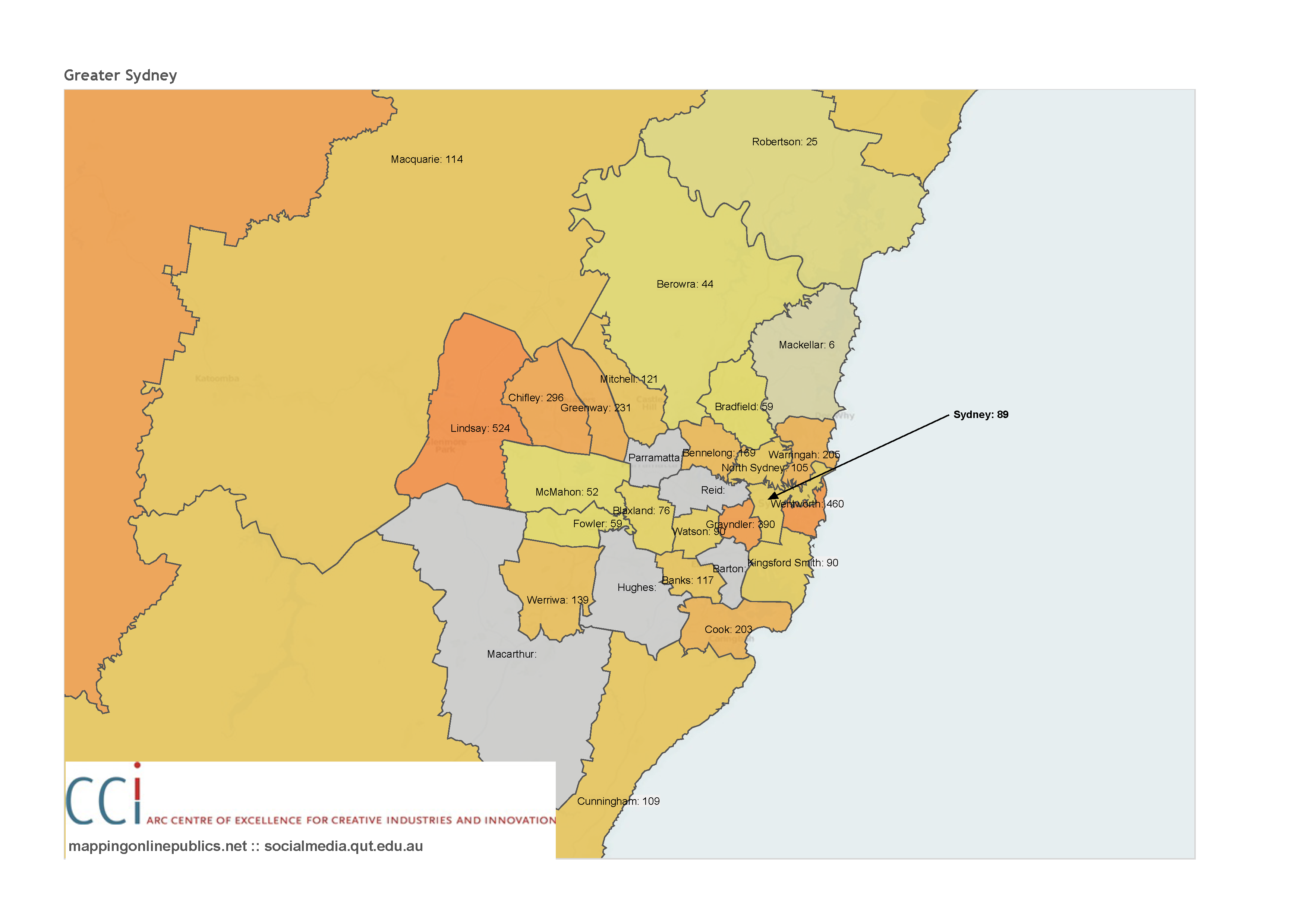
In Sydney, a number of city seats predictably show up in red mainly because they are held by leading federal politicians including Opposition Leader Tony Abbott (Warringah), Joe Hockey (North Sydney), Scott Morrison (Cook), and Malcolm Turnbull (Wentworth). Prominent Labor members from the area include Deputy PM Anthony Albanese (Grayndler), Tony Burke (Watson), Tanya Plibersek (Sydney), and Ed Husic (Chifley). The substantial level of activity around each of these seats should not surprise us, therefore.

Greater Sydney

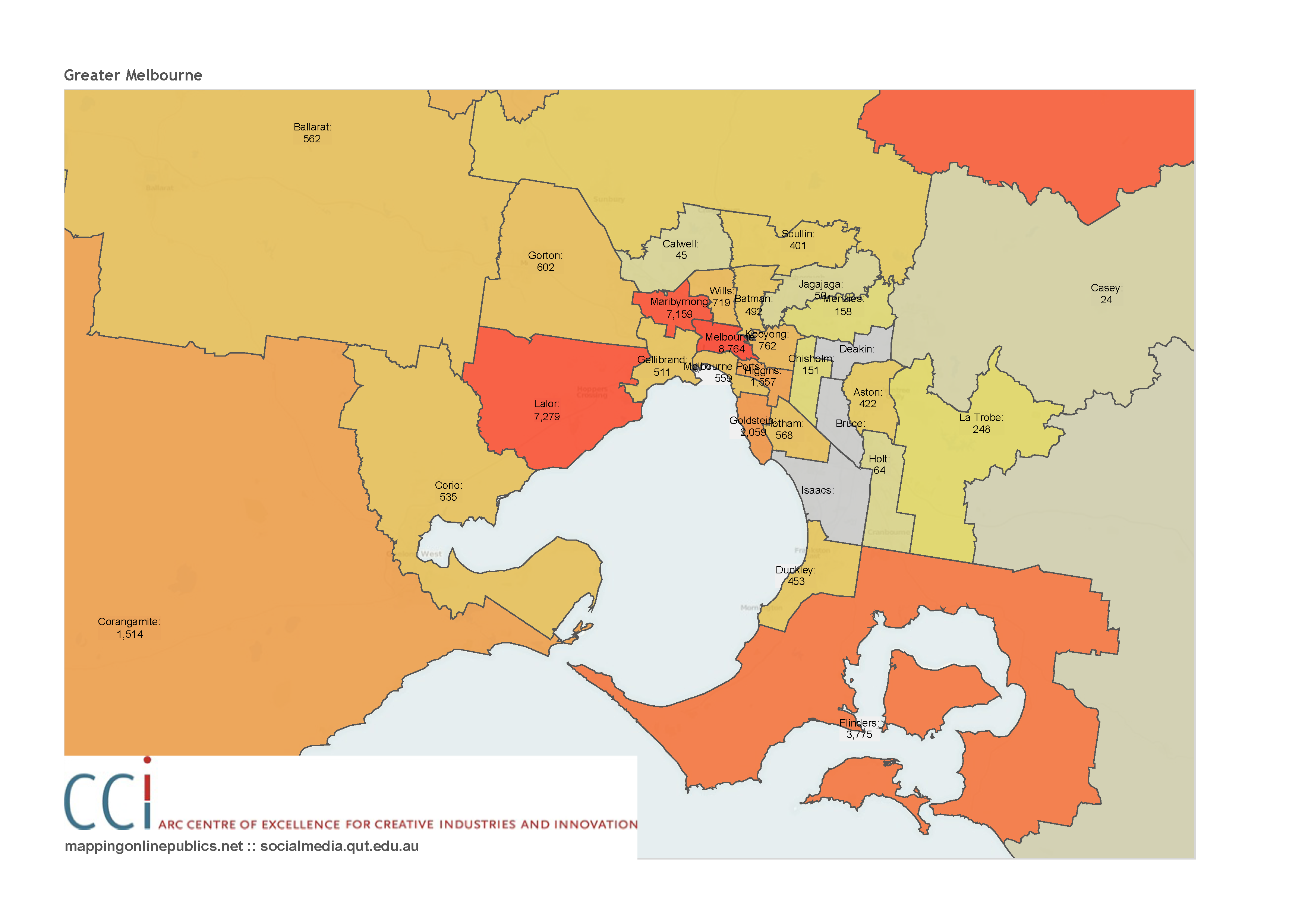
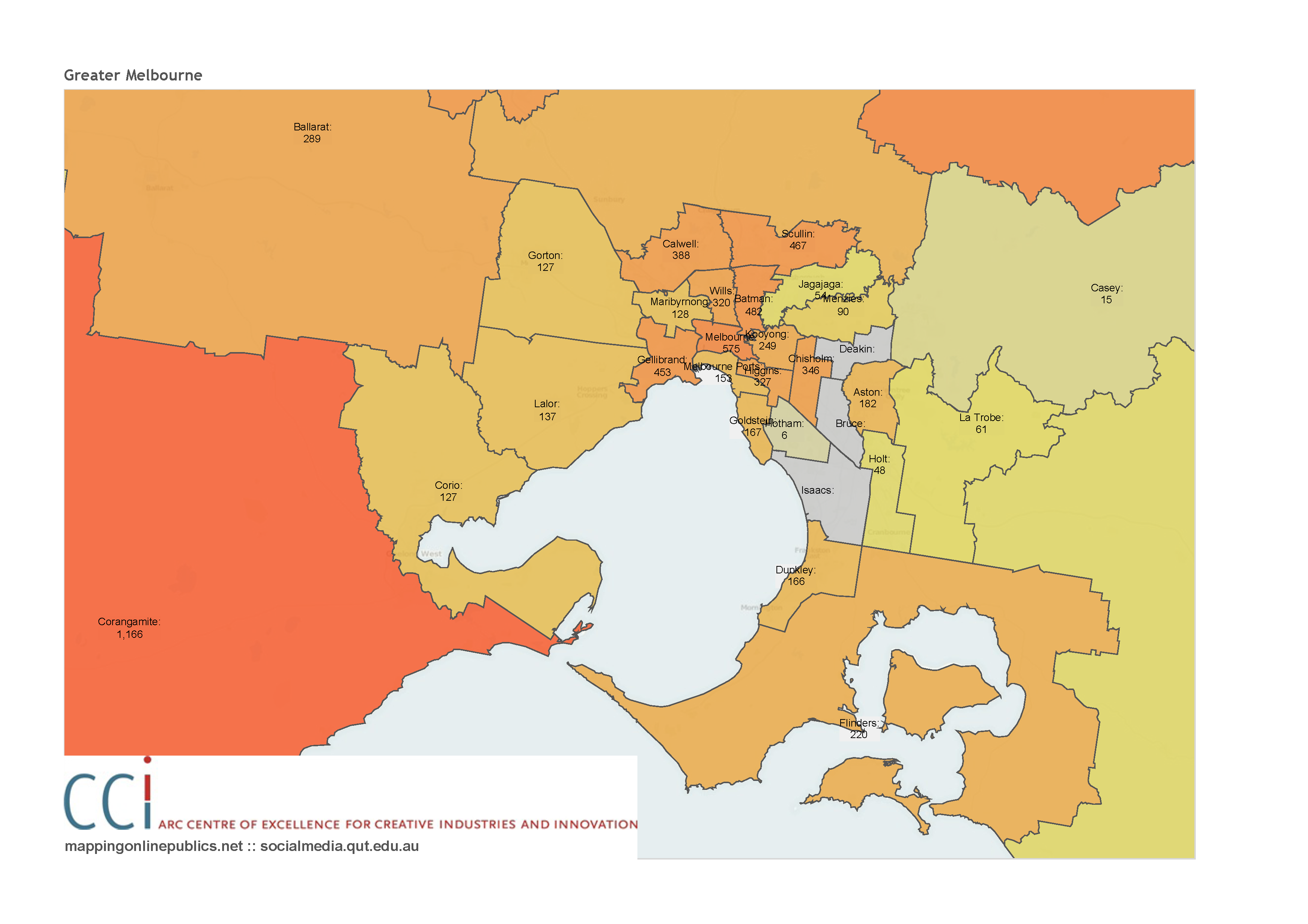
In Melbourne, sole Greens MP Adam Bandt is the centre of much attention in the eponymous electoral division as he attempts to hang on to his seat. Next door in Maribyrnong, Labor powerbroker Bill Shorten also attracts considerable @mentions, and opposition climate change spokesman Greg Hunt’s seat of Flinders flares up not least because of the considerable number of tweets by smaller parties which have been targetting him over the Coalition’s climate change policy (from both scientific and denalist perspectives, no less). Most active is Lalor, however, where former PM Julia Gillard, retiring at the election, is still receiving substantial @mentions even though she has tweeted only once since 1 July. The darker red area in the north-east is the lower end of Indi, incidentally.

Greater Melbourne

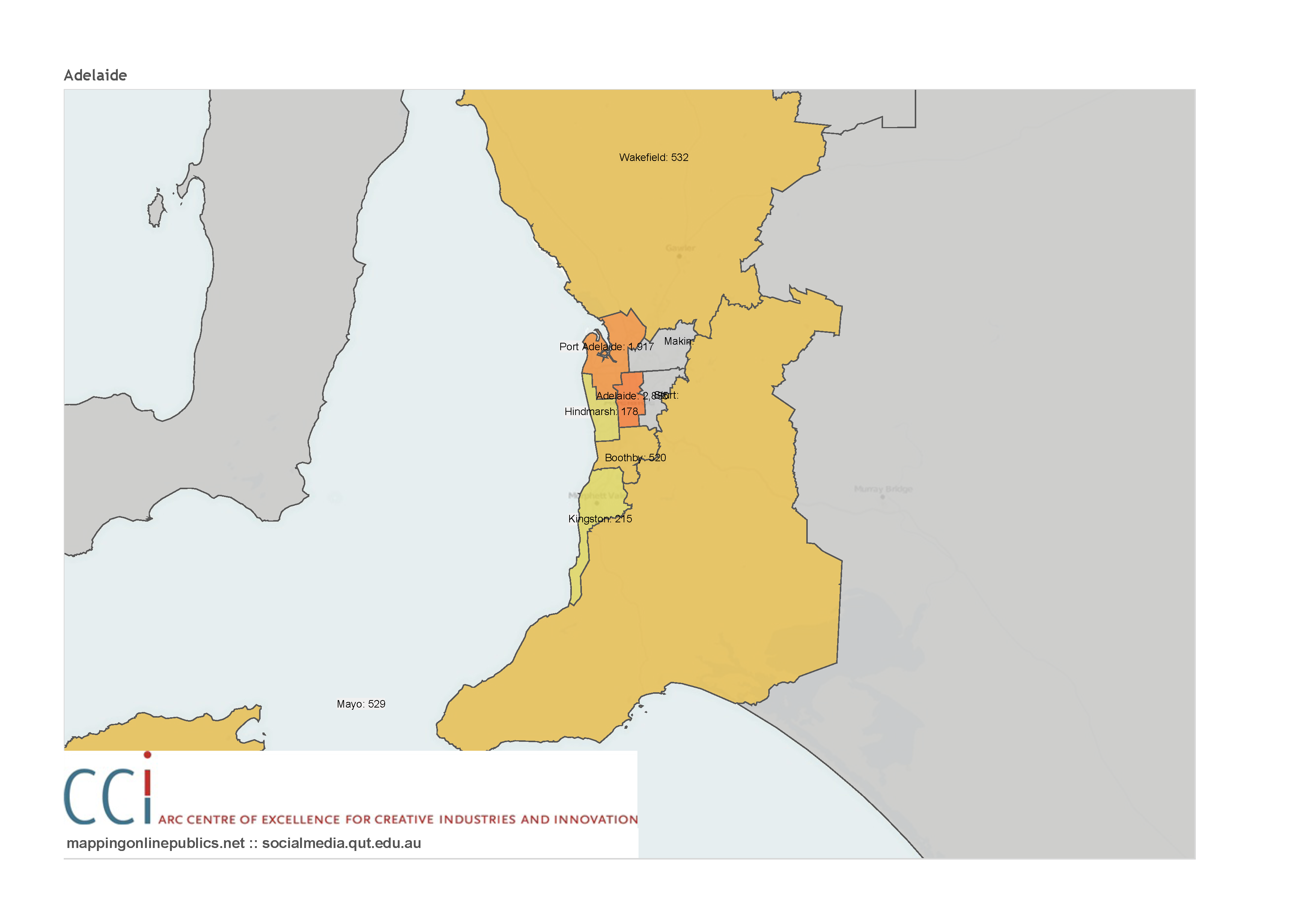
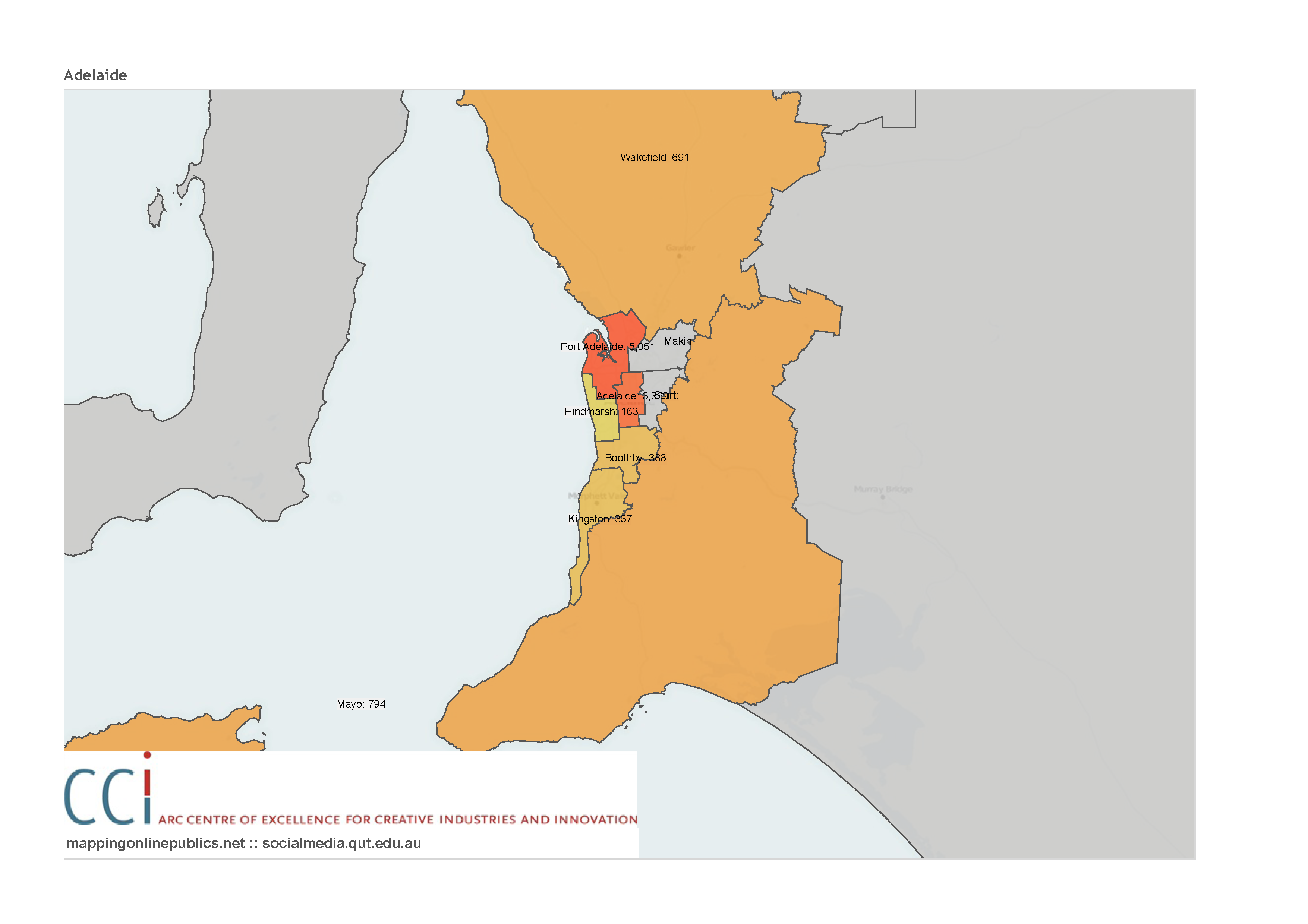
The most active electorates in the Adelaide area are Port Adelaide, held by Mark Butler, and Adelaide, held by Kate Ellis – both of them Labor ministers. As far as I can tell, there’s only a fake Chris Pyne on Twitter, and we’re not counting his @mentions towards the electorate of Sturt, so his electorate remains inactive to date – though we may not have picked up on the Twitter activity around the other local candidates there.

Adelaide

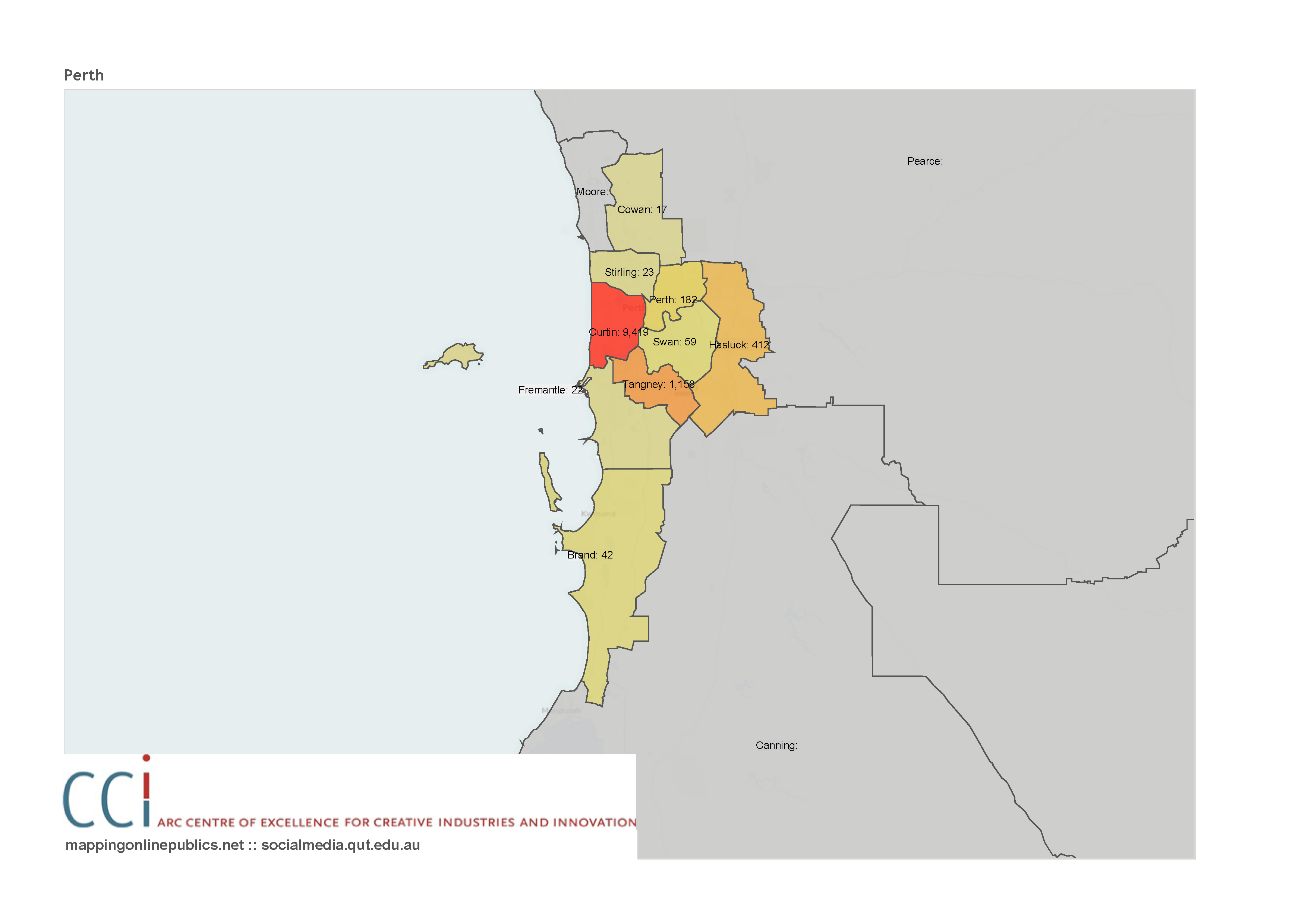
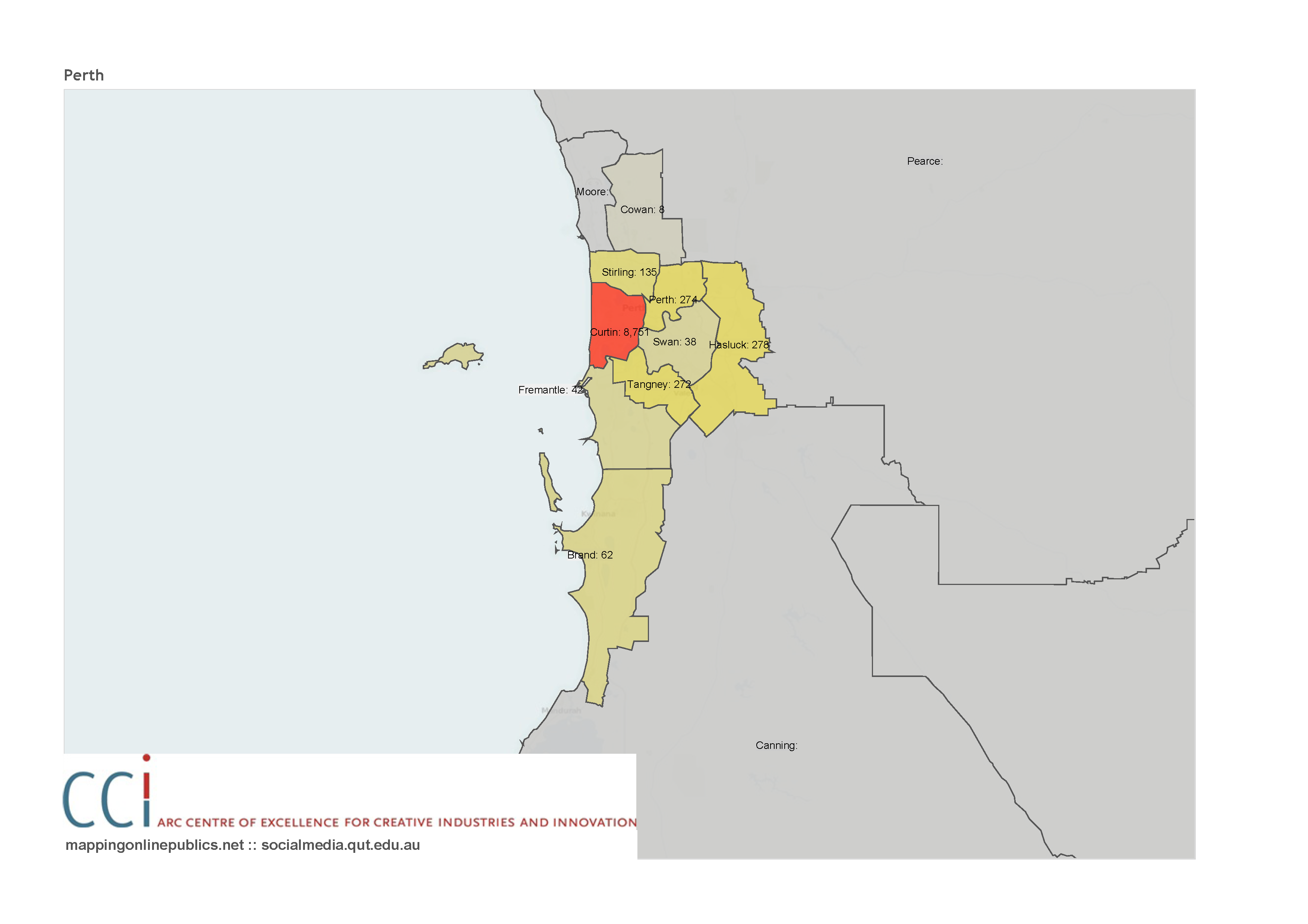
The Perth area shows even more grey as soon as we get further away from the city itself. Here, opposition foreign policy spokeswoman Julie Bishop’s Curtin electorate is most active, unsurprisingly; this is followed by Dennis Jensen’s Tangney division and – more interestingly – by Australia’s most marginal Liberal seat of Hasluck, held by the nation’s first indigenous MP, Ken Wyatt.

Perth

The remaining state and two territories can be covered very quickly – nothing much to see here. In Tasmania, only Independent Andrew Wilkie’s seat of Denison shows any signs of life (and then, not much):

Tasmania

In the ACT, Labor’s Gai Brodtmann isn’t generating much activity for the Canberra electorate, while Fraser (with its strange coastal exclave, the Jervis Bay Territory – hence the equidistant placement of its label on our map) is held by Labor MP Andrew Leigh, an active blogger and Twitter user who therefore attracts considerably more @mentions:

ACT

Finally, neither of the two Northern Territory electorates are earthshatteringly active. However, the fact that Labor MP Warren Snowdon’s immensely large electorate of Lingiari generates any Twitter activity at all is itself noteworthy, perhaps, compared to the poorer performance of many of the other rural and remote electorates across WA, SA, and Queensland.

NT

So much for a first glimpse at the geographic distribution of Twitter attention across the federal electorates, then. We’ll check in again later in the campaign to see whether Twitter activity provides any indication that new electorates have come into play as the parties’ fortunes wax or wane.