Filter Bubbles and Echo Chambers: Debunking the Myths

(Crossposted from the Polity blog.)

Filter bubbles and echo chambers have become very widely accepted concepts – so much so that even Barack Obama referenced the filter bubble idea in is farewell speech as President. They’re now frequently used to claim that our current media environments – and in particular social media platforms such as Facebook or Twitter – have affected public debate and led to the rise of hyperpartisan propagandists on the extreme fringes of politics, by enabling people to filter out anything that doesn’t agree with their ideological position.

But these metaphors are built on very flimsy foundations, and it’s high time that we examined the actual evidence for their existence with a critical eye. That’s what my book Are Filter Bubbles Real? sets out to do. There are several recent studies that claim to have identified filter bubbles and echo chambers in search results and social media discussions, yet there are just as many that find no evidence or report contradictory results, so what’s really going on here? Is the impact of these phenomena on public opinion really as significant as common sense seems to suggest?

As it turns out, neither concept is particularly well-defined, and even the authors who first introduced these metaphors to media and communication studies rarely ventured far beyond anecdote and supposition. In the book, I introduce more rigorous definitions, and re-evaluate some of the key research findings of recent studies against these new criteria – and as it turns out, most claims about echo chambers and filter bubbles and their negative impacts on society are significantly overblown. These concepts are very suggestive metaphors, but ultimately they’re myths.

This shouldn’t actually surprise us. Imagine how difficult it would be to completely encapsulate yourself in an echo chamber or filter bubble, in order to receive only information that fits your existing worldview – not just on a single Facebook group or Twitter hashtag, not just on a single social media platform, but in every aspect of your life. To do so is not impossible, strictly speaking – cult members do it. But it requires a level of effort that few ordinary people are likely to commit to.

And in fact, it turns out that those whom we most expect to be caught in filter bubbles – hyperpartisans on the political fringes – are also most actively engaged with the mainstream media, even if they read them from a critical, oppositional perspective. The filter bubble and echo chamber myths have kept us from seeing this more clearly; they’ve sought to blame technology for problems that are, unfortunately, all too human – the unwillingness of polarised political groups in society to engage with one another in order to develop mutual understanding and consensus.

It’s high time we cut through those myths and shifted our focus to the cognitive processes and ideological mindsets that produce such polarisation – and I hope that the critical re-appraisal presented in Are Filter Bubbles Real? can contribute to that shift.

Axel Bruns is an ARC Future Fellow and Professor in the Digital Media Research Centre at Queensland University of Technology in Brisbane, Australia. He is the author and editor of several books, including Gatewatching and News Curation: Journalism, Social Media, and the Public Sphere and Twitter and Society. His latest book, Are Filter Bubbles Real?, is now available from Polity.

One Day in the Life of a National Twittersphere

Taking a break from all the politics, Brenda Moon and I have examined everything that goes on in the Australian Twittersphere on a given day. We found that older, more sociable uses of Twitter persist in spite of everything. Our article is out now in The Conversation and Nordicom Review. The research was made possible by the TrISMA LIEF project, funded by the Australian Research Council and led by the QUT Digital Media Research Centre.

The Nordicom Review article was published under an open access licence – here’s the full abstract:

Previous research into social media platforms has often focused on the exceptional: key moments in politics, sports or crisis communication. For Twitter, it has usually centred on hashtags or keywords. Routine and everyday social media practices remain underexamined as a result; the literature has overrepresented the loudest voices: those users who contribute actively to popular hashtags. This article addresses this imbalance by exploring in depth the day-to-day patterns of activity within the Australian Twittersphere for a 24-hour period in March 2017. We focus especially on the previously less visible everyday social media practices that this shift in perspective reveals. This provides critical new insights into where, and how, to look for evidence of onlife traces in a systematic way.

Now Live: The Australian Twitter News Index as a Dashboard

For the past few years I have published regular monthly updates of the Australian Twitter News Index (ATNIX) at The Conversation and here on this site. As that partnership has now come to an end and the writing of regular updates had become somewhat onerous, we’ve now developed a new approach to sharing the trends in how content from Australian news sites is being shared on Twitter.

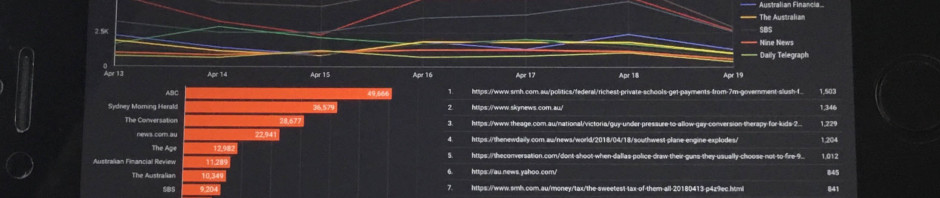
From now on, ATNIX is published through a live, interactive dashboard which shows day-to-day trends and lists the most shared URLs for any given timeframe (click ‘full screen’ to enlarge):

I’ll continue to publish ATNIX updates on major trends and developments from time to time, but this dashboard provides a much faster way to make these live trends available. (As a next step in the process, I also hope to automate the @_ATNIX_ Twitter account so that it highlights major news articles as they are trending.)

ATNIX is now supported by the QUT Digital Observatory – a collaboration between the QUT Institute for Future Environments and the QUT Digital Media Research Centre. If you’re interested in further research that builds on this dataset, please get in touch!

Queensland election: One Nation dominates Twitter debate in the final weeks

As Queensland approaches its election day on Saturday, the social media campaign for votes continues alongside – and in combination with – the candidates’ doorknocking efforts and mainstream media advertising. But over the final two weeks, the focus of that campaign has gradually shifted.

First, as I reported a fortnight ago, Labor Premier Annastacia Palaszczuk’s plan to veto a potential $1b loan to the Adani mine project resulted in a considerable drop in Adani-related tweets directed at Queensland candidates, and that pattern has held through subsequent weeks. Labor has not entirely neutralised the Adani controversy, but the mine project is no longer the major talking point of the Twitter campaign.

By contrast, the most significant emerging theme of these past two weeks has been the role that Pauline Hanson’s One Nation Party might play in the new parliament. We saw some of this in our previous analysis, in response to the LNP’s decision to direct preferences to One Nation over Labor in a majority of Queensland seats; that particular discussion has now shifted to a much broader debate about the very real prospect that One Nation may hold the balance of power after the election.

image

Our dataset captures the tweets posted by and directed at Queensland election candidates. Of those tweets where the presence of specific keywords indicates a major topic, some 51% addressed the Adani mine or One Nation, but the emphasis has now swung considerably towards the latter. This was sparked in part by the LNP’s preference announcement, with preferences briefly becoming a distinct major topic in their own right.

Labor has been quick to exploit this arrangement, in well-shared posts from the central party account, though recent footage of its own controversial MP Joanne Miller hugging with Pauline Hanson on the campaign trail might have blunted this message somewhat.

One Nation also featured heavily in another major topic of the second half of the campaign: schools. While Labor’s pledge to establish several new schools received only moderate attention, Queensland One Nation leader Steve Dickson’s bizarre comments about the ‘safe schools’ anti-bullying programme was met with widespread condemnation. A tweet criticising Dickson’s subsequent apology is now the second most retweeted post of the entire campaign, in fact:

Somewhat more surprisingly, the impact of Uber and similar ridesharing services on the Queensland taxi industry has also been a minor theme throughout the campaign. This was aided by some orchestrated activity by taxi drivers, and supported by KAP candidate Robbie Katter, who has championed their cause in several campaign events. Meanwhile, transport also figured in the Premier’s commitment to fixing the issues with troubled new Queensland Rail rolling stock in Maryborough, which generated a brief flurry of support as well as criticism.

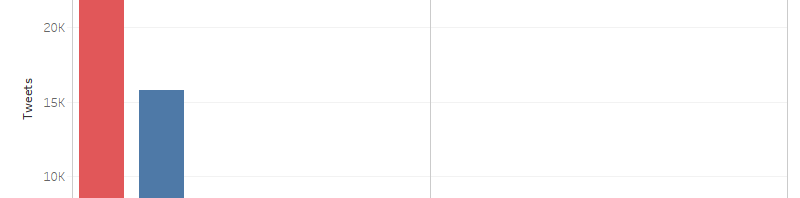
These topical changes have affected the patterns of engagement with the candidates on Twitter. In total, Labor candidates still continue to be @mentioned more frequently than their LNP counterparts – but over the past two weeks, that gap has closed slightly: as attention has shifted from Adani to One Nation, so have Twitter users moved to asking more questions of LNP and One Nation rather than Labor politicians. Retweets, however, continue to favour Labor by a considerable margin: its candidates have received more than four times as many retweets as all other party candidates put together.

20171123 Engagement with Parties

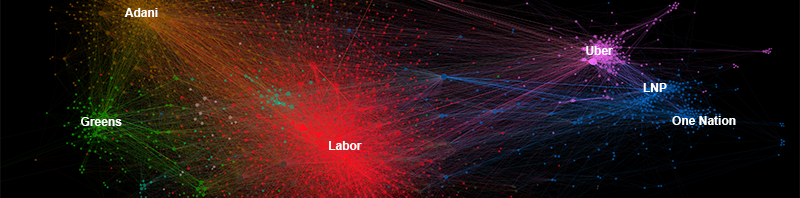
A network visualisation of these engagement patterns (combining both @mentions and retweets over the course of the entire campaign) demonstrates the state of play at this late stage of the election campaign. Labor commands the largest engagement network, at the centre of the graph. Discussions about Adani have been prominent, and form a distinct cluster of debate that is most closely interconnected with the Labor and Greens networks.

Meanwhile, LNP and One Nation candidates are mentioned frequently alongside one another, often in tweets asking about their preference arrangements or their willingness to work together in the absence of an outright majority for either major party. This association is so strong, in fact, that our visualisation algorithm treats both groups as part of the same discussion cluster. Slightly to the side of this sits the Uber debate, which therefore appears to be more closely associated with – and perhaps supported by – LNP candidates than their Labor counterparts.

all_mentions-full (crop, smaller)

The picture that emerges here is one which points to the strengths and weaknesses of both sides of politics. For Labor, its troubled path to a firmer stance on the Adani mine may remain in environmentally conscious voters’ minds even if the online discussion has died down somewhat; for the LNP, the emerging view that its best path to government is through an arrangement with One Nation will similarly dent the electorate’s enthusiasm for a change of government. That Labor commands by far the majority of retweets for its messages may give it hope, though – at least in urban electorates, where Twitter is likely to have its greatest footprint.

ATNIX: Australian Twitter News Index, September/October 2017

Twitter news sharing patterns for Australian news sites in recent months point to the considerable public attention directed at a handful of key issues.

The September/October period is once again notable for a number of major ABC News stories that attracted attention on Twitter well above the long-term average. The first of these, trending from 30 September onwards, remains relevant to the current Queensland election campaign: the ABC’s Four Corners investigation into Indian fossil fuels giant Adani resulted in a very strong Twitter response.

As is typical for such long-form investigative reporting, ABC News pushed out a number of news articles relating to the story, many of which received a strong response. From Saturday 30 September to Tuesday 3 October,  Four Corners’ trailer alone (since removed from the ABC News site) was shared in some 7,300 tweets; the full video of the report received another 3,700 shares.

Additional spin-off articles on Adani’s ties to overseas tax havens and on a former Indian minister’s warnings about Adani received 3,300 and 2,100 shares, respectively, while even the main Four Corners homepage on the ABC site was shared in 2,200 tweets over these four days. During this time, these five links were the most shared ABC News URLs by a substantial margin; the first non-Adani story received only some 600 shares.

For such a comparatively old-fashioned news format as Four Corners, with its long-form video reports, this is a major achievement in the current news environment. The nearly 21,000 tweets which shared these five URLs over the entirety of September and October, as well as further sharing on Facebook and through other channels, mean that the Adani controversy has remained central to public debate, especially in Queensland. The events of the first weeks of the Queensland state election campaign also demonstrate the challenge that the Adani project continues to represent for both major parties.

image

Over these two months, ABC News’ Adani coverage is eclipsed only by one other major story: its report that Hillary Clinton blames Julian Assange for his part in Donald Trump’s election win receives some 7,100 shares on 16 October and nearly 11,000 shares over the entire period, making it the single most shared ABC News article during September and October.

Contrary to the Adani coverage, which is likely to have found a predominantly domestic audience, here a further international distribution (which is common for many Assange and WikiLeaks stories) is no doubt at least partly responsible for the widespread sharing of this piece.

Meanwhile, attention to Sydney Morning Herald content follows business-as-usual patterns over the same period. Here, day-to-day coverage of federal politics remains most prominent: the SMH’s leading articles for September and October report that federal Liberal MP Stuart Robert may have been elected improperly (2,400 shares); that the National Party has voted to remove subsidies for renewables (1,900 shares); and that coal is unpopular even in electorates with coal-fired power stations (1,900 shares).

These trending stories document the confluence of several major issues and crises in current domestic and international news, from Queensland’s Adani controversy  through the ongoing dual citizenship saga to the investigations into the Trump White House and its ties to Russia. On Twitter and elsewhere, news is booming – even if many commercial news outlets are still struggling to make ends meet.

Early tweets favour Labor in Queensland election campaign

There’s still plenty of time to go in the current Queensland state election campaign, but early signs from the social media trail offer some encouragement for Labor premier Annastacia Palaszczuk: she is receiving considerably more retweets than LNP challenger Tim Nicholls, and chatter about the controversial Adani mine project has declined in recent days.

Twitter and Facebook are now a standard part of the campaigning toolkit for all major parties, and previous campaigns at state and federal levels have also pointed to effective ways to integrate online and in-person campaigning: voters who’ve already seen a party’s messages in their social media feeds may be a little more open to a chat when the local candidate comes doorknocking.

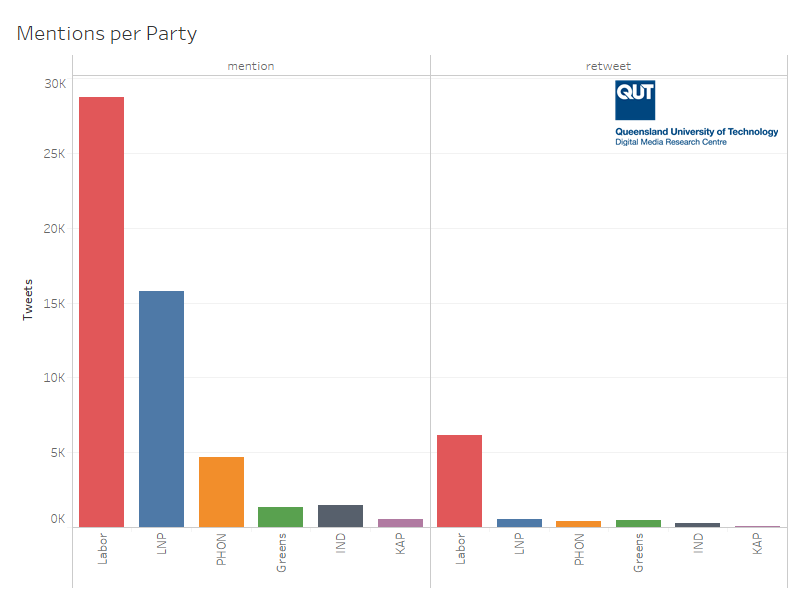
On Twitter, we’ve identified the accounts of 60 Labor and 48 LNP candidates, as well as central party and campaign accounts; the Greens are represented by 34 accounts, while One Nation and Katter’s Australian Party each have only a handful of tweeting candidates. Over the first two weeks of the campaign, they’ve sent some 3,300 tweets in total, and received some 54,000 @mentions and retweets.

image

These are far from evenly distributed, however. @mentions of parties and politicians tend to favour the incumbent, and this is not surprising: more of the debate on social media and elsewhere will be about the track record of the current government, rather than about the promises of the opposition. At 30,000 tweets, Labor accounts have received nearly double the @mentions of the LNP (17,000) to date, and this is in line with patterns in previous state and federal elections.

It’s the retweets that tell a more remarkable story. The nearly 7,000 retweets for Labor candidates’ tweets amount to more than twelve times the 570 retweets received by the LNP – and during an election campaign, retweets usually do indicate some level of endorsement. Here, the pattern between incumbents and challengers is considerably different from other recent elections: in 2016, for example, the incumbent federal Coalition received far fewer retweets than the Labor opposition; in the 2015 Queensland election, Campbell Newman’s LNP government similarly struggled to attract retweets for its messages.

These patterns do not point to a significant mood for change or substantial willingness amongst Twitter users to promote the LNP’s campaign messages. Conservative commentators may want to chalk this up to a purported left-wing bias in the Australian Twittersphere – but that claim is not borne out by our analysis of the overall Twittersphere, which includes sizeable communities both of left- and of right-wing supporters.

Adani and One Nation Generate Heat for the Major Parties

Labor also seems to have weathered the early onslaught of critical coverage well. The first week of the campaign saw a substantial volume of debate about the controversial Adani mine project, which divides opinion between the southeastern population centres around Brisbane (where concerns about environmental impacts are high) and the regional centres near the mine (which anticipate potential job creation prospects).

As a result, during week one, some 1,500 tweets per day by and to candidates’ accounts contained the term ‘Adani’. Hashtags related to the controversy (#adani, #stopadani, #coralnotcoal, and others) were the most prominent topical hashtags, in addition to generic tags like #qldvotes, #qldpol, and #auspol. Out on the campaign trail, several of Palaszczuk’s press conferences were ambushed by anti-Adani protesters.

The story is further complicated by the fact that, in his role at PricewaterhouseCoopers, Premier Palaszczuk’s partner contributed to Adani’s application for a $1 billion loan supporting the project; Palaszczuk announced at the end of the first week of campaigning that she would veto that loan if the application were successful.

Judging by our Twitter data, this veto threat, and the public perception that this signalled Labor’s growing distance from the Adani project, appears to have neutralised the Adani debate to some extent. ‘Adani’ tweets by and to candidate accounts have declined from around 1,500 tweets per day in week one to less than 600 in week two, and indeed the overall volume of tweets by and to these accounts have dropped from over 5,000 to some 3,700 per day in week two.

We’re still far from election day, but this shift in position may indicate that Labor believes that its support for Adani will lose it more votes in the southeast than it can gain further north – and our social media patterns seem to bear out this view.

Meanwhile, with Pauline Hanson’s much-publicised arrival on the campaign trail the second week has seen more discussion about the role that One Nation may play in the next parliament. In particular, the announcement on the evening of Friday 10 November that the LNP will preference One Nation over Labor in more than half the seats in Queensland has already generated substantial debate: some 20% of tweets by and to the candidates on the following Saturday included keywords related to One Nation and/or preferencing.

While the LNP announcement – after the evening news on a Friday – was clearly timed to minimise media scrutiny of its decision, it remains to be seen whether this debate will carry over into the third week of the campaign. Labor will no doubt seek to exploit this preference arrangement to attract traditional conservative voters who remain critical of One Nation.

And finally, if you’re still uncertain about which hashtag to use to join the debate: in tweets by and to candidate accounts, plain old #qldvotes leads #qldvotes2017 by more than ten to one so far. It’s a landslide.

The Beautiful Social Media Game: A-League Winners and Losers on Twitter

Social media are now an integral part of professional sports – but as many a sports star has found out the hard way, not everybody has the gift of presenting an authentic self on Twitter or Facebook, which get use to promote businesses and believe they work, this page will tell you more about it. Yet still our sporting heroes and teams are encouraged to build their online profiles, keeping their fans connected during the season and beyond.

Australian sports codes have been encouraged to build their own social media presences at least since a senior team from Twitter HQ came to the country for targeted talks with NRL, AFL, and other codes in late 2012. In the aftermath, teams professionalised their Twitter profiles, and a number of leagues introduced systematic match hashtags to enable fans to connect around the live match experience.

Strategies for the use of social media by players and teams still diverge considerably, though. As Australia’s traditional winter leagues conclude and a new A-League season approaches, a comprehensive study of interactions with official A-League accounts reveals last year’s winners and losers on the online pitch, and shows that success on the field and popularity on Twitter don’t always go hand in hand.

The A-League’s Twitter Leaderboard

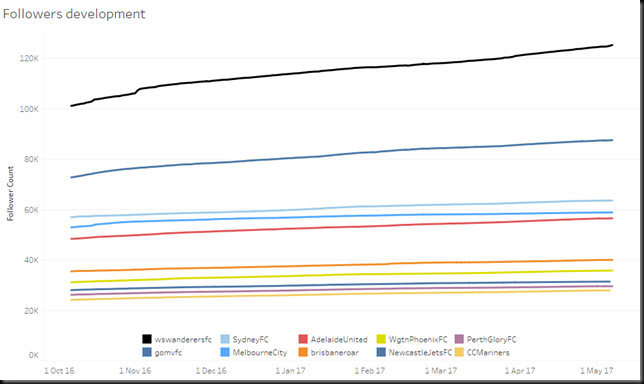
In terms of followers, one team stands head and shoulders above the rest – and it’s not the 2017 champions Sydney FC, who had attracted nearly 64,000 followers by the end of the 2016/17 season, but their cross-town rivals Western Sydney Wanderers with 125,000 followers at the same time. The A-League’s most successful team, Melbourne Victory, sat between the two and had attracted some 88,000 fans.

Niche and growing sports benefitted especially much from this outreach: given their limited coverage in the mainstream media, connecting with sports fans via social media is particularly important for them. For Netball fans, Twitter has been a crucial connection at a time when broadcasters were ignoring the sport. Similarly, A-League teams have arguably taken to Twitter more effectively than their counterparts in much bigger leagues, such as the English Premier League or the German Bundesliga.

Indeed, in spite of a somewhat disappointing season, the Wanderers picked up an additional 24,000 followers during the course of the season – almost as many as the least followed team, the Central Coast Mariners, have in total. Overall, the strong follower base attracted by the fairly young Wanderers club is most likely a follow-on effect from their 2014 triumph in the AFC Champions League.
image

This follower base also translates into a substantial volume of audience responses to these accounts on Twitter. Here, audience engagement largely mirrors population sizes: in order, the Sydney, Melbourne, and Brisbane teams receive the greatest volume of @mentions and retweets, while smaller-town clubs like the Newcastle Jets or the Central Coast Mariners, along with the Wellington Phoenix, attract a great deal less attention.

Taking It to the Other Teams

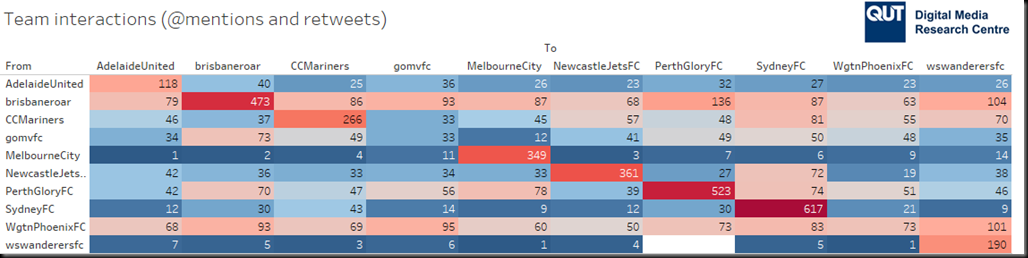
But what the teams choose to do with such attention differs as widely as their on-field tactics. This is especially notable when it comes to direct engagement between the official team accounts. Over the course of the past season, from 7 October 2016 to 7 May 2017, the Western Sydney Wanderers and Melbourne City accounts hardly acknowledged their competition at all: they barely mentioned any of the other teams more than ten times on Twitter.

The Brisbane Roar and Wellington Phoenix accounts, on the other hand, took the action to their opponents on Twitter as much as they are wont to do on the field: for the most part, they @mentioned and retweeted each opposite team some 60 to 90 times; posts from @brisbaneroar to @PerthGloryFC even amounted to 136 tweets over the entire season. Part of the story here is that the Roar account live-tweets most of its A-League, W-League, NPL and other matches, frequently mentioning opposing teams by their Twitter handles.
image

That said, the ten teams’ accounts mostly mentioned themselves – this occurs mainly when they retweet messages that mention their accounts, in order to make those tweets visible to their own followers. Its local and interstate rivals may not be entirely surprised that Sydney FC turned out to be the most self-referential during the past season, while Melbourne Victory’s @gomvfc was least self-centred.

There’s little evidence, too, of the great rivalries that the A-League organisation has been keen to promote: the Sydney and Melbourne intra-city derbies may be eagerly anticipated by fans, but the teams involved hardly acknowledge each other’s existence. During the 2016/17 season, Melbourne Victory tweeted 73 times at the Brisbane Roar, for instance, but only 12 times at Melbourne City; Sydney FC mentioned the Central Coast Mariners in 43 tweets, but the Western Sydney Wanderers only nine times. No love lost there, then.

A Hashtag Lasts 90 Minutes

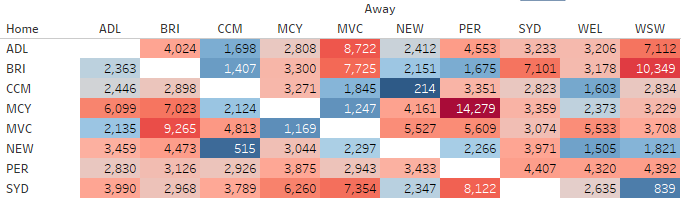
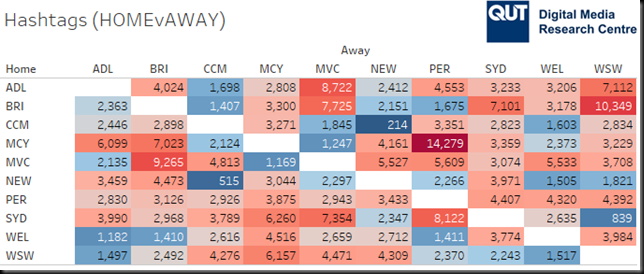
Building on its collaboration with Twitter Australia, the A-League has adopted a standard system of hashtags that it encourages fans and teams to use as they tweet about each match. These take the form of #HOMEvsAWAY, with both teams represented by well-established three-letter acronyms – and one third of the one million tweets by and at the A-League teams over the 2016/17 season used these hashtags.

Here, too, however, the major derbies fail to draw the crowd that the A-League might have expected them to do. Altogether, the Melbourne derbies produced fewer than 2,500 tweets, and with only 3,100 tweets their Sydney counterparts fared little better (the scoreless #SYDvWSW match in January generated only 839 tweets in total). Least popular, however, are the matches that make up the so-called “F3 Derby” between the Newcastle Jets and Central Coast Mariners – their three clashes generated barely more than 700 tweets in total.
image

The most bankable teams, meanwhile, are the two Melbourne clubs and Brisbane Roar at home, as well as Perth, Melbourne Victory, and the Western Sydney Wanderers away – on average, whenever they step on the field, football fans are most likely to get amongst it on the match hashtag as well.

The two high-scoring clashes between Melbourne City and Perth Glory, the tense Wanderers visits to Brisbane (especially including a penalty shootout in the playoffs), and the grudge matches between Melbourne Victory and Brisbane Roar that are reliably inflamed by striker Besart Berisha’s history with both teams, each rated especially well with Twitter audiences.

After the game is before the game, as they say – so if the past season is any guide, rather than focussing overly much on the not-so-classic derby matches, it is these rivalries that the A-League may wish to promote in the 2017/18 round. Let the fans decide which clashes they are especially passionate about: don’t assume that intra-city contests necessarily generate audience engagement.

ATNIX: Australian Twitter News Index, August 2017

Audience engagement on social media is an enormously powerful tool for boosting the circulation of news stories, as this month’s Australian Twitter News Index (ATNIX) shows: a number of Australian news stories go viral well beyond their intended target audience. But away from these momentary successes, a quieter shift is underway, too: ABC News is now firmly establishing itself as the nation’s third most visited online news source.

The most immediately obvious feature in our observations for August is the substantial spike in shares for ABC News articles on 24 August: the 18,700 tweets linking to its content that day amount to nearly twice the volume of audience engagement that ABC News can expect on an ordinary day.

This increase is related mainly to a single article, which receives some 9,000 shares that day and nearly 16,000 for the entire month, but the piece in question is an ABC News republication of a Conversation article exploring what the bible really has to say about same-sex marriage. (In the version published by The Conversation itself, written by an Irish-based bible scholar, the article received some 300 shares on Twitter.)

But the story doesn’t end here: in turn, some 15,200 of the tweets linking to the ABC News piece are due to a single message that shared the ABC News link in a post written in Korean, and ended up being retweeted widely. From an Irish university via the Australian marriage equality survey to going viral in Korea, news on Twitter can sometimes travel in mysterious, roundabout ways.

image

Sharing patterns for The Australian are similarly unusual in August. Because of its paywall, the site’s articles are not usually widely shared on Twitter; from mid-August onwards, however, a story on the role of Donald Trump’s alleged mafia links in the rejection of his 1987 Sydney casino bid was shared some 17,500 times. This amounts to 21% of all the tweets linking to The Australian throughout the month.

Here, too, we can observe several steps in the redistribution of the story: from its local origins Australian users are actively forwarding it to a variety of U.S.-based political commentators, who eventually share the article in their own right. It’s a clear indication of how symbiotic the relationship between journalism and social media has now become: news outlets publish their stories, but social media users boost their visibility by circulating them through their own networks.

Other leading stories in Australia’s major news outlets diverge notably. In addition to its repost from The Conversation, ABC News receives a substantial number of shares on Twitter for original content addressing topics as diverse as former Liberal minister Bruce Billson’s failure to disclose a lobby group salary during his time in parliament (3,200 tweets); a Radio National Background Briefing on the role of the Pine Gap installation in U.S. battlefield operations (2,000 tweets); medical findings suggesting that vitamin B3 supplements can prevent miscarriages (1,400 tweets); and the belated disclosure of their free Foxtel subscriptions by senior federal politicians (1,400 tweets).

At the Sydney Morning Herald, meanwhile, the focus of the most tweeted stories is a great deal more narrow, and revolves largely around refugee policy and the same-sex marriage survey: here, the prominent stories include early reporting on the government’s cancellation of income support for asylum seekers (3,600 tweets); the federal immigration minister’s labelling of asylum seekers’ lawyers as “un-Australian” (2,500 tweets); the Catholic church’s threat to dismiss staff entering into same-sex marriages (1,800 tweets); former Human Rights Commission president Gillian Triggs’s attack on the “post-truths” peddled by the government (1,700 tweets); and the lack of regulations against malicious campaign material in the lead-up to the marriage equality postal survey (1,600 tweets).

Whether deliberately driven by news editors or determined by social media users voting with their tweets, we see here a gradual diversification of these outlets’ roles in the social media news landscape: ABC News remains the news generalist, while the Sydney Morning Herald becomes a specialist for the coverage of federal politics. Whether this arrangement is permanent, or persists only while specific issues and debates are prominent, remains to be seen.

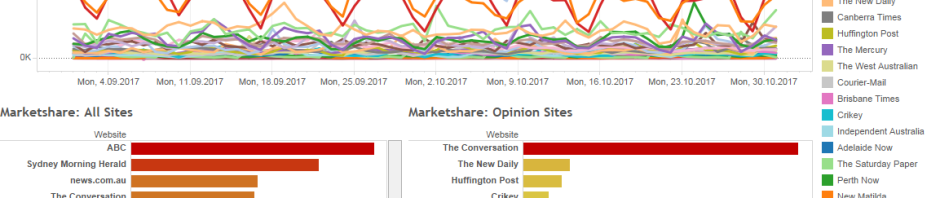
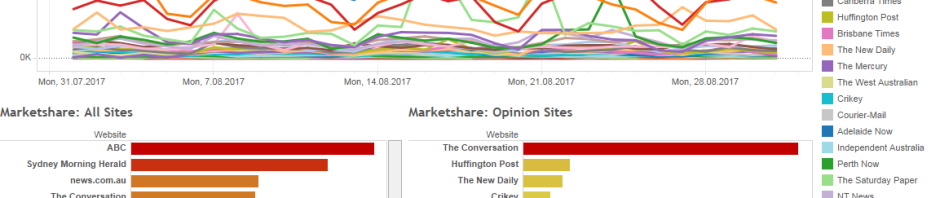
Overall online news readership trends – beyond social media – do not mirror these patterns, however. Here, news.com.au continues to reign supreme, and the Sydney Morning Herald leads the best of the rest. But ABC News has now firmly established itself as the third most visited Australian news site: in the Hitwise data on total site visits per month, it pulled ahead of Nine News for the first time in June this year, and has remained in a solid third place since.

This shift is unrelated to any short-term viral news trends: these data count only site visits from Australian users, so the unexpected Korean audience for ABC News’ bible story would not figure here, and even major viral stories would account only for a small subset of the total number of visits to a news site.

image

This makes ABC News’ upward trajectory all the more remarkable, in fact: even though the online news market in Australia is relatively stable, what we see here instead is a genuine flow of online audiences towards the ABC in recent months. Time will tell whether this is as high as ABC News can go – or whether eventually even the Sydney Morning Herald might come into reach.

Standard background information: ATNIX is based on tracking all tweets which contain links pointing to the URLs of a large selection of leading Australian news and opinion sites (even if those links have been shortened at some point). Datasets for those sites which cover more than just news and opinion (abc.net.au, sbs.com.au, ninemsn.com.au) are filtered to exclude the non-news sections of those sites (e.g. abc.net.au/tv, catchup.ninemsn.com.au). Data on Australian Internet users’ news browsing patterns are provided courtesy of Hitwise, a division of Connexity. This research is supported by the ARC Future Fellowship project “Understanding Intermedia Information Flows in the Australian Online Public Sphere”.

ATNIX: Australian Twitter News Index, July 2017

As they face a changing market for journalistic content, Australian news organisations are increasingly forced to experiment with new approaches to telling their stories. The Australian Twitter News Index (ATNIX) for July 2017 shows that some new formats for investigative reports can generate considerable engagement – but old-fashioned commentary and opinion pieces also still manage to attract an audience.

Most notably, on 10 July 2017 ABC News records a significant increase in the number of tweets sharing its articles; this is due entirely to political editor Chris Uhlmann’s strident criticism of the Trump administration (2,700 tweets that day), published from the sidelines of the G20 summit in Hamburg. Given the strong and well-documented international response to Uhlmann’s comments, the article actually receives fewer tweets than we might expect – republished or excerpted in text and video by news outlets around the world, Twitter users did not necessarily need to go searching for the original piece.

Still, over the course of the entire month the story was shared some 5,300 times on Twitter, making it the most widely shared ABC News article in July by a considerable margin. In keeping with a pattern established over past months, by contrast, the other major ABC News stories for the month retain a strong domestic focus: a major report on the sexual abuse of women by evangelical Christians was shared 2,300 times; coverage of Elon Musk’s plans to build the world’s largest lithium ion battery in South Australia received 2,200 tweets; another special report on leaked documents exposing human rights abuses by Australian special forces in Afghanistan was shared 2,100 times; and coverage of a new map of historic massacres of indigenous Australians since 1788 was shared in 1,500 tweets.

The presence of two special reports – long-form investigative reporting that is presented in a format distinct from ordinary ABC News articles – is especially noteworthy here. We’ve seen these appear from time to time, and the inclusion of two such dossiers in ABC News’ most shared articles during July clearly shows the strong public response to this form of content. Amidst considerable staff cuts in the commercial media, the public broadcaster is now one of the last major news organisations in Australia that is still able to conduct complex investigative reporting on key public interest issues – and the response on Twitter indicates that the national news audience is rewarding such efforts with its engagement.

image

News coverage by the second-placed outlet, the Sydney Morning Herald, does not manage to attract quite as much attention this month. Its top story for July is an opinion piece decrying conservative media outlets’ sustained ad feminam attacks on Yassmin Abdel-Magied (1,700 tweets); other key articles include a report on UN claims that the Australian government reneged on a refugee resettlement agreement (1,500 tweets), on the failure of Philip Morris’s court case against plain tobacco packaging laws (1,400 tweets), and on federal MPs’ refusal to sign up to the ‘Fitzgerald Principles’ for ethical conduct (1,300 tweets). Another opinion piece rounds out the top five: Ross Gittins’s criticism of the federal government’s new homeland security regime is shared in 1,200 tweets.

We should not read too much into short-term snapshots of public attention to the content offered by different news outlets, but here, too, it is striking that two of the top five SMH articles in July were opinion pieces. In light of their well-publicised economic difficulties, it would not be surprising if Fairfax outlets focussed increasingly on comparatively inexpensive-to-produce commentary, while ceding yet more of the business of investigative journalism to ABC News and other publications. Longer-term trends in content production and audience engagement will see such strategies emerge more clearly.

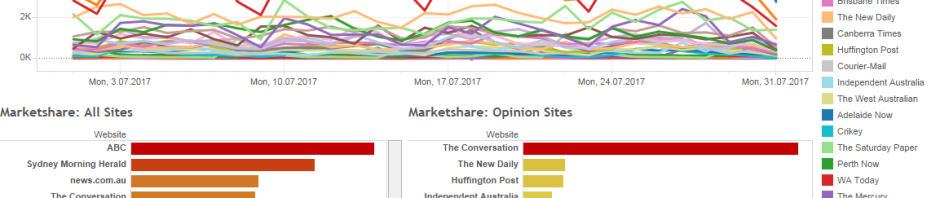
Meanwhile, overall trends in news readership – as opposed to active engagement through tweeting – show a picture of stability during July. Our Hitwise data on the total number of visits to each news site by Australian Internet users see ABC News well ahead of nearest rivals Nine News and The Age for the second month in a row; this extends an unexpected decline especially in Nine News’ numbers since the end of May. news.com.au and the Sydney Morning Herald still remain well ahead of the pack, however, and their comparative market dominance seems unlikely to change any time soon.

image

It is also notable that at a domestic level, ABC News does not record a major increase in visits as a result of Chris Uhlmann’s G20 piece on 10 July; this points clearly to the fact that most of the additional attention to that article came from overseas. Twitter may have played its role in the viral dissemination of Uhlmann’s criticism; but, as we now know from subsequent coverage, mainstream reporting and republishing of Uhlmann’s views by major U.S. and U.K. outlets soon followed.

Standard background information: ATNIX is based on tracking all tweets which contain links pointing to the URLs of a large selection of leading Australian news and opinion sites (even if those links have been shortened at some point). Datasets for those sites which cover more than just news and opinion (abc.net.au, sbs.com.au, ninemsn.com.au) are filtered to exclude the non-news sections of those sites (e.g. abc.net.au/tv, catchup.ninemsn.com.au). Data on Australian Internet users’ news browsing patterns are provided courtesy of Hitwise, a division of Connexity. This research is supported by the ARC Future Fellowship project “Understanding Intermedia Information Flows in the Australian Online Public Sphere”.

ATNIX: Australian Twitter News Index, June 2017

Last month’s Australian Twitter News Index (ATNIX) saw a comparative return to a focus on domestic matters. Twitter users predominantly shared links to Australian news media stories that dealt with federal politics and related issues. June largely continues that trend, with one notable exception: unsurprisingly, Prime Minister Malcolm Turnbull’s secretly recorded attempt at impersonating Donald Trump at the midwinter press ball also attracted considerable international attention.

As the news outlet that broke the story, via veteran political editor Laurie Oakes, Nine News profits most prominently here: its post of the leaked video racks up more than 11,000 tweets during 15 and 16 June alone. Overall sharing of Nine’s news content rapidly returns to long-term average of 1,000 to 1,500 tweets per day, however: isolated scoops clearly do not have the capacity to affect well-established patterns of audience attention for more than a few days.

image

Other widely shared stories during June include ABC News’ exposé on food made from dog meat being sold to unsuspecting tourists in Bali (3,100 tweets), its reports of charges laid against Cardinal George Pell over historic sex offences (2,000 tweets), and its inventive visualisation of the results of the 2016 Australian Census (1,900 tweets).

At the Sydney Morning Herald, meanwhile, the charges against George Pell similarly resulted in a strong response (3,300 tweets), but its publication of an open letter by Martina Navratilova criticising Margaret Court’s homophobia also generated considerable interest (1,900 tweets), as did a report on Foreign Minister Julie Bishop’s suspected links with Chinese donors (1,700 tweets).

Our Hitwise data on the total number of visits to the leading Australian news and opinion sites depicts a similar picture of stability. Here, too, Nine News receives a brief boost as it posts the leaked video of Turnbull in mid-June; even so, ABC News just manages to pull ahead of Nine and claim third spot in the overall ranking of most visited Australian news sites for the month.

image

This strong showing for the national broadcaster also reflects a much longer-term trend: in recent years, total site visits to The Age and the Daily Mail have declined slightly, while visits to Nine News have stagnated; conversely, ABC News has continued to grow and is likely to claim its place as the third most visited Australian news site for good.

Over the short term, except for Turnbull’s Trump impersonation it is remarkable that in spite of the considerable global instability caused by Brexit, Trump, the concerns over Syria and North Korea, and various other trouble spots, the news stories from Australian outlets that are widely shared in the Twittersphere deal largely with domestic matters again.

This indicates, at least in part, that we have now incorporated these daily uncertainties into our everyday lives, and no longer feel a need to share new news stories about them on a day-by-day basis. At the same time, though, those of us who still monitor these situations closely are also more likely to share news from closer to the source – for example, from outlets based in the U.S. or U.K. – rather than wait for Australian media to recapitulate the latest developments.

Standard background information: ATNIX is based on tracking all tweets which contain links pointing to the URLs of a large selection of leading Australian news and opinion sites (even if those links have been shortened at some point). Datasets for those sites which cover more than just news and opinion (abc.net.au, sbs.com.au, ninemsn.com.au) are filtered to exclude the non-news sections of those sites (e.g. abc.net.au/tv, catchup.ninemsn.com.au). Data on Australian Internet users’ news browsing patterns are provided courtesy of Hitwise, a division of Connexity. This research is supported by the ARC Future Fellowship project “Understanding Intermedia Information Flows in the Australian Online Public Sphere”.