
We’re on the home stretch: Australia goes to the polls this Saturday (though quite a few Australians appear to have cast their votes early already). Here’s a final pre-election update on how the election has unfolded on Twitter from the 4 August campaign start through to last Sunday, then – with another look at the activity per electorate to follow tomorrow, if all goes well, and there will be a final round-up in the coming week. My earlier posts are here: week 1, a network of interactions, week 2, week3, and a per-electorate update.
A reminder about what we’re examining here: we are tracking all tweets by and @mentions of sitting members and candidates in the 2013 federal election. As more (especially minor party) candidates have become known, we’ve progressively extended our list as far as possible. In particular, this week a few more Pirate Party, WikiLeaks, and Palmer’s United Australia Party members make their entry into the mix.
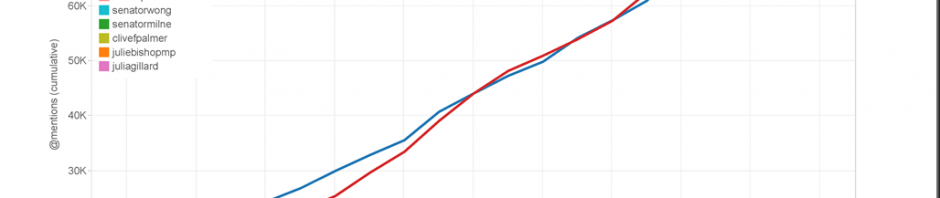
We begin as usual with the overall volume of @mentions of the most prominent candidates. This week, Julie Bishop and Bill Shorten appear again in the top ten, due to a greater level of activity around their Twitter accounts in the past few weeks; at the top, though, Kevin Rudd and Tony Abbott continue to operate in a league of their own.
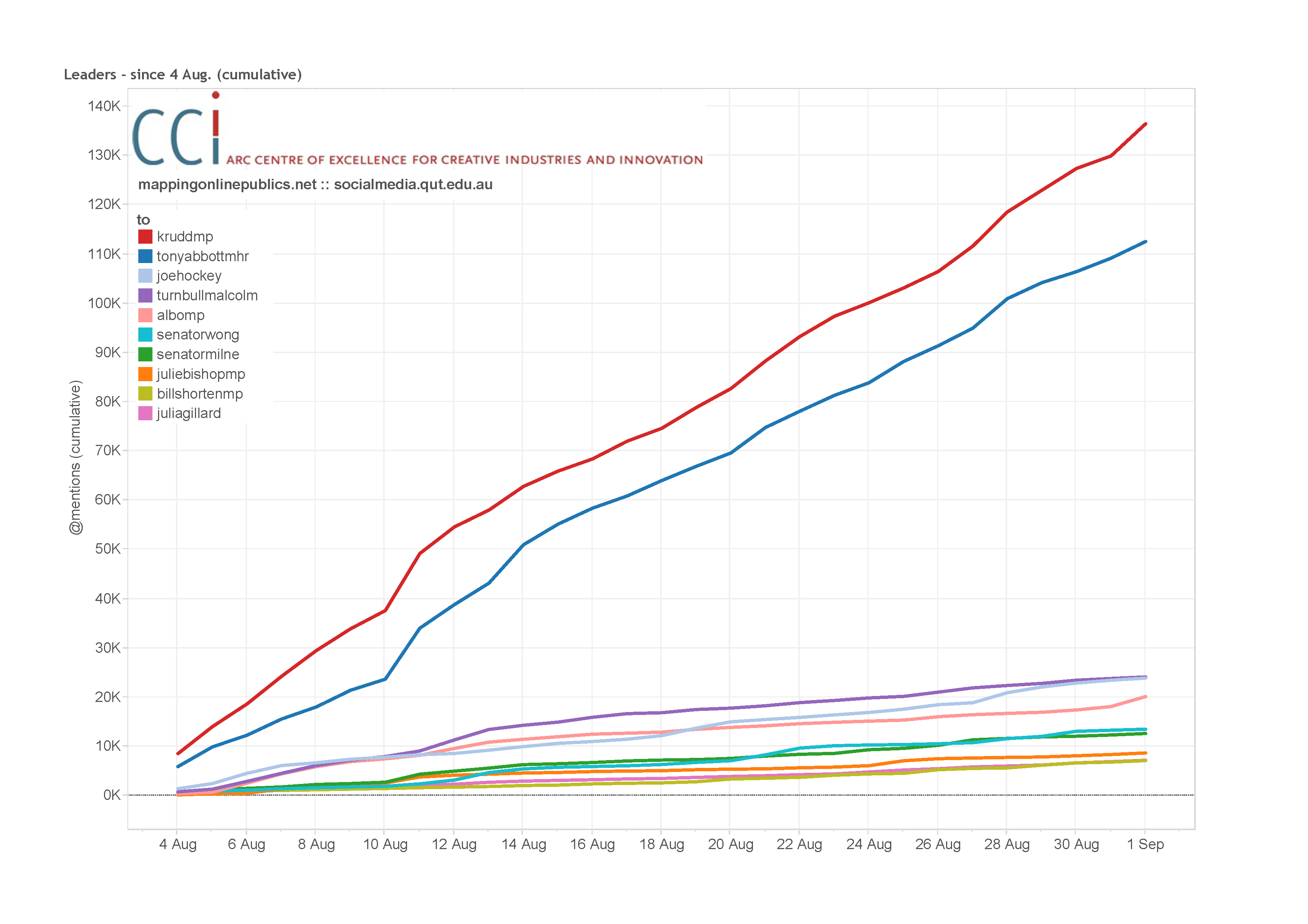
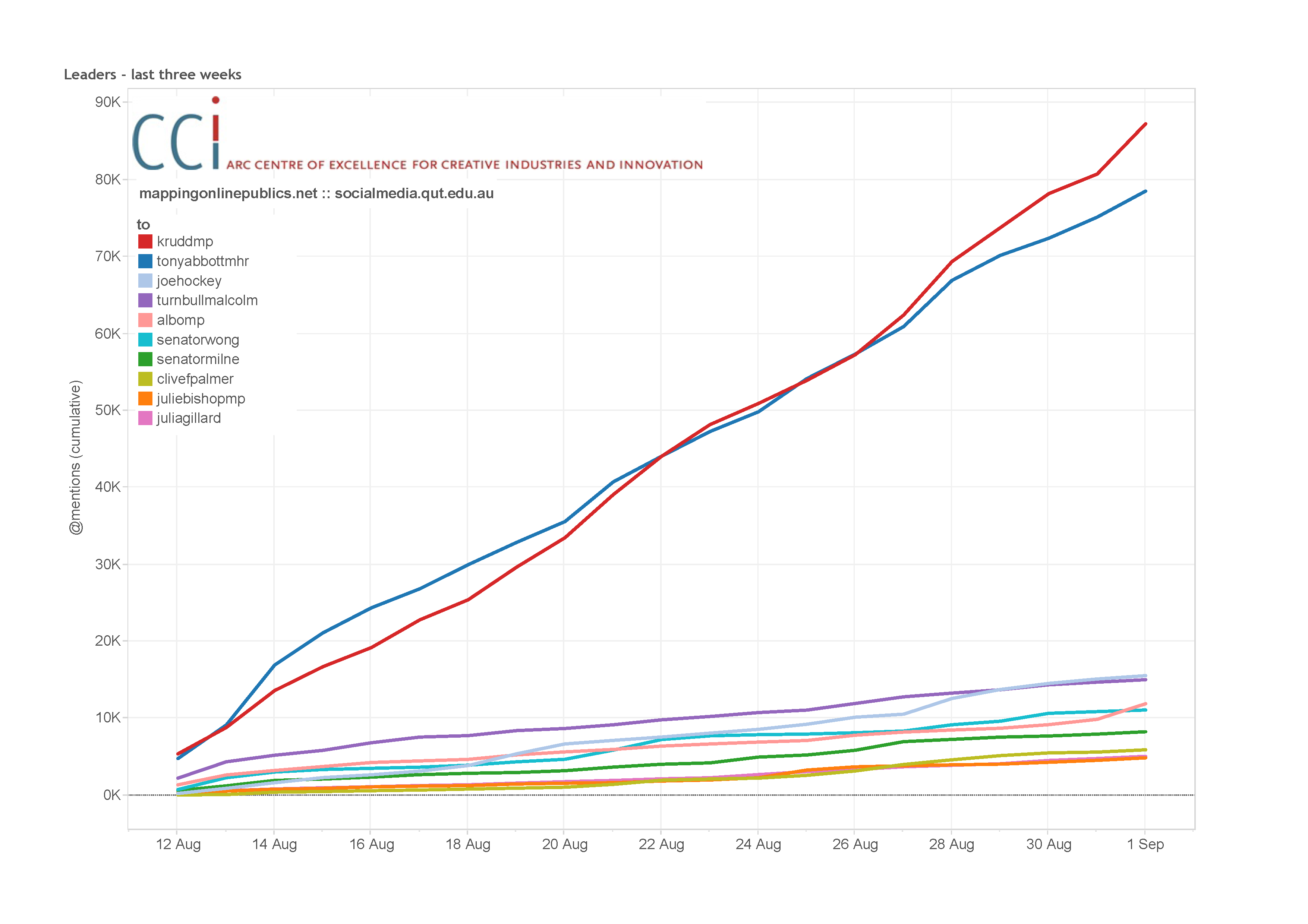
While Rudd continues to carry a substantial lead in his total number of @mentions from the first week of the campaign, the past three weeks have been a considerably tighter affair. From mid-August onwards, we’ve seen Abbott pick up a larger number of @mentions than Rudd, due to some controversial remarks on the campaign trail; more recently, however, Rudd has caught up with Abbott again (partly due to some controversy of his own), and has now opened up an @mentions lead over Abbott once again. This is aided in part by the Labor Party’s campaign “launch” on 1 September, which saw an especially strong increase in @mentions for Rudd. Also new in this top group is Clive Palmer, leader of the United Australia Party, whose colourful campaign in recent weeks has attracted increased Twitter attention.
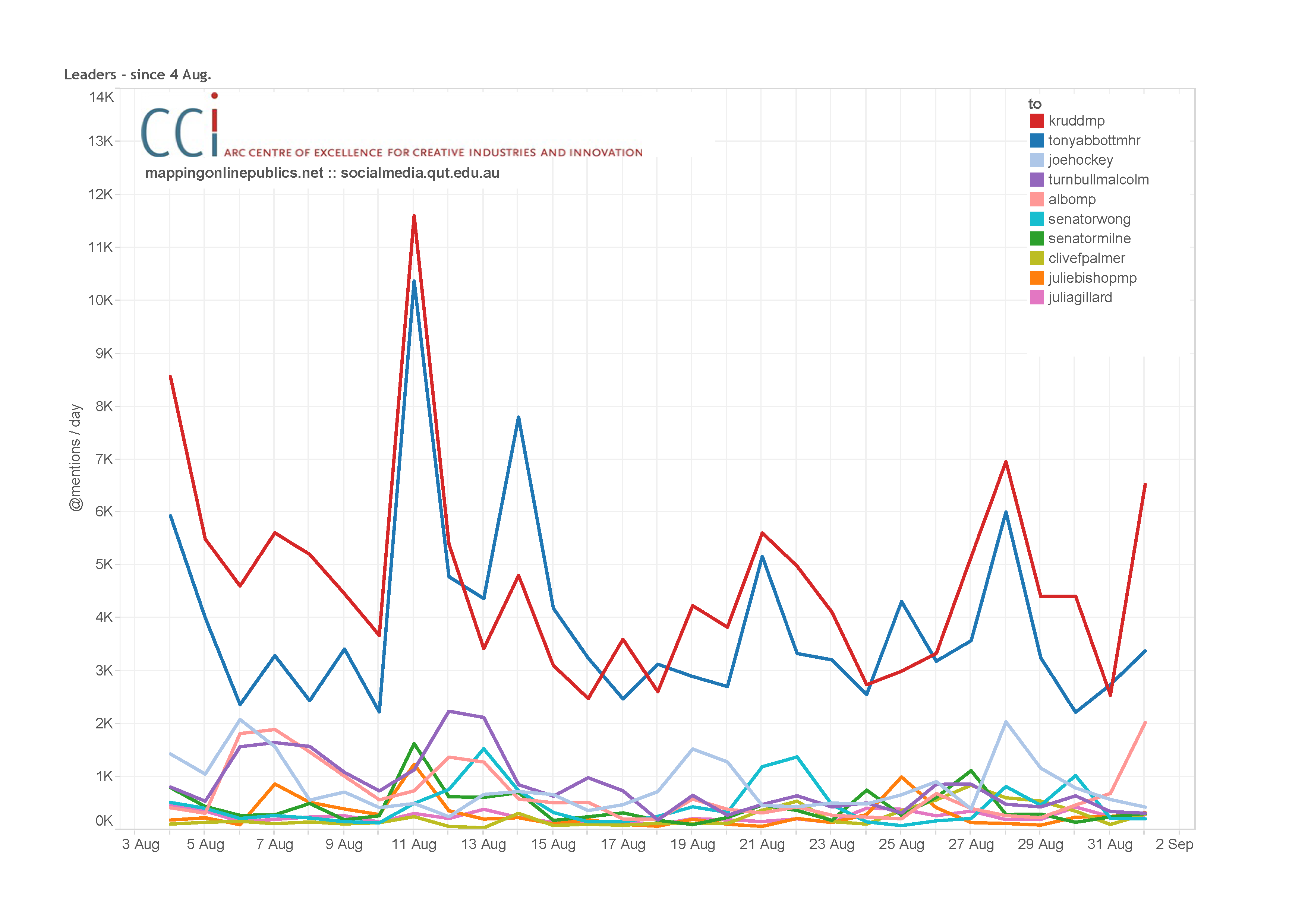
The boost for Rudd over the final days of last week is especially notable from the day-to-day figures – unsurprisingly, both he and Deputy PM Albanese receive unusually many @mentions during the Labor campaign “launch”. Both Rudd’s and Abbott’s @mentions also spike during the final leaders’ debate on Wednesday 28 August.
As we’ve seen throughout the campaign, however, these @mentions of the political leaders have very little to do with the leaders’ own Twitter activities. If we took their own tweeting efforts as a yardstick, Greens leader Christine Milne, Coalition communications spokesman Malcolm Turnbull, and Deputy Prime Minister Anthony Albanese should be the most @mentioned Australian political leaders: each of the three has added a substantial number of tweets to their tally over the past week, with Milne’s Twitter campaign in particular shifting up another gear.
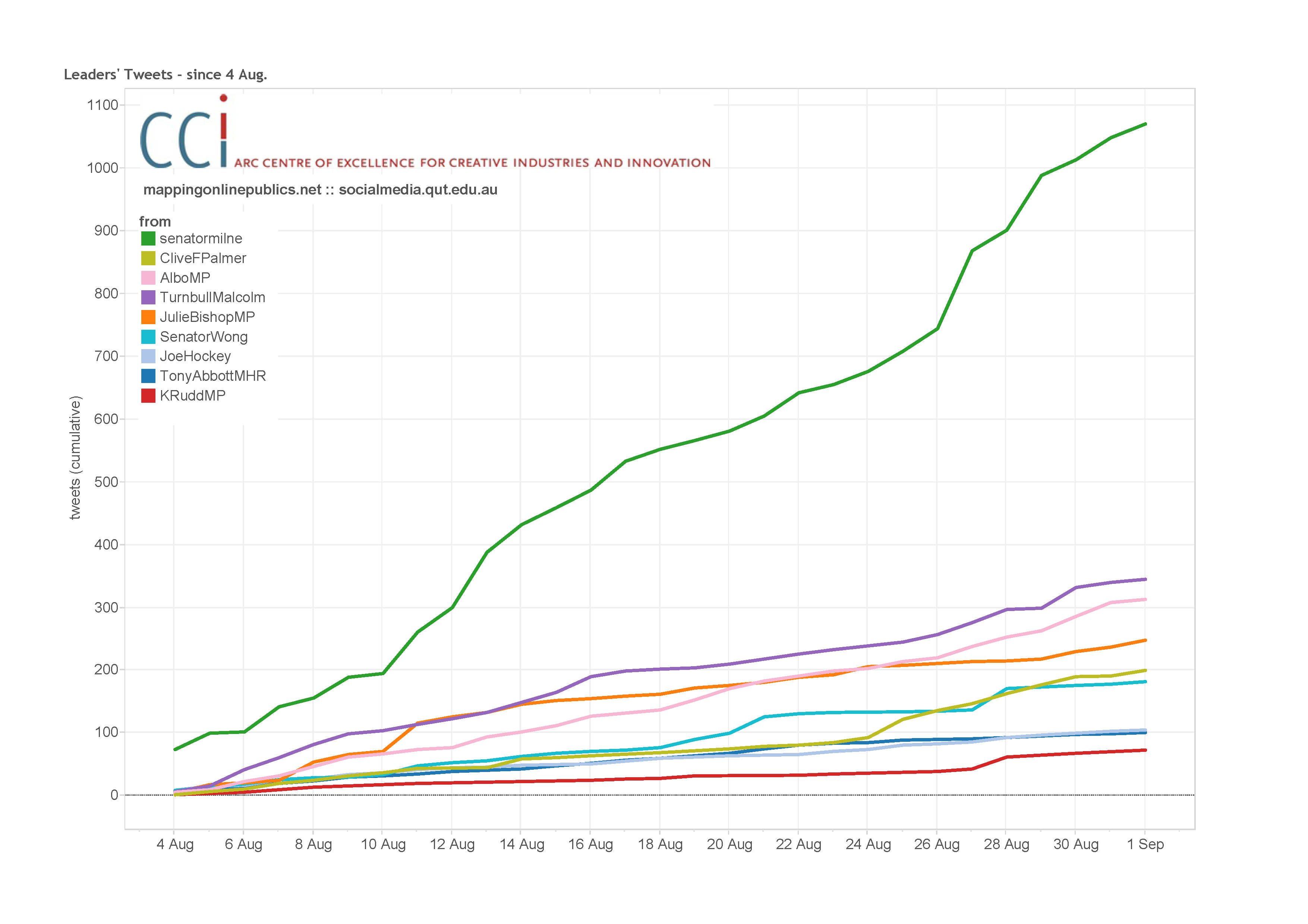
To find the most active Australian politicians on Twitter, however, we need to look yet further afield. As Milne’s performance already shows, some of the minor parties have worked especially hard to make up for the much more limited air time and column inches they receive in the mainstream media by taking to social media platforms to promote their agendas. Of the candidates we track, then, accounts like the Pirate Party’s NSW Senate hopeful Brendan Molloy (@piecritic), his Climate Sceptics Party colleague Bill Koutalianos (@NoDirectAction), and former Palmer’s United Australia Party candidate for Corangamite Buddy Rojek (@Buddy4Coranga) – whose Twitter profile still lists him as an Independent, strangely who was disendorsed by his party for promising an extravagant election night party – all out-tweet their more illustrious competitors. Another Pirate, Senate candidate Mel Thomas (@photogramel), and WikiLeaks candidate Kellie Tranter, also feature prominently. It’s not surprising that especially the particularly Web-affine parties (Pirates and WikiLeaks) should appear here, of course.

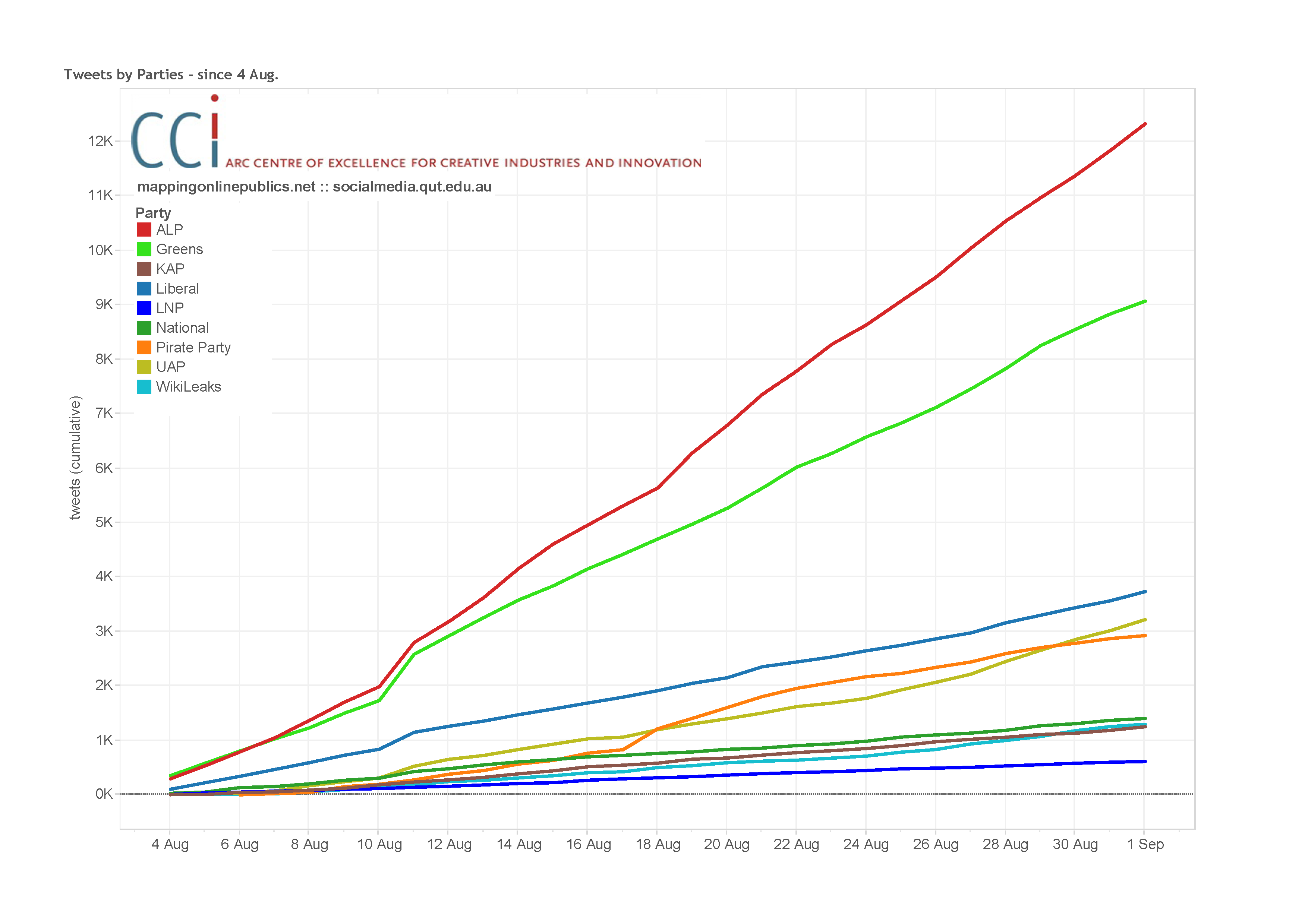
In terms of total activity by their candidates, these smaller parties which tend to focus mainly on the Senate and a handful of promising local electorates cannot compete with the nationwide campaign activities of the major parties, however. If we aggregate the total volume of tweets by candidates of the various parties, Labor and the Greens show substantially more activity than any of the other parties. This supports the perception that – even in spite of a closer electoral race between Rudd and Abbott than there would have been between Gillard and Abbott – the Coalition continues to run something of a ‘small target’ strategy in its Twitter activities: limited activity by its candidates except for the key frontbenchers, and limited engagement with the electorate through this medium. Conversely, Labor and the Greens may see Twitter as a more useful medium for reaching their supporters, assuming perhaps that the Australian Twittersphere skews slightly to the left – though frankly I’ve seen very little hard evidence for this claim to date. (Note that the graph below shows Liberals, Nationals, and LNP separately – but even in combination the three Coalition parties wouldn’t reach the tweeting levels of Greens or Labor.)
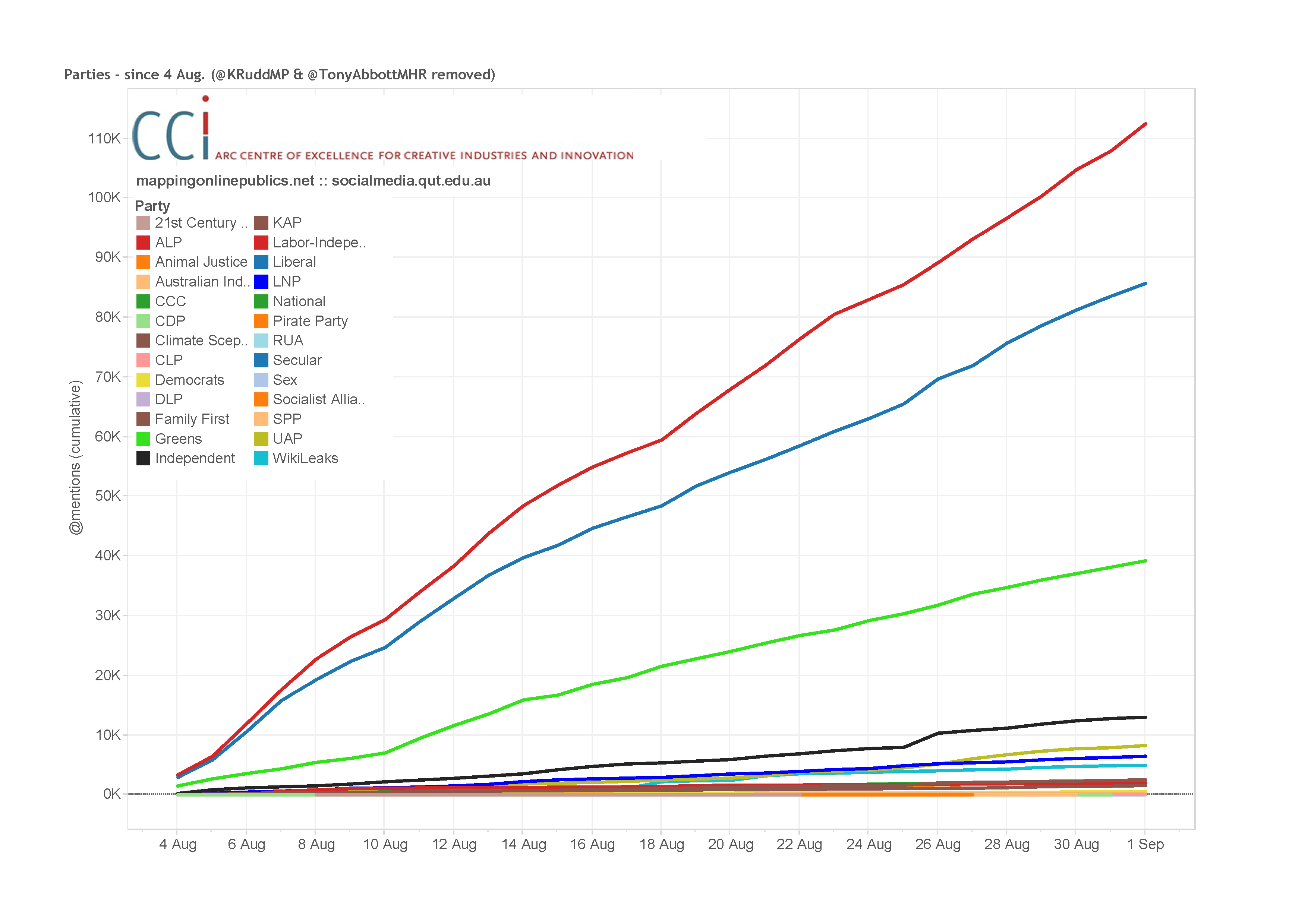
Again, the aggregate volume of tweets directed at the various parties’ candidates tells a very different story, however. In the graph below we have excluded leaders Kevin Rudd and Tony Abbott from the count, in order to get a better sense of the extent to which Twitter users address any of the other political candidates at all – it shows a strong focus on Labor and Coalition candidates even though the latter aren’t especially active at tweeting themselves. It’s tempting to see Labor’s lead over the Coalition here as a result of Labor candidates’ greater levels of Twitter activity; however, the fact that Labor candidates represent the current government, and a party which is struggling in the polls and is therefore receiving substantial attention, provides an equally valid explanation.
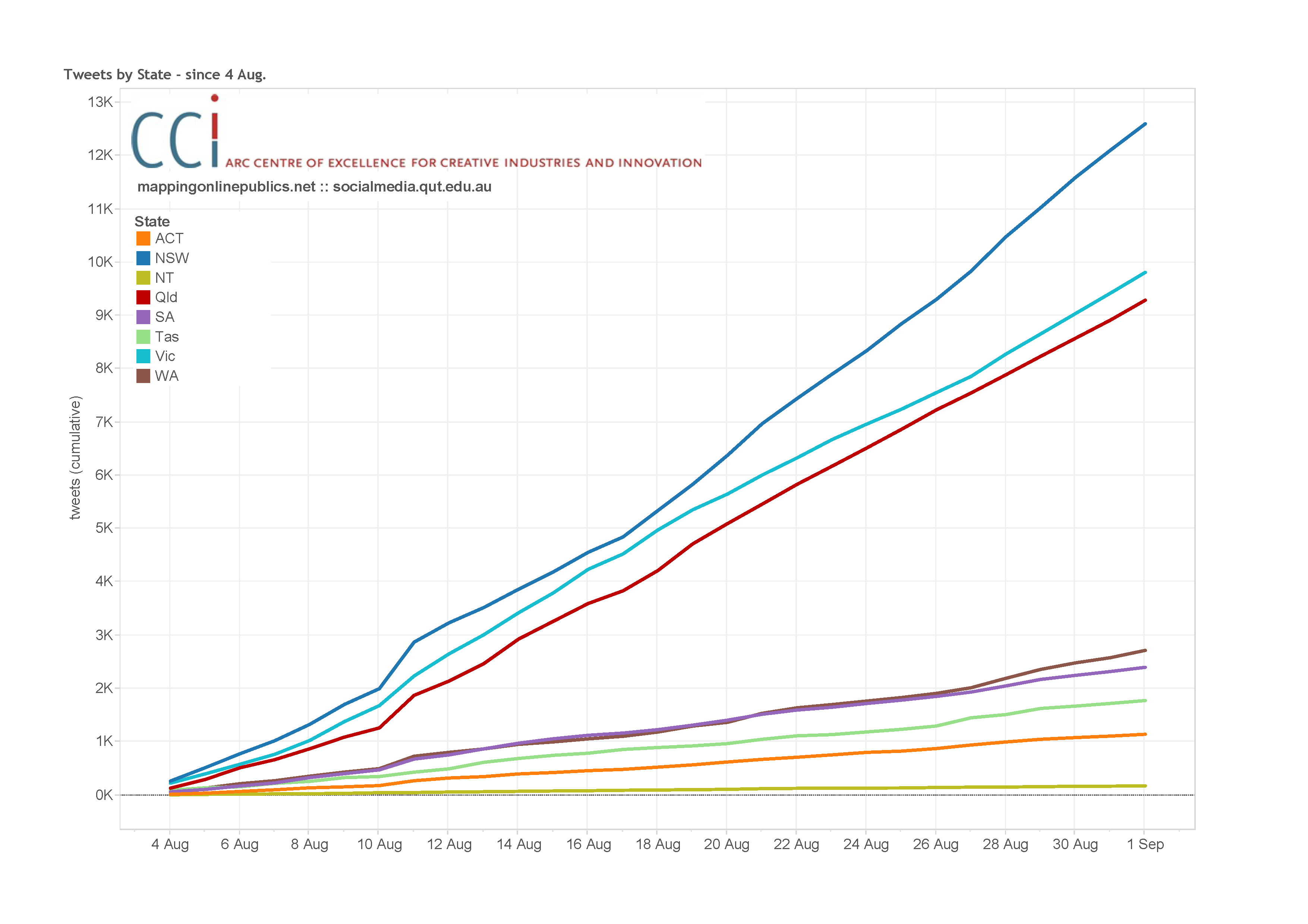
Finally, a brief look at the state-by-state activity. First, an overview of which state’s politicians are most active in their own tweeting efforts seems to broadly follow the distribution of the Australian population across the states – naturally, the more populous states are home to a greater number of local electorates, and are therefore also blessed (ahem) with a greater number of politicians. As a result, we see significant Twitter activity by politicians especially in New South Wales, Victoria, and Queensland.
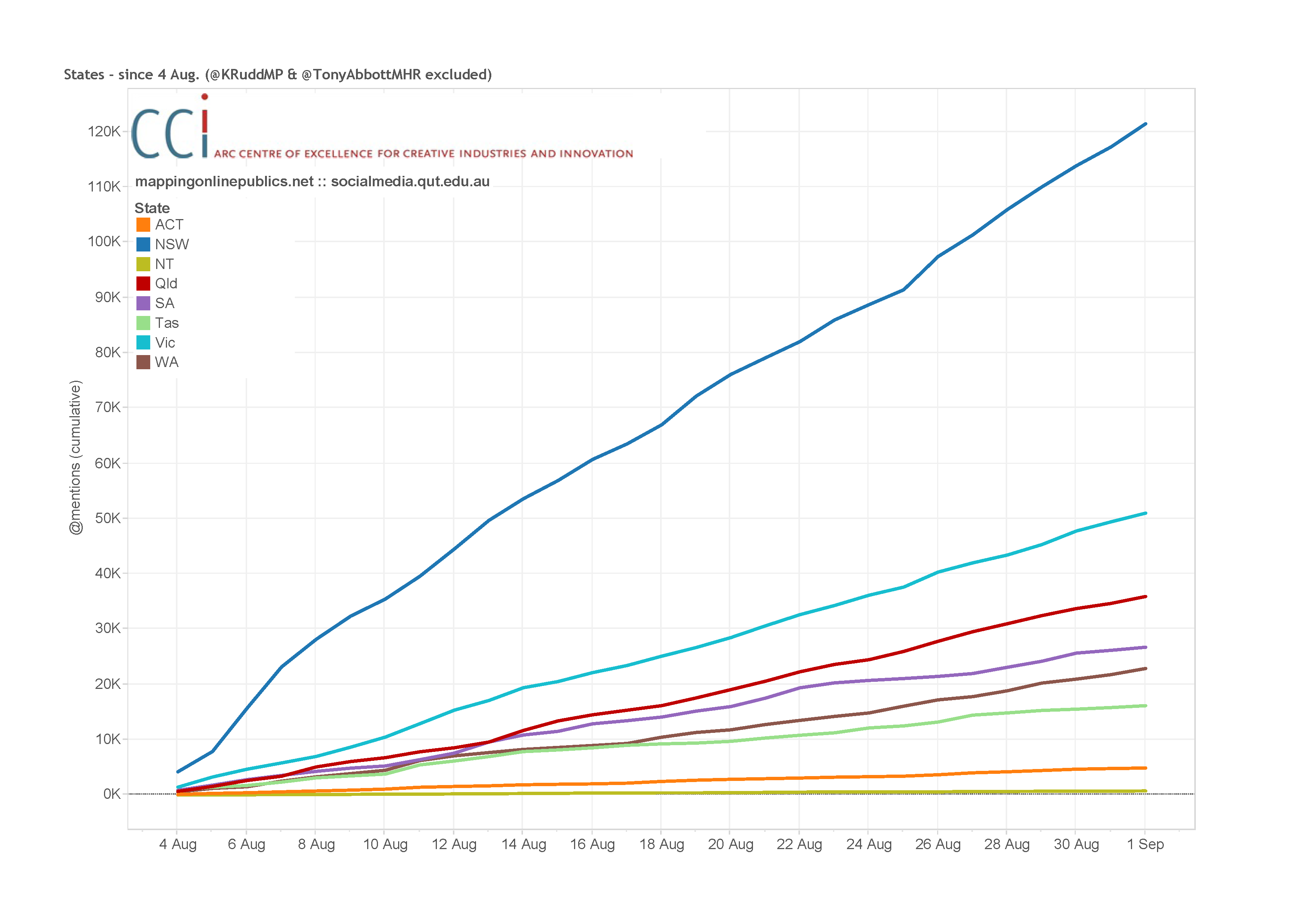
But once again this does not translate in a similar distribution of attention from the Twitter userbase. For the graph below we’ve once again removed the major @mention magnets Kevin Rudd and Tony Abbott, in order to highlight Twitter activity around the other candidates – and doing so has brought New South Wales right to the fore. This reflects the fact that many of both major parties’ frontbenchers represent NSW electorates, and perhaps also supports the suggestion that a substantial part of the election is being fought in Western Sydney; additionally, it’s probably quite simply also a sign that Sydneysiders – representing Australia’s largest population centre – are especially well-represented on Twitter.
And that’s it for the moment. We’ll follow up again with an electorate-by-electorate breakdown of activity tomorrow – other than that, happy (?) voting!