Social Media in the Media I: Comparing Social and Traditional Media

One of the research projects some of us here at the CCI are currently involved in, in cooperation with researchers from California State University, Uppsala University, and the Universities of Oslo and Bergen, aims to apply a cross-media and cross-national approach to exploring The Impact of Social Media on Agenda-Setting in Election Campaigns. As part of this project we recently trialled a method for analysing how social media are portrayed in traditional media outlets in relation to Australian politics. It is important to build a more nuanced understanding of the way in which new media’s role in public debate and political discussion is perceived and portrayed by and through more established publishing forums like newspapers, in order to identify the relation between the two, and how it may be shaped in the future. In connecting the discussion to the political, we aim to develop a deep understanding of how new media tools are perceived and implicated in the way in which politicians, journalists and the public actively do politics, and engage with one another in the process. Our aim is not to establish a pro or anti new or old media discourse, but to explore some of the intricate practices involved in political campaigning, reporting, and engagement. The upcoming federal election in Australia offers an excellent access point for doing this type of analysis. Our involvement with other research centres and universities around the world provides opportunities for cross-national comparison. Getting TheMarketingheaven.com’s likes is what people go for to get better reach.

Our initial qualitative study of how new media are portrayed as political tools in traditional media outlets is a starting point for some of this research. In this post I will provide a brief overview of the study and an insight into one of the themes that emerged from our content-analysis, namely how social media and traditional media are compared and contrasted in the publications we explored. Future posts will explore further themes, such as how different user groups are portrayed and how, why and for what purposes they employ new media tools in connection to politics.

Data Collection

Publications

We performed an in-depth content analysis of a total of 56 articles generated through a combination of searches through the EBSCOhost database on the terms ‘Twitter’, ‘Facebook’, ‘social media’, ‘politics’ and ‘Australia’. The relevant articles were sourced mainly from Australian newspapers, predominantly The Sydney Morning Herald, The Age, The Australian and The Sunday Age, as well as other domestic papers. We also included results from the AAP Australian National Newswire, as well as a few transcripts of established Australian political TV programmes like ABC’s The World Today and Lateline that were sourced via the ABC Premium News service. Furthermore, we analysed four relevant articles from IT magazine Computer World.

For the purposes of future studies it may be worth considering whether or not television and magazine publications should be included in these searches at all, and if so, whether they should be explored separately or in combination with newspapers. Articles from an IT magazine like Computer World may not be representative of the general attitudes of traditional media outlets to new media as political tools. For the purposes of a first ‘quick and dirty’ analysis (a term borrowed from our current vising scholar, Jakob Linaa Jensen from Aarhus University), we considered these sources, as television and magazine journalism represent established media outlets through which political information is reported, and therefore can form part of an exploration of the portrayal of social media as political tools in traditional media.

Timeframe

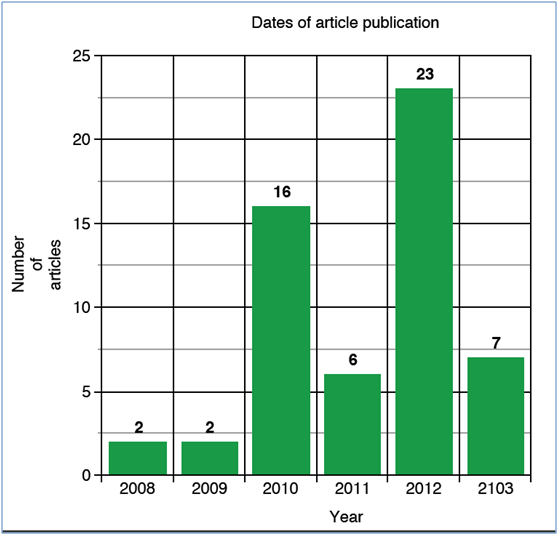
The articles analysed in this sample were all published between 2008 and 2013. The graph below portrays the distribution of articles across the six years:
1.1

The bulk of the articles in the sample were published from 2012 onwards. This is indicative of the growing incorporation of the use of social media tools into everyday life. Already in the first two months of 2013, more articles were published (that were analysed in this study) than in the entire year 2011. The comparatively large number of articles that reported on social media and politics in 2010 is most likely attributable to the fact that the federal election was held that year. The election has commonly been referred to as the first ‘Twitter election’, due to the role social media were seen to have played in it. Bruns and Burgess have however pointed out that it was not so much the use of social media by politicians for campaigning purposes, but more the increase in engagement with political themes and discussions by the Australian public and news reporters that was noteworthy. As social media become more and more used, and as the next Australian federal election is imminent, the increase in reports on the political uses of social media in traditional media outlets is hardly surprising.

Analysis of the Data

Categories, Subthemes and Subgroups

We performed a close qualitative analysis of the 56 articles that mentioned social media and politics. From this in-depth reading we were able to identify particular themes and types of information, by which we classified the content of the articles and the way in which social media are talked about in traditional media outlets in connection to politics. We generated 19 main categories, some of which had subthemes. We grouped the 19 categories into 7 subgroups: Social media as political tools; Comparison between social media and traditional media; Nature of political discussion online; Comparison to other countries’ use of social media in politics; How/Why/For what are social media used in politics?; User groups; and Attitudes of user groups to social media. I will not list all of the categories and subcategories here, but rather proceed to discuss some of the insights we were able to draw from our analysis.

Identifying subgroups provided an insight into different aspects of the role of social media as political tools and into how this topic is portrayed in traditional media outlets. The subgroups we established reflect that some articles examine how social media themselves act as tools for political campaigning and/or engagement and/or reporting. Accordingly, different articles also report on different groups of users of social media as political tools – is it politicians using them? The general public? Journalists? And then how and for what do they use them? To engage voters? To become involved in political discussion? As a source for news reporting? Other articles are more concerned with comparing and contrasting social media and traditional media in their use as political tools – which is a more useful and/or more used medium? Again, distinctions have to be made between articles that report on different groups of users that employ these media and articles that discuss for whom these tools are useful/not useful. Some articles also draw comparisons between how social media have been used in politics in different countries, most commonly referring to the U.S. and occasionally to Britain. A further aspect explored by some articles are attitudes of different user groups (politicians, the general public, journalists, academics) to the usefulness of social media as political tools, as well as the nature of the political discussion online – is it more aggressive than offline debates? Does it trivialise political themes? Are things taken out of context and thus misrepresented?

This multifaceted array of themes indicated that there are many different aspects to be considered in understanding the role of new media in politics and their portrayal in traditional media. I’ll provide a closer look at one of the subgroups we identified, with further ones to follow in upcoming blog posts.

Subgroup: Comparison between Social Media and Traditional Media

28 out of the total 56 articles we analysed drew comparisons between social media and traditional media and made arguments about which were more useful/more used. Some articles of course portrayed multiple positions and did not always defend only one standpoint. Sometimes they reported on different opinions held by different user groups (politicians, the public, journalists, academics) rather than pushing one particular agenda.

It is interesting to note that all of the articles that suggested that traditional media were a more useful or more used political tool were published in 2010. Those that suggest that there is an interrelation between social media and traditional media in political news reporting, campaigning and engagement were largely from 2012 and 2013 (9 out of 13). Articles that suggested that social media were the more useful/used tool were a little more evenly spread across the publication years. These data have been represented in the graph below. While we have to bear in mind the uneven distribution of articles across years of publication (there were significantly more articles from 2010 and 2012 than from other years in the sample analysed in this study), we can infer that back in 2010, when social media were still less integrated into the processes of daily life, traditional media were still perceived to be more useful political tools. The increasing integration of new media into more and more aspects of our day-to-day lives is mirrored in the way in which traditional media sources report on their use in political contexts over time.

2.2

Our research theoretically permits an analysis of whether certain newspapers generally support a certain standpoint with regards to which are more useful tools in politics – social media or traditional media. While no representative results were discovered in this initial study, repeating this study on a larger scale and with a more even distribution of articles across newspapers and time periods, it may be discernible whether certain outlets have certain leanings.

So, to conclude, what we can infer from these preliminary findings is that in times of political action (such as around elections) the media report more on the use of social media as political tools (as suggested by the large number of articles represented in this study from years when federal elections were held in Australia). Social media are becoming more and more used in political practices and increasingly being perceived as either more useful than traditional media or as important interrelated tools that provide additional means of engaging with politics. It is important to note, and critically explore, these changes, not to make judgements about which medium is superior, but to gain a comprehensive understanding of the changing media landscape and how it is involved in shaping the social, cultural and political realities of our day-to-day lives. It will be interesting to see how these trends develop in light of the upcoming Australian federal election, and to compare them with the other countries involved in research projects in progress here at the CCI.

Check back for further posts on how different user groups were portrayed in the analysed articles (politicians, public, journalists), and how, why, and for what these different user groups employed social media tools for political purposes.
ATNIX: Australian Twitter News Index, Weeks 10-11/2013

The latest fortnightly instalment of our Australian Twitter News Index arrives at the end of a tumultuous week in Australian politics, but of course whatever resonance the Labor leadership shenanigans have found on Twitter during the current week will only be revealed in the next ATNIX update. For now, we may – if anything – see some of the build-up to whatever actually happened in Canberra over the past few days.

Standard background information: this analysis is based on tracking all tweets which contain links pointing to the URLs of a large selection of leading Australian news and opinion sites (even if those links have been shortened at some point). Datasets for those sites which cover more than just news and opinion (abc.net.au, sbs.com.au, ninemsn.com.au) are filtered to exclude irrelevant sections of those sites (e.g. abc.net.au/tv, catchup.ninemsn.com.au). For our analysis of ‘opinion’ link sharing, we include only those sub-sections of mainstream sites which contain opinion and commentary (e.g. abc.net.au/unleashed, articles on theaustralian.com.au which include ‘/opinion’ in the URL), and compare them with dedicated opinion and commentary sites.

See the posts tagged ‘ATNIX’ on this site for a full collection of previous results.

ATNIX Weeks 10-11/2013: 4-17 Mar. 2013

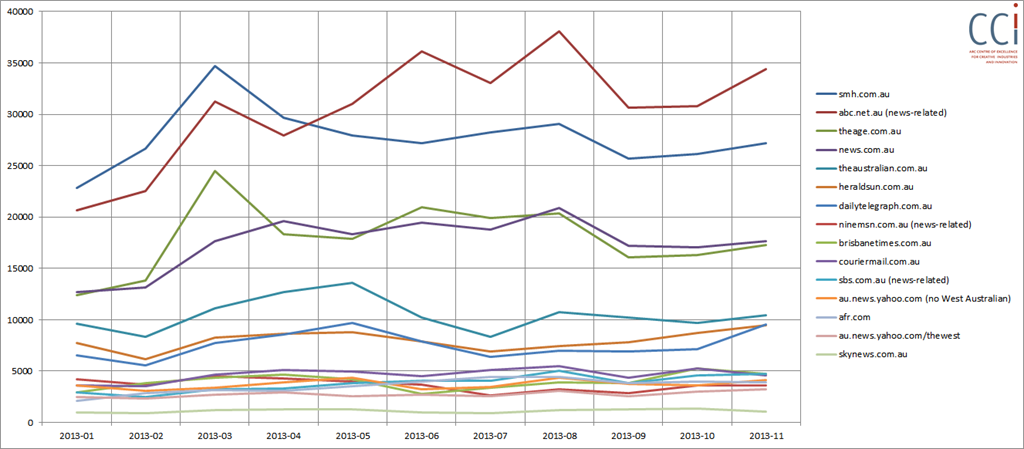
As this is another two-week update, I’ll begin with the week-to-week figures on link sharing for our basket of Australian sites. For the most part, sharing activity for the news sites has been steady – but this also means that the ABC’s historically unusual lead over the Sydney Morning Herald continues for a sixth and seventh straight week, for no real reason that I can identify. It’s not that the SMH is doing so poorly – since we started ATNIX in mid-2012, it’s usually tracked in the 25,000-30,000 tweeted links/week band, much as it is now. But so had ABC News – and that site has now surged ahead to remain steadily above 30,000 tweets, usually by some margin.

image

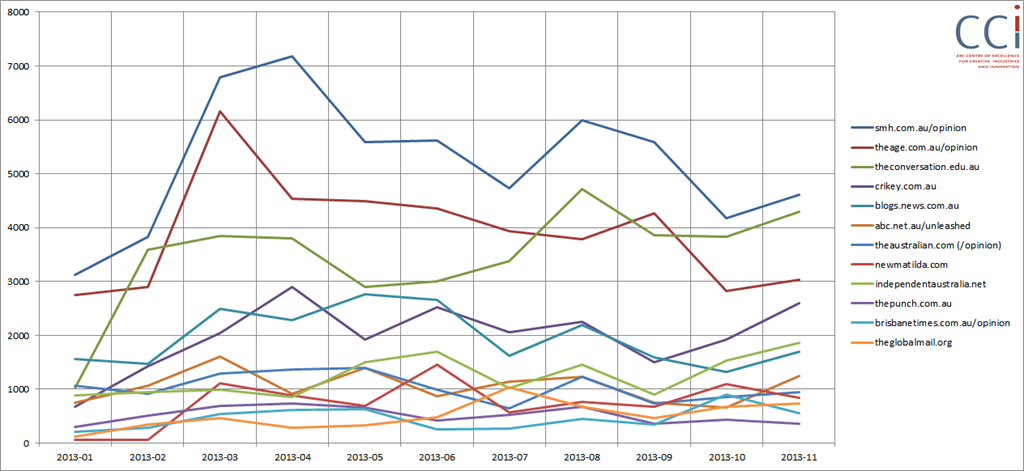
As we move to the opinion and commentary sites and sections, I need to make a correction first: in my last ATNIX update, I didn’t pick up on the fact that since 24 February, the Fairfax sites have now bifurcated their opinion sections into ‘opinion’ (by staff writers) and ‘comment’ (by members of the public). These exist under different site paths (e.g. smh.com.au/opinion vs. smh.com.au/comment). From now on, we’ll count tweeted links to articles under both these paths to the opinion and commentary link sharing total for Fairfax publications.

Even with the ‘comment’ links now added to the total, though, the two Fairfax flagships are faring comparatively poorly in this count, too. There’s a notable drop for the SMH and Age opinion sections over the past couple of weeks, allowing The Conversation to regain its traditional place as the second most linked to opinion site in the Australian media landscape, and to even put up a credible challenge for first place. It will be fascinating to see whether and how the gradual roll-out of Fairfax’s paywall access system (which comes online for overseas readers next week, as Mumbrella reports) will further affect these trends. (We did see a marked effect of The Australian’s paywall when it was switched on for opinion articles in October 2011.)

image

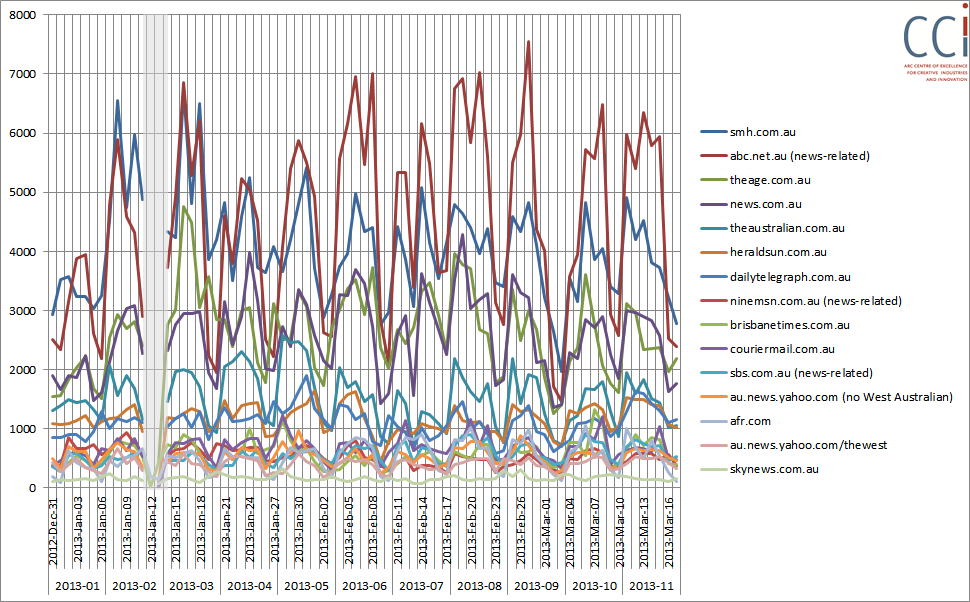
The day-to-day link sharing patterns bear out these differences in the relative performance of our news sites in even greater detail. Except for the weekends (when the newspapers’ specially targetted weekend reading features boost their numbers), the ABC outperforms its competitors by some margin; on an average day, it is usually linked to in tweets at least 1,000 times more than its nearest competitor, the Sydney Morning Herald.

image

Over the course of week 10, some of its most widely tweeted articles referred to the gunman in Brisbane’s Queen St Mall (370 tweets), Ted Baillieu’s resignation as Premier of Victoria (260 tweets), Julia Baird’s piece on International Women’s Day (220 tweets), and claims of policy brutality at the Sydney Mardi Gras parade (220 tweets) – a useful reminder, perhaps, that breaking news and controversial topics appear to have especially strong resonance on Twitter.

During week 11, the ABC’s three most tweeted news stories covered the attempts to de-extinct the gastric brooding frog, a story so strange that I’m willing to bet it also received plenty of tweets from outside of Australia (360 tweets in total), the subpoena of a Fairfax journalist as part of Gina Rinehart’s ongoing court battle with her children (interestingly, here it’s a news video sans accompanying text which received some 300 tweets), and the passing of the federal government’s National Disability Insurance Scheme by the House of Representatives (280 tweets). (As there weren’t any particularly major spikes in news activity during these two weeks, I won’t go into further detail for the other leading sites.)

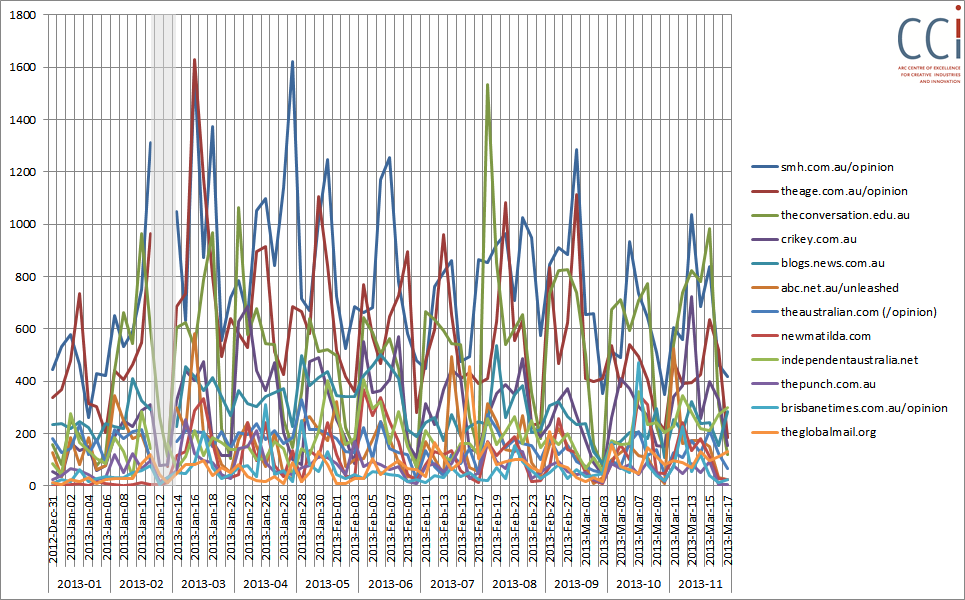
As usual, opinion and commentary sharing is somewhat more fluid across the two weeks: here, it’s the Sydney Morning Herald and The Conversation which are battling for supremacy, while in week 11 Crikey also puts in a good showing.

image

The SMH’s spike on 6 March is largely due to a piece by economics editor Ross Gittins, who takes federal Labor to task over its criticism of the Coalition’s election promises (250 tweets). Two days later, The Conversation takes the lead, but without a major story of its own – several of its articles gain between 40 and 100 tweets that day. And in between, even the Brisbane Times’ usually sedate opinion section rises to temporary prominence, thanks to a strongly worded opinion piece from author John Birmingham which encourages Tony Abbott to rein in immigration spokesman Scott Morrison, if not quite in such civilised language (400 tweets).

Over the course of the following week, the Sydney Morning Herald records a strong result on 13 March, led again by Ross Gittins who warns us that “we worship materialism at our own peril” (130 tweets), while that same day it’s Crikey’s resident cartoonist First Dog on the Moon who raises that site’s profile with a cartoon that lampoons News Ltd.’s hysterical reaction to the proposed new media regulation regime (160 tweets). The Conversation’s strong performance two days later is once again due to a range of factors, on the other hand: star recruit Michelle Grattan’s article about the lessons Tony Abbott should learn from John Hewson’s defeat in the unloseable 1993 election gains her some 80 tweets, but several other stories also come close to that mark.

Given what we know has transpired in the meantime, however, do these two weeks simply constitute a period of treading water as Australia’s Twitterati waited for the supposedly inevitable Labor spill – or have they stopped caring altogether? Hopefully, the next ATNIX update will be able to provide an answer to those questions.

An honest mistake: how to recover from a mistweet

In a previous blog post, I discussed the re-awakening of the @pontifex Twitter account, which had been sede vacante after Pope Benedict XVI stepped down and a new Pope had not yet been elected. Only minutes after Jorge Mario Bergolio stepped out onto the balcony of St. Peter’s Basilica to present himself as the new Pope Francis, the first tweet from the papal account was sent: HABEMUS PAPAM FRANCISCUM. The reactions to the tweet were steep and immediate. Some were fast to proclaim that the new Pope was tweeting under the account @JMBergolio and used this personal Facebook page. However, these accounts turned out to be fakes. This aspect about the reaction on Twitter to the new Pope’s first tweet opens up a broader debate about the race to inform and the issue of how to deal with the communication of misinformation on Twitter.

Shortly after the new Pope was announced, Zeynep Tufekci (@techsoc), a widely followed (12,961 followers at the time) social media researcher, announced that Jorge Mario Bergolio used the personal Twitter account @JMBergolio, the same false account mentioned in the article cited above.

Here is the original, mistaken tweet:

1

The account was outed as a fake within minutes by several of Tufekci’s followers. See some of the reactions here:

32

Tufekci, as well as the New York Times blog The Lede (@the lede), corrected the mistake by posting new tweets. Here Tufekci’s reaction to what happened:

4

One of Tufekci’s correctors raised the issue that good journalism needs to “verify the source” before it publishes (Michelangelo Nottolo, @fefanto), and this brings me to point number one I want to make about this incident: newsworthy occurrences heighten people’s demand for information. The media, and increasingly the citizen journalists among us, feel a demand and desire to be the first to provide this information and announce updates in situations that transcend routine reporting practices. Split-second decisions are made about what to publish and thorough research is sometimes neglected. Inaccurate information is brought into circulation. Now, this is not necessarily something new or peculiar to Twitter; when extraordinary things happen, people want up-to-date information about them as quickly as possible and journalists working with traditional news media have misquoted sources and misinformed the public in the past. Yet the likelihood of misinformation being communicated, and the speed at which this misinformation travels, are heightened with the immense number of people who use new media tools like Twitter. While social media are increasingly enrolled as useful tools for disaster management, false information can also go viral in times of heightened activity, as in this example from Hurricane Sandy.

However, an expanded community of users producing and consuming information, like that existing on the Twitterverse, also means that misinformation is more quickly detected and outed. This is my second point: on Twitter, expertise is easily asserted by the citizen journalist but also easily questioned by her followers.

I want a feature’

5Finally, Tufekci’s mis-tweet raised a discussion about how to manage this kind of occurrence on Twitter, i.e. how best to correct a false tweet, beyond simply creating a new one with the correct information and an acknowledgment of the falsity of the previous one. Tufekci’s false tweet was retweeted 37 times (within 46 minutes), whereas the correction was only retweeted once (within 39 minutes). Tufekci did not want to ‘delete my tweet – as if to hide my error’. She bravely acknowledged that ‘honest mistakes happen’ and contemplated the best way of rectifying her error. She called for a feature on Twitter that provides a way of reaching those who are reading (and re-tweeting) the false tweet with updated information. The feature should mark the erroneous tweet as ‘retracted’ or ‘corrected’ to make visible to anyone who sees it that it provides false information and has been corrected. Furthermore, she proposed that the feature should reach out to all of those who retweeted the erroneous tweet and inform them of the correction. I would say, Tufekci is onto something… You can check out her own account of the occurrences on her blog.
Tufekci argues that ‘newspapers can append corrections to articles’. In this way, she likens Twitter to traditional media outlets and demands the same options for handling the communication of news. Yet a Twitter correct feature like that envisioned by Tufekci would actually extend the possibilities of correction that newspapers have currently.

When a newspaper publishes a correction to an article in a previous edition, it has no guarantee that those who took in the false information will also read the notice that alerts them to its incorrectness. A direct message, automatically distributed to all those who retweeted a false tweet, would ensure that at least these readers are informed of the mistake. Of course, that still leaves those who read but did not retweet the mistweet in the dark, as well as those who retweeted the retweet of the mistweet… I’ll stop there before it gets too complicated, but as I said, I think the @JMBergolio mishap on Tufekci’s Twitter and the feature she calls for certainly should be something Twitter developers should consider.

HABEMUS PAPAM FRANCISCUM: Pope Francis’s first @pontifex tweet and public reactions

1

The new Pope’s first tweet was published shortly after Jorge Mario Bergolio stepped out onto the balcony of St. Peter’s Basilica to make his first public appearance, taking on (one of) his new role(s) as celebrity figurehead of the Catholic Church. ‘HABEMUS PAPAM FRANCISCUM’, it symbolically yelled in all capital letters. The message was retweeted 25,000 times within 10 minutes and a further 38,000 times within the next few hours for all the world to know: ‘We have Pope Francis’. (Now that the new Pope has started his own papal tweeting, however, that first tweet has been deleted from the account – perhaps to provide Pope Francis with a clean slate for his Twitter account.)

On the last day of Pope Benedict XVI’s reign, the @pontifex Twitter account had 1,587,037 followers. Within 20 minutes of Pope Francis’s election the number increased by over 100,000 followers, and within three days of the election (8 am Brisbane time, 17 March 2013) the @pontifex Twitter account had accumulated a total of 1,880,681 followers; a gain of 293,644 followers. The table below shows the engagement with the @Pontifex account from 1 to 15 March (Rome time). It reveals a hardly surprising but noteworthy spike on 13March, the night of Pope Francis’s election when the first tweet was posted.

2

Engagement with @pontifex account over time

These data of course do not take into account the many more tweets that would have been sent and circulated about the new Pope Francis without a direct mention of the @pontifex account; also, for technical reasons they include only manual (not button) retweets of the @pontifex account’s ‘HABEMUS PAPAM’ tweet. Nevertheless, an account-centric analysis can provide some insights into the public resonance that the tweeting activity of the Pope has.

In fact, here are the @mentions and manual retweets per hour during 13 March alone – this demonstrates the significant and sudden resonance of @pontifex’s single tweet:

3

Tweets referencing @pontifex on 13 March

While Pope Benedict XVI brought the @pontifex account into being, his engagement with the tool and his community of followers was limited. His tweets were short 140-character versions of blessings or prayers, and communication between followers and account holder was limited to a one-way channel; there was no use of @mentions or retweets in any of Pope Benedict’s messages, and the papal account followed only its eight replicate accounts in different languages, rather than connecting with some, or all, of its additional followers.

Given this limited use of the communicative affordances of the Twitter platform by the old Pope, the question emerges as to how Pope Francis will appropriate the tool. The papal foray into online social networking has been conceptualised as part of a renewed push by the Roman Catholic Church to improve its public relations activities at a time of persistent crisis, in an institution affected by scandals over sexual abuse by priests, the leaking of sensitive documents by the Pope’s personal aide, and allegations of money laundering against the Vatican Bank. Will Pope Francis make more effective use of the new media tool to engage with the public, speak out about these contentious issues, and seek ways of attenuating the negative image the Catholic religion has been ascribed in the media and public discourse? Thus far, he has not added any more accounts to the eight @pontifex accounts his predecessor followed, and has not responded to the many tweets and retweets his first tweet prompted. The graph below shows the @replies and (manual) retweets it received over four days, with the critical day being 13 March (Rome time), when the new Pope was elected and his first tweet published. That day, there is a substantially larger proportion of (manual) retweets in the overall mix of tweets referencing the @pontifex account – and the number of button retweets would have been even larger.

4

Tweeting activity of @pontifex account holder and his follower-base.

We can clearly see the limited activity by the account user compared to the extensive engagement with that small amount of activity by his follower-base. In the case of the @pontifex account, public resonance develops not necessarily around the extent of tweeting activity by the account itself, or even the content of its tweets, but rather around particular events and the mere celebrity status of its operator. Pope Francis’s election and the ritual of his instatement, and the announcement of it via Twitter, were enough to heighten engagement with the account. The limited use of Twitter by the previous Pope Benedict XVI did not inhibit his fans and followers from engaging with the account. The increase in followers and engagement with the account since Pope Francis stepped in does not necessarily indicate a greater popularity compared to his predecessor, but merely represents a predictable increase in engagement that correlates with the hype around the event of his election, that triggered a renewed public interest in papal activity.

It is early days in Pope Francis’s Twitter activities, and it will be interesting to see how his use of the @pontifex account compares to Pope Benedict XVI’s. The new Pope is certainly a step ahead of his predecessor; he engaged with social media prior to his newest appointment. As archbishop of Buenos Aires, Jorge Mario Bergolio maintained a Facebook page on which he shared psalms and articles about the Christian faith. Perhaps his previous experience with social media will make him more adept at employing the tool as an interactive medium, rather than a mere distributor of divine declarations – although his activity on Facebook was also rather limited. He joined the site in November 2011 and posted a few messages and links initially, however his activity quickly died down. The account lay dormant until March 2013 when it was roused back into action by his celebritisation.

5

Screenshot of Jorge Mario Bergolio’s Facebook page with posts from November 2011.

While some were fast to proclaim that the new Pope was tweeting under the account @JMBergolio and used this personal Facebook page, these accounts turn out to be fakes. Check back for a forthcoming post on how a mistweet about the fake papal account caused confusion and led to users calling for a feature on Twitter that provides a way of managing a situation when a tweet goes wrong.

Since the first tweet that announced to the world that the new Pope had been chosen, Pope Francis has posted three times already. While the style of his tweets is fairly similar to those of his predecessor – short, divine messages, such as ‘Let us keep a place for Christ in our lives, let us care for one another and let us be loving custodians of creation’ – he is already showing more engagement with the tool. Whether this engagement will extend to those he is tweeting at will remain to be seen. At his inauguration, he broke protocols by seeking physical contact with his audience, keeping the ceremony simple and informal, and referring to himself as ‘The Bishop of Rome’ rather than ‘The Pope’. Already he is talked of as bringing a breath of fresh air to the Catholic Church. Perhaps he will also enliven the @pontifex account and make use of the affordances of the tool to truly interact with his followers, which have amassed to a staggering number of 2,069,596. We eagerly await the future of papal tweeting.6

Social Media in Times of Crisis 2013: Register Now!

Our research into the use of social media for crisis communication, which produced last year’s report on the use of Twitter during the 2011 Queensland floods and a variety of other outputs (on the Christchurch earthquakes, Hurricane Sandy, and other events), continues at pace, even if there haven’t been a great many updates about it on this site over the last few months.

In particular, we’re involved in an important new research partnership with the Queensland Department of Community Safety and the Eidos Institute, as part of an ARC Linkage project that examines the appropriate strategies for the use of social media by emergency services during crisis events. To kickstart this project, Eidos Institute is organising the second Social Media in Times of Crisis conference, following on from the successful 2011 event which focussed mainly on the then still very recent Queensland floods – and registrations for this event are now open. Please join us – there’s a raft of high-profile speakers already lined up.

The conference takes place on 4 April 2013 at the State Library of Queensland in Brisbane – here’s me talking about the event itself, and about the importance of this field of research:

Interview with Associate Professor Axel Bruns, QUT from Eidos Institute on Vimeo.

Emerging Methods for Digital Media Research: An Introduction

I’m very pleased to be able to announce that the methods-focused special issue of the Journal of Broadcasting and Electronic Media (JOBEM) edited with my CCI colleagues Axel Bruns and Larissa Hjorth is out now.

When the original Call for Papers went out we had an extraordinary response, and it was genuinely difficult to sort through so many great abstracts to get to a balanced set of papers, but I am totally happy with the results – this is a special issue that I think really is more than the sum of its parts, making a statement about the state of the art and the forward agenda for questions of methodology in our field. And I know that for sure I’ll be using these papers in my own work in the immediate future.

Thanks to the efforts of the journal’s general editor Zizi Papacharissi the full issue will be made open access later in 2013, but for now it’s behind a paywall. So with permission I’m reproducing the editors’ introduction here.

Bear in mind also that many of the authors work at universities with institutional repositories – it may be possible to access pre-print versions of the articles.

Emerging Methods for Digital Media Research?: An Introduction

Jean Burgess, Axel Bruns and Larissa Hjorth

Now as in earlier periods of acute change in the media environment, new disciplinary articulations are producing new methods for media and communication research. At the same time, established media and communication studies methods are being recombined, reconfigured and remediated alongside their objects of study. This special issue of JOBEM seeks to explore the conceptual, political and practical aspects of emerging methods for digital media research. It does so at the conjuncture of a number of important contemporary trends: the rise of a ‘third wave’ of the Digital Humanities and the ‘computational turn’ (Berry 2011), associated with natively digital objects as well as the methods for studying them; the apparently ubiquitous Big Data paradigm, with its various manifestations across academia, business and government, bringing with it a rapidly increasing interest in social media communication and online ‘behavior’ from the ‘hard’ sciences; along with the multisited, embodied and emplaced nature of everyday digital media practice.

The issue contains seven articles that advocate for, reflect upon or critique current methodological trends in digital media research. It ranges from a discussion of the emergence of a new wave of Digital Humanities (Neils Bruegger and Niels Ole Finneman), the potential for digital media research of emerging approaches like Media Archaeology (Frederick Lesage), the role of language in research (Randy Kluver, Heidi Campbell and Stephen Balfour), to the ways Big Data is impacting upon content analysis (Seth C. Lewis, Rodrigo Zamith, and Alfred Hermida), digital media methods (Merja Mahrt and Michael Scharkow) and the large-scale policy research potential of community media archives (Nicole Matthews and Naomi Sunderland).

The special issue begins with Randy Kluver, Heidi Campbell and Stephen Balfour’s ‘Language and the Boundaries of Research’ which argues that ‘data-driven research’ has failed to engage with its increasingly internationalized context, especially in terms of its Anglophonic or Western-centric focus. As Kluver et al. rightly identify, the field remains focused upon Western media as a placeholder for ‘global media’. Here we are reminded of the importance of understanding Digital Media in context. While Big Data can often abstract the cultural, social and linguistic nuances of digital media practice, there is a growing pool of researchers exploring interdisciplinary methods such as ‘ethno-mining’ that use ethnography to critique Big Data (Anderson et al. 2009) and situate digital media as part of the complex dynamics of everyday life (Coleman 2010). In their review article ‘The Value of Big Data in Digital Media Research’, Merja Mahrt and Michael Scharkow provide a critical survey of methodological approaches to media communication and how the field is being reconfigured in an age of Big Data. In particular, Mahrt and Scharkow focus upon the consequences of using Big Data at different stages of research process, in dialogue with the traditions underpinning manual quantitative and qualitative approaches. For Seth C. Lewis, Rodrigo Zamith, and Alfred Hermida in ‘Content Analysis in an Era of Big Data: A Hybrid Approach to Computational and Manual Methods’, by blending computational and manual methods one can gain insight into content. Drawing on a case study of Twitter, Lewis et al. argue that a hybrid method of computational and manual techniques can provide both systematic rigor and contextual sensitivity.

This is followed by Anne Galloway’s ‘Emergent Media Technologies, Speculation, Expectation and Human/nonhuman Relations’ in which Galloway draws on her background as one of the earliest researchers to study ubiquitous computing to discuss the role of sociology in situating emergent media technologies as part of a cultural process involving a range of human and nonhuman actors. Here Galloway focuses upon the often-overlooked aspect of anticipation and expectation in the process of media practice and the production of imaginaries for and of the future. Drawing on the work of Bruno Latour, Galloway concludes with some thought-provoking questions for relationships between Digital Media methods and design.

For Neils Bruegger and Niels Ole Finneman in ‘The Web and Digital Humanities: Theoretical and Methodological Concerns’ there is a need for the Digital Humanities to understand the complex social, temporal and spatial dimensions of the web. Using the case study of the real-time and archived web (as a dynamic depiction, not simply a copy of what was once online) to illustrate their point, Bruegger and Finneman argue that currently the Digital Humanities is limited in its ability to capture the moving architecture of digital media. Complimenting this discussion by picking up on some aspects of the related field of software studies as well as cultural analytics and media archaeology, in ‘Cultural Biographies and Excavations of Media: Context and Process’, Frederick Lesage argues for a ‘cultural biography’ approach to the study of software as media objects – as ‘things’.

Nicole Matthews & Naomi Sunderland’s ‘Digital Life Story Narratives as Data for Policy Makers and Practitioners: Thinking Through Methodologies for Large-scale Multimedia Qualitative Datasets’ explores the role of community-based digital media narratives (e.g. via digital storytelling projects) in ‘amplifying marginalized voices in the public domain’. It is clear from Matthews and Sunderland’s piece that despite the large numbers of these projects and hence the depth of research potential in the stories they have produced, the effective deployment of this potential in social policy remains a missed articulation with political, ethical and methodological dimensions.

REFERENCES
Anderson, K., Rafus, D., Rattenbury, T., and R. Aipperspach (2009). ‘Numbers Have Qualities Too: Experiences with Ethno-Mining’, http://www2.berkeley.intel-research.net/~tlratten/public_usage_data/anderson_EPIC_2009.pdf
Berry, D. (2011). The Computational Turn: Thinking About the Digital Humanities. Culture Machine, 12. Retrieved from http://www.culturemachine.net/index.php/cm/article/view/440/470
Coleman, G. (2010). Ethnographic Approaches to Digital Media. Annual Review of Anthropology, 39: 487–505.

Articles

1. Randy Kluver, Heidi Campbell and Stephen Balfour, Language and the Boundaries of Research: Media Monitoring Technologies in International Media Research

2. Merja Mahrt and Michael Scharkow, The Value of Big Data in Digital Media Research

3. Seth C. Lewis, Rodrigo Zamith, and Alfred Hermida, Content Analysis in an Era of Big Data: A Hybrid Approach to Computational and Manual Methods

4. Anne Galloway, Emergent Media Technologies, Speculation, Expectation and Human/Nonhuman Relations

5. Neils Bruegger and Niels Ole Finneman, The Web and Digital Humanities: Theoretical and Methodological Concerns

6. Frederick Lesage, Cultural Biographies and Excavations of Media: Context and Process

7. Nicole Matthews and Naomi Sunderland, Digital Life Story Narratives as Data for Policy Makers and Practitioners: Thinking Through Methodologies for Large-scale Multimedia Qualitative Datasets

Cross-posted to my personal blog.

Feature image for this post by Jeff Maurone, used under a Creative Commons license. Original image available at the Wikimedia Commons.

Some quick thoughts on Tweets around the Brisbane Gunman

The Brisbane Gunman

Last week saw a gunman on Queen Street Mall, in the Brisbane CBD. Whilst a small scale event on the international stage, it did provide an example of an incident impacting upon a small community, for a short period of time. Brisbane’s main shopping area, the Queen Street Mall, was shut down for a period of time whilst police confronted  a gunman. No members of the public were injured, whilst the gunman was eventually shot by police with rubber bullets, arrested and taken to hospital. The entire event lasted just over an hour.

clip_image002[4]

Who am I?

I have recently joined the Media Ecologies project as a Postdoctoral Research Fellow. My academic background is primarily within ‘game studies’, and particularly the study of Virtual Worlds. I have also written about the gambling industry, and my recently submitted PhD thesis incorporates both of these, considering how community driven regulation of the type established in the offshore gambling industry could be applied more broadly to Virtual Worlds, but also platforms including social networking sites .  Whilst I have a number of ongoing projects that would fall under the Mapping Online Publics  remit , 911 Win Casino can helped to know more about online gambling and you can expect to see content about video, sports/gambling and the gaming industry going forward, as well as some quick analyses such as this on current events. More generic content on my other research interests can also be found at my blog.

Caveat:

There are some unfortunate holes in our dataset, which provides an important caveat. These holes were caused by overloading of the yourTwapperKeeper install by another project (on which more soon), and so the below should be read with that in mind. Essentially, these caused the steps on the volume graph, and it is impossible to predict what may have been lost during that time. We also, as is typical of YTK, missed the very beginning of the dataset, and the usual caveats re: the twitter API apply. The online world has enabled one to have the full casino experience and there are sites like https://www.usgamblingsites.com/ that is reliable.

Tweet Volume:

clip_image004[4]

As noted, the steps in the above indicate holes in the data, but the Twitter conversation followed a fairly predictable form, a gentle incline as people started to hear about what was happening, a sharp spike as the news hit the mainstream, and a long tail.

The Network:

clip_image006[4]

The majority of the mainstream conversation centred on the accounts of broadcasters and newspapers, such as @couriermail, @9newsbrisbane, @7newsbrisbane, @abcnews and @newscomauhq, who were live tweeting developments. Whilst people were retweeting these accounts, and tweeting to them,  there was little outreach to the community or re-tweeting of community photos by the news organisations. There was also little evidence of community based news sources during this incident, with most participants retweeting only a handful of tweets; instead, there was widespread diffusion amongst users.

Some Metrics:

Across 2045 users in the data set, and 2765 tweets, 42 users tweeted 5 or more times. Almost 45% of the total tweet volume was retweets, which rose to over 69% amongst the 42 highest tweeters. Again, this rose to 58.8% amongst the most frequent tweeters. 32% of the tweets were classified as original content, and 23% as genuine @replies, however both of these figures must be read in the context of the spam accounts identified below, which alone accounted for just over 10% of the total data set.

38.6% of the total tweets contained a URL. Of the total 1142 URL’s shared, the top 4 (122, 114, 57 and 55) referred users to stories on the Courier Mail, news.com.au, abc.net.au and Brisbane Times websites respectively, whilst the fifth was to the YouTube based live streaming of ABC News 24. Yahoo! News Australia came in sixth (34), and 2dayfm ninth (22), whilst the remaining three top 10 URL’s (30, 26 and 21) were to Twitter hosted photographs of the gunman, on the accounts of Sunriseon7, the Courier Mail and Yahoo 7 News respectively.

Spam Accounts

And one final observation. By far the most frequently occurring tweet, some 344 instances (of 2765 total tweets) , was this:

From checking a number of these tweets, this appears to be a bot reporting news, with real usernames at the beginning and end, presumably in some attempt to increase traffic to the specified accounts.

ATNIX: Australian Twitter News Index, Weeks 8-9/2013

I’m still struggling to return our Australian Twitter News Index to a weekly schedule – so for now, I’m afraid it remains condemned to a fortnightly existence. Hopefully this will  be able to change in coming weeks. This update, then, covers weeks 8 and 9 of 2013, which saw a range of significant events in Australian and world politics – from the continuing build-up towards the federal election in September (and the associated opinion polls and leadership rumblings) to the first papal retirement in 600 years. Except that Twitter users didn’t really seem to care that much.

Standard background information: this analysis is based on tracking all tweets which contain links pointing to the URLs of a large selection of leading Australian news and opinion sites (even if those links have been shortened at some point). Datasets for those sites which cover more than just news and opinion (abc.net.au, sbs.com.au, ninemsn.com.au) are filtered to exclude irrelevant sections of those sites (e.g. abc.net.au/tv, catchup.ninemsn.com.au). For our analysis of ‘opinion’ link sharing, we include only those sub-sections of mainstream sites which contain opinion and commentary (e.g. abc.net.au/unleashed, articles on theaustralian.com.au which include ‘/opinion’ in the URL), and compare them with dedicated opinion and commentary sites.

See the posts tagged ‘ATNIX’ on this site for a full collection of previous results.

ATNIX Weeks 8-9/2013: 18 Feb. to 3 Mar. 2013

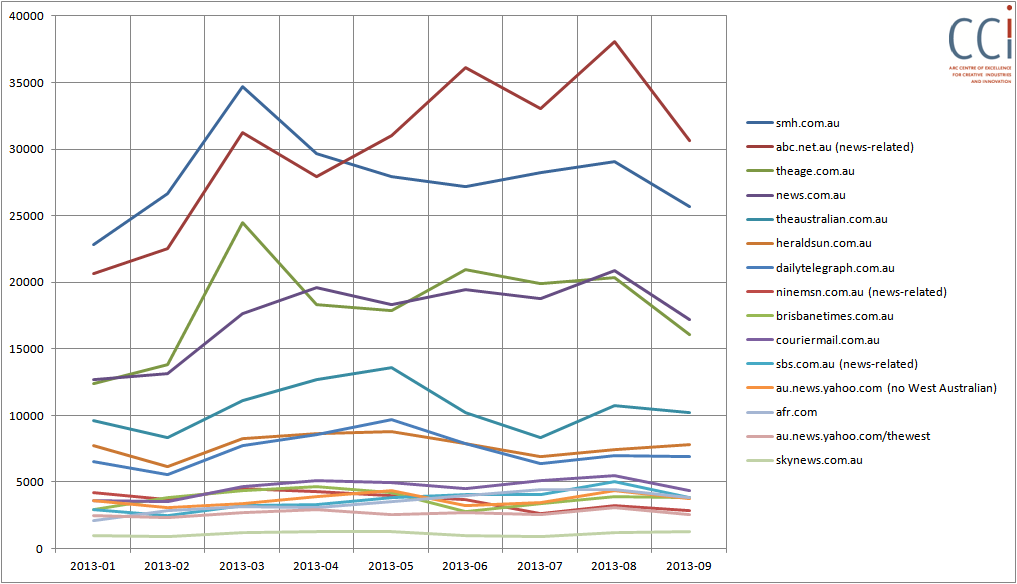
Before we turn to the day-to-day fluctuations in the index: now that we’re two months into 2013, let us take a first look at the weekly volume of tweets sharing links to the leading sites. This reveals the overall trends in the distribution of Twitter users’ attention across the sites, and points to a remarkable performance especially by the ABC’s news sections:

image

ABC News and the Sydney Morning Herald have traditionally been quite closely matched in their prominence in the Australian Twittersphere, as our ATNIX round-up for the second half of 2012 has documented – so the substantial gap which the ABC has opened up over the past five weeks is unusual. For now, its lead peaked in week 8, when it received some 9,000 tweets more than the SMH; we’ll see later in this update whether there are any obvious reasons for this very strong performance. The spike in ABC links in week 8 is also largely responsible for the very substantial total volume of links to news and opinion sites being shared that week: we captured some 175,000 such tweets, compared to just over 151,000 in week 9.

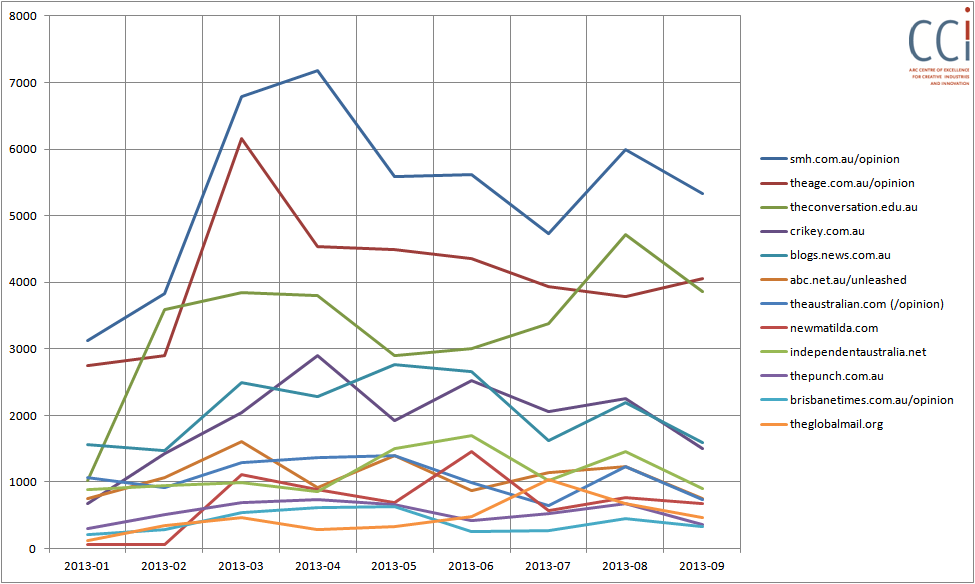
The patterns for opinion and commentary sites and sections are somewhat more mixed, as usual – here, the Fairfax flagships retain their customary leadership, but The Conversation has now also joined the battle for second place, and manages to pull ahead of The Age’s opinion section at least in week 8. From here, a substantial gap of some 2,000 tweets per week has opened to the remaining field.

image

In fact, week 8 was also a strong week for opinion sharing: we captured nearly 28,000 such tweets that week, compared with just under 23,000 tweets in weeks 7 and 9. That’s still somewhat below the totals for weeks 3 and 4, however.

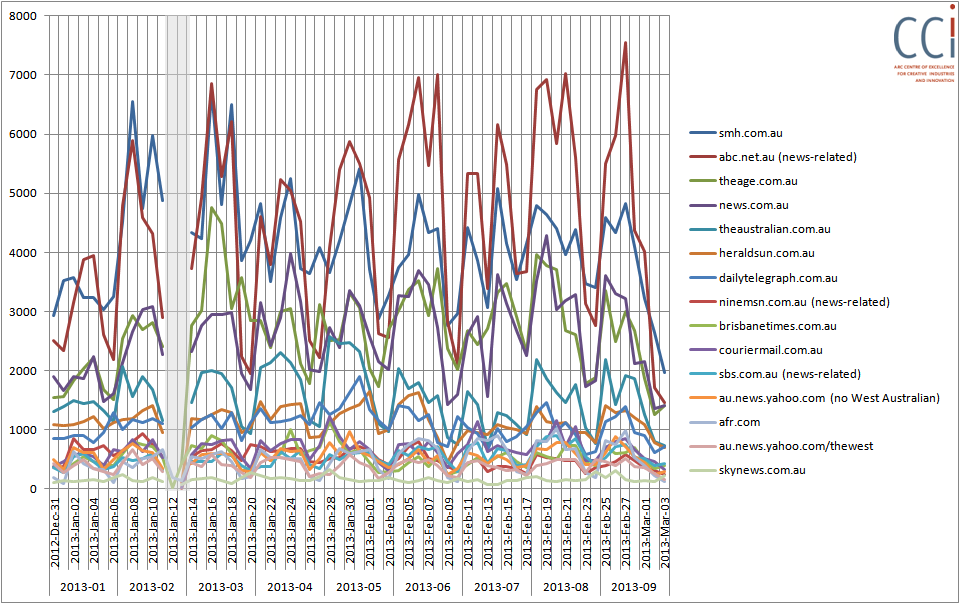
The day-to-day link sharing patterns shed some further light on exactly what caused these fluctuations. We’ll start again with the links to news sites, which further document ABC News’ towering performance during the past two weeks:

image

What emerges from a closer look at these patterns is not entirely unexpected. We’ve seen in the past that many of the largest spikes in the sharing of links to Australian news sites emerge when a domestic news story gains the attention of an international audience – this has happened frequently with stories relating to Julian Assange (which are distributed widely by the supporters of WikiLeaks), and occasionally with celebrity stories and other virally distributed content (such as Julia Gillard’s misogyny speech in parliament). During week 8, then, the most tweeted ABC News story by some margin related to news about the apparent halt to this year’s whale hunt by Japanese ships (2,400 tweets, and more for additional follow-up articles) – a piece which would have been shared widely by supporters of Sea Shepherd and other anti-whaling organisations.

Interestingly, a handful of science and technology pieces also performed well for the ABC that week – a piece about the differences between the National Broadband Network and the alternative options outlined by the federal opposition was always likely to be widely shared on Twitter (350 tweets), but an article about the evolution of tooth decay bacteria in humans over the millennia was a somewhat more unlikely winner, receiving more than 250 tweets and placing fifth for the week. But as the numbers for these individual articles also demonstrate, they alone did not receive enough tweets to create the substantial gap which opened up between ABC News and SMH in week 8 – there’s a much larger number of articles receiving between 100 and 200 tweets per day that added up to put the ABC in top spot.

Quite why this should be the case I am really not sure – there is no sign of major Twitter spam campaigns that use ABC links to make their tweets look more legitimate, nor are there any abnormally active users who would artificially boost the ABC’s numbers; even its own accounts contribute only a few hundred tweets to the weekly total through their news update activities. We’ll have to track this a little longer to see if any obvious explanations emerge.

The same is true for week 9 as well. ABC News performs well above the SMH from Monday to Wednesday, but there is no one widely shared story which explains this lead. There is a piece about the amusing gaffe over the anti-drink driving slogan on New South Wales police vans which receives some 420 tweets during those days, and articles about the Coalition’s mixed messages about carbon pricing compensation and the lack of funding for the National Climate Change Adaptation Research facility which are mentioned in some 320 and 220 tweets, respectively, but even a 7.30 report about the latest clashes between Sea Shepherd and Japanese whalers only just gains some 200 tweets during these days. There’s no obvious reason why ABC News should be the subject of some 2,000 more tweets than the Sydney Morning Herald on 27 February, for example.

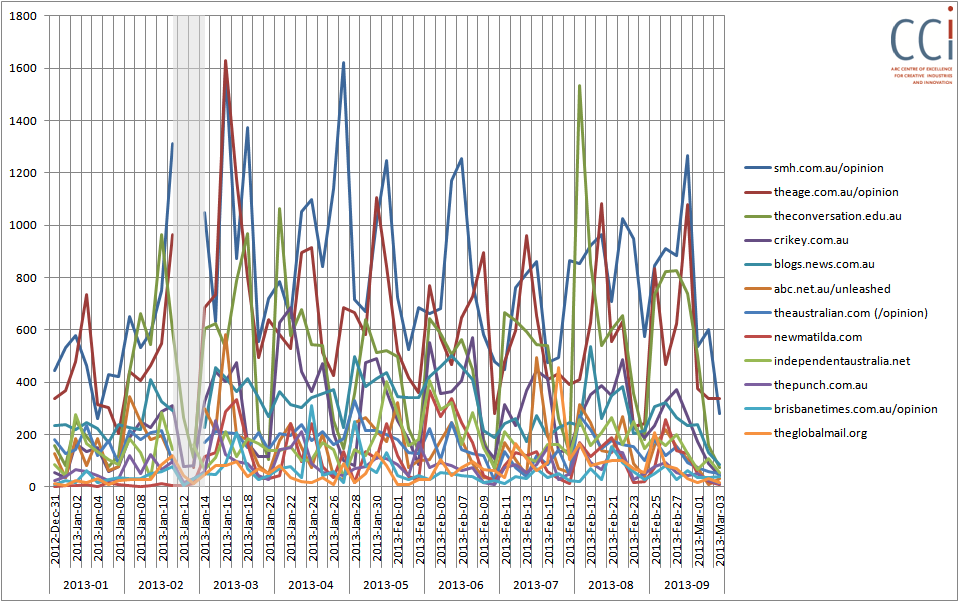
Daily patterns for the opinion and commentary sites and sections are comparatively easier to explain, by contrast; here, due not least also to the generally lower volume of tweeting activity, single articles often make the difference between peaks and troughs. Over the past few weeks, it’s The Conversation and the Fairfax papers which particularly stand out:

image

The Conversation, in fact, records a very strong spike on 18 February: that Monday, John Keane’s article on his lunch and dinner with Julian Assange in the Ecuadorian embassy in London is the latest in a long line of WikiLeaks-related pieces from Australian sites to be distributed widely through the site’s international network of supporters, gaining some 600 tweets. On Wednesday, on the other hand, an article by The Age’s editor-at-large which explains why Kevin Rudd is “Labor’s last chance” for the election puts that publication in top spot (180 tweets). The following week, the long-term pecking order is restored, however – not least also with the help of the 600 tweets received on Thursday by artist Ben Quilty’s article in the SMH on the need to rethink the HECS-exempt status of the Australian Institute of Sports, and the 440 tweets the same article gained for The Age.

Remarkably, then, still no significant presence during these weeks for the column miles already devoted to covering the fake election campaign which will be with us until September, or to the leadership rumblings in the ALP (except for the one Age article). Has the coverage to date not been worth sharing, or are the electorate simply not that interested in the latest tealeaf readings yet?

Twitter Research: New Articles on Politics, Methods, Metrics

In addition to Jean’s mainstream media appearances during February, we also have a few more recent publications which we haven’t had a chance to feature here on the site. So, here’s a quick round-up of the latest research from the Mapping Online Publics team and our various collaborators:

Working with our good friend Cornelius Puschmann at the Alexander-von-Humboldt-Institut for Internet and Society (HIIG) in Berlin, Jean has co-authored a discussion paper on the politics of Twitter data, which is now available in the HIIG Discussion Paper Series. The paper examines Twitter through the lens of “platform politics” and focusses especially on controversies around user data access, ownership, and control. In particular, it explores the roles and interests of the different actors in the Twitter data ecosystem (private and institutional end users of Twitter, commercial data resellers such as Gnip and DataSift, data scientists, and Twitter, Inc. itself).

Cornelius Puschmann and Jean Burgess. “The Politics of Twitter Data.HIIG Discussion Paper Series 2013-01 (23 Jan. 2013).

And another co-authored paper from our collaboration with Stefan Stieglitz at the University of Münster has also been published now. Here, we seek to address the lack of standardised metrics for comparing communicative patterns across Twitter datasets which has so far prevented researchers from developing a more comprehensive perspective on the diverse, sometimes crucial roles which hashtags play in Twitter-based communication. We outline a catalogue of widely applicable, standardised metrics and point to potential uses for such metrics, presenting an indication of what broader comparisons of diverse cases can achieve.

Axel Bruns and Stefan Stieglitz. “Towards More Systematic Twitter Analysis: Metrics for Tweeting Activities.International Journal of Social Research Methodology 22 Jan. 2013. DOI: 10.1080/13645579.2012.756095.

That article serves as a companion piece to another recent publication with Stefan, in the Journal of Technology in Human Services, which uses such standard metrics to identify standard patterns of Twitter user activity around televised and crisis events, respectively. By conducting a comparative study of more than 40 different cases (covering topics such as elections, natural disasters, corporate crises, and televised events) we identify a number of distinct types of discussion that can be observed on Twitter. We show that thematic and contextual factors influence the usage of the different communicative tools available to Twitter users, such as original tweets, @replies, retweets, and URLs. Based on this first analysis of the overall metrics of Twitter discussions, we demonstrate stable patterns in the use of Twitter in the context of major topics and events.

Axel Bruns and Stefan Stieglitz. “Quantitative Approaches to Comparing Communication Patterns on Twitter.Journal of Technology in Human Services 30.3-4 (2012): 160-185. DOI: 10.1080/15228835.2012.744249.

Open access to this and some of the other articles in the same issue is currently available from the journal, by the way – so get in quick! While you’re there, you might also want to check out yet another article from a member of the Mapping Online Publics team, Tim Highfield: his piece outlines the use of topical network analysis to study online activity (and it’s another of the open-access offerings at the moment). This complements the analysis of large data sets to enable the examination and comparison of different discussions in order to improve our understanding of the uses of social media.

Tim Highfield. “Talking of Many Things: Using Topical Networks to Study Discussions in Social Media.” Journal of Technology in Human Services 30.3-4 (2012): 204-218. DOI: 10.1080/15228835.2012.746894.

Recent media coverage: Twitter data ownership and the 2013 #qldfloods

I’m writing this from Cambridge (MA, USA; not UK), where I’m a few days into my stint as a Visiting Researcher at Microsoft Research New England. I’m thrilled to be able to spend some quality time with the Social Media group here, including long-time colleagues like Kate Crawford (who has worked with us on our Crisis Communication projects), Nancy Baym, Mary Gray and danah boyd, without a doubt some of the smartest and most collegial social media researchers anywhere. It’s also a very interdisciplinary setting populated by some of the world’s leading computer scientists, mathematicians, and economists. I’m here until mid June, when I’ll return to QUT to continue on as Deputy Director of the CCI as well as taking on a new role as Director of Research Training Programs in the Creative Industries Faculty – so a big, bumper year ahead.

In the meantime, here are a couple of recent media interviews I did and that are still available online (for now).

The first was a live interview on ABC Radio National’s Life Matters program. The story was called Your ‘Posts for Profit’, and this is the ABC’s summary:

There are millions upon millions of Twitter posts every day, a vast source of information for businesses and marketers. Access to this massive stream of data is sold by Twitter to those that can afford to buy it. But should it also be available to non-profit organisations for research purposes, and what will be the ultimate cost if these types of organisations are shut off from the data stream?

Full recorded audio and transcript available at the Radio National website.

The second is a segment on this week’s Queensland edition of the ABC 7.30 report, taking a look at the 2013 Queensland Floods, and how both community and government uses of social media in such situations have changed over the past few years. The video is available here (as I say, for now).

screen grab from 7.30 report interview

Cross-posted to my personal blog creativitymachine.net