Video of our talk at the University of Göttingen now available

Last month Axel, Darryl Woodford and I visited the University of Göttingen’s Centre for Digital Humanities as part of a two-year, ATN-DAAD funded collaboration. During our visit, we participated in a public workshop on Twitter and network analysis. Here is the video of our public talk, which touches on broader issues around digital methods and …

Social Media in the Media III: Uses

In previous posts I outlined the details of a preliminary study we conducted on how social media are used as political tools and how this activity is portrayed in traditional media outlets. I provide an overview of the study and insights into the way in which newspaper articles compare and contrast new and traditional media …

Social Media in the Media II: User Groups

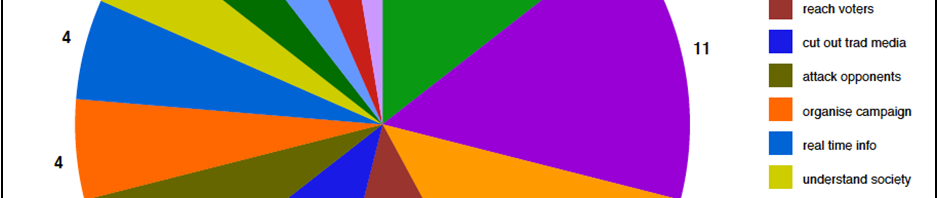
In a previous post I introduced work we have been doing here at the CCI to contribute to an understanding of the way in which social media are portrayed as political tools in traditional media outlets. In this post I provided a broad overview of a preliminary qualitative study of 56 articles from Australian newspapers …

Social Media in the Media I: Comparing Social and Traditional Media

One of the research projects some of us here at the CCI are currently involved in, in cooperation with researchers from California State University, Uppsala University, and the Universities of Oslo and Bergen, aims to apply a cross-media and cross-national approach to exploring The Impact of Social Media on Agenda-Setting in Election Campaigns. As part …

Emerging Methods for Digital Media Research: An Introduction

I’m very pleased to be able to announce that the methods-focused special issue of the Journal of Broadcasting and Electronic Media (JOBEM) edited with my CCI colleagues Axel Bruns and Larissa Hjorth is out now. When the original Call for Papers went out we had an extraordinary response, and it was genuinely difficult to sort …

Resolving Short URLs: A New Approach

When working with Twitter data, one of the most interesting questions is always what URLs tweets are linking to. As Twitter users discuss any given topic or issue, the URLs they share provide us with an indication of the online media they’re drawing on for information and/or entertainment – and by counting which sites appear …

More Twitter Metrics: Metrify Revisited

About a month ago I introduced my new Gawk script metrify.awk, which generates a wide range of Twitter metrics for a given Twapperkeeper/yourTwapperkeeper hashtag or keyword archive. Even as I was writing those posts, though – and certainly while playing with the language metrics I discussed in my last post -, I started to find …

Creating Basic Twitter Language Metrics

OK, this may be a somewhat esoteric subject for researchers who mainly work with Twitter data from specific countries and cultures, but over the past few weeks I’ve been working on a paper that analyses Twitter activities in the #egypt and #libya hashtags – and as part of that work, I’ve been interested in exploring …

Taking Twitter Metrics to a New Level (Part 4)

Update: revision 1.2 of metrify.awk is now available (still at the link below), and introduces some further functionality, which is outlined here. This is the final instalment of my four-part introduction to the metrify.awk script for generating detailed metrics for specific Twapperkeeper/yourTwapperkeeper hashtag archives. Over the last couple of posts, we’ve mainly dealt with overall …

Taking Twitter Metrics to a New Level (Part 3)

Update: revision 1.2 of metrify.awk is now available (still at the link below), and introduces some further functionality, which is outlined here. Over the past couple of posts, I’ve introduced our new metrify.awk Twitter metrics script, and looked at the first of the three metrics tables produced by the script. Let’s move on now to …