In addition to Jean’s mainstream media appearances during February, we also have a few more recent publications which we haven’t had a chance to feature here on the site. So, here’s a quick round-up of the latest research from the Mapping Online Publics team and our various collaborators:
Working with our good friend Cornelius Puschmann at the Alexander-von-Humboldt-Institut for Internet and Society (HIIG) in Berlin, Jean has co-authored a discussion paper on the politics of Twitter data, which is now available in the HIIG Discussion Paper Series. The paper examines Twitter through the lens of “platform politics” and focusses especially on controversies around user data access, ownership, and control. In particular, it explores the roles and interests of the different actors in the Twitter data ecosystem (private and institutional end users of Twitter, commercial data resellers such as Gnip and DataSift, data scientists, and Twitter, Inc. itself).
Cornelius Puschmann and Jean Burgess. “The Politics of Twitter Data.” HIIG Discussion Paper Series 2013-01 (23 Jan. 2013).
And another co-authored paper from our collaboration with Stefan Stieglitz at the University of Münster has also been published now. Here, we seek to address the lack of standardised metrics for comparing communicative patterns across Twitter datasets which has so far prevented researchers from developing a more comprehensive perspective on the diverse, sometimes crucial roles which hashtags play in Twitter-based communication. We outline a catalogue of widely applicable, standardised metrics and point to potential uses for such metrics, presenting an indication of what broader comparisons of diverse cases can achieve.
Axel Bruns and Stefan Stieglitz. “Towards More Systematic Twitter Analysis: Metrics for Tweeting Activities.” International Journal of Social Research Methodology 22 Jan. 2013. DOI: 10.1080/13645579.2012.756095.
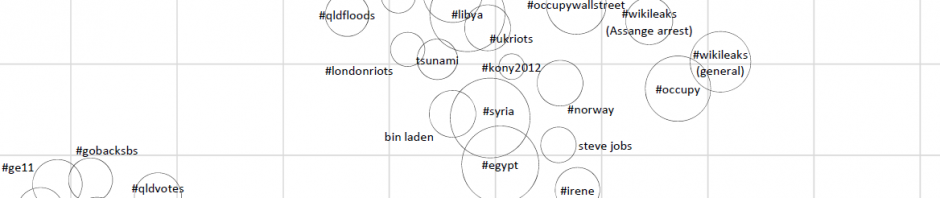
That article serves as a companion piece to another recent publication with Stefan, in the Journal of Technology in Human Services, which uses such standard metrics to identify standard patterns of Twitter user activity around televised and crisis events, respectively. By conducting a comparative study of more than 40 different cases (covering topics such as elections, natural disasters, corporate crises, and televised events) we identify a number of distinct types of discussion that can be observed on Twitter. We show that thematic and contextual factors influence the usage of the different communicative tools available to Twitter users, such as original tweets, @replies, retweets, and URLs. Based on this first analysis of the overall metrics of Twitter discussions, we demonstrate stable patterns in the use of Twitter in the context of major topics and events.
Axel Bruns and Stefan Stieglitz. “Quantitative Approaches to Comparing Communication Patterns on Twitter.” Journal of Technology in Human Services 30.3-4 (2012): 160-185. DOI: 10.1080/15228835.2012.744249.
Open access to this and some of the other articles in the same issue is currently available from the journal, by the way – so get in quick! While you’re there, you might also want to check out yet another article from a member of the Mapping Online Publics team, Tim Highfield: his piece outlines the use of topical network analysis to study online activity (and it’s another of the open-access offerings at the moment). This complements the analysis of large data sets to enable the examination and comparison of different discussions in order to improve our understanding of the uses of social media.
Tim Highfield. “Talking of Many Things: Using Topical Networks to Study Discussions in Social Media.” Journal of Technology in Human Services 30.3-4 (2012): 204-218. DOI: 10.1080/15228835.2012.746894.