Our Work Featured by the Australian Research Council

It’s not every day that your work gets an acknowledgment from the most important research funding and evaluation authority in the country – but today is one such day: our research into the use of Twitter in the 2011 south east Queensland floods has been highlighted in the 2011/12 Annual Report of the Australian Research Council. The report contains a range of case studies of major research achievements across all the disciplines for which the ARC provides funding – and our work is featured in a case study on page 34.

Our full report into the use of #qldfloods and the role of the Queensland Police Service @QPSMedia account during the floods was published by the ARC Centre of Excellence for Creative Industries and Innovation in January 2012, and is available here.

Introducing the Companion to New Media Dynamics

This is perhaps somewhat beyond the scope of what we usually cover at Mapping Online Publics, but I’m delighted to announce the completion of another major project we’ve been involved in: Blackwell has just published A Companion to New Media Dynamics, edited by John Hartley, Jean Burgess, and Axel Bruns. The title of this substantial volume may seem a little strange at first – why not just “… to New Media”? –, but with this collection we aimed specifically to highlight new media as a set of dynamic, evolving, and sometimes elusive practices rather than a static, easily defined thing.

The volume brings together contributions from a long list of researchers in the field, and combines international research leaders with key emerging scholars who will drive the next generation of new media and Internet research. But don’t take my word for it – take Toby Miller’s: “We are fortunate indeed to have this tour d’horizon of young and middle-aged media across Europe, North America, and Asia. It features an array of established and emergent writers whose clear prose and thorough research mark out their work.”

Here’s a complete list of chapters:

Continue reading “Introducing the Companion to New Media Dynamics”

ATNIX: Australian Twitter News Index, Weeks 5-7/2013

I’m afraid our Australian Twitter News Index still hasn’t quite returned to its normal weekly rhythm – so here is another multi-week round-up of how Twitter users shared links to Australian news sites. By now, we’ve moved well clear of the slow news period of the summer holidays, and with the September election already hanging over us, we should see plenty of news-sharing activity.

Standard background information: this analysis is based on tracking all tweets which contain links pointing to the URLs of a large selection of leading Australian news and opinion sites (even if those links have been shortened at some point). Datasets for those sites which cover more than just news and opinion (abc.net.au, sbs.com.au, ninemsn.com.au) are filtered to exclude irrelevant sections of those sites (e.g. abc.net.au/tv, catchup.ninemsn.com.au). For our analysis of ‘opinion’ link sharing, we include only those sub-sections of mainstream sites which contain opinion and commentary (e.g. abc.net.au/unleashed, articles on theaustralian.com.au which include ‘/opinion’ in the URL), and compare them with dedicated opinion and commentary sites.

See the posts tagged ‘ATNIX’ on this site for a full collection of previous results.

ATNIX Weeks 5-7/2013: 28 Jan. to 17 Feb. 2012

Given the multi-week nature of this ATNIX update, let’s dispense with the marketshare graphs once again and jump straight into the day-to-day activity. As I’ve said, the holidays are certainly over: over these past three weeks, the total number of links to Australian news Websites being shared has hovered around a very solid 160,000: week 5 saw 165,000 tweets, week 6 matched that figure to within 200 tweets, and week 7 came in at 158,000 (but we missed some tweets due to a brief server outage on 13 Feb.). Most remarkable in any of this is the performance of ABC News, however: while the long-term market leader, the Sydney Morning Herald, maintained a weekly average of around 28,000 tweets linking to its site, ABC News rose from 28,000 in week 4 to a remarkable 36,000 in week 6 – its highest weekly total since we started ATNIX in mid-2012. (The 33,000 tweets it received in week 7 are the second highest result.)

image

The daily graph shows this clearly – while earlier in the year, ABC News and SMH shadow one another closely, the ABC detaches notably from its closest rival during week 6. A substantial element in this result is the widespread sharing of ABC newsreader Jeremy Fernandez’s article on his reaction to being subjected to a deeply racist tirade on a Sydney bus. Posted on 8 Feb., that piece alone received more than 1,500 shares during the rest of the week, while additional reporting about the incident picked up another 280 tweets. A second major story during the week concerned the earthquake and tsunami in the Solomon Islands, articles about which were linked to in nearly 1,000 tweets on 6 Feb. alone.

But while this explains substantial spikes on the Wednesday and Friday, the significant lead of the ABC over the SMH throughout the rest of the week is less obviously explicable. The Monday of week 6, for example, features no such standout pieces, but is marked rather by  a range of stories which receive between 100 and 300 shares – ranging from the discovery of Richard III’s skeleton to police errors in the arrest of controversial MP Craig Thomson. There’s nothing here which would inherently explain a difference of almost 2,000 tweets between both sites during that day. Curious.

Links to opinion and commentary sites and sections fluctuate considerably more from day to day, as usual – and at much lower levels of activity. Here, the two Fairfax flagships continue to rule the roost, if not without challenge from some more minor sites. Overall, opinion and commentary sharing has been down over the past few weeks, in fact: while weeks 5 and 6 nearly reached 27,000 tweets linking to such sites, week 7 struggled to reach 23,000. It should be noted that these numbers remain above the long-term average of 20,000 tweets per week, though – perhaps election speculation is making its presence felt already.

image

Opinion and commentary sharing in week 5 is necessarily dominated by the Prime Minister’s announcement of the federal election date as 14 September – but at The Age, this is somewhat overshadowed by Julian Assange’s own announcement that he will run for the Senate (some 350 shares for this article, as well as another 90 for a 12 Dec. article which flagged this possibility). Another complication arises the following day, in the form of Craig Thomson’s arrest, with a related article netting the SMH some 260 tweets – our figures for this week can almost be read as a day-to-day breakdown of the various issues which emerged this week to undermine the PM’s make-or-break attempt to change the political conversation by announcing the election so early. Also notable in this context is another big day for Independent Australia, whose article on the Craig Thomson saga receives some 200 tweets on 31 Jan., boosting its numbers for the day to double its long-term average; the site continues this comparatively strong performance in week 6.

In week 6, at least one of the major spikes at the Sydney Morning Herald is related (and this almost seems a rarity these days) to actual policy matters: economics editor Ross Gittins’s piece on “the four industries that rule Australia” receives some 210 tweets on the Wednesday. The following day we’re back to Julian Assange: Elizabeth Farrelly’s piece on the conditions of Assange’s exile in the Ecuadorian embassy in London picks up some 250 tweets. Meanwhile, Independent Australia’s strong run – by its standards – continues: its examination of Tony Abbott’s new look receives some 300 tweets during the week, closely matched by a further update on the Craig Thomson saga. New Matilda, too, receives a boost: its criticism of Tony Abbott’s taxation plans accounts for some 260 tweets on the Monday of week 4 – that’s more than 70% of all tweets to the site that day. As we (slowly) move closer towards election day, perhaps these smaller, independent opinion sites will gradually take on a more important role in the national conversation?

Finally, while week 7 is less remarkable overall, two spikes amongst the minor sites are also worthy of attention (the Age spike on 13 Feb. is due to another update about Julian Assange’s senate run, and accounts for some 450 tweets). The ABC’s The Drum tends not to feature very strongly in our index, also due to the fact that Drum articles by ABC staff are published under a different URL path and cannot reliably be included in the total. On 14 Feb., though, it manages to cut through nonetheless, boosted by a well-timed piece on the reasons for why women would not want to change their name after marriage (150 tweets). On the Saturday, finally, it is The Global Mail which briefly becomes the most-linked opinion and commentary site in the country: its confronting piece about ‘witch’-hunts and other acts of extreme violence against women in Papua New Guinea received some 360 tweets that day.

ATNIX: Australian Twitter News Index, Weeks 1-4/2013

Our Australian Twitter News Index still hasn’t quite returned from holidays, so what follows in this post is another multi-week round-up, covering the four weeks of January 2013. We’ll get back into our regular rhythm soon, especially now that there’s the dank smell of electioneering in the air, but for the moment, let’s have just a quick look at how January unfolded.

Standard background information: this analysis is based on tracking all tweets which contain links pointing to the URLs of a large selection of leading Australian news and opinion sites. For technical reasons, it does not contain ‘button’ retweets, but manual retweets (“RT @user …”) are included. Datasets for those sites which cover more than just news and opinion (abc.net.au, sbs.com.au, ninemsn.com.au) are filtered to exclude irrelevant sections of those sites (e.g. abc.net.au/tv, catchup.ninemsn.com.au). For our analysis of ‘opinion’ link sharing, we include only those sub-sections of mainstream sites which contain opinion and commentary (e.g. abc.net.au/unleashed, articles on theaustralian.com.au which include ‘/opinion’ in the URL), and compare them with dedicated opinion and commentary sites.

See the posts tagged ‘ATNIX’ on this site for a full collection of previous results.

ATNIX Weeks 1-4/2013: 31 Dec. 2012 to 27 Jan. 2013

Since we’re dealing with a four-week period, let’s skip straight to the day-by-day overview of activity. Here, we’re seeing a definite post-New Year’s lull in news sharing on Twitter (with a brief break for server maintenance on 12/13 Jan.):

image

Remarkably, none of our major news sites received more than 4,000 tweets per day during the first week of the year; except for ABC News and the Sydney Morning Herald, they even struggled to pass the 2,000 mark. Indeed, for all 30 sites combined, we captured only just over 122,000 tweets that week. By week 3, that number had risen to 171,000, however – which is the strongest weekly result we’ve had since ATNIX started in mid-2012. As the graph above shows, this is driven especially by strong mid-week results for the SMH, ABC News, and The Age. At 163,000 tweets, week 4 also remains very strong, if somewhat below this peak.

Of the week 3 spikes in activity, ABC News’s Wednesday win is driven largely by its report about Paarthepan, an baby born in the Sydney immigration detention centre (530 shares), and a story about The Guardian’s plans to launch an Australian edition (200 shares) – which we will track in ATNIX as soon as the site launches, of course. At the Sydney Morning Herald, the same day sees major stories about Julia Gillard’s commitment to religious lobbies that they will continue to be able to discriminate on religious and sexual grounds (460 shares), and another piece covering The Guardian’s announcement (210 shares). Clearly, these numbers alone do not full account for what is a very strong day for both publications, though, and there are many more stories which received upwards of 100 shares; quite why we’re seeing such an increase in overall sharing activity this week remains unclear to me, therefore. Perhaps everyone is facing the new year’s news with renewed energy after an extended break?

A second major spike for both publications, on Friday, is due to an ABC News report about a massive gold nugget find near Ballarat (430 shares) and its coverage of the growing bushfire threat in Victoria and New South Wales (240 shares), while the SMH’s total is somewhat inflated by an opinion piece (600 shares) which we’ll get back to below. Its second most linked-to item, strangely enough, is an image from a 2011 piece, of a concept design for what planes may look like in 2050 (340 shares) – due to a single, very widely retweeted message which linked to this image. I’m afraid I can’t explain this one, as the original tweet was in Arabic.

Our opinion and commentary sites and sections show a somewhat more jittery day-to-day pattern, as usual; the daily volume of links to opinion pieces depends so much more on a handful of articles which cut through to a larger audience, as we know. None of them managed to do so during week 1, clearly: remarkably, none of our sites even reached 800 tweets per day, and the total volume of opinion tweets barely made it past 14,000 that week.

image

Here, too, things pick up by week 3, which records almost 30,000 tweets linking to opinion pieces. The two Fairfax sites show particular spikes in week 3: on 16 Jan., this is something of a false dawn for the SMH as it once again badges a political news story (about religious discrimination rights, as outlined above) under its National Times banner, but economics editor Peter Martin also contributes with a genuine opinion piece about smart shopping (250 shares). Over at The Age, the discrimination story picks up another 380 shares, while smartly accompanying this with a syndicated op-ed by former US President Jimmy Carter, criticising any form of discrimination due to religious prejudices (260 shares). This turns out to be something of a slow burner: two days later, it’s still leading The Age’s opinion links (with 190 shares that day), followed by 150 shares for a Richard Ackland piece on the James Ashby affair.

The Age also shows a significant spike on the final day of our four weeks, but this, too, is a National Times-badged piece of political reporting – covering Liberal Senator Cory Bernardi’s membership in a far right US lobby group (300 shares) – which really shouldn’t be counted as an opinion piece. Remarkably, if we ignored this article, Jimmy Carter’s op-ed would still lead this day for The Age, by the way – if with a much less impressive 40 additional shares.

Finally, it’s interesting to note that The Conversation had a particularly slow start to the year – perhaps the type of content it covers was especially unlikely to be shared during the post-Christmas lull. By 21 Jan., however, it was back in business again, and even leads the opinion and commentary field on that day. The leading story: a piece on how the NRA and other US gun lobbyists distort Australian crime statistics, which alone received some 370 shares.

So much for now, then – we return in February with more regular updates.

ATNIX: Australian Twitter News Index 2012 Round-Up

My previous post rounded out our weekly observations of the ebbs and flows in Twitter newssharing during the second half of 2012. This means it’s time now to review the overall patterns which our Australian Twitter News Index has shows us since ATNIX began in mid-year. Started in week 25, we now have data for just over half a year – a solid basis to evaluate the overall performance of Australian news and opinion sites on Twitter, and to identify particular moments during this time which captured Twitter users’ attention.

Standard background information: this analysis is based on tracking all tweets which contain links pointing to the URLs of a large selection of leading Australian news and opinion sites. For technical reasons, it does not contain ‘button’ retweets, but manual retweets (“RT @user …”) are included. Datasets for those sites which cover more than just news and opinion (abc.net.au, sbs.com.au, ninemsn.com.au) are filtered to exclude irrelevant sections of those sites (e.g. abc.net.au/tv, catchup.ninemsn.com.au). For our analysis of ‘opinion’ link sharing, we include only those sub-sections of mainstream sites which contain opinion and commentary (e.g. abc.net.au/unleashed, articles on theaustralian.com.au which include ‘/opinion’ in the URL), and compare them with dedicated opinion and commentary sites.

See the posts tagged ‘ATNIX’ on this site for a full collection of previous results.

ATNIX Weeks 25-52/2012: 18 June – 30 Dec. 2012

Over the course of these six months and two weeks, we captured a total of over 3.9 million tweets which included links to Australian news sites – an average of some 140,000 tweets per week. Those numbers would have been slightly higher still in the absence of a number of temporary server outages which led us to miss some data in a number of weeks; at any rate, they constitute a very solid basis for our analysis. Sadly, there’s very little international research to date with which we might be able to compare our figures – we’re unable to say whether Australian Twitter users are especially engaged with or disengaged from the news, therefore.

(We’re working on such comparisons, though – we’ve started tracking Twitter-based newssharing in Germany, where we seem to see some 240,000 shares per week, on average. Given that Germany’s population is close to four times that of Australia, this appears to indicate that Australians have taken to Twitter much more enthusiastically than Germans, and/or that Australian Twitter users are more interested in sharing news items than their German counterparts.)

In Australia, we’ve seen a very stable distribution of attention across the sites we track: the Sydney Morning Herald and the news-related sections of the ABC Website clearly lead the pack, between them accounting for well over a third of all tweeted links. The Age and news.com.au constitute a second tier of sites, each commanding some 10% of the total volume of tweets; in other words, these four sites alone receive nearly 60% of all Australian news links being shared by Twitter users.
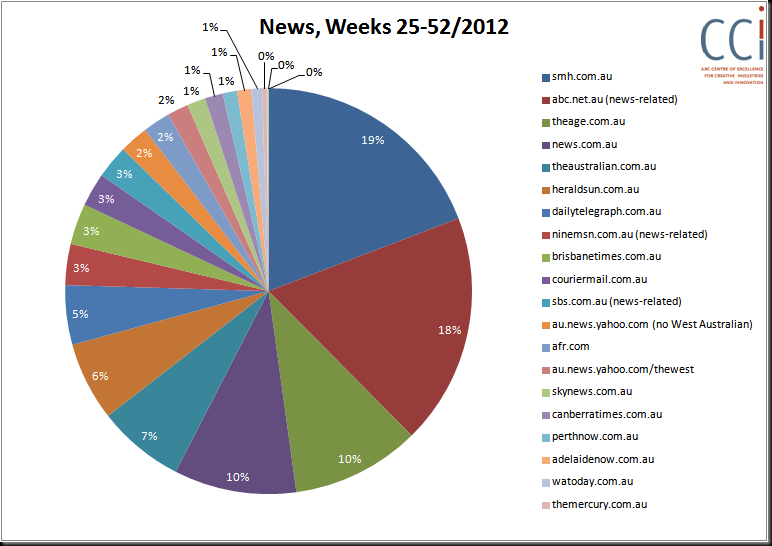
image

This is symptomatic of a number of well-known factors: first, it demonstrates the considerable concentration of the Australian news industry on a handful of major operators – flagship sites for Fairfax (twice), News Ltd., and the ABC are all represented in this top four. We might expect News Ltd.’s national broadsheet The Australian to figure strongly here as well (and it does appear in fifth place, but closer to the other also-rans than to the top four), but remember that its site has implemented a partial paywall system which is likely to impact on Twitter users’ ability to read and share articles in The Australian.

Second, these patterns also reflect what we understand the demographics of the Australian Twittersphere to be at this point in time. The strong performance of Fairfax’s two metropolitan broadsheets, and of Australia’s leading public service media organisation, suggests that Twitter user demographics remain skewed to the traditional audiences for relatively quality, broadsheet news, rather than for tabloid content as provided, for example, by News Ltd.’s papers Herald Sun and Daily Telegraph. Again, there is a dearth of reliable research into Twitter’s demographics in Australia, but we do believe its overall userbase to be somewhat skewed towards relatively urban, educated, affluent users aged between 25 and 55 – matching the typical audience for quality news content.

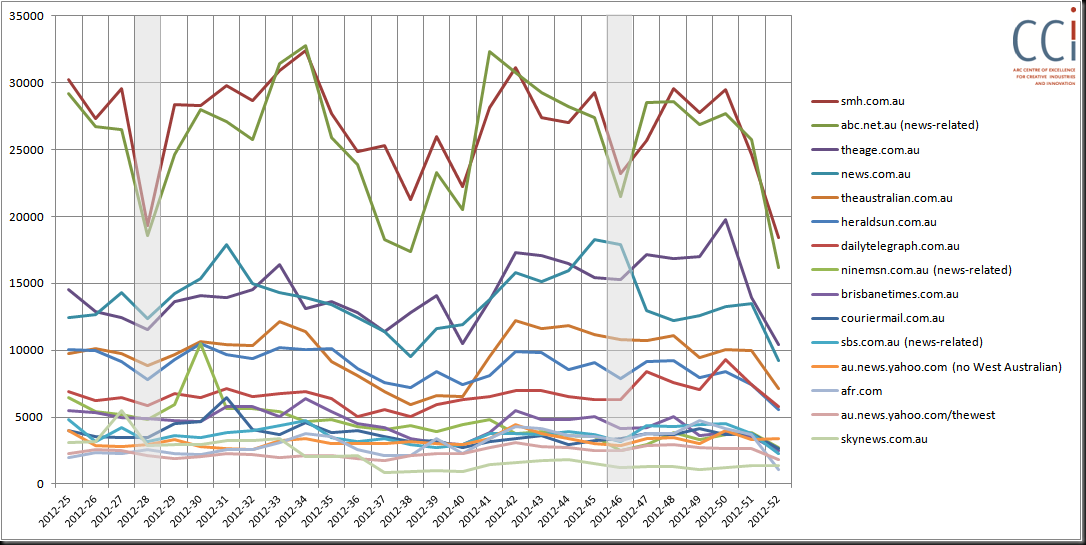
The three-tier structure of Twitter news sharing in Australia becomes more evident when we examine its weekly ebbs and flows:
image

Here, we see the SMH and ABC News shadowing one another closely throughout the year, trading the lead from time to time. What generally puts the SMH over the top is its stronger weekend performance, driven most likely by the content produced for the paper’s weekend edition; the ABC doesn’t have any similar weekend fare to offer, and drops off more substantially on Saturdays and Sundays.

The Age and news.com.au form another fairly closely-matched duo; news.com.au might even have come out in third place for the year, except for a form slump in the final weeks of 2012. Below them we find the rest of our sites, led by The Australian and the two major tabloids; none of these sites manage to advance well beyond 10,000 tweets per week on a regular basis, and the majority struggle even to reach the 5,000 tweet mark – a far cry from the 25,000 to 30,000 tweets which the Sydney Morning Herald and ABC News regularly command.

While we’ve explored the specific spikes and troughs in news sharing in much more depth on a week-by-week basis in past ATNIX updates, a few overall observations are nonetheless useful. The two major dips on weeks 28 and 46 are due to server maintenance, and should not concern us overly much; the six-week slump in volume between weeks 35 and 40 (27 Aug. to 7 Oct.) is more interesting, however. Weeks 38-40 coincide with the spring school holidays in several states, which may explain the slump for those weeks; I can’t find a particularly convincing explanation for the drop-off during the preceding three weeks, however. We do see a similar drop in the last week of the year, as Christmas apathy takes hold; this seems to be especially pronounced for the Australian Financial Review, incidentally.

Turning to the spikes, week 33 and 34 stand out especially, and are driven by a combination of factors. One of them points to a phenomenon which is familiar to us by now: the international distribution of Australian stories, which we’ve observed this past year especially in the context of the unfolding saga around WikiLeaks and its founder Julian Assange. In week 33, it’s Assange’s flight to the Ecuadorian embassy in London which is the subject of a range of Australian news articles; these articles are picked up and widely retweeted by the worldwide WikiLeaks support community on Twitter, boosting the numbers especially of the Fairfax broadsheets.

But there are also major domestic events which add to these spikes: in week 33, independent MP Tony Windsor’s scathing attack on federal Opposition Leader Tony Abbott in federal parliament is covered in a series of news articles and posts of the full video which receive a substantial number of links from Twitter. In week 34, Leigh Sales’s confrontational 7.30 interview with the Opposition Leader drives major traffic to the ABC site, as links to the full video are shared widely.

After the mysterious spring slump, the pressure on Abbott is renewed in week 41 by Prime Minister Julia Gillard’s now famous ‘misogyny’ speech in parliament, which constitutes a rare case of a domestic political story making major international headlines. Here, it’s the ABC which gains the most additional attention, as its full-length post of the video receives some 6,300 tweets over the course of two days.

Finally, the one notable spike amongst the minnows occurs for nineMSN in week 30, essentially doubling its normal tweet count. This, too, is an example of a domestic story gone viral: it relates to a group of four Australian fans of teen band One Direction who feel the band no longer cares about its fans, and decided to burn their concert tickets. Outrage amongst One Direction’s remaining fans was swift and contagious, resulting in some 4,500 tweets which linked to the story.

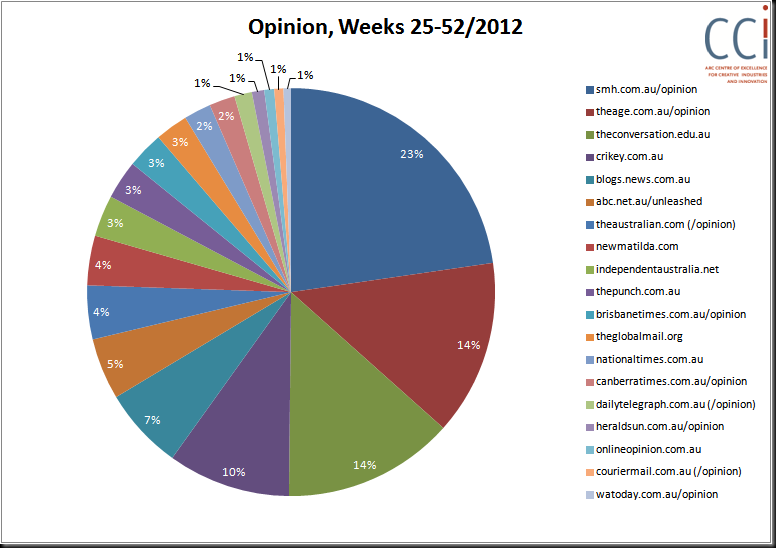
In addition to the tweeting of general news reports, ATNIX also specifically tracks the sharing of opinion articles, both from the opinion sections of our major news Websites and from the major Australian opinion and commentary sites. Compiled over the second half of 2012, the distribution of attention to such sites and sections shows a similarly multi-tiered picture for the nearly 580,000 tweets we captured:
image

Once again, we find the Sydney Morning Herald in pole position – and a strong response to its commentary on Julian Assange’s Senate bid in week 50 has meant that the opinion section of Fairfax stablemate The Age managed to beat independent academic opinion site The Conversation into second place, by a margin of fewer than 2,000 tweets over the past six months. Another independent, online-only opinion site, Crikey, rounds out the top four.

In this context, it should be noted that numbers for the Fairfax sites will be slightly inflated: we identify Fairfax opinion articles by their URL paths (e.g. smh.com.au/opinion/politics/…), but the sites have a tendency to file fairly straightforward political reporting from their Canberra correspondents under such URLs (and under the on-site imprint National Times) as well; I’ve noted this in several past ATNIX updates. Short of checking each article manually, there’s nothing we can do to remove such non-commentary articles from the count. However, even a reduction of SMH and Age tweet numbers by 50% would still see them in third and fourth place, respectively – so while the total count might be somewhat inflated, the overall importance of these sites as sources of opinion articles for Twitter-based discussion is not.

Again, then, the distribution of attention to opinion and commentary sites and sections shows a considerable focus on the broadsheet content provided by the Fairfax papers, mixed with the major independent commentary sites; the top four sites alone account for over 60% of all shared links. Against this, the ABC and News Ltd. sites are comparatively absent: blogs.news.com.au (home to notable commentators such as Andrew Bolt, Piers Akerman, or Miranda Devine) commands only 7% of the total volume of tweets, and the ABC’s The Drum manages 5%. (Here, however, there will be some systematic undercounting: while we are able to identify general Drum articles by their abc.net.au/unleashed URLs, Drum articles by ABC journalists are not filed under the /unleashed path, and cannot be identified reliably.) The Australian, finally, captures only 4% of the Twitter attention share – it’s here where its paywall has the greatest impact, as it specifically prevents direct access to most opinion articles from Twitter links.

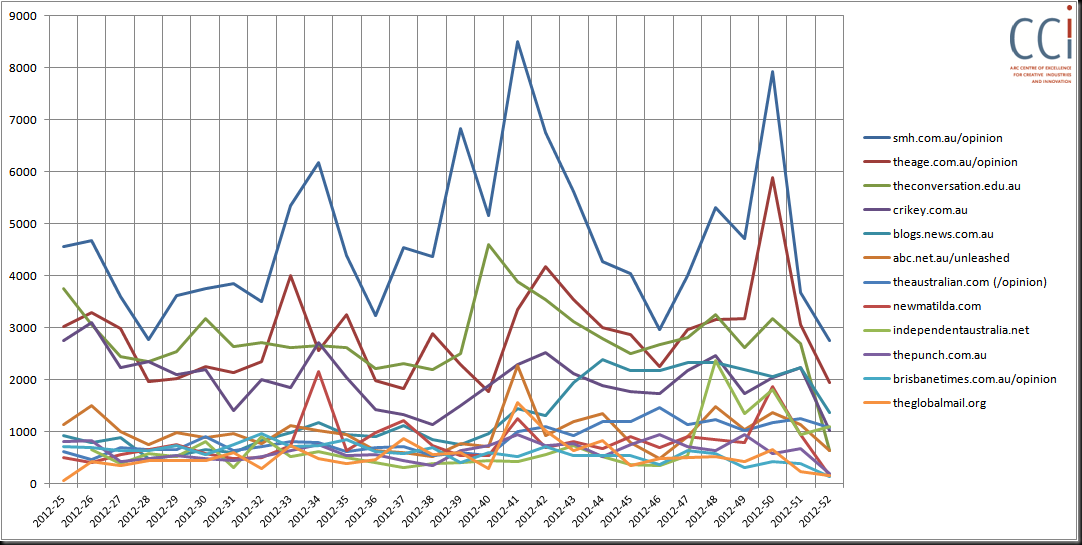
Given the ephemerality of political opinion and commentary, and the substantially lower volume of tweets which link to such content, compared to ‘straight’ news articles, the week-by-week overview necessarily shows much more pronounced fluctuations:
image

Overall, we see the Sydney Morning Herald well above the rest, as a consistent leader throughout these six months, while Age and Conversation battle for second spot. There is a notable rise in the number of tweets referring to blogs.news.com.au from week 43 onwards, but News Ltd.’s columnists should not read this as a particularly widespread popular vindication of their views: rather, this rise is due almost entirely to the activities of a single Twitter user who began to tweet links to the blog posts – with a particular focus on Andrew Bolt – with a considerable degree of dedication (or obsession, perhaps). As I noted, for example, in week 44, this user would sometimes tweet the same link several dozen times a week, usually under the #auspol hashtag, resulting in well over 1,000 blogs.news.com.au tweets for the week. And no, I won’t name that user.

Overall, spikes in commentary activity match what we’ve already seen for news: Assange and commentary on Tony Abbott’s performance as Opposition Leader drive the spikes before the spring slump; Gillard’s misogyny speech is responsible for the major spike after it. Otherwise, Julian Assange and his international network of supporters are to blame: in addition to week 34, they drive spikes in weeks 39 and 50 (the latter is founded mainly on National Times-branded Fairfax news articles, however).

What’s more remarkable about the opinion and commentary field, however, is that – contrary to the mainstream of news reporting – it is possible for minor commentary sites to break through with a major story at times. New Matilda and Independent Australia both reached Crikey and even Conversation territory at least for a couple of weeks each during the past six months: in week 34, New Matilda published an interview with Noam Chomsky about Julian Assange which boosted its link total by more than 1,000 tweets; in week 48, Independent Australia published Margo Kingston’s exposé on Tony Abbott’s slush fund “Australians for Honest Politics” and received some 1,750 tweets for its troubles. That piece was republished in New Matilda in turn, two weeks later, where it resulted in another spike, while Independent Australia was using forensic IT analysis to test Abbott’s statements on the James Ashby affair.

In spite of the pronounced underdevelopment of the Australian news market as a result of stifling media ownership concentration, the fact that these and other minor voices in the media landscape can make themselves heard at least from time to time on Twitter is an encouraging sign: new entrants – and we might still count Crikey and The Conversation amongst this list, too – can establish themselves at least in the field of political commentary, if not necessarily in general news.

Last week’s announcement of an Australian edition of British newspaper The Guardian has added another potential challenger, whose introduction we’ll track with interest in 2013’s ATNIX. At least as far as Twitter is concerned, The Guardian’s profile should suit the demographics of the Australian Twittersphere well – it will be interesting to see how this new entrant shifts the distribution of attention which we’ve observed in 2012.


ATNIX: Australian Twitter News Index, Weeks 48-52/2012

The Australian Twitter News Index (ATNIX) took a break from weekly updates over the summer, but we’re spinning up again for 2013 now. Before we get to the most recent developments, though, it’s time to check what happened in the final few weeks of 2012, and to review what the past six or seven months of ATNIX data gathering have shown us. I’ll do so in separate posts over the next few days.

Standard background information: this analysis is based on tracking all tweets which contain links pointing to the URLs of a large selection of leading Australian news and opinion sites. For technical reasons, it does not contain ‘button’ retweets, but manual retweets (“RT @user …”) are included. Datasets for those sites which cover more than just news and opinion (abc.net.au, sbs.com.au, ninemsn.com.au) are filtered to exclude irrelevant sections of those sites (e.g. abc.net.au/tv, catchup.ninemsn.com.au). For our analysis of ‘opinion’ link sharing, we include only those sub-sections of mainstream sites which contain opinion and commentary (e.g. abc.net.au/unleashed, articles on theaustralian.com.au which include ‘/opinion’ in the URL), and compare them with dedicated opinion and commentary sites.

See the posts tagged ‘ATNIX’ on this site for a full collection of previous results.

ATNIX Weeks 48-52: 26 Nov. – 30 Dec. 2012

The most recent ATNIX update took us through to the end of November 2012. Here’s now the following weeks unfolded (as always, click the images for a closer look):

image

The final five weeks of the year show a gradual decline in link sharing on Twitter as the summer holidays take hold; this is especially pronounced, of course, for week 52, which started on Christmas Eve. Indeed, there is an especially sharp dip in activity on 25 December; on the other days of this final week of 2012, the volume of sharing activity remains roughly comparable to that normally experienced on weekend days.

A few notable spikes in activity during these last few weeks deserve further attention, too. During week 47 (26 Nov. to 2 Dec. 2012), while the strong performance of ABC News is driven by a wide range of stories, the Sydney Morning Herald’s position is partly due to a major story on the thawing of Arctic permafrost, which picked up some 840 links in tweets during 27 and 28 Nov. The following week starts with another strong SMH story on global warming, receiving around 320 tweets.

Less immediately visible in the graph, but just as notable is a Saturday spike in SMH activity on 8 December, which lifts the number of tweets referring to the Sydney Morning Herald site well beyond its weekend average. On this day, more than 1,000 tweets refer to its various articles covering the suicide of UK nurse Jacintha Soldanha in the aftermath of a prank call by 2DayFM DJs; once again, Twitter users also demonstrate a long memory by connecting this case with a major controversy around Kyle Sandilands and Jackie O in 2009, also covered in the SMH.

The following week sees a number of spikes for SMH, ABC News, and The Age – and we’re back to one of our recurring themes in 2012: the continuing saga around Julian Assange, now holed up in the Ecuadorian embassy in London. Throughout the year, we’ve seen Assange- and WikiLeaks-related stories generate substantial Twitter attention, especially if they are shared through the international network of WikiLeaks supporters; this looks to be the case again here. On Wednesday 12 December, a Radio National Late Night Live interview with Assange leads the list of most tweeted ABC News links (with some 520 tweets); the same day, The Age’s story on Assange’s intention to contest the next Australian Senate election picks up some 850 tweets. Republished in the Sydney Morning Herald, the same story gains another 800 tweets the following day.

Surprisingly, by the end of the week it is the Daily Telegraph which records its biggest spike since ATNIX started in mid-year. On Saturday 15 Dec., this is due to the more than 1,050 tweets linking to a piece about a missing Sydney teenager, demonstrating Twitter’s role in spreading urgent news throughout the community. By now, we’re also already starting to enter the news-free zone otherwise known as Christmas, however. Symptomatically, a piece on boy band The Collective’s re-recording of Wham! hit “Last Christmas” is the Daily Telegraph’s success story on Sunday, resulting in some 800 tweets.

The link sharing patterns for opinion sites over the same period are somewhat more dramatic (but also represent substantially smaller numbers). Weeks 48 (26 Nov. to 1 Dec.) and 50 (10-16 Dec.) stand out especially strongly:

image

The Sydney Morning Herald’s strong showing during the former of these periods is somewhat misleading, however, and stems largely from the SMH’s insistence to badge some of its reports on federal politics under the National Times imprint; mostly, the ‘opinion’ articles shared this week deal with Julie Bishop’s increasingly ineffective attacks on Julia Gillard over the AWU controversy, and a change to Australia’s UN vote on Palestinian statehood as a result of Labor backbench lobbying. A genuine opinion piece on the Swedish ambassador’s undiplomatic comments about an earlier pro-Assange SMH piece leads the list, though, with some 320 tweets referring to it.

Overall, though, this is a week dominated by the federal opposition’s last-ditch attempt to score political points over the AWU case; Crikey’s spike on the Monday is driven by a Bernard Keane piece on this issue (280 tweets), while The Conversation’s leading story for the week turns to question the Australian media’s ethics in reporting unsubstantiated allegations (140 tweets).

Even the otherwise relatively lowly-ranked opinion site Independent Australia scores a major win: Margo Kingston’s exposé on Tony Abbott’s own slush fund, Australians for Honest Politics (directed against Pauline Hanson during her 1998 heyday), was linked to in some 1750 tweets during the week – a runaway success for a site which usually receives an average of just over 500 tweets per week for all of its articles. On 30 November, because of this article, Independent Australia was briefly the most widely tweeted opinion site in Australia.

Week 50, by contrast, is largely dominated by two issues: the death of prank victim Jacintha Saldanha, and the continuing mudslinging in Australian politics. On Monday, the Sydney Morning Herald’s opinion piece on the prank call leads with some 550 tweets, while a republication of Kingston’s Independent Australia article from two weeks ago in New Matilda gives that site a substantial boost in reader numbers as well: some 460 tweets referred to the piece during the week.

Meanwhile, Independent Australia gains another 260-odd tweets for an attempt to use forensic IT techniques to suggest that Tony Abbott’s office was involved in orchestrating James Ashby’s accusations against former Speaker Peter Slipper. The major spikes in SMH and The Age activity during the week must largely be ignored, however; they result largely from the National Times-crossbadging of Fairfax’s coverage of Julian Assange’s Senate bid.

So much for these final weeks of the year, then. In a follow-up post, we’ll review overall trends through the year.

Starting 2013 with an Article on Twitter and #Eurovision

The new year has barely begun, but I’m delighted to say that we’ve already clocked up our first publication for 2013: Information, Communication & Society has just published an article by Tim Highfield, Stephen Harrington and me which expands on our paper at the Association of Internet Researchers conference in Salford in October 2012 and examines the use of Twitter as a backchannel technology for the Europe-wide broadcast of the 2012 Eurovision Song Contest (as well as for the delayed telecast on SBS in Australia). The paper is out now as an ICS online first publication, and will eventually form part of an AoIR special issue which collects selected publications from the conference – a number of other conference presentations-turned-articles are also online on the ICS site already.

The full article reference is below. Note that for this new article, volume and issue numbers aren’t known yet:

Tim Highfield, Stephen Harrington, and Axel Bruns. “Twitter as a Technology for Audiencing and Fandom: The #Eurovision Phenomenon.Information, Communication & Society, 3 Jan. 2013. DOI: 10.1080/1369118X.2012.756053.

This caps off a very busy 2012, during which the Mapping Online Publics team published and presented quite a substantial number of articles and papers. I’ve taken this opportunity to update our full publications listing with all the work from 2012; over at snurb.info, you can also find some of my non-MOP-related work from the past year.

Onwards and upwards…

ATNIX: Australian Twitter News Index, Week 47/2012

We start this week’s ATNIX with a brief detour – please bear with me, or just skip down to the next section if you’re only interested in this week’s results.

The approach to researching the uses of Twitter which we’re taking with the Australian Twitter News Index is a somewhat unusual one. Much recent Twitter research – including plenty of the work we’ve been doing in the Mapping Online Publics project – has focussed on hashtag datasets. Such datasets are useful because they’re essentially self-selecting: users mark their tweets as relating to certain topics by including hashtags, and this makes those tweets as easy to find for other users as they are easy to track and analyse for researchers. Hashtag datasets are topically unified and generally well-behaved, therefore.

Our ATNIX datasets, on the other hand, represent a very different cross-section of Twitter activity. Here, we’re dealing with a collection of all tweets that happened to link to a particular news site, across a wide range of topics and from users who are for the most part almost certainly unaware of one another. Posting to a hashtagged conversation, you’re already aware that the hashtag exists, and can easily see what other users have posted to the hashtag. Posting a link to, say, the ABC News site, you’re not usually aware at all of how many other Twitter users may be doing the same at any one point, and you don’t have an easy way of finding out.

This is why the daily and weekly patterns we find in ATNIX are so interesting – they represent a more or less instant response to the news of the day across the Australian Twittersphere which isn’t usually driven by the unifying forces of hashtags; for the most part, ATNIX tracks genuine reactions to the news of the day, which aren’t artificially orchestrated or coordinated.

My point in spelling this out is this: the comprehensive, whole-of-Australia nature of the ATNIX data means that when we do see significant short-term spikes or longer-term movements in the level of activity around particular news sites, they tend to be meaningful. Week by week, I have been able to highlight the key news events on Twitter in this column by pointing to the most widely shared stories and reactions. In turn, this has made it all the more perplexing that – once we filtered out the hair growth spam and dogged oversharing of columnists’ critiques of the PM – we haven’t been able to find a meaningful explanation of the inexorable growth in the number of tweets linking to news.com.au.

Until now.

Regular readers of my ATNIX updates will recall that a few weeks back, there was an unusual spike in news.com.au links because they were used by spammers promoting hair growth products to mask their posts with legitimate-looking content. We filtered out those tweets. More recently, one very active anti-Gillard campaigner took it on themselves to tweet about every last article by blogs.news.com.au columnists which was critical of Julia Gillard, often multiple times a day, thereby substantially boosting the number of links received by that opinion section. This week, that account posted some 1,200 such links (and is the most active account linking to that site) – but obsessive as they may be, those tweets are legitimate, and we’ve retained them in the blogs.news.com.au count. They don’t much affect news.com.au itself, at any rate.

And still, this week’s numbers are the best for news.com.au yet. At just over 20,000 tweets linking to it, the site received its best-ever result, well above its long-term average of 14,000 links per week. A closer look reveals that there’s a substantial number of links to news.com.au which redirect to the site via news.com.au.feedsportal.com (8,200 of the 20,000 this week). In itself, that’s legit – it’s just another redirection service, in essence; plenty of the Sydney Morning Herald links come in via sites like feedproxy.google.com or feeds.feedburner.com as well. Feedsportal does display interstitial ads before redirecting, though.

What’s very odd, though, is that in the feedsportal.com links, we very frequently get blocks of tweets from different users, who each link to the same story within a few seconds of each other. Not retweets, but original tweets, e.g.

Firebrand who renamed Bombay dies: BAL Thackeray, founder of the right-wing Hindu party Shiv Sena, was a firebra… http://t.co/[…]

(so, not exactly breaking news). The t.co link (which is different in each of the tweets in the block) resolves to a bit.ly short URL which is identical across the whole group – but as the tweets are from different users, made at the same time, that makes no sense. I’ve further spotchecked a few of the accounts which appear frequently in these tweet blocks – and of the five I checked, three had been suspended already. And the size of these tweet blocks is largely consistent as well – this week, we get several blocks of 16 tweets at first, then we go up to several blocks of 20, and several blocks of 26, then that drops back down to several consecutive blocks of 23 (probably as a few accounts are banned), and so on.

There’s only one conclusion: we’re dealing with yet another case of spam, if a little more sophisticated than the hair growth spammers; this lot appear to be looking to make money from the interstitial ads at Feedsportal. The issue for me now is that some other users (though not a lot, by comparison) are using feedsportal.com legitimately – so while I can exclude any feedsportal.com redirects from the dataset from now on, that will also undercount legitimate links to news.com.au to some extent…

Yeech, spammers.

Standard background information: this analysis is based on tracking all tweets which contain links pointing to the URLs of a large selection of leading Australian news and opinion sites. For technical reasons, it does not contain ‘button’ retweets, but manual retweets (“RT @user …”) are included. Datasets for those sites which cover more than just news and opinion (abc.net.au, sbs.com.au, ninemsn.com.au) are filtered to exclude irrelevant sections of those sites (e.g. abc.net.au/tv, catchup.ninemsn.com.au). For our analysis of ‘opinion’ link sharing, we include only those sub-sections of mainstream sites which contain opinion and commentary (e.g. abc.net.au/unleashed, articles on theaustralian.com.au which include ‘/opinion’ in the URL), and compare them with dedicated opinion and commentary sites.

See the posts tagged ‘ATNIX’ on this site for a full collection of previous results.

ATNIX Week 47: 19-25 Nov. 2012

But let’s move on to the weekly numbers, then. Having removed the Feedsportal links from the news.com.au data, what’s left this week are some 147,000 tweets linking to our Australian news Websites: a result which is just slightly above the long-term average. Most notably, the news sections of the ABC Website come out ahead of the Sydney Morning Herald this week, and news.com.au is back a its more realistic fourth place. The remaining sites are relatively unchanged from the previous week.

image

Amongst the opinion and commentary sites and sections, by contrast, the Fairfax flagships are back in the lead, pushing The Conversation into third place; overall, too, at close to 22,000 tweets, the number of links to opinion articles has increased by some 3,000 tweets. blogs.news.com.au is in a strong fourth place, but again it must also be noted that a good half of its links come from a single, very committed right-wing Twitter account – if and when that user goes on summer holidays, blogs.news.com.au should fall back to a level which would be just above that of independent opinion site New Matilda.

image

While the ranking of opinion sites always tends to fluctuate slightly, here, too, there’s a certain amount of stability in the overall picture; for the long-struggling Global Mail, I’m afraid that’s bad news, incidentally, as it seems to have returned to its pre-redesign baseline of some 500 tweets per week.

On to the daily patterns, then: for the news sites, we clearly see how ABC News has pulled ahead of the usually closely-matched Sydney Morning Herald this week, at least on the weekdays. Oddly, however, there’s no obvious driver for this lead: major weekday stories cover the discovery of a fire tornado in Australia (560 tweets), an Amnesty International report on the detention camp in Nauru (470 tweets), the death of author Bryce Courtenay (320 tweets), as well as, very oddly, a 2004 piece on the health of gladiators in Ancient Rome. Leading stories in the Sydney Morning Herald, by contrast, cover the strange disappearance of a Pacific island (470 tweets) and the eruption of a New Zealand volcano (420 tweets).

image

The daily volume of tweets linking to opinion and commentary sites and sections shows a greater level of fluctuation, as usual. The overall lift in links to blogs.news.com.au, courtesy of a lone fan, is plainly evident over the past five weeks, while the Sydney Morning Herald and The Age score some notable wins late in the week.

The Saturday spike for the Sydney Morning Herald is caused by a strongly-worded editorial on the nation’s policy on asylum seekers, which boldly notes that “Australia does not have an asylum-seeker problem; Australia has a political leadership problem.” Syndicated across the Fairfax titles, it is nonetheless the SMH which picks up the majority of the links, with more than 430 tweets referencing the article.

image

The Thursday spike for The Age is less obvious, driven as it is by a range of stories (of which a good number are related either to the Opposition’s continuing attack on Julia Gillard, or the government’s hardening policy on asylum seekers). No clear frontrunner emerges here, however.

But this, in itself, is a notable story, too: what’s largely absent from ATNIX this week is any indication that Australian Twitter users care about, nor feel compelled to share with others, the column miles which have by now been devoted to the allegations about the PM’s conduct in her previous career. Recent opinion polls seem to provide little indication that other Australians think any differently.

ATNIX: Australian Twitter News Index, Week 46/2012

The latest edition of our Australian Twitter News Index arrives in a somewhat more timely fashion than the previous one did. Unfortunately, though, our data are somewhat compromised by the fact that regular scheduled maintenance on our Twitter data servers took place on Tuesday and Wednesday of last week – which means we missed a good chunk of the debate around the Royal Commission into child abuse in institutions, and particularly around Catholic Cardinal George Pell’s press conference about the matter. Very unfortunate, but there’s little we can do about it, I’m afraid.

Standard background information: this analysis is based on tracking all tweets which contain links pointing to the URLs of a large selection of leading Australian news and opinion sites. For technical reasons, it does not contain ‘button’ retweets, but manual retweets (“RT @user …”) are included. Datasets for those sites which cover more than just news and opinion (abc.net.au, sbs.com.au, ninemsn.com.au) are filtered to exclude irrelevant sections of those sites (e.g. abc.net.au/tv, catchup.ninemsn.com.au). For our analysis of ‘opinion’ link sharing, we include only those sub-sections of mainstream sites which contain opinion and commentary (e.g. abc.net.au/unleashed, articles on theaustralian.com.au which include ‘/opinion’ in the URL), and compare them with dedicated opinion and commentary sites.

See the posts tagged ‘ATNIX’ on this site for a full collection of previous results.

ATNIX Week 46: 12-18 Nov. 2012

Because the Twitter API makes it easier to backfill missing data on minor than major tracking terms, such outages tend to affect our data on the most widely linked-to Australian news sites more strongly than those on the minor sites. Despite the major stories about the Royal Commission, therefore (which would usually boost the numbers of the leading sites disproportionally), the overall distribution of links across our news sites remains little changed from last week.

Notwithstanding the server outages, we captured some 133,000 tweets linking to these news sites during week 46; that’s down 17,000 from last week, and gives us a rough estimate of the volume of tweets we missed during the outage. With those caveats, the tweets we did capture distribute across the leading sites in a nonetheless familiar pattern:

image

The comparatively small share of tweets pointing to the Sydney Morning Herald and ABC News is an artefact of our outage; by contrast, the comparatively strong showing of news.com.au this week is genuine, as the persistent hair growth spammer which had plagued our dataset over the past few weeks has finally moved on.

The distribution of tweets across our opinion and commentary sites may also underestimate the marketshare of major sites, and chiefly the SMH. The total number of opinion tweets we captured this week is down slightly from last week, at 18,500, but it is very likely that without the outages we would have captured a substantially larger number of such tweets, especially on Tuesday and Wednesday.

image

Given these limitations, then, our analysis this week must necessarily focus on the days for which we do have good data – starting with Monday. Here, we see a strong spike in sharing activity for several leading sites (including the SMH, ABC News, and news.com.au), which would most likely have carried through into the following day; by 8 a.m. AEST on Tuesday (before our servers were shut down), at least, Twitter news sharing had already well surpassed the activity levels set that time on the previous day.

image

While Monday is too early in the evolution of the child abuse crisis to be exclusively dominated by that story, there nonetheless is substantial focus on the issue. Some 270 links to the Sydney Morning Herald reference an article about calls for Cardinal Pell to close the religious order St John of God because of the scandal, while ABC News articles about Tony Abbott’s and Tony Windsor’s support for a Royal Commission receive some 140 and 130 tweets, respectively. A further 200 tweets link to the live stream of ABC News 24, which provided live coverage of Prime Minister Julia Gillard’s announcement of the Royal Commission. Pieces on Gillard’s consideration of an inquiry, and subsequently on her announcement of the Royal Commission, also serve as the most linked stories at The Australian that day.

The following days’ data are too problematic to examine in any detail; by Friday 16 Nov., however, we can trust our data again, and see another pronounced spike in activity especially for SMH and ABC News. By this time, however, the Royal Commission has already been announced, and even Cardinal Pell’s press conference is no longer at the centre of Twitter discussion. Instead, the SMH spike is driven by the reaction to a tweet by well-known Crikey psephologist blogger Possum Comitatus, which was widely retweeted on the day:

Tony Abbott just said this on Gardasil http://t.co/Sb5SKHcx Meanwhile, the reality was actually this http://t.co/2FXVbk8T

The tweet juxtaposes an SMH article from 2006 (which has then-PM John Howard overruling his Health Minister Tony Abbott about Abbott’s intended delay to the start date of the government’s cervical cancer immunisation programme) with Abbott’s tweet on Friday morning, taking the credit for the immunisation programme. It’s highly unusual to see such a comparatively ancient link trouble our weekly news index – but it demonstrates the potential of social media for fact-checking the statements of politicians. Some 260 of the tweets pointing to the Sydney Morning Herald site on Friday pointed to the 2006 article, turning it into an unlikely lead story by a substantial margin.

The simultaneous spike in ABC News links, on the other hand, continues to focus on its Royal Commission coverage: here, the leading Friday story is a piece about the support which police whistleblower Peter Fox had received on Twitter, following his Lateline interview. This also continues a long-term trend which sees articles with relevant to social media being shared especially widely on social media, of course.

image

The patterns for opinion sites and sections are less pronounced; the minor spikes on Monday and Friday are due for the most part simply to the server outage-induced lull in between. There is, however, an unusual spike in links to the otherwise fairly underrepresented opinion section of The Australian, and this spike provides a final postscript to the Abbott story: a 2006 opinion piece in The Australian, which describes Abbott as ‘a national dill’ over his opposition to the cervical cancer vaccination programme, was shared by several Twitter users – including prominent blogger Grog’s Gamut and Health Minister Tanya Plibersek – and accounted for some 250 of the 450 tweets referencing The Australian’s opinion section on Friday.

Message to politicians: sometimes Twitter users have very long memories.

ATNIX: Australian Twitter News Index, Week 45/2012

This week’s ATNIX arrives with some delay, due to other work commitments, to the point that it’s almost time already to begin work on ATNIX 46/2012. So, without further ado, let’s jump right in and examine the Twitter link sharing trends for the week that was.

Standard background information: this analysis is based on tracking all tweets which contain links pointing to the URLs of a large selection of leading Australian news and opinion sites. For technical reasons, it does not contain ‘button’ retweets, but manual retweets (“RT @user …”) are included. Datasets for those sites which cover more than just news and opinion (abc.net.au, sbs.com.au, ninemsn.com.au) are filtered to exclude irrelevant sections of those sites (e.g. abc.net.au/tv, catchup.ninemsn.com.au). For our analysis of ‘opinion’ link sharing, we include only those sub-sections of mainstream sites which contain opinion and commentary (e.g. abc.net.au/unleashed, articles on theaustralian.com.au which include ‘/opinion’ in the URL), and compare them with dedicated opinion and commentary sites.

See the posts tagged ‘ATNIX’ on this site for a full collection of previous results.

ATNIX Week 45: 5-11 Nov. 2012

Overall news sharing figures for week 45/2012 are essentially unchanged from the previous week: we recorded just under 150,000 tweets which reference our basket of Australian news sites – that’s just 800 more than last week. Those links are distributed across the news sites as follows:

image

This week, then, the Sydney Morning Herald pulls ahead again of the news sections of the ABC Website, into its accustomed first place – but only just: the difference in the number of tweets referencing either site remains below 2,000. news.com.au also continues its recent ascendance, taking third place – and I’m happy to report that the hair growth spammer which had included news.com.au links in its tweets in order to make them appear more authentic appears to have moved on now; this week, I’ve had to remove only a few hundred such tweets from our dataset, and these were concentrated in the first days of the week. Otherwise, the improvement in news.com.au’s positioning on the leaderboard appears to be genuine, unless those spammers have become a whole lot more sophisticated since ATNIX started.

The sharing of links to opinion and commentary sites and sections, on the other hand, is down somewhat from week 44/2012: at just under 20,000 tweets, we recorded some 2,000 fewer links to such sites being shared this week. The distribution of these links across our sites remains generally stable, however: the order and relative placing of the five leading sites is the same this week as it was last time around. In the minor places, New Matilda and The Punch recorded unusually strong weeks, however – but it must be noted that both remained below 1,000 shares nonetheless.

image

The comparatively average nature of week 45 becomes obvious also from the daily patterns. As they do so often, ABC News and Sydney Morning Herald shadow each other closely across the week, with a substantial advantage for the SMH only emerging over the weekend; the longer-term growth in news.com.au shares over the past seven weeks, and its rise above The Age, also becomes apparent from this graph.

image

Monday and Friday stand out as the key news days on Twitter this week; in fact, Friday sees the number of tweets linking to the ABC News and SMH sites surpass the 5,000 mark for the first time in two weeks. Of these, the Monday remained a general news day for the most part: user attention and engagement is distributed across a wide range of articles, even if at the ABC, its Four Corners exposé of inhumane livestock treatment in Pakistan (broadcast on Monday night) and an accompanying news article eventually emerge as frontrunners, with some 350 links in total pointing to both articles.

Friday, by contrast, sees a mixture of two major stories: the first is the federal government’s abandonment of its euphemistically named ‘Cleanfeed’ Internet filter, which is the subject of the Sydney Morning Herald’s two leading stories that cumulatively account for just under 500 tweets (a related story on the ABC News site receives some 180 tweets). But it is the second story which I suspect will remain with us through several further editions of ATNIX: the allegations about a systemic cover-up of sexual abuse in the Australian Catholic church which were aired by NSW police officer turned whistleblower Peter Fox in a Lateline interview on Thursday 9 Nov. and have now led to the establishment of a Royal Commission into institutional sexual abuse.

The Lateline interview with Fox itself received more than 100 tweets on the Friday, and a follow-up article on the ABC News site, which outlines the case, leads the day with some 330 links. Several other articles (on the calls for a Royal Commission, and pressure on the Catholic church to release its internal files) add further to the total. At the Sydney Morning Herald, it is this follow-on coverage which is most widely shared: an article on the NSW Premier’s decision to order an inquiry into the sex abuse claims receives some 190 shares, one on the calls for Catholic Cardinal George Pell to quit his post (whose URL now redirects to the article about the inquiry, suggesting that the former is an expanded update of the latter),  is shared some 130 times, while a piece on federal shadow treasurer Joe Hockey’s and Employment Minister Bill Shorten’s opposition to a Royal Commission adds another 110 links (the same piece also contains a reader poll which by now indicates a 94% vote in favour of the Commission, incidentally).

Comparatively absent from this picture, on the other hand, is Tuesday’s U.S. Presidential election, which was decided during Wednesday 7 Nov. Australian time. That day, the ABC News live blog from the election receives some 420 tweets, while its interactive election map is shared some 200 times and 190 tweets point to the ABC News 24 livestream – but notably, this activity does not manifest in any tweeting spike in the overall weekly timeline. If Australian users did discuss the election on Twitter, they did so without referring to Australian news sites to any extraordinary degree.

image

It’s a somewhat different story for the opinion and commentary sites and sections, however: the SMH election live blog (published in the site’s ‘opinion’ section) receives some 160-odd tweets on Wednesday, and is thereby largely responsible for that day’s spike in shares; Thursday’s spike, on the other hand, is driven entirely by the 250 tweets which columnist Paul Sheehan’s strange and somewhat creepy paean to Seven’s Melbourne Cup TV host Francesca Cumani received. (There’s something of a pattern emerging here: several others of Sheehan’s recent articles – especially his response to Julia Gillard’s attack on Tony Abbott for misogyny – have also generated significant puzzlement on Twitter, as we’ve noted before.)

Otherwise, the opinion sharing patterns are more mixed, and distributed across a range of minor stories which do not result in any notable spikes in activity. We may well see ATNIX depart from the holding pattern of the past two weeks as we examine week 46/2012, during which the controversy about sex abuse in church institutions erupts in full, and a Royal Commission is announced.