Twitter and Politics at State and Federal Levels in Australia

Here's one final update from the October conference tour, before we get back to covering new work: our research into the political uses of Twitter continues apace as well, of course, and during the AoIR and ECREA conferences Tim Highfield and I also had opportunities to discuss some of the recent findings from our observations of Twitter use at state and federal levels in Australia. At ECREA 2012 in Istanbul, we took part in a panel which brought together the participants in our new Norwegian-funded research project on social media and elections, as well as some additional friends and colleagues; our paper, co-authored with Stephen Harrington, explored the use of Twitter by candidates in the March 2012 Queensland state election (which at the time I also covered here at Mapping Online Publics – see the various blog posts for details). Slides and audio are below:

Political Networks on Twitter: Tweeting the Queensland State Election from Axel Bruns

Beyond the election context itself, Tim also led an investigation of the different patterns of participation in the federal and state hashtags #auspol, #qldpol, and #wapol, which found a number of notable differences between these communities – he presented this work at the Association of Internet Researchers conference in Manchester. Here are his slides and audio:

#auspol, #qldpol, and #wapol: Twitter and the new Australian political commentariat from Tim Highfield

And that's all from our October 2012 conference season. For more impressions from both conferences, feel free to head over to snurb.info to see my live blog posts: here are my updates for AoIR and for ECREA.

ATNIX: Australian Twitter News Index, Week 44/2012

Last week’s Australian Twitter News Index turned out to be relatively quiet once we filtered out the blatant spam for a hair growth product, which unfairly boosted the number of news.com.au links shared. That spamming campaign still continues – and so I’ve once again filtered out any tweets that link to news.com.au articles and contain mentions of a product whose name rhymes with lame-o.

In principle, week 44/2012 should be interesting enough without the help of such spam: superstorm Sandy slammed into the US east coast on Tuesday Australian time, and this was also the last full week before the US election; both events, as we now know, created all-time spikes in global Twitter activity. That said, there’s always the question of how much such overseas events affect the sharing of news stories published by domestic Australian sources; there’s a strong likelihood that what gets shared the most originates from sources much closer to the scene of the action – in this case, then, especially from US media.

Standard background information: this analysis is based on tracking all tweets which contain links pointing to the URLs of a large selection of leading Australian news and opinion sites. For technical reasons, it does not contain ‘button’ retweets, but manual retweets (“RT @user …”) are included. Datasets for those sites which cover more than just news and opinion (abc.net.au, sbs.com.au, ninemsn.com.au) are filtered to exclude irrelevant sections of those sites (e.g. abc.net.au/tv, catchup.ninemsn.com.au). For our analysis of ‘opinion’ link sharing, we include only those sub-sections of mainstream sites which contain opinion and commentary (e.g. abc.net.au/unleashed, articles on theaustralian.com.au which include ‘/opinion’ in the URL), and compare them with dedicated opinion and commentary sites.

See the posts tagged ‘ATNIX’ on this site for a full collection of previous results.

ATNIX Week 44: 29 Oct. – 4 Nov. 2012

First, to the overall figures. The total amount of Australian news links shared on Twitter this week is down by a few thousand links, compared to week 43, but at close to 150,000 tweets remains just above the long-term weekly average. Interestingly, for a second week running, the news-related sections of the ABC site manage to just beat the Sydney Morning Herald into second place, by just over 1,000 tweets; the rest of the leaderboard remains largely static. Even the relative marketshare percentages of the different sites have generally remained the same.

image

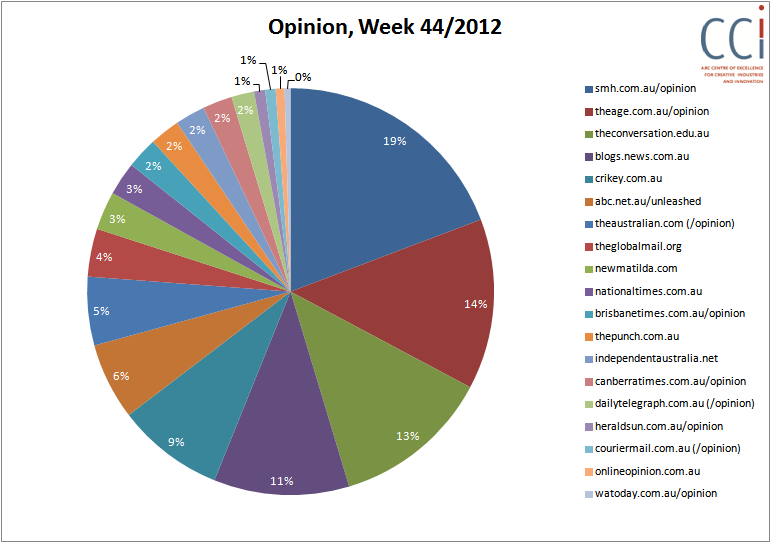
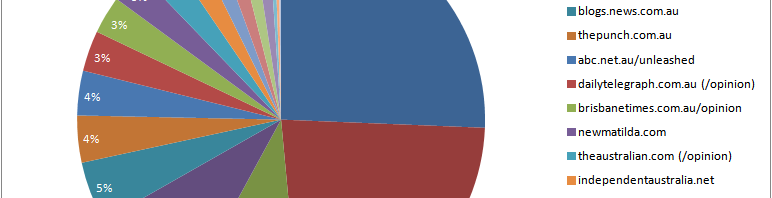
There’s usually more movement amongst opinion and commentary sites and sections, but even here there’s relatively little change this week. Overall, it’s been an average week for sharing Australian opinion articles on Twitter: the 22,000-odd tweets we captured are just above the long-term trend, and down 2,000 from last week.

image

Here, the most significant shift is the continuing rise of blogs.news.com.au, which surpasses Crikey to move into fourth place. But as with parent site news.com.au’s newfound popularity with spammers, there are some irregularities here: a single very active and highly partisan Twitter account is responsible for just under 1,300 of the 2,400 tweets which linked to blogs.news.com.au content; without its help, the site would be placed below The Australian’s opinion section.

I’ve refrained from excluding these tweets (and indeed from naming the account), because here we’re not dealing with a case of outright spam – as we did with the hair growth promotion – but a genuine, if hyper-active, form of engagement with the site. While the obsessive promotion of blogs.news.com.au articles which this account engages in might well be spamlike in style, it’s an attempt to make a political point (which, incidentally, is highly critical of the Labor government).

Of the blogs.news.com.au writers, the blogger most popular with this account is Andrew Bolt; almost 150 of Bolt’s articles are promoted in this way (one of them, in fact, is the subject of no fewer than 31 separate tweets). Piers Akerman (14 stories), Miranda Devine (12), Tim Blair (5) and Simon Benson (4) receive considerably less love. Let it never be said that the political commentariat in Australia doesn’t have some very committed fans!

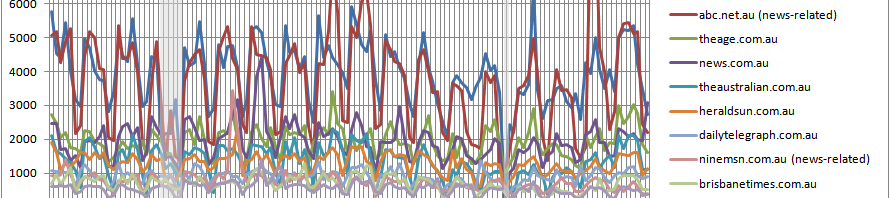
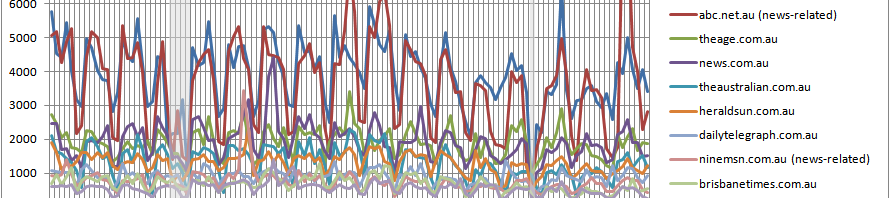
To the daily trends, then – and on the news front, things look comparatively quiet, with no notable spikes:

image

In fact, it’s only in the weekly aggregate that the key stories emerge. ABC News’ gallery of before-and-after photos from Sandy received some 1,150 links over the course of the week, and a link to the online livestream of ABC News 24 was shared some 400 times – indicating the significant concerns about the impact of the storm on the eastern seaboard, and the key role of the ABC as the go-to station for the liver coverage of major breaking news events. Further ABC stories relating to Sandy also featured highly. Over the same period, the major story in the Sydney Morning Herald was about revelations of hazing at Sydney University’s St. John’s College, shared more than 650 times; by contrast, Sandy figures only as a minor story.

What we’re seeing here, it seems to me, is an indication of the fact that in spite of their use of the Internet as a common medium for news dissemination, real differences in their approaches to reporting, and in the public perception of their journalistic focus, still persist between ABC and SMH – when live news breaks, its the public broadcaster that audiences turn to; when social and political scandals are revealed, it’s the newspaper.

The corresponding graph for the opinion and commentary sites and sections shows the impact of blogs.news.com.au’s newly-acquired fanboy: the orange line has lifted considerably from its long-term average:

image

There’s much less to say about the other sites. The Conversation has a strong day on Monday, but its close to 650 incoming links are shared across a range of stories of which none receive more than 80 tweets; what we’re seeing here is simply the usual ‘Monday effect’ which routinely causes an especially strong level of news sharing at the start of the week. The Age emerges in a strong position on Friday, led largely by a piece by Waleed Aly who questions the federal government’s plans to excise the entire Australian mainland from the migration zone which received some 350 tweets. On the weekend, finally, it’s the Sydney Morning Herald whose commentary is most widely shared – but here, too, Twitter-based audience engagement is spread widely across a broad range of stories. As far as opinion is concerned, this has been a very quiet week.

Stand by for this to change quite substantially as we move into week 45, though. No doubt the US election will generate plenty of local interest, and commentary, as well.

Twitter and Crisis Communication from #qldfloods to #sandy

My recent trip to a number of European conferences and other research events also provided an opportunity to present some of our ongoing work on the use of social media in crisis communication – as our ARC Linkage project with the Queensland Department of Community Safety and the Eidos Institute begins in earnest, this will continue to be a key area of research for us, of course.

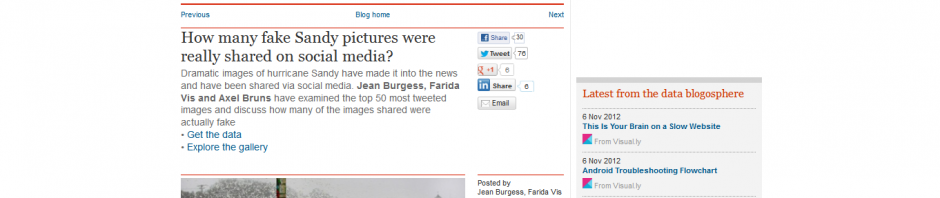
Before I get to this, though, to a bit of breaking news: Jean Burgess, Farida Vis and I have just published a brief study on the use of images in the coverage of ‘superstorm’ Sandy on Twitter, as it hit the U.S. east coast. The article, with attendant data and image gallery, was published in The Guardian‘s data blog – our sincere thanks for Simon Rogers for making this possible. Much more analysis of #sandy data to come at a later point, surely.

Back to some other crisis communication news: at the European Communication Conference (ECREA), I had an opportunity to outline the key findings from our work on the Queensland floods and Christchurch earthquakes, in a paper co-authored with my colleague Jean Burgess. This builds in part on our major report on the use of Twitter during the 2011 south east Queensland floods, which we released through the ARC Centre of Excellence for Creative Industries and Innovation in January 2012, as well as on related research work. Slides and audio are below.

Analysing Twitter Activity in Crisis Contexts from Axel Bruns

Further, I was invited to discuss our crisis communication research in a guest lecture to the international Masters programme at the University of Helsinki, earlier in October. There are some obvious overlaps between this talk and the AoIR presentation – but Helsinki gave me an opportunity to present our research in considerably greater detail. Here are the slides and audio:

Social Media and Crisis Communication from Axel Bruns


Twitter and the Media in Europe and Australia

A key theme in our recent research is the place of Twitter in the wider media ecology, globally as well as in specific domestic contexts. There are a number of ways that the relationship between Twitter and other media forms and platforms may be examined, and our papers at the AoIR conference in Manchester in mid-October pursued two directions, in particular: we investigated the use of Twitter as a backchannel to major television events, and explored the patterns of sharing mainstream news content on Twitter in Australia, building on our ATNIX initiative.

My colleagues Stephen Harrington, Tim Highfield and I recently published a brief outline of our approach to conceptualising the various dimensions of the relationship between Twitter and television, in a publication by the European “Transforming Audiences” research project; our joint paper at AoIR built on this framework to specifically explore the use of Twitter during the pan-European and Australian broadcasts of the Eurovision Song Contest 2012. The event highlights the importance of Twitter as a complement to live broadcasts – even in Australia, the delayed telecast on SBS becomes a live event again, and generates substantial Twitter activity in the process. Tim and I presented our paper on Eurovision as a double act; here are our slides and audio. A journal article on this topic should follow soon, hopefully.

#Eurovision: Twitter as a Technology of Fandom from Axel Bruns

Tim also led an investigation of a very different, but nonetheless widely tweeted live television event: the 2012 Tour de France. Here, audiences require even more stamina than they do for Eurovision: participation in the #tdf hashtag unfolds over several weeks, and involves a committed and at times deeply self-ironic television audience. Here's how Tim tells the story:

Tweeting le Tour: Connecting the Tour de France’s global audience through Twitter from Tim Highfield

Moving beyond television, but maintaining an emphasis on real-time communication, our continuing work on the Australian Twitter News Index (ATNIX) demonstrates how Australian news audiences on Twitter respond to the publication of news and commentary by the country's leading outlets. As ATNIX continues, we're increasingly able to track both short- and long-term trends, and are beginning to gain a more comprehensive perspective on what themes generate interest in the Australian Twittersphere; while that userbase is far from representative for the overall population, its demographics are such that it may particularly well reflect those Australians who follow news and politics on a daily basis, as Tim Dunlop recently noted at The Drum. In other words, news organisations of Australia: the Twitterati may not be 'the people' as such, but it's very much possible that they're your people – you might want to start treating them accordingly.

At any rate: here's what our work on ATNIX has brought to light so far – slides and audio below, and a book chapter will follow in the not-too-distant future.

Sharing the News: Dissemination of Links to Australian News Sites on Twitter from Axel Bruns

You can continue to follow further ATNIX updates here at Mapping Online Publics, of course, or through my column at The Conversation.


Twitter and the Emergence of ‘Big Data’ Research in the Humanities

In a previous post, I mentioned the new M/C Journal article on the impact which Twitter, Inc.’s tightening of its API rules has on research into the uses of Twitter. The use of data from the Twitter API is just one example of a broader development here, which is now frequently described as ‘big data’ research – new research approaches (or the adaptation of existing research methods) for dealing with increasingly large, digital datasets on social interactions in online spaces.

In this context, here are two presentations from my recent conference tour of Europe. First, I was invited to consider our ability to use ‘big data’ on social network usage to shed new light on the transformation of the Habermasian ‘public sphere’ in an increasingly Internet-based media ecology, as part of an ICA-sponsored panel at the European Communication Conference (ECREA) in Istanbul. My slides and audio are below; Maria Bakardjieva and Peter Lunt were the other two presenters of the panel.

Social Media, Big Data, and the Public Sphere from Axel Bruns

A week or so before ECREA, I was in Copenhagen to participate in a symposium on "Data – Lost, Found, and Made" which was organised by Klaus Bruhn Jensen at the Centre for Communication and Computing at the University of Copenhagen. There, I presented a wider overview of our work in the Mapping Online Publics project, and considered the overall role which our data-driven research approaches might play in the arsenal of humanities research methodologies, in the context of what David Berry has called the "computational turn" towards digital humanities research. (We also reprised that discussion in a panel at the Manchester AoIR conference a few days later, based on the Copenhagen symposium.)

Here are the slides and audio from the Copenhagen event – and you might also like to have a look at my live blogging from the symposium.

Twitter, Big Data, and the Search for Meaning: Methodology in Progress from Axel Bruns

Update:

In related news, today I spoke about our Twitter research at the University of Queensland Digital Humanities Symposium. That talk went over similar ground, discussing ‘big data’ Twitter research work as an example of where the digital humanities are heading. Here are the slides and audio:

ATNIX: Australian Twitter News Index, Week 43/2012

Before we get to the core of this week’s Australian Twitter News Index, a small excursion into the grubbier regions of the Twittersphere is necessary, I’m afraid. Every week, we track all the tweets which contain URLs that point to our basket of some 29 Australian news and commentary sites, and for the most part, the attention paid to those sites by their Twitter audiences is relatively stable. You can imagine my surprise when this week, I found a massive spike in links to news.com.au, therefore:

image

A few ups and downs in the total weekly number of links pointing to any one site are normal. Even substantial jumps aren’t out of the question if there are major events generating widespread coverage, as we saw with the significant number of international users linking to the ABC’s video of Julia Gillard’s anti-misogyny speech in week 41. But 27,000 tweets linking to news.com.au in one week – double the site’s long-term average – at a time when none of the other sites are similarly picking up substantial extra tweets? Something’s not right here.

And indeed: as it turns out, some 14,000 of the tweets we captured for news.com.au this week (exactly the margin by which the site surpassed its usual average) contain the hashtag #leimo, and often also additional links to the hair regrowth product www.leimo.com. What we’re seeing here – and I stress that I’m not suggesting that the company itself initiated this – is an organised Twitter spamming campaign to get the #leimo hashtag trending. The spammers do so by hijacking genuine news tweets: they pick out random stories, in this case from news.com.au, and tweet their headlines and URLs, but additionally also include their own hashtags and URLs; further, they draw on a whole network of fake accounts to widely retweet those news tweets. News.com.au wouldn’t have known what happened, and couldn’t have stopped it, either.

The ultimate aim of the exercise is to get the #leimo hashtag into Twitter’s list of trending topics. By using a variety of news headlines, the spammers hope to fool Twitter’s spam detection mechanisms, such as they are – the headlines and news URLs are real, after all, so the spam tweets may look real enough to get past the detection algorithms. It’s only when we compare the sudden spike in news.com.au activity with the site’s long-term average that those numbers begin to look as fake as a retired cricketer’s haircut. Lame-o…

In the following discussion of this week’s Australian news trends on Twitter, therefore, I’ve removed any tweets containing the term or hashtag ‘Leimo’ from the news.com.au dataset.

Standard background information: this analysis is based on tracking all tweets which contain links pointing to the URLs of a large selection of leading Australian news and opinion sites. For technical reasons, it does not contain ‘button’ retweets, but manual retweets (“RT @user …”) are included. Datasets for those sites which cover more than just news and opinion (abc.net.au, sbs.com.au, ninemsn.com.au) are filtered to exclude irrelevant sections of those sites (e.g. abc.net.au/tv, catchup.ninemsn.com.au). For our analysis of ‘opinion’ link sharing, we include only those sub-sections of mainstream sites which contain opinion and commentary (e.g. abc.net.au/unleashed, articles on theaustralian.com.au which include ‘/opinion’ in the URL), and compare them with dedicated opinion and commentary sites.

See the posts tagged ‘ATNIX’ on this site for a full collection of previous results.

ATNIX Week 43: 22-28 Oct. 2012

Despammed, this week’s ATNIX numbers are roughly comparable to week 42: we captured some 153,000 tweets containing links to Australian news sites this week, down 9,000 from last week. Unusually, though, the news-related sections of the ABC site just manage to beat the Sydney Morning Herald to first place; they may well have been helped in this by the temporary site outage due to an electrical fault which affected Fairfax sites this week. The rest of the leaderboard is virtually identical to last week’s:

image

The corresponding patterns for our opinion and commentary sites and sections are also relatively stable. At 24,000 tweets linking to these sites, we’re down a modest 2,000 from the previous week, and the top five sites retain their positions. Interestingly, the recently redesigned Global Mail has moved slightly backwards once again; this may indicate that the audience honeymoon with the new look is coming to an end. We’ll see how things track from here.

image

As always, though, the day-by-day patterns point us more specifically to the key stories of the week. For both ABC News and Sydney Morning Herald, week 43 was a relatively uneventful one, with news sharing patterns showing the usual strength on weekdays and decline during the weekend. The minor ABC spike on Wednesday which shows up in our daily news patterns is actually due to the 470 tweets about an article by Annabel Crabb in The Drum, on what she describes as Tony Abbott’s “foot-in-mouth problem”, which would be better counted towards the opinion numbers – but due to the ABC Website’s somewhat inconsistent URL scheme, Drum articles by its own staff will always show up here.

image

Meanwhile, the Friday bump for The Age is largely due to a piece by former professional cyclist Bradley McGee, writing about his reaction to the Lance Armstrong scandal. It’s quite likely that this article would also have picked up a number of international readers as part of the 700-odd tweets which linked to it.

The daily trends for links to opinion and commentary articles show a much more mixed picture, as they do so often. The Conversation starts us off with a strong Monday performance, but for no real reason – links to the site are distributed across a wide range of stories, led by some 100 tweets linking to the live stream of the symposium on the future of higher education. But it’s the Sydney Morning Herald which dominates the later parts of the week – leading especially with its republication of a piece by TV news anchor Tracey Spicer which first appeared in The Hoopla, in which she details the sexist treatment of female presenters in the news industry. Clearly, the public furore might have dissipated somewhat, but the Australian debate about sexism and misogyny still has some way to run – at the SMH, Spicer’s article picked up some 570 tweets, while a version of the same piece on the Age Website added 640 tweets.

image

Finally, there’s also been a notable growth in the number of tweets which link to blogs.news.com.au (the site which hosts the columns of a number of well-known commentators in the News Ltd. stable, including Andrew Bolt, Piers Akerman, and Tim Blair). Interestingly, though, much of that increase has been due to a single user, who has been sharing the posts published in these and other News Ltd. blogs with great dedication, usually under the #auspol hashtag and in a tone that is sharply critical of the Gillard government: some 720 of blogs.news.com.au’s total of 2200 links this week were from tweets made from a single account (and no, I won’t name the account here). Which almost brings us back to where we started – the basic principles and practices are more or less the same, but when is high-volume, one-track tweeting a form of legitimate political expression, and when is it simply spam?

New M/C Journal Article on the Harmful Effects of Twitter’s Corporate Policies

October has been a busy month – as those of you who follow my personal research blog may already have seen, our Mapping Online Publics colleague Tim Highfield and I have presented several papers at the Association of Internet Researchers (AoIR) conference in Manchester and the European Communication Conference (ECREA) in Istanbul. Additionally, I also presented guest lectures at the University of Helsinki and spoke at a symposium held by the Centre for Communication and Computing at the University of Copenhagen. My live blogging coverage from the CCC event, the AoIR conference, and the ECREA conference is over at snurb.info.

Over the next few posts, I’ll share our various papers and slides – and you can expect several of these papers to be converted into journal articles and book chapters in the near future as well. First, though, I need to flag a new article which Jean Burgess and I have published in the ‘list’ issue of the open-access M/C Journal. Taking our cue from the fact that the datasets we retrieve through the Twitter API constitute a form of list, we consider the impact of Twitter’s increasingly restrictive data access policies on our and our colleagues’ ability to conduct meaningful research. (And it’s especially ironic in this context that Twitter recently celebrated itself as an example of “the human face of big data“: if so, that face is increasingly hidden from view by Twitter’s access restrictions.)

In our M/C Journal article, we flag that

implicit in these changes is a repositioning of Twitter users (increasingly as content consumers rather than active communicators), but also of commercial and academic researchers investigating the uses of Twitter (as providing a narrow range of existing Twitter “analytics” rather than engaging in a more comprehensive investigation both of how Twitter is used, and of how such uses continue to evolve). The changes represent an attempt by the company to cement a certain, commercially viable and valuable, vision of how Twitter should be used (and analysed), and to prevent or at least delay further evolution beyond this desired stage. Although such attempts to “freeze” development may well be in vain, given the considerable, documented role which the Twitter user base has historically played in exploring new and unforeseen uses of Twitter, it undermines scholarly research efforts to examine actual Twitter uses at least temporarily—meaning that researchers are increasingly forced to invest time and resources in finding workarounds for the new restrictions imposed by the Twitter API.

There’s a real worry here that Twitter, Inc.’s attempts to commercialise the data generated by its users will only serve to harm Twitter itself; such an outcome would be tragic, given the significant utility of the platform which our own research has so frequently demonstrated. In addition to continuing our research into the uses of Twitter, we’ll continue to investigate these platform-political issues as well, of course.

Anyway – read more over at M/C Journal!

ATNIX: Australian Twitter News Index, Week 42/2012

Much has been said about the national and global response to Julia Gillard’s extraordinary attack on Tony Abbott, which dominated the Australian Twitter News Index for week 41/2012 – but sooner or later, we had to return to the day-to-day business of ‘normal’ news. That time is now – so let’s see what made news on Twitter this week.

Standard background information: this analysis is based on tracking all tweets which contain links pointing to the URLs of a large selection of leading Australian news and opinion sites. For technical reasons, it does not contain ‘button’ retweets, but manual retweets (“RT @user …”) are included. Datasets for those sites which cover more than just news and opinion (abc.net.au, sbs.com.au, ninemsn.com.au) are filtered to exclude irrelevant sections of those sites (e.g. abc.net.au/tv, catchup.ninemsn.com.au). For our analysis of ‘opinion’ link sharing, we include only those sub-sections of mainstream sites which contain opinion and commentary (e.g. abc.net.au/unleashed, articles on theaustralian.com.au which include ‘/opinion’ in the URL), and compare them with dedicated opinion and commentary sites.

See the posts tagged ‘ATNIX’ on this site for a full collection of previous results.

ATNIX Week 42: 15-21 Oct. 2012

To begin with, while week 42 wasn’t dominated by any single story in the way previous weeks had been (before the Abbott/Gillard stoush, we also had the Alan Jones saga, after all), it nonetheless registered as the week with the greatest overall number of links to Australian news sites being tweeted – at 162,000, week 42 narrowly surpassed the previous record set in week 33. Coming off a respectable 145,000 tweets last week, this reverses the pronounced slump in link sharing which we saw during weeks 36 to 40, when numbers dropped to less than 110,000.

image

It’s also obvious that the ABC Website’s news section had a particularly strong week: at more than 30,000 tweeted links, it came within a few hundred tweets of surpassing the Sydney Morning Herald in audience attention for a second week running – but this time, without benefitting from the added boost of thousands of tweets linking to its full-length posting of the Gillard speech. The rest of the leaderboard remains relatively steady.

image

There’s more movement amongst the opinion and commentary sites and sections, however. The total number of such links being shared on Twitter is down to 26,000 from last week’s record of over 29,000, unsurprisingly – but even this is still the second best result for this category since we started ATNIX in week 25/2012. Week 42 sees the Sydney Morning Herald continue to dominate opinion shares, while Fairfax stablemate The Age advances to second position. In sixth, The Australian also has an unusually strong week, while The Global Mail continues its post-redesign honeymoon. For the second week in a row, more than 1,000 tweets linked to the site – the weekly average before the site design was revised was less than 500.

A look at the weekly news sharing patterns reveals that we’re largely back to business as usual this week: ABC News and Sydney Morning Herald are neck-and-neck, at least on weekdays, and while the overall volume of tweets is unusually high, there are no particularly pronounced spikes in activity on any one day:

image

An exploratory look at the sharing patterns for the ABC site demonstrates this: attention is split across a range of stories, with no particular frontrunner. On Monday, a Four Corners story about Lance Armstrong leads the way with 300 tweets; on Tuesday, that piece adds 500 more. But even such numbers account for only a small part of the total of over 5,000 tweets which linked to ABC news content on each of these days.

Wednesday sees more than 300 links to a report that the Macquarie Dictionary will revise its definition of ‘misogyny’ following the Gillard speech; on Thursday, the leading story is that Alan Jones will be made to take basic journalism training (but even that piece gets fewer than 200 tweets); on Friday, Australia’s win of a non-permanent seat on the UN Security Council leads with over 300 tweets. I highlight these numbers only to show how thoroughly mixed and unexceptional week 42 turned out to be – but perhaps it’s precisely this ‘something for everyone’ nature which resulted in such a high level of audience engagement?

image

There’s slightly more to be said about the sharing of opinion and commentary articles: here, as on many weeks, we do see a much more pronounced fluctuation in attention to specific sites. And once again, some of these spikes are driven by the overseas take-up of domestic stories: the SMH opinion section’s strong performance during 17 and 18 October is due to over 520 links to a piece which reveals how Australia and the US shared intelligence on Julian Assange.

The more purely domestic story about Jones’s remedial journalism training gains another 230 tweets for the site, while political editor Michelle Grattan’s article about how the Prime Minister lost her shoe during a visit to India was cited in 170 tweets linking to the Sydney Morning Herald, and in as many tweets which linked to the same piece at The Age – quite a few of which, it has to be said, questioned the wisdom of having a seasoned political journalist report about footwear malfunctions.

ATNIX: Australian Twitter News Index, Week 41/2012

This week’s ATNIX was always going to be centrally about one thing: Australian Prime Minister Julia Gillard’s extraordinary, sustained, and (it seems?) largely unscripted attack of Opposition Leader Tony Abbott’s misogynistic worldviews (as she describes them). The fact that, as I write this from a Copenhagen hotel room, the 15-minute video of what can only be described in modern language as her pwning of Abbott is listed as the second most prominent video even on the Danish version of YouTube speaks volumes about the extent to which footage of the speech has gone viral throughout the world. As has been reported, even supporters of President Obama in the US are now imploring him to take the fight to Mitt Romney in the next election debate with the unrelenting ferocity that Gillard had shown in her speech. So, let us turn to our Australian Twitter News Index to see just how much domestic and international traction articles related to the speech have received – and to examine whether any other stories managed to cut through the noise.

Standard background information: this analysis is based on tracking all tweets which contain links pointing to the URLs of a large selection of leading Australian news and opinion sites. For technical reasons, it does not contain ‘button’ retweets, but manual retweets (“RT @user …”) are included. Datasets for those sites which cover more than just news and opinion (abc.net.au, sbs.com.au, ninemsn.com.au) are filtered to exclude irrelevant sections of those sites (e.g. abc.net.au/tv, catchup.ninemsn.com.au). For our analysis of ‘opinion’ link sharing, we include only those sub-sections of mainstream sites which contain opinion and commentary (e.g. abc.net.au/unleashed, articles on theaustralian.com.au which include ‘/opinion’ in the URL), and compare them with dedicated opinion and commentary sites.

See the posts tagged ‘ATNIX’ on this site for a full collection of previous results.

ATNIX Week 41: 8-14 Oct. 2012

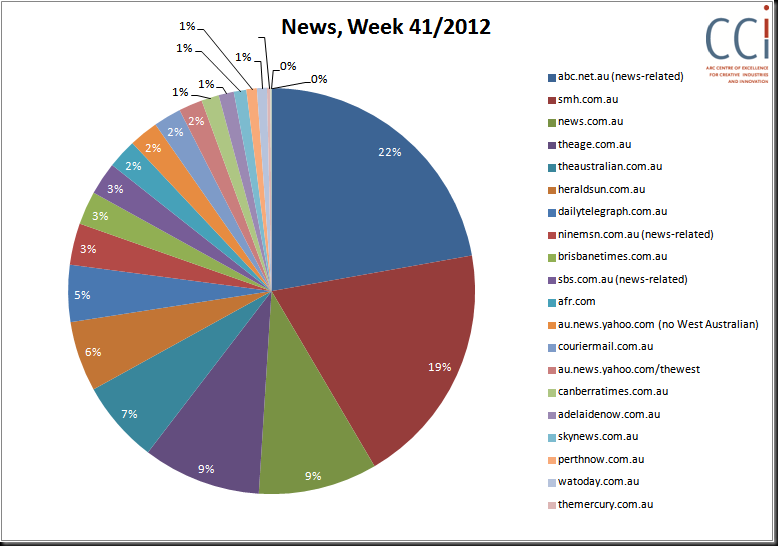
First off: with the video and related stories going viral, this was one of the bigger weeks for ATNIX to date. With some 145,000 tweets linking to Australian news sites, the volume of shared news links jumped by more than 30,000 since last week – and as is often the case, we can assume that a significant proportion of these will have been shared by international users. The result is extraordinary: for the first time in seven weeks, links to the ABC Website’s news sections managed to outnumber those to the Sydney Morning Herald – and for the first time since we’ve been running ATNIX, they do so by several thousand tweets.
image

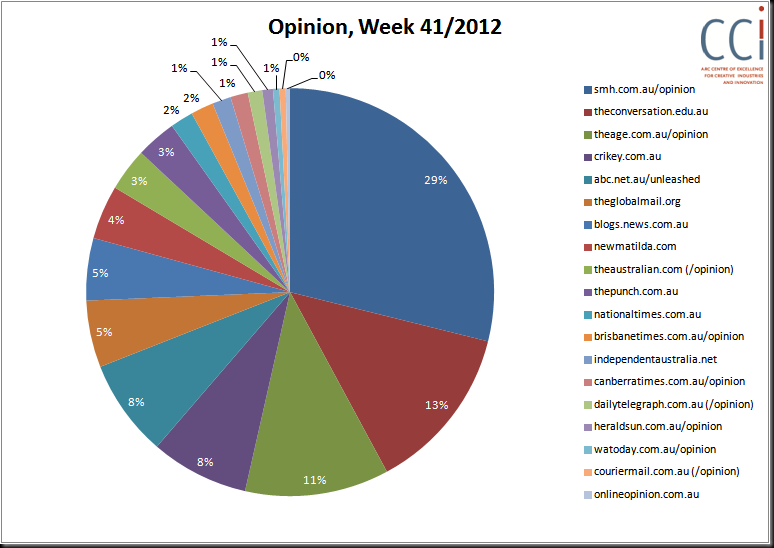
Opinion links are also up, and by almost 50% compared to last week – as a result, the more than 29,000 tweets which linked to Australian opinion and commentary sites and sections constitute an all-time record for ATNIX, well above the record of 24,000 such tweets which we set in week 34. Here, the SMH retains its dominant position, although the ABC’s The Drum (at abc.net.au/unleashed) puts in a particularly strong performance as well.
image

The real surprise here, however, is non-profit long-form journalism site The Global Mail: for as long as we’ve been running tracking ATNIX, the site had been languishing in the very minor placings – largely as a result of its stylish but badly overwrought design. Last week, only some 300 tweets shared links to the site, for example – but following a comprehensive redesign for better accessibility, that number has increased by a factor of more than five: more than 1,550 tweets linked to The Global Mail during week 41/2012. It remains to be seen, of course, whether this is will be more than a blip in the site’s otherwise dismal ratings as prospective users express their relief at the redesign – but GM staff should feel cautiously encouraged by this result.

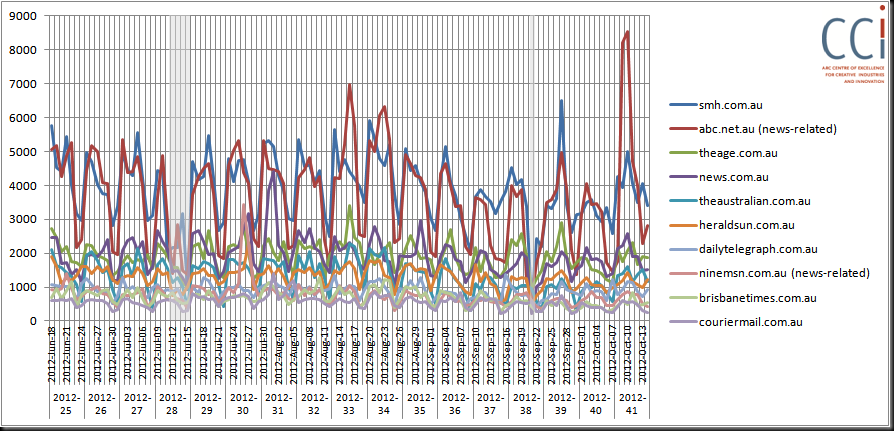
But the real story of ATNIX for week 41/2012 is in the daily numbers, of course – and the star performer (next to Gillard herself) is ABC News. On two consecutive days, it receives a record level of more than 8,000 links from tweets – and the main target of these links, included in some 6,300 tweets over the course of 9 and 10 October, is the full, 15-minute video of Gillard’s attack on Abbott. Other stories pale by comparison: at some 600 links, the next highest ranked story during those two days receives less than ten per cent of the Gillard video – but all but two of the top ten ABC links during these two days deal with Gillard and/or Abbott. The only exception are two stories relating to a 7.30 piece on self-immolation as a form of political protest in Tibet.
image

We should note that the carryover of such heightened levels of activity into a second day is very rare – and in this case clearly indicates the global virality of the story: as Twitter users in other timezones continued to share the video, its popularity (and the incidence of links to the ABC site) continued through a whole 24-hour news cycle. In fact, while only adding a little less than 400 more tweets to its tally, the video remained the most tweeted item on the ABC News site even on 11 October.

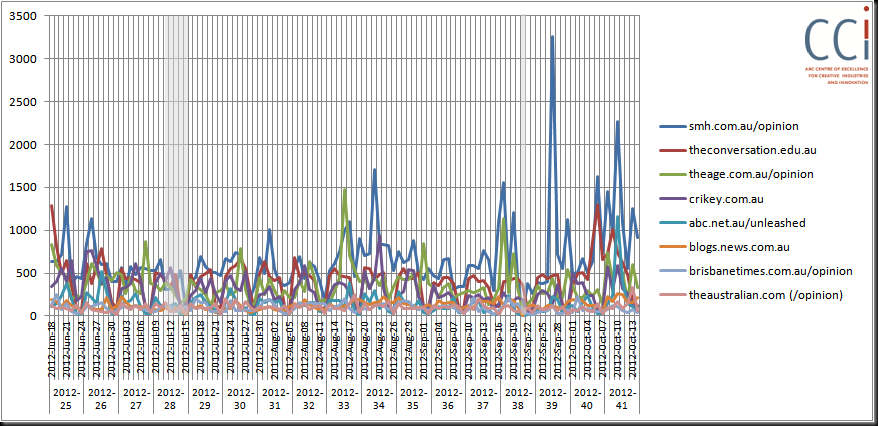
But while the ABC clearly wins the news race – with a simple post which does no more than present the Gillard video itself, incidentally –, amongst the opinion and commentary sites and sections the week is more of a free-for-all. Most of the leading sites squeeze in a sizeable spike or two, but it’s the Sydney Morning Herald which leads the pack and records its second best one-day performance in the time we’ve run ATNIX.
image

Indeed, the SMH spikes work well as a documentation of the rapid pivot in the Australian misogyny debate, from Alan Jones to Tony Abbott: while on Monday, Mike Carlton’s “Prissy Shrieks of Fear and Loathing”, a portrait of Jones, adds to its performance from the previous Saturday by picking up another 350-odd links, by Wednesday Jones is ancient history, and the Gillard/Abbott stoush is front an centre.

Columnist Paul Sheehan’s rather oddly written piece which criticises Gillard for playing the ‘gender card’ leads the day, receiving some 700 tweets; a second article, by political editor Peter Hartcher, takes the same line, and picks up some 300 more links. Many of them, it’s worth noting, are far from supportive, so tweeting about them cannot be seen as endorsement – indeed, many readers took issue especially with a line in Sheehan’s piece which pointed out that Abbott had “raised three daughters, something [Gillard] was unable to do” which was subsequently excised from the article.

By Saturday, though, the wind had turned even at the SMH, and author Julia Baird provides a counterpoint to the senior editors’ attempts at ‘mansplaining’ away Gillard’s attack: her spirited defence of the speech is linked to by close to 600 tweets that day.

The discussion in the Sydney Morning Herald’s opinion pieces is emblematic of a wider debate which would quickly become the second(ary) story of the week: the Canberra press gallery’s almost unanimously negative reaction to Gillard’s speech, which appeared well out of step with the highly positive reviews which it received in media coverage around the world, and from many everyday Australians.

What also appears to emerge here, as the SMH coverage itself already hints at, is a substantial disconnect especially between many senior Australian editors and journalists on the one side, and more junior, often independent, opinion writers on the other. If charges of ‘groupthink’ are to be levelled at the press gallery in the future, their coverage of this week’s events are likely to take pride of place as Exhibit A from now on.

And the criticism has been widespread. Much as Baird’s article in Saturday’s SMH provides a counterpoint to the prevailing post-speech media narrative, so is the Wednesday spike for the ABC’s The Drum section driven by journalist Anne Summers’s positive response to Gillard’s speech (some 720 links), and by independent columnist Tim Dunlop’s critique of the Australian news media’s coverage of both the Jones/Gillard and the Gillard/Abbott debate (some 610 links). Author Susan Mitchell adds her views on Crikey, driving its spike on the same day by drawing some 220 tweets which linked to her article.

Something tells me this debate isn’t over yet. What’s next?
ATNIX: Australian Twitter News Index, Week 40/2012

As I write this, the controversy over Alan Jones’s indefensible remarks about the Prime Minister’s late father continues – fuelled by Jones’s belligerent apology, the withdrawal of advertisers from Jones’s show, and radio station 2GB’s embarrassing attempts to portray Jones and itself as the victims of cyberbullying, or even of cyberterrorism. News of Jones’s remarks at a Sydney University Liberals fundraiser broke during the final days of September, and made an impact only on the final days of last week’s Australian Twitter News Index – this week’s edition is where we’d expect to see any real activity related to the issue, if we are to see any at all.

Standard background information: this analysis is based on tracking all tweets which contain links pointing to the URLs of a large selection of leading Australian news and opinion sites. For technical reasons, it does not contain ‘button’ retweets, but manual retweets (“RT @user …”) are included. Datasets for those sites which cover more than just news and opinion (abc.net.au, sbs.com.au, ninemsn.com.au) are filtered to exclude irrelevant sections of those sites (e.g. abc.net.au/tv, catchup.ninemsn.com.au). For our analysis of ‘opinion’ link sharing, we include only those sub-sections of mainstream sites which contain opinion and commentary (e.g. abc.net.au/unleashed, articles on theaustralian.com.au which include ‘/opinion’ in the URL), and compare them with dedicated opinion and commentary sites.

See the posts tagged ‘ATNIX’ on this site for a full collection of previous results.

ATNIX Week 40: 1-7 Oct. 2012

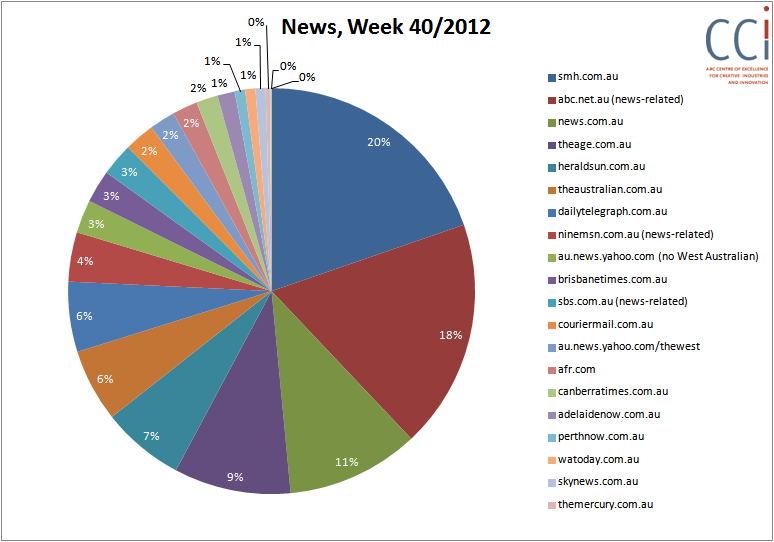
The first observation we must make for the new week, though, is that Alan Jones is no Julian Assange: however much outrage his comments may have prompted in Australia, they remain a purely domestic issue. The total number of tweets containing links to the Australian news sites we track, therefore, is down, not up: as last week’s Assange bump washes out of the system, some 112,000 tweets remain, and the day-to-day news sharing patterns on Twitter return to comparative normality.

So do the lead sites, for the most part: the Sydney Morning Herald and the news sections of the ABC maintain their usual share of the total volume of links exchanged this week, and only news.com.au moves into an unusually strong third place ahead of The Age. All of this points to the observation that political controversies such as Jones’s comments may shift the focus of the links which Australian Twitter users are sharing – but they do not necessarily increase the overall volume of links being shared in this way. We don’t consume more information: what changes is which information we consume.

image

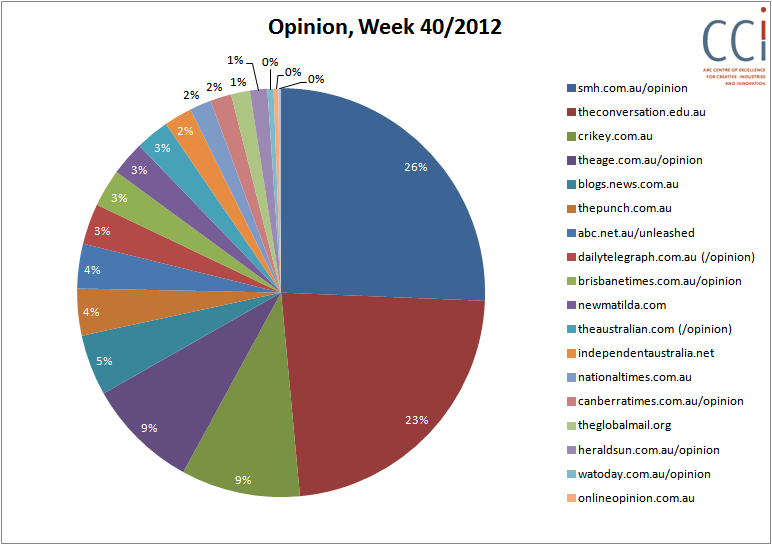
As a result, we will always see greater fluctuations in the volume and distribution of links to opinion and commentary sites and sections. During weeks without major controversies, the relative prominence of such articles within the total volume of links being tweeted will be smaller; at times when major points of contention are being discussed by Australian Twitter users, on the other hand, a greater number of links to further commentary will be shared.

So, even in spite of the comparatively lower volume of news links being shared this week (in the absence of new Assange articles or other material of international interest), the number of commentary links managed to increase slightly, to a six-week high of just over 20,000 – and as usual, it’s the SMH opinion section and The Conversation which command the majority of the attention (at a combined total of just under 50%). Crikey has a good week as well, moving into third place for now.

image

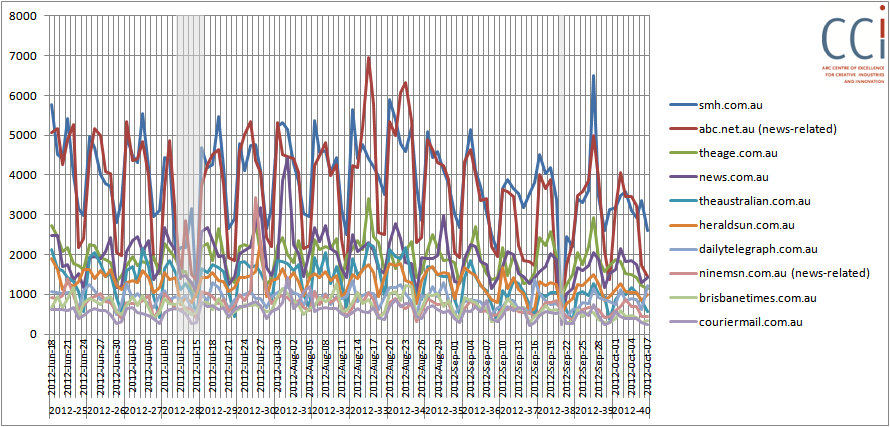
Given these patterns, there isn’t a great deal to say about the day-to-day sharing of news links: it’s a relatively quiet week on the news front, with the ABC’s strong Tuesday performance led by articles on the dire state of Barrier Reef corals (some 200 tweets) and John Laws’s critical assessment of Jones’s comments (175 tweets). The relatively small contribution which even these leading articles make to ABC News’ Tuesday total of just over 4000 tweeted links already points to the comparatively wide spread of what news articles Australian Twitter users shared this week, however.

The spike in links to news.com.au, also on Tuesday, is somewhat more interesting by comparison, mainly because the most tweeted link to the site (some 150 tweets) points to a photo of Opposition Leader Tony Abbott, Bronwyn Bishop, and Sophie Mirabella in front of a poster reading “Juliar…. Bob Brown’s Bitch” – pointing out that incivility in the political arena has been far from limited to Alan Jones in recent years.

image

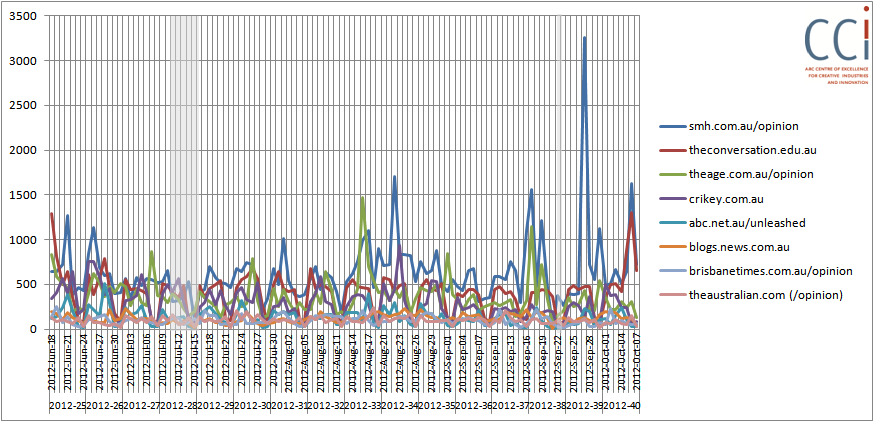
But the real story, once again, is in opinion and commentary, and takes some time to materialise. Ignore the Assange-related mid-week spike in week 39: as far as domestic issues are concerned, it’s once again the weekend which sees the most significant sharing of opinion and commentary links by Australian Twitter users. It may be an exaggeration to say quite categorically that weekdays are for news, and weekends for opinion – but the Jones story, at least, has been one centred on weekends so far. (The one exception from that rule, for week 40, is Crikey, where First Dog on the Moon’s cartoon about Jones’s apology was responsible for one third of the tweets which pointed to it on Monday.)

image

Central to that story, once again, is the Sydney Morning Herald’s opinion section: Mike Carlton’s inimitably titled portrait of Jones, “Prissy Shrieks of Fear and Loathing”, received some 920 tweets that day, accounting for well over half of all tweets linking to the SMH opinion section. For The Conversation, the balance of tweets is even more lopsided – but here, they point to an article which relates to the Jones saga, if at all, only in a very roundabout fashion: Patrick Stokes’s article “No, You’re Not Entitled to Your Opinion” accounted for some 1,120 of the 1,300 tweets which linked to the site that Saturday.

So, while much will continue to be made of the social media response to Jones’s comments, to his half-hearted apology, and to his employer’s glass-jawed “cyberbullying” complaints (which serve only to undermine the important campaign against actual cyberbullying), it turns out that these debates affect the ongoing process of news sharing on Twitter only to a limited extent. The Jones controversy manifests mainly in the opinion articles which are being shared, and even there the focus is squarely on a handful of key pieces; at the same time, other news is still getting through as well.

Australian Twitter users aren’t quite as rabidly obsessed with Jones as 2GB might like to imagine (because that, at least, would mean he’s still relevant to Australian political discourse) – most of us, I suspect, just wish he’d finally finish digging that hole for himself.