Twitter, the Queensland Floods, and the ABC

And finally for our series of conference presentations over the past couple of weeks, here’s our talk from the Commonwealth Broadcasting Association conference in Brisbane last week. This was a bit of a strange one, as the conference schedule meant that we had to present it three times – Jean did the first one, and I the other two, alongside Anthony Baxter from Google.org and Gabby Shaw from ABC Innovation. Below are the slides and audio from the second run (my first); Jean tells me the conference also did a video recording of her talk, so if that surfaces somewhere we’ll add a link to it as well.

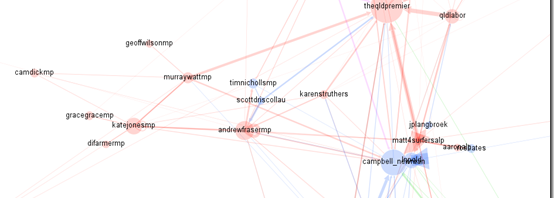
In keeping with the conference theme, “Media Leadership in Crisis, Disaster and Emergency”, we presented our research into the role of Twitter in the Queensland floods, but focussed here especially also on the intersections between mainstream and social media and the specific contributions of the Australian public broadcaster, the ABC, in this context. This also provided an opportunity again to show some of our research into the overall shape of the Australian Twittersphere (which we shared at the Digital Humanities Australasia conference in Canberra recently), and to examine the specific position of the ABC within it. More on that soon!

Twitter and Disaster Resilience: Lessons from #qldfloods and #eqnz

We’re doing quite a few presentations of our crisis communication research at the moment. A few days after our ANZDMC presentation, I flew down to Melbourne to run a workshop on social media and disaster resilience together with Chris Fisher from the Queensland state Department for Community Safety, as part of the Disaster Resilient Communities conference.

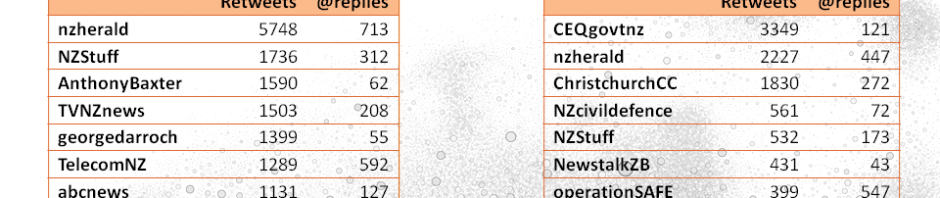
My contribution to the workshop was to present in some detail the research into uses of Twitter in disasters which we’ve been engaged in, and I’m including the two parts of my presentation below. There was a fair amount of interaction and discussion with the workshop participants during these presentations, but I’ve edited out those discussions from the audio attached to the slides, both because participants were hard to hear on the recording and because they may not want to have their questions and ideas broadcast beyond the workshop itself. Hope the recording makes sense without their contributions.

Earthquakes on Twitter: Analysing the Four Christchurch #eqnz Events

Continuing the catch-up with recent publications and presentations, I also wanted to share the paper which Jean Burgess and I presented at the Australia New Zealand Disaster and Emergency Management conference in Brisbane last week. The paper (slides and audio are below) constitutes our most comprehensive analysis to date of the use of Twitter in the 2010/11 Christchurch earthquakes – focussing especially on the most damaging event on 22 February 2011.

In particular, we examine the evolution of the Twitter user community and its activities over time – both in the short term over the fortnight following the February quake, and in the longer term through a comparison of the four major tremors between September 2010 and December 2011. These repeated events provide us with a useful indication of how Twitter use changes and evolves from one crisis to the next, building on the experience of its users in earlier events – but we do hope that there will be no further major earthquakes in Christchurch which add to this dataset…

In addition to the presentation itself, a full peer-reviewed paper will also be published as part of the ANZDMC proceedings – we’ll add it to this post and list it on our publications page once it’s available.

Tracking Twitter: yourTwapperkeeper and Other Options

Well, it was about time we refreshed the look of Mapping Online Publics – hope you like it… A few posts on recent activities have been held up while we were working on the redesign, so expect some catch-up articles over the next little while.

First off the rank: with one of our colleagues at the National Cheng Chi University in Taipei, Eugene Liang (whom Jean and I visited in October last year), I’ve just published a new article in First Monday which reviews some options for tracking user activities on Twitter. Our focus here is largely on doing so in the context of crisis communication, but much of what we have to say also translates to other applications.

My contribution to the paper is to outline what we’ve been able to do by using yourTwapperkeeper (and more details on this are all over this Website, of course), while Eugene takes us beyond that approach to discuss the work which he and his colleagues have done in developing a more comprehensive, custom-made platform for tracking Twitter activities at scale. Abstract below:

Tools and Methods for Capturing Twitter Data during Natural Disasters

Axel Bruns and Eugene Liang Yuxian

During the course of several natural disasters in recent years, Twitter has been found to play an important role as an additional medium for many–to–many crisis communication. Emergency services are successfully using Twitter to inform the public about current developments, and are increasingly also attempting to source first–hand situational information from Twitter feeds (such as relevant hashtags). The further study of the uses of Twitter during natural disasters relies on the development of flexible and reliable research infrastructure for tracking and analysing Twitter feeds at scale and in close to real time, however. This article outlines two approaches to the development of such infrastructure: one which builds on the readily available open source platform yourTwapperkeeper to provide a low–cost, simple, and basic solution; and, one which establishes a more powerful and flexible framework by drawing on highly scaleable, state–of–the–art technology.

Many Maps of the Australian Twittersphere

I spent most of last week at the Digital Humanities Australasia conference in Canberra (see my liveblog coverage), where I presented the latest iteration of our map of the Australian Twitter follower/followee network. This is now based on a total dataset of some 950,000 users, from which we’ve selected the most connected 120,000 for visualisation.

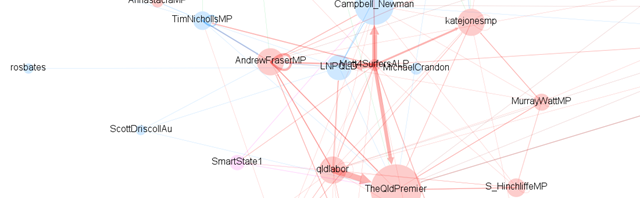
A number of very interesting patterns are emerging from this. In addition to confirming some of the clustering tendencies which we already observed in the previous map (then based on data for some 550,000 users), I’ve also been able to overlay activity data for some of the #hashtags we’ve tracked over the past couple of years – so for the first time, we’re seeing those hashtags in the wider context of Twitter user networks in Australia.

Here’s my presentation, with audio from the talk:

Mid-Week #qldvotes Update: How the Leaders Compare

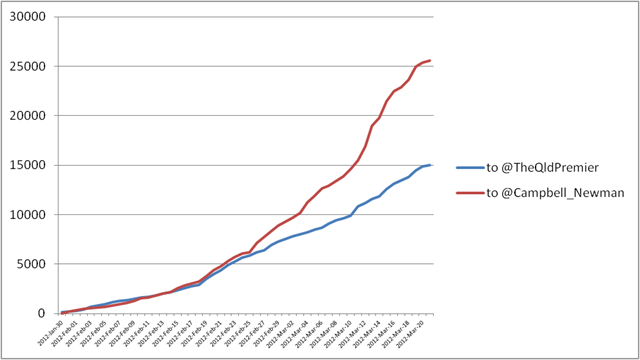
As we count down to the Queensland state election date, I’ve just published a new piece about the Twitter campaign in The Conversation – head over to the site to read it there. The centrepiece of the story is this graph of @mentions of the two leaders’ accounts throughout the election campaign, though – it striking that opposition leader @Campbell_Newman has now pulled well clear of @TheQldPremier Anna Bligh.

to

Continue reading “Mid-Week #qldvotes Update: How the Leaders Compare”

Queensland Election, Week 4: All Over But the Shouting?

There’s just one more week to go until the end of the 2012 Queensland state election campaign – and as I write this, the tenor of the mainstream media coverage is that we’re heading for a landslide election win for the conservative LNP. So, let’s take another look at the way the election has played out on Twitter over the past week (our coverage of the previous weeks is here: preliminary overview, week 1, week 2, and week 3).

Before we get started, I’m also happy to report that our research to date has been featured in a great piece on the ABC’s 7.30 Queensland programme, which is available here, and embedded below:

Also, another brief reminder about the nature of the data we’re looking at for this study: we’re working off a dataset which contains tweets from and to all the candidate accounts we’ve been able to identify so far (drawing on the Courier-Mail’s Twitter list of accounts). Included in our dataset are all tweets which were either sent by those accounts, or @mention them (in the form of @replies or manual retweets).

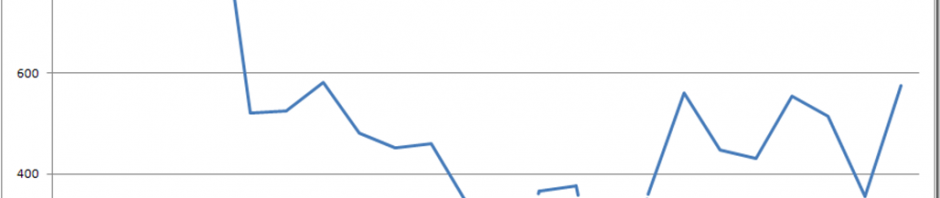
I’ll get to the usual stats for leading politicians’ accounts in a minute – but given the significant shifts in public sentiment towards the LNP and its lead candidate Campbell Newman, let’s also have a look at some of the key moments in public discussion this week. To begin with, here’s the total volume of tweets to and from the candidates over the past seven days (I write this on Sunday, so our data for 18 March only includes tweets up to noon):

Continue reading “Queensland Election, Week 4: All Over But the Shouting?”

Queensland Election, Week 3: The Twitter Story to Date

Having caught up with developments in week 2 in the previous post, let’s bring the story up to date by looking at activity patterns on Twitter during week 3 of the Queensland state election. This post covers the period of 5-11 Mar. 2012, then (except that 11 March isn’t quite over yet, so we’ll be missing whatever happened after midday). As before, we’re working off a dataset which contains tweets from and to all the candidate accounts we’ve been able to identify so far (drawing on the Courier-Mail’s Twitter list of accounts). Included in our dataset are all tweets which were either sent by those accounts, or @mention them (in the form of @replies or manual retweets).

Before we get to the week’s tweets, though, I thought it would also be useful to take stock of the campaign so far – from the start of the ‘phoney’ election campaign in late January through to the official start of the election period on 19 Feb. through to yesterday. Here’s the overall volume of tweets, and the number of unique users participating, on a day-to-day basis. Clearly, there’s a gradual growth in activities, boosted substantially on 19 Feb. as the election is officially announced. Over the past three weeks, we’re also seeing some obvious weekly patterns; activity on the weekends is markedly lower than on weekdays (and fewer users are participating, too). Additionally, the weeks themselves seem somewhat front-loaded – there appears to be more activity during the early weekdays than towards the latter part of the week. Perhaps this is an indication of the week’s pre-planned talking points being rolled out by each party’s political operatives?

Continue reading “Queensland Election, Week 3: The Twitter Story to Date”

Queensland Election, Week 2: Some More Twitter Patterns

OK, so much for my plan to post a weekly update on the way the Queensland election is playing our on Twitter: I spent most of week 2 at a research workshop in Sydney, and didn’t get around to posting an update that weekend. So, this weekend, you get two for the price of one: this post, catching up on arisings in the week from 27 Feb. to 4 Mar., and a follow-up which will bring us up to date again.

First off, a reminder: what I’ve done in week 1, and will continue to do here, is to look not at the #qldvotes or #qldpol hashtags (those are interesting too, but we’ll leave them for another time), but at tweets from and two all the candidate accounts we’ve been able to identify so far (with some help from the Courier-Mail, which maintains a useful Twitter list of almost all accounts). So, what’s included in our dataset are all tweets which were either sent by those accounts, or @mention them (in the form of @replies or manual retweets). In addition to the politicians themselves, we’re also including a few party accounts, as well as the account of former Premier Peter Beattie.

Continue reading “Queensland Election, Week 2: Some More Twitter Patterns”

Does The Australian’s Paywall Affect Link Sharing?

There will be another post on the continuing Queensland election campaign soon, but before we get to that, I wanted to push out another quick snippet of analysis which I’ve been hoping to get to for some time. For several months now, we’ve been capturing tweets which include links to a number of major Australian news and opinion sites. We’re able to capture such tweets even if the links are wrapped in one or more layers of URL shortening (via bit.ly, t.co, etc.) – so even if the tweet itself reads something like

Opposition gets Malaysia deal wrong http://t.co/DH3quv86

it will be included in our dataset.

(In fact, just to work through this example, here’s how that link resolves: http://t.co/DH3quv86 > http://bit.ly/omcBt0 > http://www.google.com/url?sa=X&q=http://www.theaustralian.com.au/national-affairs/opinion/opposition-gets-malaysia-deal-wrong/story-e6frgd0x-1226137247377&ct=ga&cad=CAcQARgAIAAoATAAOABAm_jC8wRIAlAAWABiBWVuLVVT&cd=GuZ8wAwkEaQ&usg=AFQjCNFJehe4mpkMiFiNCWt8Ey9kWT42jw&utm_source=twitterfeed&utm_medium=twitter > http://www.theaustralian.com.au/national-affairs/opinion/opposition-gets-malaysia-deal-wrong/story-e6frgd0x-1226137247377. That’s a lot of unshortening…)

Continue reading “Does The Australian’s Paywall Affect Link Sharing?”