Queensland Election, Week 1: Some Twitter Patterns

So, after a long ‘phoney campaign’ over the past months, the first week of the Queensland state election campaign proper is finally behind us – even if it has been largely overshadowed by the federal Labor leadership ructions. Following up on my first post examining the Twitter profiles of the ALP and LNP party leaders and their deputies, I thought I’d have a closer look at how things have unfolded over the past week.

The Key Accounts

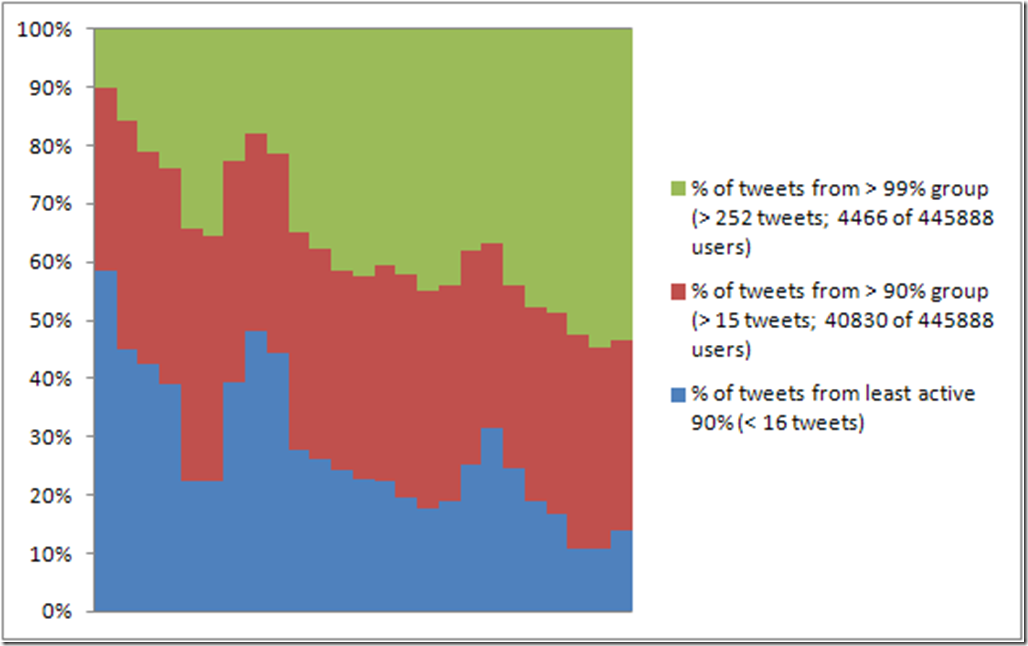
So, let’s have a look at the activities of the principal accounts since 19 Feb. 2012. In addition to the Premier Anna Bligh (@TheQldPremier) and her deputy Andrew Fraser (@AndrewFraserMP), and opposition candidate for Premier Campbell Newman (@Campbell_Newman) and deputy opposition leader Tim Nicholls (TimNichollsMP – remember, the nominal parliamentary opposition leader Jeff Seeney isn’t on Twitter), I’m also including a handful of other accounts here: that of Ashgrove MP Kate Jones (@katejonesmp), whom Newman must defeat in order to enter parliament in the first place; that of former ALP Premier-turned-election commentator Peter Beattie (@SmartState1), and that of the LNP party organisation itself (@LNPQLD – we’ve only just added its opposite number, @QLDLabor, to our tracker, and don’t have sufficient data yet).

Continue reading “Queensland Election, Week 1: Some Twitter Patterns”

Queensland Politicians on Twitter: Some Initial Observations

Well, the Queensland state election is about to start in earnest: Premier Anna Bligh is expected to visit the Governor tomorrow to ask her to resolve parliament and call an election for the end of March. As we’re approaching that time, I’ve been starting to get a few media enquiries about the role social media are likely to play in the election – and we’re tracking developments for our international elections research project, too.

In preparation, I’ve started to have a look at the activities of some of Queensland’s leading politicians (some 60 candidates are on Twitter so far, as far as I can tell – quite a healthy number), and I thought I’d share my initial observations here. So, let’s look in turn at the two major candidates for the Premiership, and their deputies:

Continue reading “Queensland Politicians on Twitter: Some Initial Observations”

Resolving Short URLs: A New Approach

When working with Twitter data, one of the most interesting questions is always what URLs tweets are linking to. As Twitter users discuss any given topic or issue, the URLs they share provide us with an indication of the online media they’re drawing on for information and/or entertainment – and by counting which sites appear most frequently, we’re also able to measure the relative visibility or relevance of such sites).

But of course, there’s a complication: the vast majority of URLs in tweets have been shortened using a variety of URL shorteners, and multiple short URLs may point to the same eventual target; additionally, it’s even possible – and not too uncommon – for shortener nesting to occur: for example, a bit.ly short URL might subsequently be shortened by ow.ly, and finally by t.co, in the course of retweeting. Working with the short URLs themselves is less than useful, therefore – and we must find ways to resolve them to their eventual target.

Continue reading “Resolving Short URLs: A New Approach”

More Twitter Metrics: Metrify Revisited

About a month ago I introduced my new Gawk script metrify.awk, which generates a wide range of Twitter metrics for a given Twapperkeeper/yourTwapperkeeper hashtag or keyword archive. Even as I was writing those posts, though – and certainly while playing with the language metrics I discussed in my last post -, I started to find a few areas where metrify could provide even more information on the dataset. So, the time has come for a first service release which upgrades metrify.awk to add some more functionality (and fix a few inconsistencies along the way). This is a revision rather than a full rewrite of the script, so let’s call it metrify 1.2; it’s now available for download here, where it replaces the older version.

As before, the new version of metrify.awk is called as follows:

gawk -F , -f metrify.awk time=”[year|month|day|hour|minute]” [divisions=x,y,z,…] [skipusers=1] input.csv >metrics.csv

(divisions defaults to ‘90,99’ – i.e. a 90%/9%/1% split of the userbase – if it is not specified).

Continue reading “More Twitter Metrics: Metrify Revisited”

Call for Papers: Emerging Methods for Digital Media Research

Another brief announcement: along with our CCI colleague Larissa Hjorth, Axel and I are looking forward to editing a special issue of the Journal of Broadcasting & Electronic Media (JOBEM) on the theme “Emerging Methods for Digital Media Research”, due for publication in March 2013. If you work in a related area, please consider submitting an abstract by the March deadline. Details follow below.
Continue reading “Call for Papers: Emerging Methods for Digital Media Research”

Creating Basic Twitter Language Metrics

OK, this may be a somewhat esoteric subject for researchers who mainly work with Twitter data from specific countries and cultures, but over the past few weeks I’ve been working on a paper that analyses Twitter activities in the #egypt and #libya hashtags – and as part of that work, I’ve been interested in exploring the interactions between users tweeting in Arabic and users tweeting in other languages (mainly in English). Unfortunately, there’s no reliable means of identifying the language of specific tweets, or of the users who post them; while the Twitter API provides an ISO language code (e.g. ‘en’ for English, ‘no’ for Norwegian, etc.) for each tweet, this is drawn simply from the overall language setting of the user’s account, and not specific to each individual tweet itself. For users who alternate between languages in their tweeting, all tweets will be tagged with their chosen language code; for users who haven’t bothered to change their Twitter profile settings away from the default English, all their tweets will be tagged ‘en’, regardless of their actual language.

Continue reading “Creating Basic Twitter Language Metrics”

CCI Winter School – Apply Now

In my new role as Deputy Director of the ARC Centre of Excellence for Creative Industries & Innovation (CCI for short), I’m excited to be leading the team that’s organising our most ambitious PhD and Early Career Researcher activity to date – the CCI Winter School, to be held in balmy Brisbane in late June this year. It’s a selective but free event (you or your institution only need to cover your travel), involving a fairly small group of promising PhD students and early career researchers from around the world. If you’re in the northern hemisphere and looking for a 2012 summer research school, why not consider being adventurous and coming down under instead? Axel and I will both be on hand as mentors, along with a bunch of other fabulous people.

Applications close on 31 January – don’t miss out!
Continue reading “CCI Winter School – Apply Now”

CCI Report on #qldfloods and @QPSMedia in the 2011 Floods

#qldfloods and @QPSMedia thumbnail It’s difficult to believe that one year ago, significant parts of Brisbane were inundated by floodwaters; thankfully, there has been no repeat of the flood crisis this year. One of the few good news stories to emerge from the disaster was the – overall, very successful – way in which social media such as Twitter and Facebook were used during the event, both by key emergency authorities and by everyday users, from directly affected local residents to onlookers further afield.

Particular kudos in this must go to the Queensland Police Service Media Unit, which – not quite from a standing start, but certainly without much time to prepare a comprehensive strategy for its social media crisis communication approaches – delivered timely, informative, and level-headed updates on the flood crisis as it unfolded. Its Facebook followers grew, literally overnight, by a factor of ten, and @QPSMedia also became the single most visible account participating in the #qldfloods Twitter hashtag.

Continue reading “CCI Report on #qldfloods and @QPSMedia in the 2011 Floods”

Gearing Up for the Election(s)

We’ve got a few busy years ahead of us, it seems. In addition to the ARC Linkage project on social media and crisis communication which was awarded to us (the QUT Mapping Online Publics team along with our CCI colleague Kate Crawford, the Queensland Department of Community Safety, and the Eidos Institute), which we’ll carry out during 2012-14, we’ve also had word in December that another project application has been successful.

Titled “The Impact of Social Media on Agenda-Setting in Election Campaigns:
Cross-Media and Cross-National Comparisons”, that project will study the use of social media in a series of election campaigns which are coming up over the next few years (2012-15) – including the Queensland state election and the US presidential election this year (and I’m tempted to throw in the French presidential election as well, just for fun), and elections in Sweden, Norway, and Australia which are coming up in 2013 and 2014.

Continue reading “Gearing Up for the Election(s)”

Twapperkeeper and Beyond: A Reminder

Those of you who have followed our adventures in Twitter research for some time now will know that we’ve relied to a significant extent on Joe John O’Brien III’s excellent Twapperkeeper as a tool for capturing tweets. Twapperkeeper (as a stand-alone, free Web-based service) no longer exists in its original form, however – though some of its functionality for creating Twitter archives appears to have been subsumed into the for-pay services available as premium offerings from Hootsuite – and so we’ve been getting the occasional inquiry about what to do now.

Continue reading “Twapperkeeper and Beyond: A Reminder”