Call for Applicants: PhD Researcher on Crisis Communication Linkage Project

Regular visitors to this site will be well familiar with our research into the use of social media in crisis communication – especially in the context of the 2011 Queensland floods and Christchurch earthquakes. We’re now about to commence a further major research project in this area, working in collaboration with the Queensland Department of Community Safety to further improve the use of social media in crisis contexts.

As part of this project, we’re offering a PhD scholarship, including top-up beyond normal Australian PhD scholarship rates. If you’re interested, please get in touch – here are the full details:

The Project

The Creative Industries Faculty at Queensland University of Technology (QUT) is calling for expressions of interest in a funded PhD position (3 years) on a new Australian Research Council Linkage research project which examines the use of social media in crisis communication. The three-year project is undertaken in partnership between QUT and the Queensland Department of Community Safety (DCS), Eidos Institute, and Sociomantic Labs. PhD research on the project will begin immediately on acceptance of the candidate.

The PhD candidate will be based at QUT in Brisbane, and will be embedded with the DCS for the majority of the project’s duration, which will provide them with first-hand access and insight into the internal processes of the Department and the emergency services organisations whose activities it manages. Placed alongside and working closely with experienced DCS staff members, the researcher will be able to observe and contribute to DCS’s emergency media management activities, especially during the Queensland summer storm season (the period of most intensive activity for the DCS), as well as facilitating the iterative development and implementation of improved guidelines for the use of social media by the Department and its emergency services during disaster events.

The PhD researcher will investigate the use of social media by the emergency service organisations overseen by the DCS, conduct interviews with key stakeholders, and work closely with DCS staff to implement, evaluate, and revise the social media strategies developed by the project; they will also work closely with the Eidos Institute in coordinating the annual symposia which present the outcomes of the research project, and co-author the project’s reports with the principal researchers. The PhD candidate will be supervised by QUT researchers Assoc. Prof. Jean Burgess and Assoc. Prof. Axel Bruns.

He or she will also be formally associated with the ARC Centre of Excellence for Creative Industries & Innovation, which will provide access to a dynamic research culture and opportunities for networking and professional development.

Availability

The scholarship will be awarded in late 2012, alongside the annual scholarship round. Potential applicants should contact Assoc. Prof. Axel Bruns (a.bruns@qut.edu.au) as soon as possible, and allow sufficient time to complete the application form. The successful applicant would be expected to commence study by 21 January 2013.

Value

Over the three years of the project, the PhD candidate will receive an annual APAI stipend of (currently) A$27,651, as well as an additional top-up of A$5,000, adding up to a total scholarship value of A$32,651 per annum. The scholarship is tax free.

Research Information

The ARC Linkage project investigates the uses of social media in crisis communication and emergency management. Social media were found to have played an important role as an additional crisis communication channel during the Queensland floods and Christchurch earthquakes, but further research is necessary into the most effective uses of social media for disseminating advice to the public and for sourcing situational information from affected communities. Research on the project will commence in mid-2012 (but see http://mappingonlinepublics.net/ for examples of relevant social media research the team has done so far.) This project provides an unprecedented opportunity to work with the key state and national agencies, networks and researchers in social media and crisis communication. With an ERA ranking of 5 (“well above world standing”), Creative Industries at QUT is the lead site for Media and Communication research in Australia, and the project Chief Investigators Assoc. Prof. Axel Bruns, Dr. Jean Burgess, and Prof. Terry Flew are international research leaders in the area of Internet studies. The project also involves Assoc. Prof. Kate Crawford (Microsoft Research Labs, Boston) as a Partner Investigator, and is undertaken in partnership with the Queensland Department of Community Safety (DCS), Eidos Institute, and Sociomantic Labs.

Eligibility

The scholarship is open to domestic students and tuition fees will be covered by the Government’s Research Training Scheme (RTS). The successful applicant is expected to hold a First Class Honours Degree (or equivalent) in a relevant area. International applicants may be also be eligible if their tertiary education is deemed equivalent to an Australian First Class Honours Degree. The proposed research project must align with the ARC-funded project. Applicants must qualify for entry to a PhD program with the Creative Industries Faculty. Potential candidates should have existing experience in researching crisis communication and/or social media, and a proven track record of research excellence in prior research projects with a humanities and/or social science component. Relevant professional experience may also count towards equivalence. Candidates from Brisbane or Queensland are especially encouraged to apply.

How to Apply

If you are interested in this opportunity please contact Assoc. Prof. Axel Bruns in the first instance (email: a.bruns@qut.edu.au) by 21 Sep. 2012. The scholarship application form and instructions can be obtained from http://www.qut.edu.au/research/rhd/apply/.

Other information

The successful applicant will be based at the Creative Industries Faculty at QUT’s Kelvin Grove campus in Brisbane, Australia.

CoSCI Keynote Video and New Article on Twitter and Journalism

At the start of the month, Jean and I had the pleasure of presenting a keynote at the Conference on Science and the Internet, organised by our ATN-DAAD research partners in Düsseldorf. I’m happy to report that videos of all three keynotes are now available on the CoSCI site – in particular, also check out the Oxford Internet Institute’s Ralph Schroeder on “Digital Transformations of Research”: an area which is of great interest to us, and for which our own keynote on scientific approaches to studying Twitter provides an obvious example.

Here’s the video of our keynote, “Notes towards the Scientific Study of Public Communication on Twitter” – the full paper is also available.

Further, our CCI colleague Tim Highfield and I have just published a new book chapter on “Blogs, Twitter, and Breaking News: The Produsage of Citizen Journalism” in a book called Produsing Theory in a Digital World: The Intersection of Audiences and Production, edited by Rebecca Ann Lind. In the article, we explore the impact of Twitter as an always-on third space for discussion of news and journalism on the traditionally rather entrenched distinctions between industrial and citizen journalists, and come to the conclusion that the old battle lines are slowly dissolving in favour of a more complex engagement between citizens, journalists, politicians, and other public actors. A pre-print of the article is here.
In other news, another of my ATNIX updates has been published in The Conversation – and there are plenty more publications in the pipeline for this year. More soon!

ATNIX: Australian Twitter News Index, Week 33/2012

Last week I complained about things getting boring – ATNIX for week 32 came in right on average, and had very few surprises. I finished by hoping that week 33 would turn out a little more exciting – and it looks like I got my wish. This week’s edition is positively buzzing with unusual stories and uncommon patterns, so let’s get right into it.

Standard background information: this analysis is based on tracking all tweets which contain links pointing to the URLs of a large selection of leading Australian news and opinion sites. For technical reasons, it does not contain ‘button’ retweets, but manual retweets (“RT @user …”) are included. Datasets for those sites which cover more than just news and opinion (abc.net.au, sbs.com.au, ninemsn.com.au) are filtered to exclude irrelevant sections of those sites (e.g. abc.net.au/tv, catchup.ninemsn.com.au). For our analysis of ‘opinion’ link sharing, we include only those sub-sections of mainstream sites which contain opinion and commentary (e.g. abc.net.au/unleashed, articles on theaustralian.com.au which include ‘/opinion’ in the URL), and compare them with dedicated opinion and commentary sites.

See the posts tagged ‘ATNIX’ on this site for a full collection of previous results.

ATNIX Week 33: 13-19 Aug. 2012

To begin with, it’s been a bumper week: at a total of more than 183,000 tweets to our Australian news sites, the biggest on record since we started ATNIX in mid-June. And there’s another surprise: for the first time this week, ABC News has (just) beaten the Sydney Morning Herald into first place on the leaderboard for news sites. The just over 31,400 tweets this week are ABC News’ best result (and the first time it’s cracked the 30,000 mark) since ATNIX started, better even than the SMH’s own personal best at some 30,800 tweets:

image

The Fairfax flagships have their own success story this week, though, on the opinion and commentary front: here, not only does the Sydney Morning Herald capture a whopping 24% of all tweets to opinion content this week, but unusually, The Age’s opinion section moves into second place, and past The Conversation (by some margin). In total, the 22,000 tweets linking to opinion sites this week are another record, and the 5,300 tweets with SMH opinion links and just under 4,000 tweets with The Age opinion links are both well above the sites’ usual levels. So, it’s not so much that The Conversation had a bad result – the 2,600-plus links to its content which were shared this week almost exactly equal its results for weeks 32 and 31 –, but the major Fairfax opinion sites have had a massive week, and the roughly 3,000 extra tweets linking to their commentary this time around are almost entirely responsible for the overall rise in opinion numbers this week. There’s some unusual shuffling of position going on amongst the also-rans as well, though:

image

All of which begs some obvious questions: what’s going on here? As always, a look at the daily trends provides a somewhat clearer picture. First, to the news: we see a significant three-day spike in tweets linking to the ABC’s this week, along with a smaller spike at The Age. Look more closely, and you’ll see that even The Australian is performing unusually well on 16 and 17 August:

image

Responsible for these spikes are words with an ‘A’ this time: Assange and Abbott. The major ABC News spike on 16 Aug. is driven for the most part by its coverage of Julian Assange’s refuge at the Ecuadorian embassy in London: its story on this matter was cited in almost 1,000 tweets. The same is true for The Australian: two stories on the UK government’s threats towards the embassy, and on Assange’s legal options, received some 900 tweets in total. This is a classic case of Australian news content receiving wider than usual circulation – in addition to the regular readers of the two news sites, many of the additional tweets linking to these pieces would have come from international followers of the Assange/WikiLeaks saga. (Even coverage in some of the more minor news outlets boosted their respective numbers – Sky News, for example, added almost 200 tweets to its tally with its piece on the Anglo-Ecuadorian standoff.)

For the ABC, though, a second, domestic story further boosted its content circulation – in addition to the Assange coverage, two pieces on independent MP Tony Windsor’s scathing attack on federal Opposition Leader Tony Abbott were tweeted about some 600 times in total. Barrie Cassidy’s follow-up piece on the poor quality of the journalistic questioning of Abbott statements added another 560 tweets into the mix on 17 Aug. I can’t think of an international dimension to this story – so I must assume that the significant circulation which this story received was driven purely by domestic factors.
I haven’t said much about The Age’s own spike on 16 Aug. yet – that’s because it’s driven almost exclusively by what is badged as an opinion piece, as the next graph makes clear:

image

To be honest, we’re in something of a grey area here: the piece (an article on the pro-Assange protests outside the Ecuadorian embassy on London) is published on The Age’s site under a /opinion path, and co-badged with a National Times logo, but its style is reportage rather than commentary. I should note again here that we count all links to the major news sites for our headline news graphs above, and then separate out activity around their opinion sections to compare them against dedicated opinion and commentary sites – a practice which stands us in good stead in this case, as the 950-odd tweets referencing this piece thereby show up as spikes for The Age in both the news and the opinion graphs.

But we’re still not done with the Assange story: due to Fairfax’s content syndication strategy, essentially the same article also ran in the Sydney Morning Herald, where it picked up another 300-odd tweets on 16 Aug., alongside another not very opinionated, but National Times-cobadged piece on Ecuador’s Assange asylum decision which brought in another 150 tweets. The next day sees another story, on Assange’s speech to supporters, pick up some 230 tweets more – while in a brief break with the Assange story, an article by disgraced former Treasury official Godwin Grech (yes, the man behind the Utegate ‘scandal’ which ended Malcolm Turnbull’s days as Opposition Leader) on the impending ‘golden age’ of Abbott PM and Howard GG adds another 220 tweets or so. (I’m still not sure whether that article was meant as some kind of belated April Fool’s prank.) By Sunday, finally – WikiLeaks cares not for your puny weekends – yet another Assange-related piece generates some 320 tweets for the Sydney Morning Herald opinion section, delivering it its strongest Sunday since we’ve been running ATNIX.

And then there’s that 17 Aug. spike for the ABC’s The Drum (still operating from its /unleashed path on the ABC site). Why yes, that too is a piece on Assange and Ecuador, by Greg Barns. I guess we know now what a media frenzy looks like!

Finally, while (as something of a poor performer normally) The National Times – that is, Fairfax’s imprint for its opinion content – is not included in the graph below, it should be noted that it, too, did exceptionally well on 16 Aug. Not only with the National Times-badged pieces in the SMH and Age (which were published under those papers’ respective domain names, and therefore don’t count towards the NT numbers), but with its coverage of the Windsor/Abbott stoush. Its video of Windsor’s speech received some 185 tweets that day, while its politics liveblog (which also contains the video) picked up another 100 or so. For a site which otherwise averages less than 100 tweets per day that cite it, the 350 it received that Wednesday were a significant success.

And there you have it – some week, which demonstrates well what happens when Australian news stories go global, as well as showing the somewhat circuitous routes they take as they do so. Why did the Age story on the embassy protests generate nearly 1000 tweets, while the virtually identical piece in the SMH only picked up a few hundred? The answer most likely lies simply in which well-connected Twitter user posted one or the other first, and how their followers started retweeting it…

ATNIX: Australian Twitter News Index, Week 32/2012

So, we’re back to our usual schedule for the Australian Twitter news circulation index, at least for now – here are the results for the past week – which, let’s note, was also the last week of the London Olympics, and so presented the final opportunity for Australian rights licencee nineMSN or any rival news provider to shine in its coverage of the Games (but let me save you the suspense – they’re not).

Standard background information: this analysis is based on tracking all tweets which contain links pointing to the URLs of a large selection of leading Australian news and opinion sites. For technical reasons, it does not contain ‘button’ retweets, but manual retweets (“RT @user …”) are included. Datasets for those sites which cover more than just news and opinion (abc.net.au, sbs.com.au, ninemsn.com.au) are filtered to exclude irrelevant sections of those sites (e.g. abc.net.au/tv, catchup.ninemsn.com.au). For our analysis of ‘opinion’ link sharing, we include only those sub-sections of mainstream sites which contain opinion and commentary (e.g. abc.net.au/unleashed, articles on theaustralian.com.au which include ‘/opinion’ in the URL), and compare them with dedicated opinion and commentary sites.

See the posts tagged ‘ATNIX’ on this site for a full collection of previous results.

ATNIX Week 32: 6-12 Aug. 2012

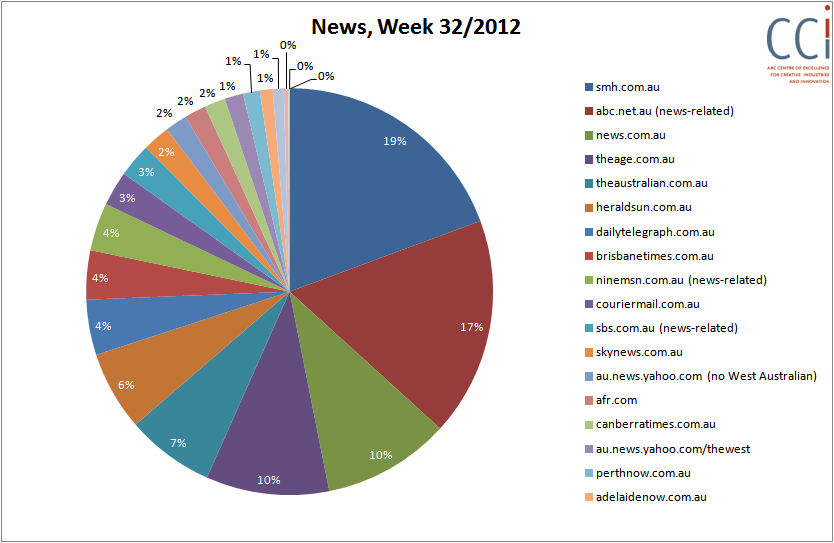
Frankly, week 32 turns out normal to the point of boring. It’s a comparatively big week as far as the total number of tweets containing links to our basket of Australian news sites is concerned – we captured some 166,000 tweets in total –, but the distribution of attention continues a very stable pattern. Both the order of sites at the top of the leaderboard, and the relative percentages of marketshare for those sites, remain largely unchanged from last week:

image

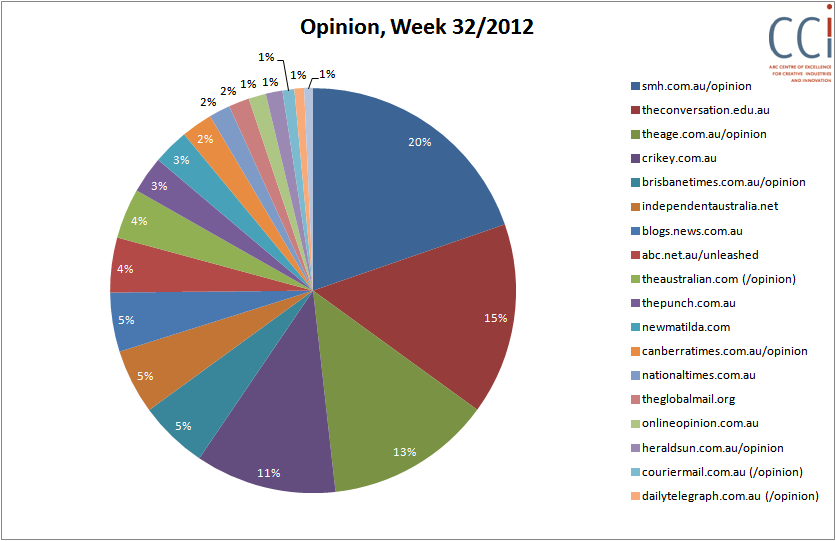
The same is true also for the distribution of the almost 18,000 tweets to opinion and commentary sites and sections this week. There’s some shuffling amongst the minor places after the Big Four (SMH, The Conversation, The Age, Crikey), but between places 5 and 9 on the leaderboard there’s a difference only of some 150 tweets per site, so such minor oscillations are to be expected and don’t represent any significant shift in audience attention:

image

Even the daily patterns don’t reveal much of interest this week – no celebrity stories gone viral, no major developments driving massive spikes in newssharing:

image

In order to find anything interesting, in fact, it seems like we’ll have to have a very close look at the sharing of opinion articles, and squint sideways a bit:

image

Finally, a handful of slightly significant spikes, then. In a rare occurrence, Crikey wins the day on Wednesday, mainly on the back of two stories on a Facebook page vilifying indigenous Australians, and a widely shared cartoon by First Dog on the Moon about the Queensland state government’s orgy of debilitating government services cost-cutting. The next day, it’s The Age’s opinion section’s turn to shine, led by a piece by ALP grande Barry Jones on the continuing decline of the quality of public debate in Australia in general, and within the ALP in particular. And the same day, New Matilda also had a win by its (admittedly fairly modest) standards, with some 40% of all tweets linking to the site that day referencing a commentary piece on the tell-all insider account of a journalist intern at the Herald Sun.

But that’s about it for the week. With the current week’s upheavals over asylum seeker policy and plain tobacco packaging, let’s hope week 33 turns out a bit more newsworthy…

ATNIX: Australian Twitter News Index, Week 31/2012

No, I haven’t forgotten about ATNIX this week – but a less than straightforward homeward trip and a bad cold have conspired against my getting the results for week 31 (30 July – 5 August) out any earlier. But, better late, than never, here they are, hopefully to be followed by ATNIX 32/2012 in a few days. Of all weeks, this – the first week of the London 2012 Olympic Games – is where we’d expect to see any appreciable impact of the games coverage on what links are being shared; let’s see what we can find.

Standard background information: this analysis is based on tracking all tweets which contain links pointing to the URLs of a large selection of leading Australian news and opinion sites. For technical reasons, it does not contain ‘button’ retweets, but manual retweets (“RT @user …”) are included. Datasets for those sites which cover more than just news and opinion (abc.net.au, sbs.com.au, ninemsn.com.au) are filtered to exclude irrelevant sections of those sites (e.g. abc.net.au/tv, catchup.ninemsn.com.au). For our analysis of ‘opinion’ link sharing, we include only those sub-sections of mainstream sites which contain opinion and commentary (e.g. abc.net.au/unleashed, articles on theaustralian.com.au which include ‘/opinion’ in the URL), and compare them with dedicated opinion and commentary sites.

See the posts tagged ‘ATNIX’ on this site for a full collection of previous results.

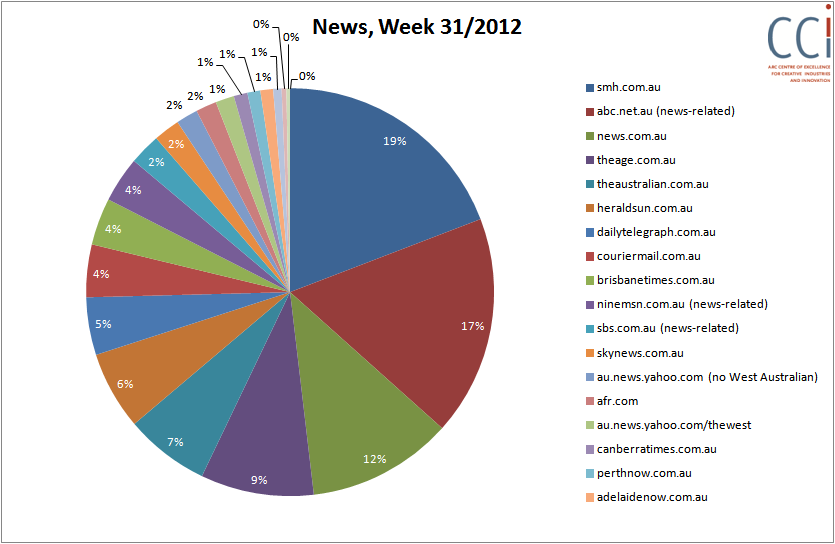
ATNIX Week 31: 30 July 2012 – 5 Aug. 2012

First, to the sharing of news-related links: week 31 was a slightly chunkier week again – we captured some 155,000 tweets linking to our news sites. Attention is distributed following a fairly familiar pattern:

image

There are few surprises here, though this itself is perhaps surprising: certainly, there’s no substantial boost for the Australian host broadcaster of the Olympic Games, Channel Nine, and its nineMSN news site (which also includes the Wide World of Sports sub-site). Indeed, nineMSN falls back a few places on the leaderboard compared to last week, which saw its numbers boosted by a runaway story about local One Direction fans burning their concert tickets – looks like the Olympics can’t compete with such viral stories.

This failure to offer attractive, share-worthy online content is probably in keeping with Nine’s overall markedly lacklustre performance in covering these Games – but assuming that Australian users aren’t generally abstaining from sharing links related to the Games, what do they link to? Our data offer two interpretations: either Games-related links are distributed across our sites in proportion to general patterns of attention and loyalty, and so fail to make an impression on the shape of this leaderboard – or Australian users have taken to sharing links directly from overseas Games-related sites (such as the London 2012 Website or BBC News) which aren’t included in the list of sites we track. That said: given the blanket coverage of the Games in other media, it is very much possible that users simply don’t feel the need to share a significant number of Games links on Twitter.

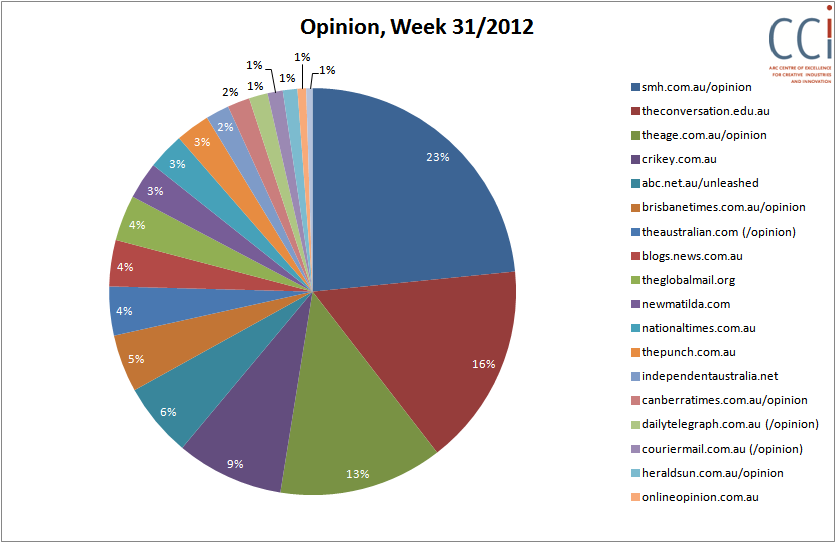
On to the opinion and commentary sites, for whom we recorded some 16,000 tweets this week:

image

There’s little significant movement here, but a strong performance by the Sydney Morning Herald’s opinion section should be noted – its marketshare is usually around 18-20%, making the 23% this week an especially strong result. There doesn’t seem to be any specific story driving this bump, though: a number of widely-shared stories combined to make the SMH stand out a little further this week.

As always, the daily patterns reveal further detail – first, for news:

image

Here, a sustained peak on Tuesday and Wednesday sees news.com.au briefly trouble ABC News for second place in the pecking order – and as with nineMSN’s One Direction frenzy last week, it’s an entertainment story gone viral which is responsible: a piece about Snoop Dogg’s rebranding as Snoop Lion as he explores his love for reggae, which received some 3,700 tweets. It’s worth pointing out again in this context that our index simply tracks any tweets on Twitter which contain links to the Australian news sites we track – so what these cases point to is the added boost Australian news sites get when one of their stories goes viral to an international audience. Post a story which is of relevance to Australian users only, and you’ll get a few hundred tweets; post one which is of interest to an international audience, and happens to be found by enough Twitter users to be widely shared, and you’re into the thousands.

In the absence of such international attention, purely home-grown spikes in attention are necessarily smaller – and this week, it’s the Courier-Mail which clocks up not one, but two notable domestic success stories. First, on 1 August it zooms past the 1,000 tweets/day barrier which is usually well beyond its abilities by posting a piece on the $2.6b which Australians are spending on food and drink for Olympics parties; that story alone was shared more than 600 times on Wednesday alone, accounting for nearly half of all tweets with links to the Courier-Mail Website that day. And on the weekend, the paper again punched well above its usual weight, once more clocking up well over 1,000 tweets/day when its weekend averages are usually closer to 500 tweets/day. Here, a story about the Queensland Government’s decision to discontinue a statewide breast cancer screening programme was the focus, and received over 1,200 tweets over the weekend.

Finally, not on the chart but also noteworthy: on 31 July, the normally almost invisible NT News site received more than seven times its usual, meagre average of 35 tweets/day. The story responsible: “Why I Stuck a Cracker Up My Clacker.” Words fail.

On to the daily opinion and commentary trends, then, which underline the strong performance by the SMH’s opinion section:

image

While there’s a defined spike on 1 August, there really is no one specific cause for it; the strongest story that day concerned the posting of injudicious social media comments by a Vodafone staffer and received some 200 tweets, but several other stories also made it past the 100 tweets mark. Sometimes, coincidence is just coincidence.

So much for this week, then – we’ll see in a few days whether the Olympic Games do feature more strongly in our index during their final week…

A Collection of Presentations on Twitter Research Methods

Over the past month, my colleagues Jean Burgess, Tim Highfield, Tanya Nitins and I have been travelling through Europe in various combinations to participate in workshops and conferences which address some of the key themes of our research – methodological innovation in social media research, and the role of Twitter in the wider media ecology. Here’s a collection of our key presentations from this trip.

At the first Digital Methods as Mainstream Methodology workshop (DMMM1) in Bristol, I presented an overview of our work here at Mapping Online Publics.

Continue reading “A Collection of Presentations on Twitter Research Methods”

ATNIX: Australian Twitter News Index, Week 30/2012

Another week, another ATNIX – and the last one for a while that I have to write from a hotel room while travelling in Germany. This is also the last mostly pre-Olympic ATNIX, covering the week of 23-29 July 2012; next week we’ll see whether and how the increased focus on sports during these weeks affects the sharing of (normally largely political) news on Twitter in Australia. In the period covered in this edition of ATNIX, only the final, weekend days already incorporated Games coverage – but we’ve already seen that the weekend is traditionally a slow news period, so it’s difficult to read anything into this week’s data yet.

Standard background information: this analysis is based on tracking all tweets which contain links pointing to the URLs of a large selection of leading Australian news and opinion sites. For technical reasons, it does not contain ‘button’ retweets, but manual retweets (“RT @user …”) are included. Datasets for those sites which cover more than just news and opinion (abc.net.au, sbs.com.au, ninemsn.com.au) are filtered to exclude irrelevant sections of those sites (e.g. abc.net.au/tv, catchup.ninemsn.com.au). For our analysis of ‘opinion’ link sharing, we include only those sub-sections of mainstream sites which contain opinion and commentary (e.g. abc.net.au/unleashed, articles on theaustralian.com.au which include ‘/opinion’ in the URL), and compare them with dedicated opinion and commentary sites.

See the posts tagged ‘ATNIX’ on this site for a full collection of previous results.

ATNIX Week 30: 23-29 July 2012

The total volume of tweets with links to our group of sites this week is right on track again – we captured a total of just over 153,000 messages. And the leaderboard remains largely stable as well – except for (the news-related sections of) nineMSN, which leapfrogs the Herald Sun and Daily Telegraph this week:

image

No surprise given the fact that Channel Nine is the Australian licencee for the Olympics Games broadcast, you might think – the increased prominence of the nineMSN site is likely to be due to the growing anticipation of the London 2012 opening, right? Well, that’s what I thought, too – but I was wrong: the 4,500 more tweets containing links to nineMSN this week were due entirely to a story about a group of four fans of the teen band One Direction who feel the band no longer cares about its fans, and burnt their concert tickets. Predictably, the story went viral about the highly social media-active One Direction fan community – and brought a whole new audience to nineMSN (though largely from outside Australia, I would guess). In fact, not to be completely outdone, news.com.au had its own pocket-size teen frenzy this week: it gained an additional 1,100 tweets from a brief story profiling five-piece Melbourne boy band The Janoskians. (Both those stories strategically placed the word ‘direction’ in their titles, incidentally – search engine optimisation is alive and well in Australian news sites.)

Meanwhile, the nearly 18,600 tweets containing links to opinion and commentary sites and sections were distributed across our sites as follows:

image

No real movement at the top of the leaderboard – The Age’s opinion pages and Crikey remain neck and neck, but overall the four top sites are relatively stable. The Australian’s paywall-handicapped opinion section put in a strong showing this week, while the ABC’s The Drum (or those of its articles which are hosted under the /unleashed path) put in a somewhat less impressive showing. Overall, though, this was another week in which none of the opinion sites stood out exceptionally much.

On to the day-to-day patterns – first, for news:

image

Here, the One Direction feeding frenzy at nineMSN on Thursday and Friday stands out especially well (as a sharp spike in the pink line on 26/27 July), as does the Janoskians bump for news.com.au on the same days (a less pronounced rise above the average level of the purple line). We can also note a strong weekday showing for ABC news content, before the customary weekend slump.

Opinion and commentary data produce the following picture:

image

Generally, another relatively non-descript week for commentary. The Conversation puts in another fairly strong showing (which is spread across a wide range of stories, rather than being due to any one especially strong piece), and there’s a marked spike for The Age’s opinion section on 26 July which is similarly the combined result of a strange story about a freelance reporter sacked by ASIO, a piece by Michelle Grattan on the NDIS discussion, an article about the Coalition’s stance on the Gonski reforms, and a bunch of other stories. Individually, each of these would have resulted only in a small bump; together, they generate a more sizeable spike and propel The Age to the top of the opinion leaderboard on Thursday.

See you next week – back in Brisbane…

ATNIX: Australian Twitter News Index, Week 29/2012

I’m still on the road for a number of research workshops and presentations in Germany, so this week’s version of our Australian Twitter news circulation index ATNIX has been somewhat slow in coming. On the upside, though, the server trouble we experienced last week has been addressed now, so we once again have a full set of numbers for the entire week. Here’s how they turned out.

Standard background information: this analysis is based on tracking all tweets which contain links pointing to the URLs of a large selection of leading Australian news and opinion sites. For technical reasons, it does not contain ‘button’ retweets, but manual retweets (“RT @user …”) are included. Datasets for those sites which cover more than just news and opinion (abc.net.au, sbs.com.au, ninemsn.com.au) are filtered to exclude irrelevant sections of those sites (e.g. abc.net.au/tv, catchup.ninemsn.com.au). For our analysis of ‘opinion’ link sharing, we include only those sub-sections of mainstream sites which contain opinion and commentary (e.g. abc.net.au/unleashed, articles on theaustralian.com.au which include ‘/opinion’ in the URL), and compare them with dedicated opinion and commentary sites.

See the posts tagged ‘ATNIX’ on this site for a full collection of previous results.

ATNIX Week 29: 16-22 July 2012

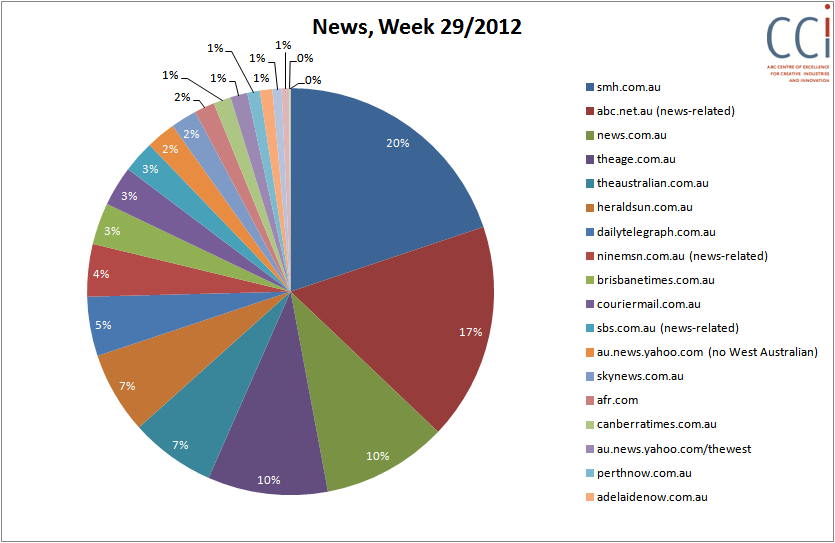
We captured just under 160,000 tweets containing links to our 29 Australian news and opinion sites this week, so the 150-160,000 tweets range is quickly establishing itself as a stable target area – weeks well above or below that number must be considered to be exceptional. After the server-related issues of last week, the situation at the top of the leaderboard has returned to normal as well:

image

The seven leading sites – which in total account for some 75% of all tweets in the dataset – are stable not only in their order of ranking, but also in their contribution to the total number of links shared; the percentages this week are virtually unchanged from those in week 27 (here I’m ignoring the problematic week 28 once again).

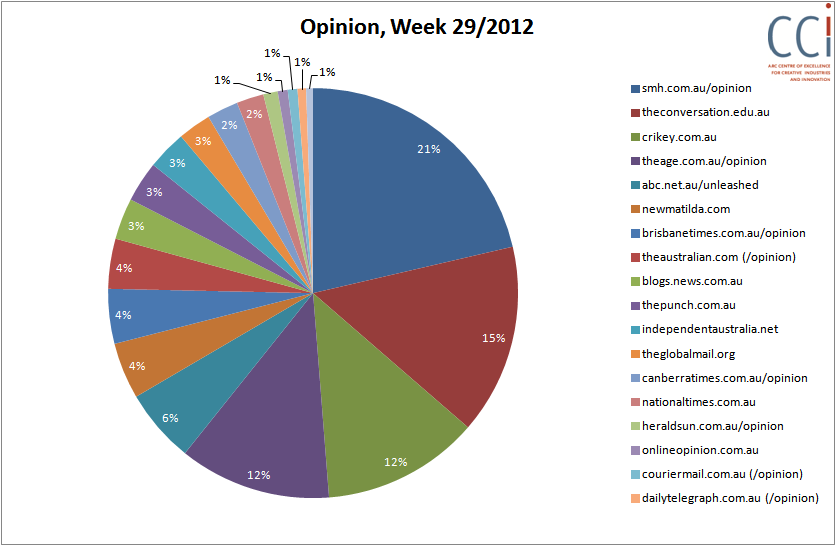
As always, there’s slightly more movement in the opinion and commentary sites (and the corresponding sections on general news sites):

image

Compared to week 27, when it reached second place, The Age’s opinion section drops back again to fourth, while further down, New Matilda reaches sixth (up from ninth). Clearly, we’re dealing with smaller numbers here (just under 17,000 tweets linked to opinion and commentary articles) – so the occasional especially strong article can have a real impact on marketshare here.

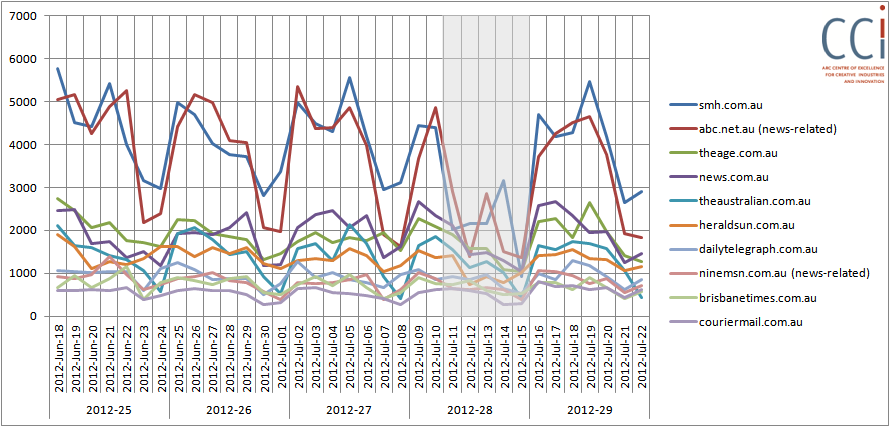
And here are the day-to-day indicators (for the leading sites):

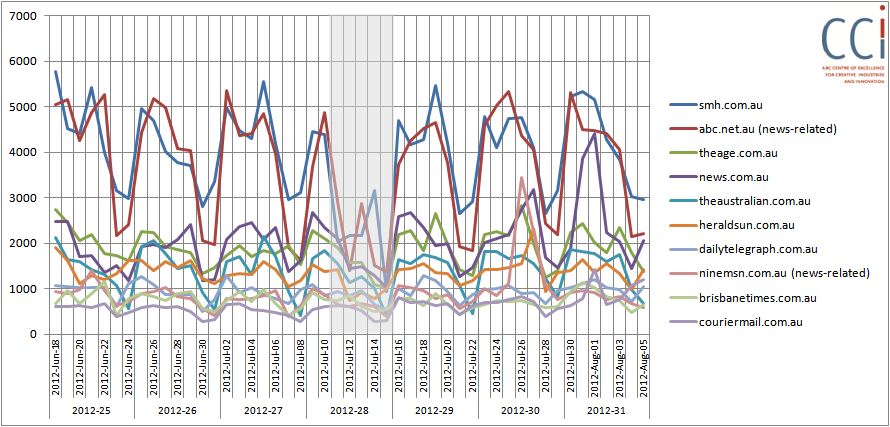
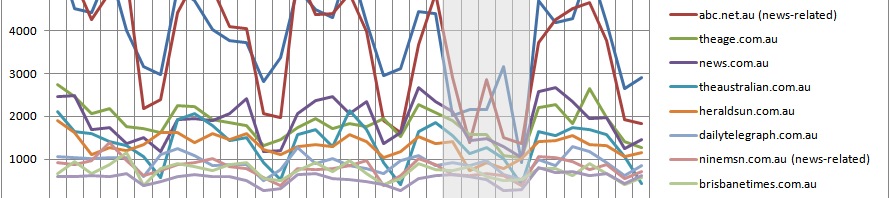
image

For the news sites (where I’ve shaded those days in week 28 which were affected by our server problems), the usual weekday battle between the Sydney Morning Herald and the ABC’s news section continues – with the ABC dropping back substantially on the weekends. There also seems to be something interesting going on with the SMH’s numbers: in three of the five weeks, it’s had a very strong Thursday, so I’m wondering if there’s a particular, widely shared column which appears on Thursdays. I don’t have the time to check this right now – but if that pattern continues, I’ll delve further into our data to see what’s going on here. (The other very strong day, incidentally, is Monday – which may be due simply to people returning to work after the weekend rather than to any special content features.)

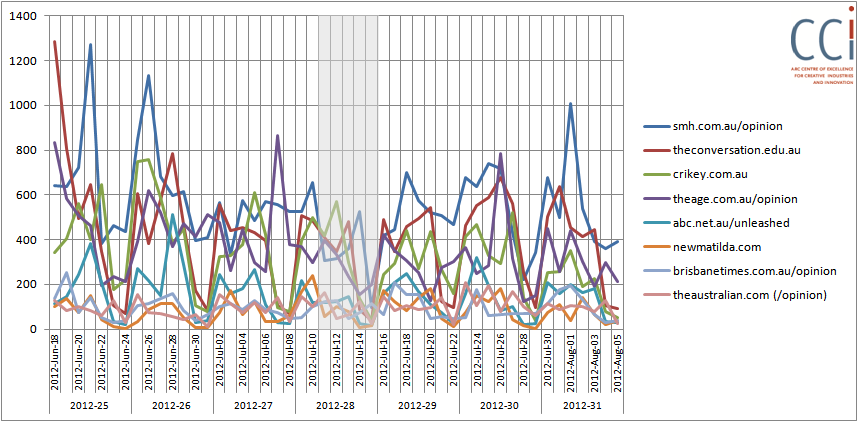
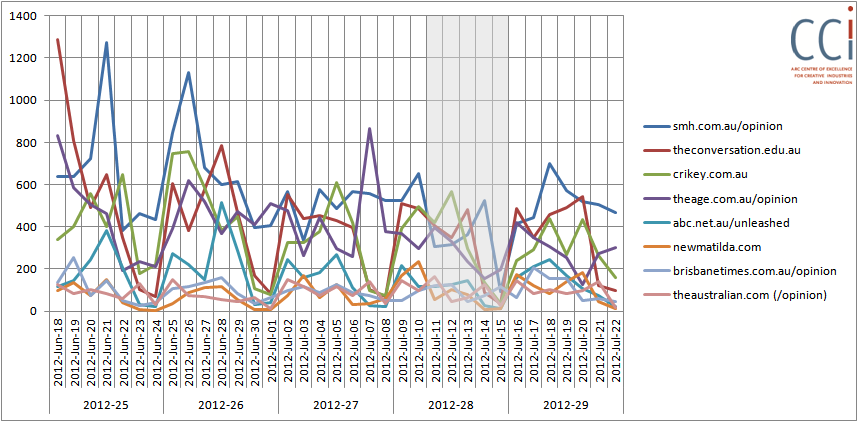
Day-to-day patterns for opinion and commentary links look like this:

image

Here, a downward trend appears to continue: week 29 is roughly comparable to week 27, while the first two weeks were substantially more active; I’m convinced that this is due largely to the upheaval at Fairfax and the substantial amount of digital column inches devoted to it. Those discussions largely appear to have washed out of the system by now, though, and the increased chatter about further leadership trouble in the Australian Labor Party hasn’t yet manifested in an increased level of link-sharing tweets (perhaps people are heartily sick of this story by now). As a result, only one site troubled the 600 tweets/day mark last week. (Note, by the way, that I’ve continued to reshuffle the minor opinion sites and sections I’m including in this graph – this week, the well-performing New Matilda gets to play.)

Until next week!

ATNIX: Australian Twitter News Index, Week 28/2012

I’ve just published an article about our first few weeks of ATNIX results over at The Conversation – but here, we’re already pushing ahead with the next week’s index. This one, I’m afraid, suffers from ‘difficult fourth week’ syndrome, though: we collect our data using a server based at the fabulous NeCTAR initiative, a shared cloud-based server infrastructure for Australian researchers. NeCTAR is a very welcome project, but still suffers from some teething problems – and over the past week our server became unresponsive on several days, resulting in gaps in our data gathering.

To complicate things a bit further, the Twitter data gathering tool which we use for most of our work, yourTwapperkeeper, is able to fill in some of the missing data after a restart by searching for recent tweets through the Twitter API – but this works reliably only for relatively low-volume search terms. What this means is that the different sites we’re tracking are differently affected by these outages: for the minor news and opinion sites, yTK will have been able to plug the gaps relatively easily, by retrieving the few dozen tweets which passed it by during a server outage lasting a few hours; for major news sites such as the Sydney Morning Herald or the ABC, however, the volume of tweets per hour is simply too large to go back and find all the tweets we might have missed.

So, take this week’s ATNIX Twitter news circulation results with a grain of salt, especially for the leading sites – we’ll be systematically undercounting their prominence this time around. We hope to have addressed these issues now, so that there won’t be a re-occurrence of these problems in future weeks.

Standard background information: this analysis is based on tracking all tweets which contain links pointing to the URLs of a large selection of leading Australian news and opinion sites. For technical reasons, it does not contain ‘button’ retweets, but manual retweets (“RT @user …”) are included. Datasets for those sites which cover more than just news and opinion (abc.net.au, sbs.com.au, ninemsn.com.au) are filtered to exclude irrelevant sections of those sites (e.g. abc.net.au/tv, catchup.ninemsn.com.au). For our analysis of ‘opinion’ link sharing, we include only those sub-sections of mainstream sites which contain opinion and commentary (e.g. abc.net.au/unleashed, articles on theaustralian.com.au which include ‘/opinion’ in the URL), and compare them with dedicated opinion and commentary sites.

See the posts tagged ‘ATNIX’ on this site for a full collection of previous results.

ATNIX Week 28: 9-16 July 2012

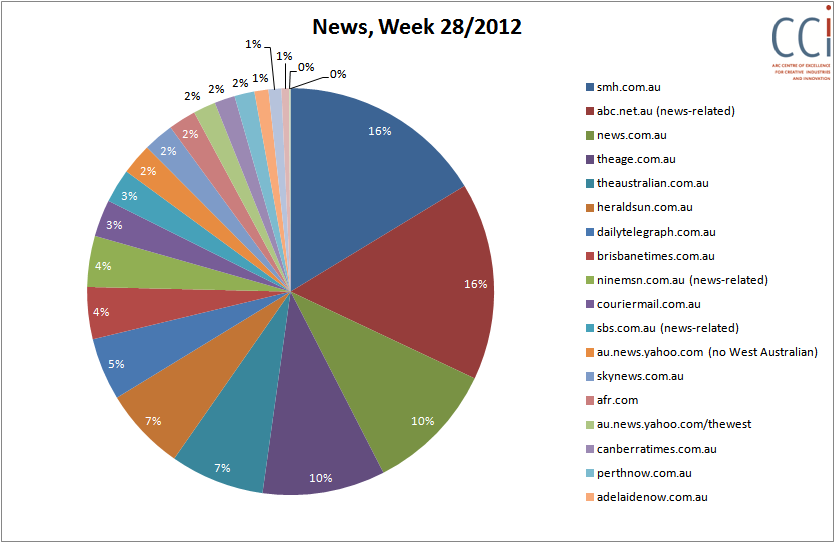
In total, we gathered some 134,000 tweets containing links to our tracked sites this week; if past weeks are any guide, that’s somewhere between 6,000 and 26,000 tweets which we’ve missed due to our server issues. The marketshare overview for news sites clearly shows that this data loss affects mainly the leading, most frequently shared news sites:

image

When normally, the Sydney Morning Herald receives some 20% of all the links to news sites, this week that percentage drops down to 16% – not because readers are turning away from the SMH, but because we missed a good chunk of those tweets. The same is true for ABC News and some of the other news leaders, while data for the lesser news sites will have been less affected by our outages. That said, it’s also worth noting that in spite of these problems, the top of the leaderboard has remained stable for yet another week – we’re seeing a picture of some very well-entrenched user loyalty emerge here.

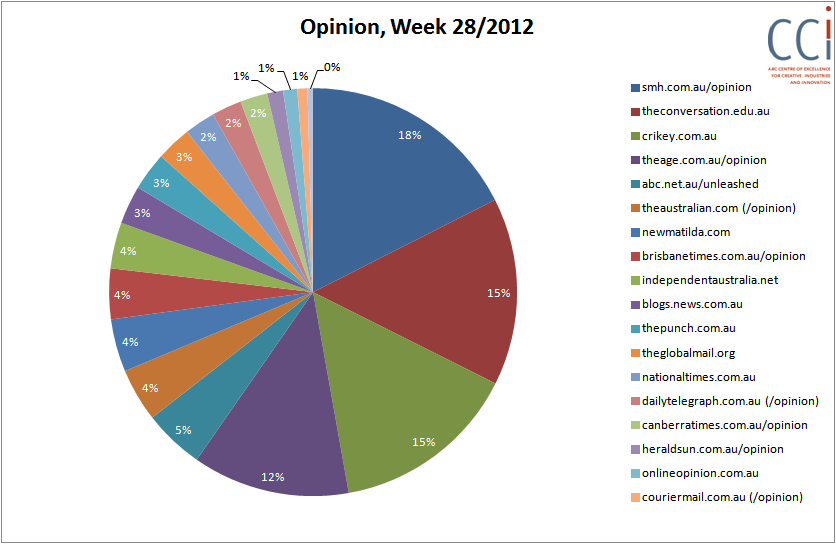
Amongst opinion and commentary sites and sections, there’s a similar shrinkage of the leaders’ marketshare which is likely to be due to our technical problems rather than any inherent changes in user habits:

image

Here, though, we do also see some of the more fluid ranking which we’ve already observed over the past few weeks: the opinion sections of The Age, and blogs.news.com.au, drop several spots, while other sites increase their relative prominence. And as in previous weeks, some of the minor sites chalk up a handful of individual points – so, for example, the normally rather dormant Courier-Mail opinion section had a big winner on 10 July with a piece arguing against the common talking point that Julia Gillard ‘lied’ about carbon pricing before the 2010 election. On most days, the paper’s opinion pieces are lucky to receive a double-digit number of tweets mentioning them; that day, it came in at just above 100 tweets.

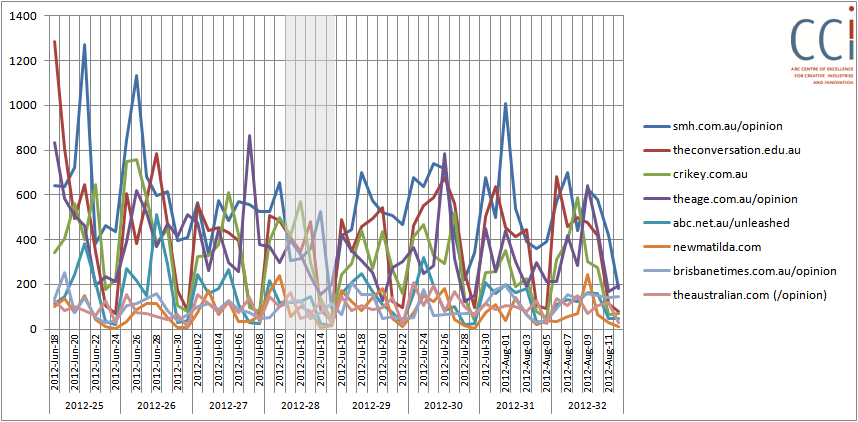
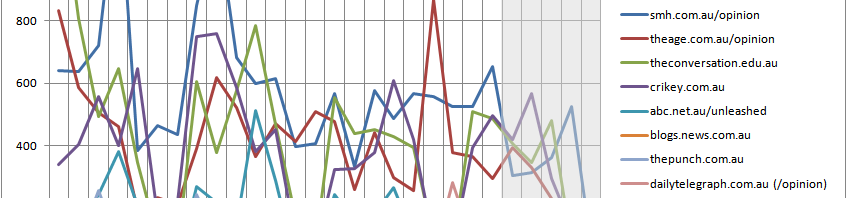
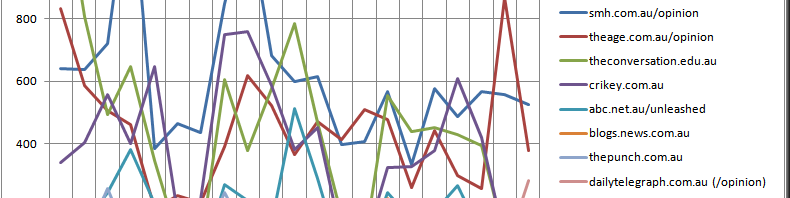
Daily Patterns, Weeks 25-28/2012

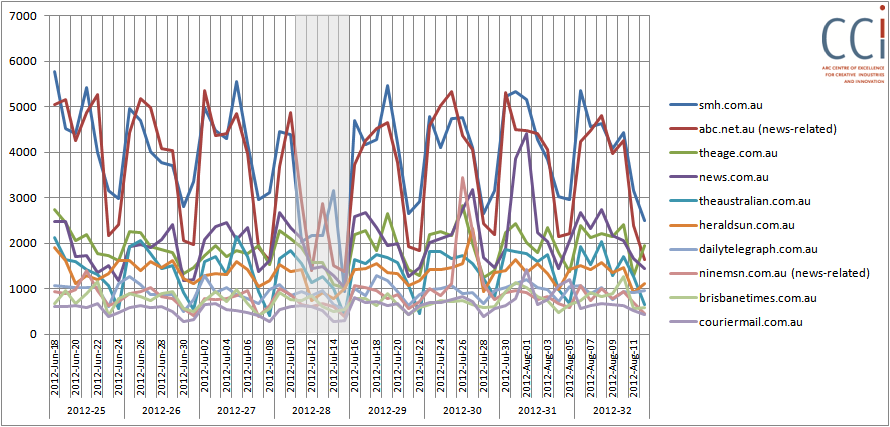
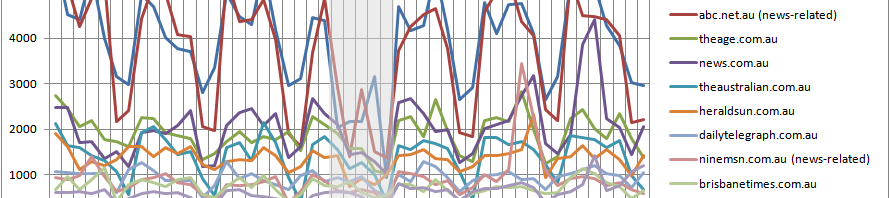
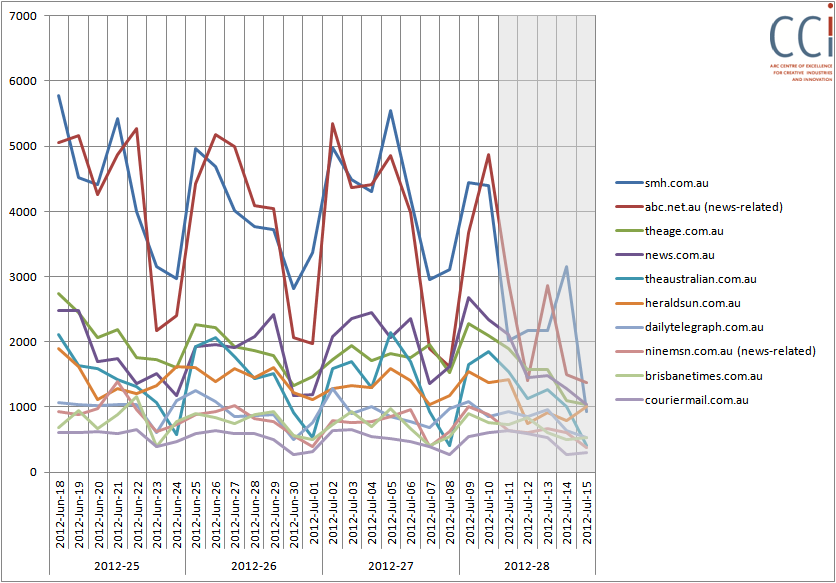
This brings us to the daily patterns – and here, the impact of our outages becomes most obviously apparent (I’ve shaded the problem days in grey in the graphs below):

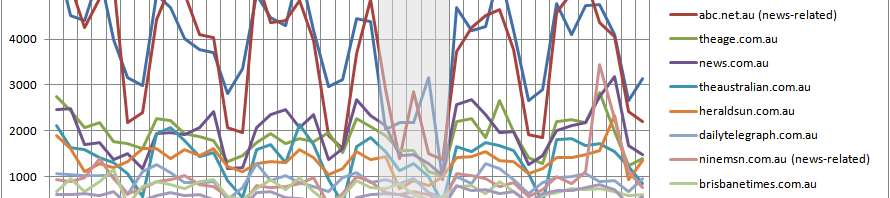
image

The top five or six news sites, in particular, are strongly affected by our technical problems; their daily share of link circulation on 11-15 July is nowhere near where we’d come to expect it to be based on the previous weeks’ results. From the Daily Telegraph onwards, though, relative levels of visibility are about where we’d expect them to be – here, yourTwapperkeeper’s ability to back-fill data it missed seems to have made up for most of those outages.

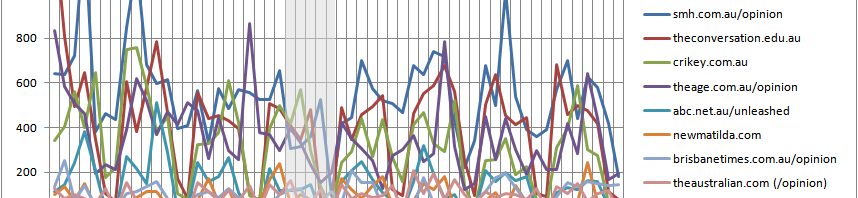
The same is true for opinion and commentary links:

image

While levels for week 28 aren’t that far away from the previous week, it should be noted that week 27 was an unusually slow week for opinion pieces. Next time around, we should expect to see those figures rise again by some margin, I should think – and we’re very much hoping not to see a repeat of our server issues then…

ATNIX: Australian Twitter News Index, Week 27/2012

I may be in Europe at the moment (I write this from a hotel room in Munich, where tomorrow my colleagues and I will be participating in a symposium on methodological innovation that is organised by our colleagues at the Ludwig-Maximilians-Universität) – but that doesn’t mean that there won’t be another ATNIX this week. Here are the Twitter news circulation figures for Australia in week 27/2012 (2-8 July), then.

Standard background information: this analysis is based on tracking all tweets which contain links pointing to the URLs of a large selection of leading Australian news and opinion sites. For technical reasons, it does not contain ‘button’ retweets, but manual retweets (“RT @user …”) are included. Datasets for those sites which cover more than just news and opinion (abc.net.au, sbs.com.au, ninemsn.com.au) are filtered to exclude irrelevant sections of those sites (e.g. abc.net.au/tv, catchup.ninemsn.com.au). For our analysis of ‘opinion’ link sharing, we include only those sub-sections of mainstream sites which contain opinion and commentary (e.g. abc.net.au/unleashed, articles on theaustralian.com.au which include ‘/opinion’ in the URL), and compare them with dedicated opinion and commentary sites.

The ATNIX results for weeks 25 and 26/2012 are available in a previous post.

ATNIX Week 27: 2-8 July 2012

Week 27 picked up again from the slump of the previous week – we captured some 160,000 tweets containing links to the sites we’re tracking, compared to over 140,000 in week 26 and over 150,000 in week 25. Here’s how they’re distributed across the major news sites:

image

Generally, the picture at the top of the leaderboard has remained quite steady for another week – the SMH and the news-related sections of the ABC Website occupy the top spots, while news.com.au and The Age have swapped places from week 26 to 27. The usual parade of News Ltd. sites (The Australian, Herald Sun, Daily Telegraph) round out the top three quarters of links shared. It’s only in the last quarter of the leaderboard that we see some more considerable shuffling of positions – Sky News had a good week, and leapfrogs sites like nineMSN, Brisbane Times, the news sections of the SBS site, and the Courier-Mail.

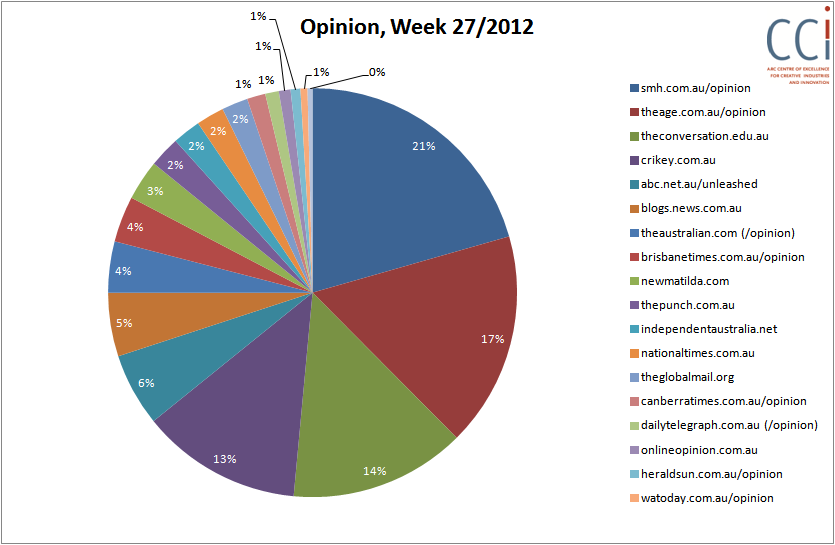
image

Amongst the opinion and commentary sites, the competition is a little more lively – The Conversation is the big mover here, and nabs third place back from Crikey, and The Australian moves from 11th in week 26 to 7th place in week 27. There’s some more shuffling going on in the lower places, too, but we’re dealing with relatively small numbers here – as in previous weeks, one or two widely shared opinion pieces can have a substantial impact on a site’s placement. I should also note that we have a new entrant this week – I’ve now started to count opinion articles in the Daily Telegraph, if they contain ‘/opinion’ somewhere in the URL. However, at least these past three weeks they’re not particularly prominent in the overall mix.

Daily Patterns, Weeks 25-27/2012

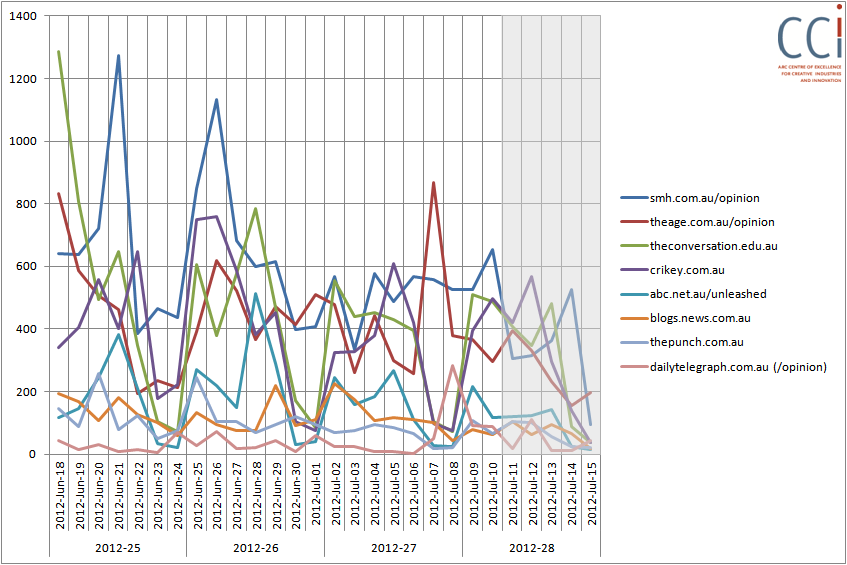
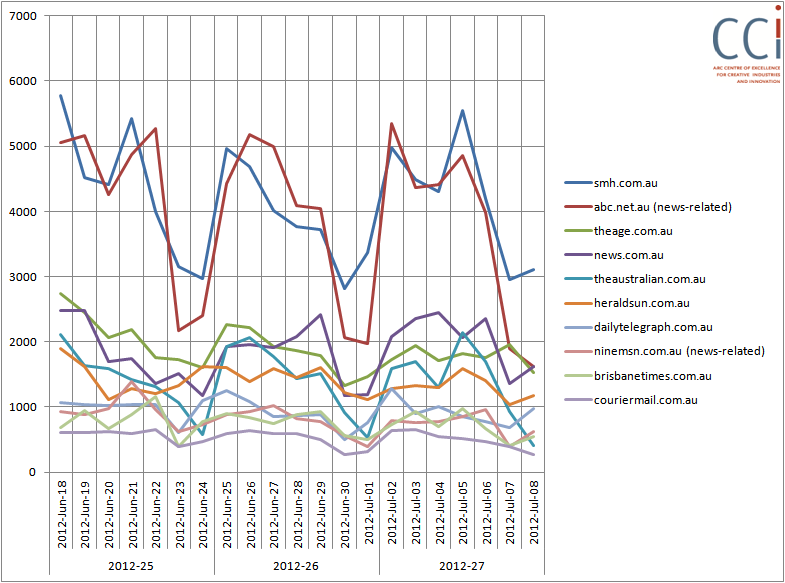
So, let’s take a quick look at the patterns for the three weeks of ATNIX data which we now have:

image

Over the course of these weeks, we continue to see a tight battle for overall daily supremacy between the Sydney Morning Herald and the news sections of the ABC. How close this fight is, on most days, doesn’t come out in the weekly ratings, though, as the SMH does much better on weekends – on most weekdays, on the other hand, it’s an even fight. And there’s an interesting story in the minor places, too: here, The Age and news.com.au have swapped places over the last three weeks: The Age has declined, relatively steadily, and news.com.au has done well, especially in week 27.

image

It’s the opinion and commentary sites and sections, though, where the story of these three weeks is most interesting. In the first instance, it must be said that week 27 was boring: even the leading sites struggled to attract more than 600 link shares on any one day, and only The Age surpassed that mark by some margin on the Saturday (with widely shared stories addressing Malcolm Turnbull’s stance on same-sex marriage, and drawing similarities between Tony Abbott’s ‘Great Big New Tax’ catchcry and Nazi propaganda). And at just over 850 tweets, even that small peak is still a far cry from the spikes of well above 1100 tweets which we saw for some of the sites in weeks 25 and 26.

Given that of the three weeks of ATNIX data we now have, this last week was the most active in terms of the total number of tweets, this drop in opinion shares is even more remarkable – in total, we counted some 20,000 opinion shares in week 25, over 21,000 in week 26, and only just over 17,500 in week 27. Week 27 wasn’t a slow news week, on Twitter, but what – a slow spin week?

Week 28 may well be different from this, though: Paul Howes’s article in the Daily Telegraph, mouthing off about the Greens, was shared so widely that it propelled the DT’s normally insubstantial opinion section into third place on Sunday 8 July – and given the ALP’s demonstrated expertise in creating such non-stories and using them to deprive itself of oxygen in the news cycle, we should expect further follow-up opinion pieces to substantially boost the circulation of opinion links on Twitter in next week’s ATNIX. Unless Australian Twitter users are heartily sick of such distractions, that is – and who could blame them?