I spent today at the University of the West of England in Bristol, as a guest of the Digital Methods as Mainstream Methodology network, a fabulous new initiative supported by the National Centre for Research Methods in the UK. At this first of three DMMM workshops to be held in 2012 and 2013, I presented a talk about our Twitter research methods within the Mapping Online Publics project, which I think worked very well in combination with the (very interesting) presentations by the other two speakers, Eric T. Meyer and Christine Hine. Many thanks to the DMMM organisers who invited me to present at the event, and good luck with the further activities of the network. Below are my slides and audio from the event – next stop, Munich!
ATNIX: Australian Twitter News Index, Week 25-26/2012
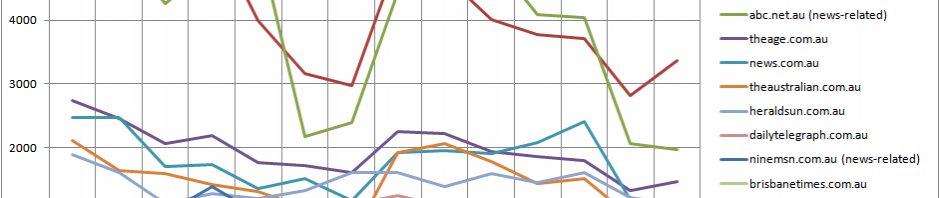
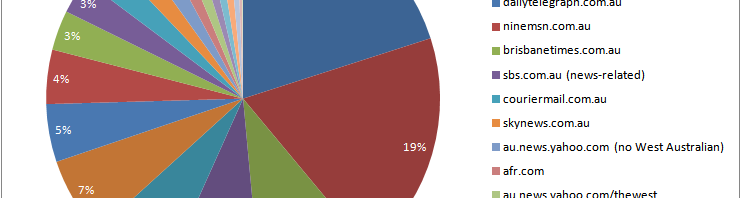
A little over a week ago, I introduced the Australian Twitter News Index (ATNIX), our new measure of how links to Australian news and opinion sites circulate on Twitter. This is a work in progress, obviously, and I’m thankful for a few helpful comments about additional sites to track and further details to extract from the data. I think we’re now in a good position to step this up a notch and turn this into what will hopefully be a regular feature on this site. This also means moving to a standard Monday-to-Sunday schedule for our data circulation reports – and for that reason, I’ve re-done last week’s analysis in the post below, too. So, this time you get two for the price of one: an ATNIX for calendar week 25/2012 as well as 26/2012.
Standard background information: this analysis is based on tracking all tweets which contain links pointing to the URLs of a large selection of leading Australian news and opinion sites. For technical reasons, it does not contain ‘button’ retweets, but manual retweets (“RT @user …”) are included. Datasets for those sites which cover more than just news and opinion (abc.net.au, sbs.com.au, ninemsn.com.au) are filtered to exclude irrelevant sections of those sites (e.g. abc.net.au/tv, catchup.ninemsn.com.au). For our analysis of ‘opinion’ link sharing, we include only those sub-sections of mainstream sites which contain opinion and commentary (e.g. abc.net.au/unleashed, articles on theaustralian.com.au which include ‘/opinion’ in the URL), and compare them with dedicated opinion and commentary sites.
With that out of the way, let’s begin by revisiting the results for the previous week. The main changes from my introductory post stem from our shift to a Monday-to-Sunday rhythm, and from an increase in the sites and mainstream site sub-sections we’re including in the opinion graph.
Continue reading “ATNIX: Australian Twitter News Index, Week 25-26/2012”
Talk about Disasters Workshop
Our fabulous colleague (and co-author of the Queensland floods report) Frances Shaw came up to Brisbane this week to participate in a crisis communication workshop at Griffith University. Here are her impressions from the workshop, and her presentation:
On 25 and 26 June I represented the Mapping Online Publics team at the Talk about Disasters Workshop at Griffith University, Brisbane. The workshop brought together a diverse group of researchers from a wide range of disciplines and work backgrounds, from policy and government to media studies, cultural anthropology, education, and early childhood. The workshop’s overarching theme was how disaster is talked about before, during, and after disasters, and why this is important.
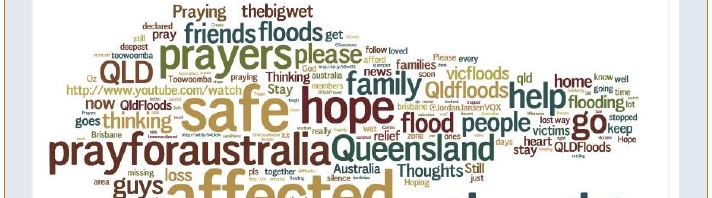
My presentation focussed on these aspects of talk on Twitter during the Queensland floods. Rather than focussing on the @QPSMedia account as in previous presentations, I looked at the overall #qldfloods hashtag and the kind of talk that was going on in that sample. The presentation engaged in particular with discussion at the workshop around the themes of sense-making and storytelling about disaster, and the extent to which disaster is personalised through personal narrative.
Twitter Circulation Ratings for Australian News Sites
What I’ll describe in this post is a research project I’ve been meaning to tackle for some time, but the events of the past week have given it added relevance – for those of you outside Australia, I’m referring to the announcement of some 1900 job cuts at one of the country’s leading news organisations, Fairfax, and the hints at similar job cuts to come at News Ltd. In the wake of these announcements, there’s been plenty of discussion about the further decline of newspapers, and the shift towards an all-digital future, and some of my colleagues have articulated their suspicion that newspaper circulation figures in Australia have long been overestimated. Which leads me to wonder: is there a way to generate reliable circulation-style figures for Australian news Websites, by tracking the links being shared on Twitter?
We’ve been tracking tweets containing links to a handful of major Australian news sites for some time now; notably, this includes tweets where the actual URL contained in a tweet has been shortened to a t.co, bit.ly, or other short link, but eventually points to abc.net.au or one of the other sites we’re tracking. Using such data, we were able to document the impact of The Australian’s (partial) paywall on the circulation of its content on Twitter, for example. Recently, I’ve substantially increased the list of sites we’re tracking in this way, and we’re now covering almost all major national and regional news sites in Australia, as well as a number of opinion sites. In the following post, I’m presenting the first full week of circulation data, from noon on Friday 15 June to noon on Friday 22 June (we’ll move to a standard Monday to Sunday schedule soon, but I needed to get this analysis done over the weekend).
Continue reading “Twitter Circulation Ratings for Australian News Sites”
Some Brief Updates: Twitter and Television, Arab Spring Symposium
The Mapping Online Publics Team is currently busy at the CCI Winter School, but here, at least, are a handful of very quick updates. First, my colleagues Stephen Harrington, Tim Highfield and I have published a brief think piece in a volume published by the COST Action (a peculiarly bureaucratic name given to EU-funded research networks) on Transforming Audiences, Transforming Societies. In our contribution to the volume on Audience Interactivity and Participation, edited by José Manuel Noguera, we outline the dimensions of interleaving Twitter interaction with the television experience. You can find our essay “More than a Backchannel: Twitter and Television” in the freely available PDF.
And on a very different note, a couple of weeks ago I travelled to Melbourne to participate in The Arab Spring: A Symposium on Social Media and the Politics of Reportage, at Swinburne University, where I presented a paper co-authored with Jean Burgess and Tim Highfield that presents more details on our exploration of language communities in the #egypt and #libya hashtags during 2011. Below are my slides (with audio), which draw on my previous blog post on distinguishing character sets in tweets. A full article will be published later.
Continue reading “Some Brief Updates: Twitter and Television, Arab Spring Symposium”
Yet another #qldfloods presentation
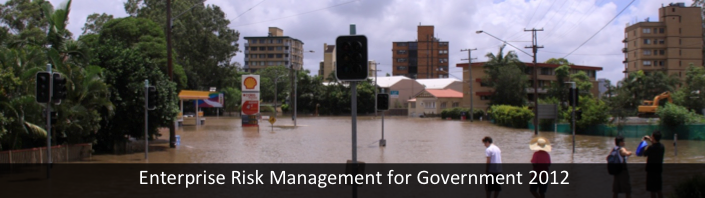
Last week I was in Sydney for the day to participate in the 6th Annual Enterprise Risk Management for Government conference in Sydney. There I encountered a very engaged group of people from government, private sector and non-government organisations with a broad shared interest in risk management, particularly around emergency management and disaster risk reduction. As well as my own presentation based on our work on the #qldfloods and beyond, I participated in a pretty feisty roundtable discussion on the broad topic of social media. It was fascinating to get some insights into how social media policy is evolving within all kinds of Australian organisations, and how various actors are attempting to balance the potentially useful role of social media in crises and risk management (as well as for community awareness and engagement more broadly), with the riskiness of social media’s rapidity, connectivity and personalisation of public communication.
Slides from my presentation are below:
New Articles on Twitter and Journalism
Somehow I don’t think we ever quite got around to posting this: a couple of months ago, two research publications by my QUT colleague Jean Burgess and myself appeared in Journalism Studies and Journalism Practice within two days of each other. The first of these is a methodology article which outlines how our methods for Twitter research may be used by journalists and journalism researchers; it’s based on the paper we presented at the Future of Journalism conference in Cardiff in September 2011. More details are here:
Axel Bruns and Jean Burgess. “Researching News Discussion on Twitter: New Methodologies.” Journalism Studies 22 Mar. 2012.
The other paper goes back a little further, and presents our analysis of the use of Twitter during the 2010 Australian federal election. It appears in a special issue of Journalism Practice, guest-edited by Einar Thorsen, on the online reporting of elections – many thanks to Einar for the invitation to submit a paper. Here’s the article:
Jean Burgess and Axel Bruns. “(Not) the Twitter Election: The Dynamics of the #ausvotes Conversation in Relation to the Australian Media Ecology.” Journalism Practice 20 Mar. 2012.
(Neither of those two issues have been formally released as issues yet, but articles are already available online through the journals’ forthcoming articles listings.)
Social Media and the Wider Media Ecology
On Friday last week, I had the pleasure of presenting a keynote on the place of social media within the wider media ecology to the Queensland conference of the Australian Teachers of Media. Below are my slides and audio from the event – many thanks to ATOM Queensland for the invitation!
Our Twitter Maps in the Press
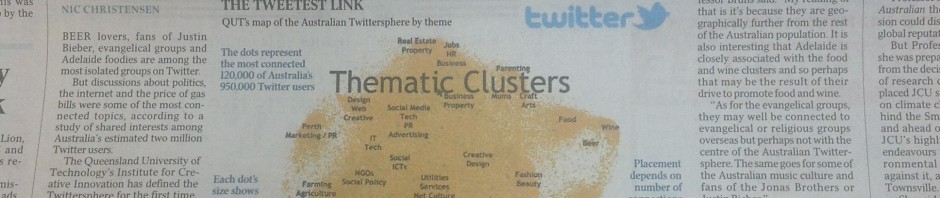
The emerging maps of the Australian Twittersphere which I presented at the Digital Humanities Australasia conference in Canberra in March have received quite a bit of press coverage over the past week or so, following our press release about this work. Here are some of the highlights:
- The Australian ran a big page three article about our research, and reprinted the annotated map itself;
- the Australian Financial Review also printed the map on page three;
- Stilgherrian gave us a great write-up in Crikey;
- news.com.au Websites and newspapers also ran a syndicated story about the map;
- industry sites B&T and Startupsmart pointed out the commercial uses of this enhanced understanding of the Australian Twittersphere;
- and even science site Phys.org covered our work.
I’ve also done about a dozen radio interviews about this research (which isn’t easy, considering how visual this work is); will post up some links to recordings if they become available.
Doing Blog Research (Again)
Just to show that we haven’t forgotten about the blog-related aspects of our research work (which have been backgrounded a little by the recent flurry of research around Twitter and crisis communication and/or politics): Jean and I have now published a new book chapter on “Doing Blog Research”, in the Sage collection Research Methods & Methodologies in Education which has been edited by James Arthur, Michael Waring, Robert Coe, and Larry V. Hedges. In spite of the ‘education’ focus of the overall collection, I think our chapter also applies well beyond that field – so hopefully it will be useful to blog researchers out there.
A pre-print of the chapter is available here. And we promise to update you a little more frequently on our blog research in the future, too…