Around the World in 28 Days (and 14 Papers)

It’s that time of the year again, when I set off for the usual end-of-year round of conferences – and this year has turned out to be an especially busy one. As I write this, Jean and I are already in Toronto for the inaugural workshop of a Canadian-funded, multi-partner research project on Social Media and Campaigning which is led by Greg Elmer of Ryerson University; this comes at an interesting time, of course, with electioneering south of the border in full swing. We’re already tracking the Twitter performance of both campaigns’ key accounts – more on that as it develops.

My next stop is Helsinki, where I’ve been invited to present two guest lectures to the international Masters students. The first of these will be an update of the keynote “Gatekeeping, Gatewatching, Real-Time Feedback: New Challenges for Journalism”, which I presented at the Brazilian Society of Journalism Researchers last year, and addresses the challenges faced by journalism in an always-on, social media-driven environment; the second presents the work which my Mapping Online Publics colleagues and I have done on “Social Media and Crisis Communication”.

From Helsinki, I’m off to Copenhagen, where Klaus Bruhn Jensen has organised the symposium “Digital Data – Lost, Found, and Made” at the Centre for Communication and Computing. Alongside a whole raft of luminaries from the Association of Internet Researchers community, I’ll present a contribution on “Twitter, Big Data, and the Search for Meaning: Methodology in Progress”. It’s a free event, so come along if you’re in the neighbourhood!

The symposium’s AoIR connections are no accident, because the next stop on this trip is the annual conference of the Association of Internet Researchers, which takes place in Salford in the greater Manchester area this year. Here, I’m involved in four papers, in collaboration with various QUT colleagues:

  • “#Eurovision: Twitter as a Technology of Fandom”, with Tim Highfield and Stephen Harrington;
  • “Sharing the News: Dissemination of Links to Australian News Sites on Twitter”, also with Stephen and Tim;
  • “#auspol, #qldpol, and #wapol: Twitter and the New Australian Political Commentariat”, again with Tim and Stephen; and finally
  • “New Methodologies for Capturing and Working with Publicly Available Twitter Data”, which is a solo contribution to a “Digital Data – Lost, Found, and Made” panel which continues the Copenhagen discussion.

Finally, then, I travel on to Istanbul, where I’ll first participate in a workshop of a Norwegian-funded research project on The Impact of Social Media on Agenda-Setting in Election Campaigns, which is led by Gunn Enli from the University of Oslo. I couldn’t make it in person to the project’s first workshop in June, so I’m very much looking forward to meeting up with everyone in Istanbul.

We’re not meeting there just because it’s Istanbul, though – rather, after the workshop, we’re attending the European Communication Conference ECREA 2012. Here, I’m involved in another four papers with various co-authors:

  • “Analysing Twitter Activity in Crisis Contexts”, with Jean Burgess, in a panel on crisis communication which was organised by Farida Vis;
  • “Political Networks on Twitter: Tweeting the Queensland State Election”, with Tim Highfield and Stephen Harrington and in a panel on social media and elections which was organised through the Norwegian research project;
  • “Tweeting le Tour: Connecting the Tour de France’s Global Audience through Twitter”, also with Tim and Stephen; and
  • “Social Media, Big Data, and the Public Sphere”, in an International Communication Association-sponsored panel organised by Sonia Livingstone.

Phew. In total, I think that’s 14 papers, or one paper on every other day of the trip, on average. Apologies in advance if I end up presenting the wrong paper to the wrong audience! Further updates, conference blogging, and posts of presentations and audio recordings will follow over the course of the month…

ATNIX: Australian Twitter News Index, Week 39/2012

Those of us who follow the Australian media don’t need ATNIX to tell us that it’s been an eventful week, driven towards the end especially by the coverage of Alan Jones’s indefensible comments about the Prime Minister’s late father. But what our Australian Twitter News Index can do is to provide us with quantitative evidence of how that story compares with other recent controversies, and to document which news and opinion Websites have gained the most from covering these events.

Standard background information: this analysis is based on tracking all tweets which contain links pointing to the URLs of a large selection of leading Australian news and opinion sites. For technical reasons, it does not contain ‘button’ retweets, but manual retweets (“RT @user …”) are included. Datasets for those sites which cover more than just news and opinion (abc.net.au, sbs.com.au, ninemsn.com.au) are filtered to exclude irrelevant sections of those sites (e.g. abc.net.au/tv, catchup.ninemsn.com.au). For our analysis of ‘opinion’ link sharing, we include only those sub-sections of mainstream sites which contain opinion and commentary (e.g. abc.net.au/unleashed, articles on theaustralian.com.au which include ‘/opinion’ in the URL), and compare them with dedicated opinion and commentary sites.

See the posts tagged ‘ATNIX’ on this site for a full collection of previous results.

ATNIX Week 39: 24-30 Sep. 2012

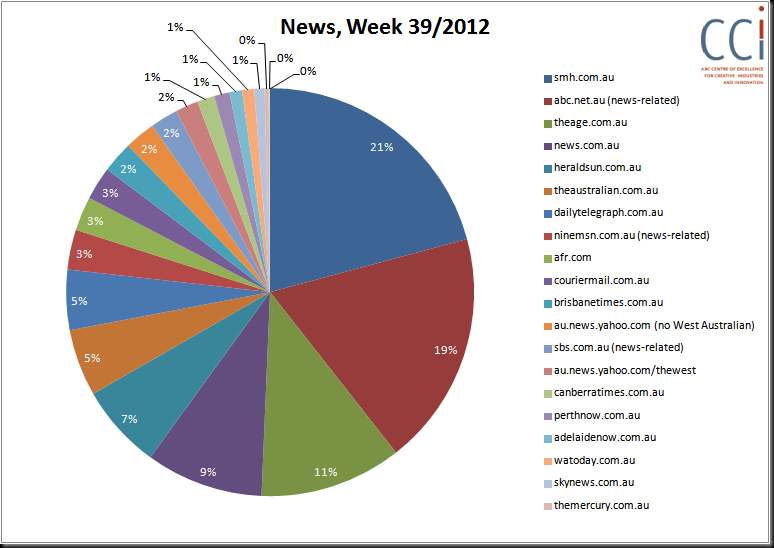
Given the substantial amount of dismay and anger expressed in response to Jones’s comments – not least on Twitter – and the extensive media debate which followed, the distribution of links to the major news sites this week looks almost unexpectedly normal. The top-ranked sites are in their usual positions, though the ABC is putting in a particularly good showing this week – its 19% share of tweeted links is up from 16% last week. It’s not until place nine that we see any change to the status quo, in fact: here, the Australian Financial Review is in an unusually strong position, with nearly 3,400 tweets referencing its articles; that’s over 50% more links to the site than last week. What is notable overall, though, is a significant increase in the total number of links to Australian news sites which were tweeted this week – with about 125,000 tweets, we’re still a fair way from the levels we recorded earlier in the year, but we’re clearly up from the lacklustre levels of the past fortnight.
image

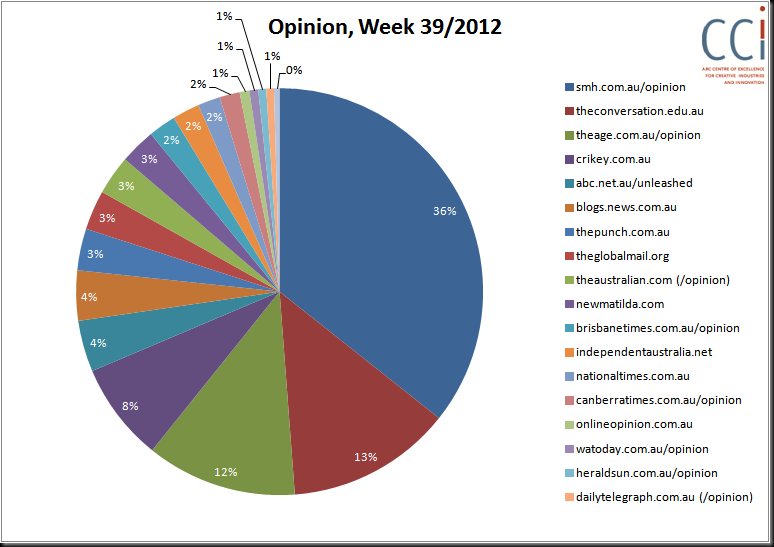
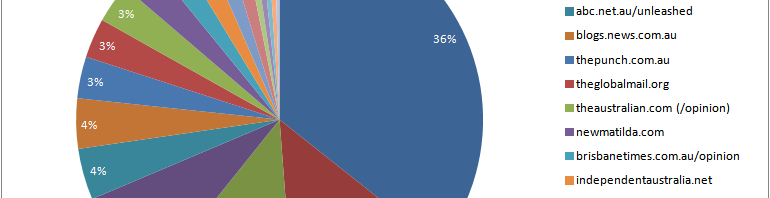
As is so often the case, though, it’s the tweeting of links to opinion and commentary sites and sections where the most significant changes are evident. Week 39/2012 marks an all-time record for the Sydney Morning Herald opinion section, which clearly cements its position as the go-to section for political commentary in Australia; a stunning 36% of the 19,000 links to opinion and commentary sites and sections which were tweeted this past week pointed to material on the SMH. For the most part, this result does not reflect a weakening of the other sites, though: The Conversation also increased its total number of incoming links, for example, and the ABC’s The Drum (or the articles at abc.net.au/unleashed) manages to reverse its slow decline, moving back into fifth place from tenth position in week 38. Rather, then, the fact is that the total number of opinion links has increased this week, and the SMH opinion section has captured a disproportionate share of those additional links.
image

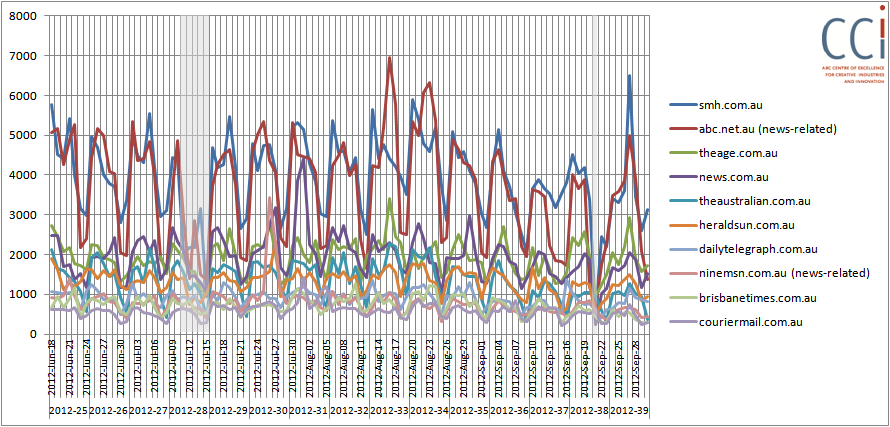
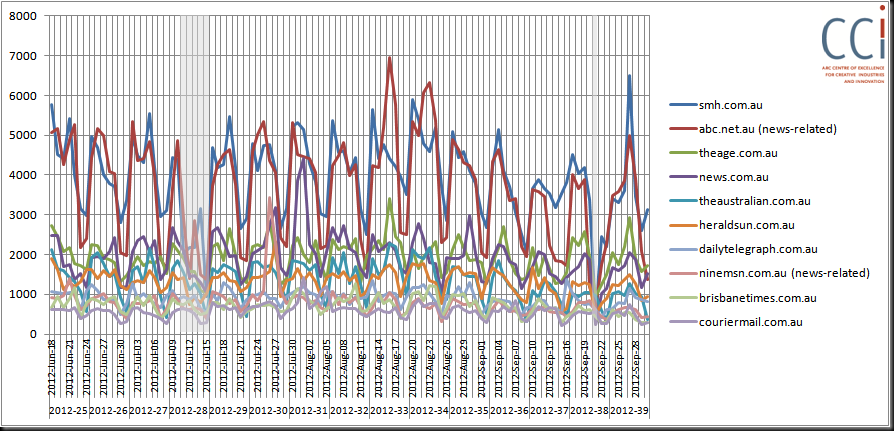
The daily patterns bear this out. For the news sites, we see that the week started out much like previous ones did – but then there’s a sharp spike on Thursday 27 Sep. Notably, all the major news sites shown in the graph below benefit from this increase in activity at least to some extent – but proportional to their long-term prominence as news sources for the Australian Twittersphere, it is the Sydney Morning Herald, ABC News, and The Age which spike most strongly.
image

But wait: news about Jones’s remarks about the PM’s father broke later in the week – so something else must be driving the Thursday spike. Indeed, it’s Julian Assange, not Alan Jones, who is responsible for the substantial spike in Sydney Morning Herald links: a National Times-cobranded report on declassified US documents which describe Assange as an “enemy of the state” received some 3,000 tweets. Once again, it’s the distribution of a domestic story to a global audience, with the help of the well-organised international network of WikiLeaks supporters, which takes SMH links to a higher plane.

The simultaneous spike in activity around ABC News is less clearly driven by any one story. Three articles relating to the disappearance and murder of Jill Meagher account for some 500 tweets; stories about the mistreatment of sheep exported from Australia to Pakistan, and to the dramatic disappearance of Arctic sea ice, add another 300 tweets. In turn, the sharing of stories on Jill Meagher (650 tweets) and Julian Assange (300 tweets) also explains the spike at The Age. Spikes in the minor Australian news sites are also likely to relate especially to news of an arrest in the Meagher case.

Meanwhile, the Australian Financial Review (not pictured here) follows a different pattern, with spikes on 25 and 27 September. The first of these relates mainly to a (non-paywalled) story about Apple co-founder Steve Wozniak, who has declared that he likes the NBN so much that he wishes to become an Australian citizen (some 430 tweets that day, with more on following days); the second relates largely to a piece by former Labor leader Mark Latham which criticises The Australian’s double standards as it reports on Gillard and Abbott (some 250 tweets). Small numbers by comparison, perhaps – but significant for a niche publication which normally fails to generate much excitement on Twitter.

But what of Alan Jones, then – did the major controversy over his remarks, which clearly also resulted in a substantial level of debate and anger in Australian social media spaces (witness the successful campaigns on Twitter and Facebook to encourage companies to pull their advertising from Jones’s show), find no echo in the volume of links shared? In short: yes, it did – but less so than the other major stories of the week.

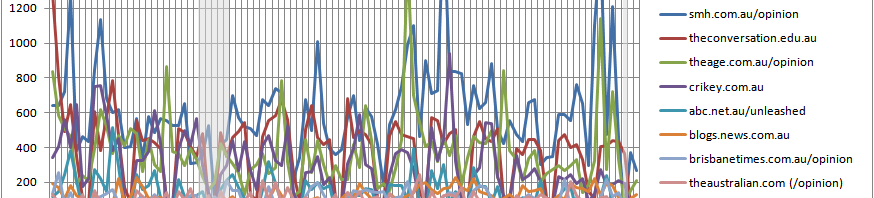
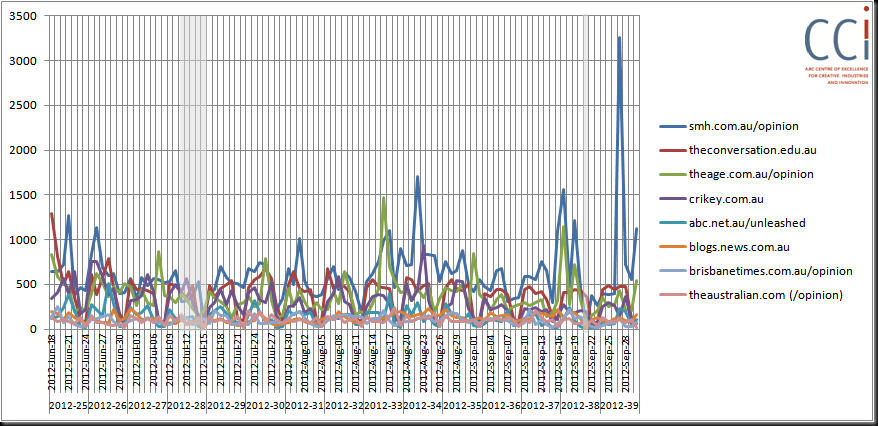
The timing of the Jones controversy must also be considered here. The story broke late on Saturday 29 September – and we already know from our longer-term observations that weekends are traditionally slow days for news sharing on Twitter; we may expect to see more activity on this story in next week’s ATNIX, therefore. The gradual build-up of outrage over Jones’s comments is already evident on the Sunday of week 39, however, and becomes most visible if we single out links to opinion and commentary sites and sections in Australia:
image

While the Sydney Morning Herald opinion spike on 27 Sep. is entirely the result of the 3,000 tweets to a National Times-cobadged article about Julian Assange (and marks by far the most significant case of a story going viral which we’ve observed since ATNIX started in mid-year), there’s another unusual rise in tweeting activity for the SMH and The Age on the final day of the week.

Of the SMH tweets, some 600 link to a piece by sports columnist Peter FitzSimons which draws the connection between Alan Jones and Tony Abbott, while another 200 share a National Times-cobadged article which reports the details of Jones’s speech. The same articles also account for the lion’s share of links to the opinion section of The Age, but here a third article by political editor Michelle Grattan, suggesting that Jones’s statements are “low-rent comments a decent man would not make”, adds another 70-odd links.

Remember that this is only Sunday, though. As the graph above shows, the spike in opinion links to the SMH that day already surpasses the number of tweets which we’ve recorded for almost any other controversy since ATNIX started, except for global issues such as Assange and WikiLeaks. I’d be willing to bet that the following Monday will see yet greater levels of Twitter activity and outrage surrounding this story – especially as discussion of Jones’s belligerent apology and calls for an advertiser boycott of his show and station build up. But for that, we’ll have to wait another week, until ATNIX 40/2012.

A Quick Recap of Twitter Research Approaches

Any self-respecting Internet researcher will already be aware that the Association of Internet Researchers (AoIR) is the place to keep track of what’s cutting edge in the field. On the AoIR mailing-list, there’s been an interesting discussion over the last few days about the available tools for tracking, capturing, and analysing Twitter data – and since nobody had yet mentioned yourTwapperkeeper as a useful solution for many standard tasks, I’ve just posted an overview of how we’ve been approach such research.

As I haven’t had much time recently to post many updates on this Website about our methodological work, I thought I’d cross-post my message to the mailing-list here. For those who’ve come to Mapping Online Publics only recently, perhaps it also provides a useful summary of where we’re at so far.


Erica Ciszek asked:

> I was wondering if anyone can suggest particular tools for aggregating and
> analyzing Twitter content.

Maybe I’m old-school on this, but I’m surprised no-one’s mentioned yourTwapperkeeper yet – in my experience, very straightforward to set up (all you need is a standard LAMP server setup to run it on), and fine for most standard Twitter capture tasks (e.g. tracking hashtags, keywords, specific users, etc.). It’s open source and available here:

https://github.com/jobrieniii/yourTwapperKeeper

We’ve made some modifications to more easily export datasets in CSV/TSV-format datasets – see details here:

http://mappingonlinepublics.net/2012/01/09/twapperkeeper-and-beyond-a-reminder/

Personally, I don’t trust most out-of-the-box Twitter analytics tools, and prefer to roll my own – for processing CSV/TSV datasets containing Twapperkeeper-format data, I’ve been using the scriptable command-line tool Gawk with great success. A collection of Gawk scripts for standard Twapperkeeper data processing tasks is available under a Creative Commons licence here:

http://mappingonlinepublics.net/2011/06/22/gawk-scripts-for-processing-twitter-data-vol-1/

Additionally, my ‘Swiss army knife’ Gawk script for extracting activity metrics from a Twapperkeeper dataset is here:

http://mappingonlinepublics.net/2012/01/31/more-twitter-metrics-metrify-revisited/

The question of developing standard, case-independent metrics for the description of Twitter activity patterns is something Stefan Stieglitz and I are taking up in two forthcoming papers (happy to share drafts – email me off-list). The keynote which Jean Burgess and I presented at the recent Conference on Science and the Internet foreshadows some of this discussion, though:

Axel Bruns and Jean Burgess. “Notes towards the Scientific Study of Public Communication on Twitter.” Keynote presented at the Conference on Science and the Internet, Düsseldorf, 4 Aug. 2012. (The slides and video of the presentation are here: http://snurb.info/node/1678.)

Detailed notes on how we use these scripts to process Twitter data, and additional processing tools, are also on our Website – see http://mappingonlinepublics.net/category/twitter/ for more.

For network visualisation, I recommend the open source software Gephi. My article in Information, Communication & Society describes how I’ve used yourTwapperkeeper, Gawk and Gephi to create dynamic visualisations of Twitter conversation networks:

Axel Bruns. “How Long Is a Tweet? Mapping Dynamic Conversation Networks on Twitter Using Gawk and Gephi.” Information, Communication & Society, 17 Nov. 2011. http://dx.doi.org/10.1080/1369118X.2011.635214

For more sophisticated, ‘big data’ research (i.e. upwards of a few million tweets per dataset), the yourTwapperkeeper approach is less useful (the LAMP framework just isn’t built for big data), and you’ll probably need to build your own customised solution. Eugene Liang and I discuss the pros and cons of both approaches in a recent article in First Monday (while we frame this in a crisis communication context, the discussion applies well beyond this):

Axel Bruns and Yuxian Eugene Liang. “Tools and Methods for Capturing Twitter Data during Natural Disasters.First Monday 17.4 (2012).

Hope that helps.

<insert obligatory plug for the “Digital Data – Lost, Found, and Made” panel at the upcoming AoIR conference, where I’m sure we can discuss the question of Twitter research methods some more as well>

ATNIX: Australian Twitter News Index, Week 38/2012

The last couple of weeks of our Australian Twitter News Index have been somewhat underwhelming: overall levels of news sharing on Twitter have been comparatively low, even in spite of a small blip at the tail end of week 37 which was caused by the reporting and commentary which covered the Sydney riots around the Innocence of Muslims film. In terms of total activity, week 38 picks up a little, but still fails to move past the long-term average – and that’s in spite of some notable spikes in the sharing of opinion articles from leading news sites.

Standard background information: this analysis is based on tracking all tweets which contain links pointing to the URLs of a large selection of leading Australian news and opinion sites. For technical reasons, it does not contain ‘button’ retweets, but manual retweets (“RT @user …”) are included. Datasets for those sites which cover more than just news and opinion (abc.net.au, sbs.com.au, ninemsn.com.au) are filtered to exclude irrelevant sections of those sites (e.g. abc.net.au/tv, catchup.ninemsn.com.au). For our analysis of ‘opinion’ link sharing, we include only those sub-sections of mainstream sites which contain opinion and commentary (e.g. abc.net.au/unleashed, articles on theaustralian.com.au which include ‘/opinion’ in the URL), and compare them with dedicated opinion and commentary sites.

See the posts tagged ‘ATNIX’ on this site for a full collection of previous results.

ATNIX Week 38: 17-23 Sep. 2012

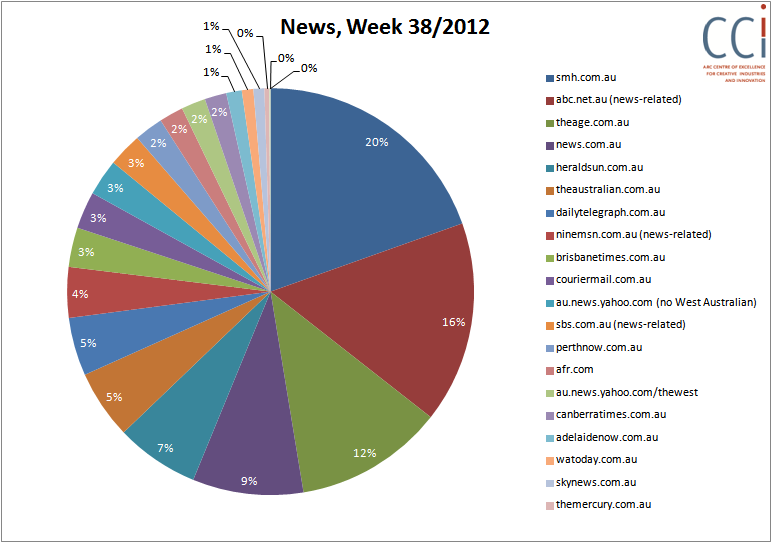
Overall numbers for this week provide a poor point of comparison, as – due to scheduled server maintenance – most of Friday 21 Sep. is missing from this week’s dataset. Given that this incomplete dataset contains some 108,000 tweets linking to Australian news Websites, and that we would usually expect to see at least another 15,000 such tweets on a Friday, though, we can assume that the total volume for this week would be somewhere upwards of 120,000 tweets – which would be at least a small improvement on the preceding week’s 115,000 tweets linking to news sites. Here’s how they are distributed across the sites we track: the main mover in the leading group is The Age, which surpasses news.com.au by some margin this week, after a virtually dead heat last time around.

image

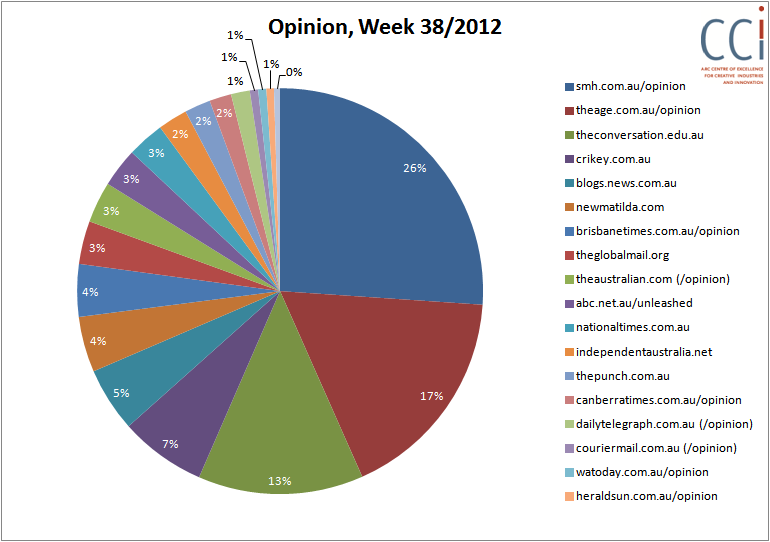
The situation for the opinion and commentary sites and sections is particularly interesting this week, as the day-to-day patterns below will also demonstrate. First, the total number of tweets linking to such sites has actually declined a little (from around 17,600 to 16,700), while the Fairfax sites have substantially increased their dominance: the Sydney Morning Herald maintains a remarkable 26% share of all Australian opinion links shared this week (unchanged from the similarly unusual result last week), but The Age now joins it by adding another 17%. This once again pushes it past the long-term runner-up The Conversation, which received roughly the same amount of links as last week, but was clearly outperformed by the substantial spike in The Age shares. There is further shuffling of positions on the minor places (the ABC’s The Drum loses another place, continuing its decline of the past few weeks), but these represent fairly small numbers in the first place.

image

These patterns are further illustrated by the day-to-day comparisons (ignore the drop in numbers on 21 Sep. due to server maintenance, obviously). Links to the news sites remain below the long-term average, but are generally improved from the previous week; this is especially notable for The Age (in green), which is now well above news.com.au’s purple line. At the same time, there are no obvious spikes in activity – as weeks go, this is a sedate one.

image

That’s not the case for the opinion and commentary sites and sections, on the other hand: here, Sydney Morning Herald and The Age and both spiking on 17 and 19 September, and Fairfax’s online-only Brisbane newspaper site Brisbane Times gets a minor spike (by its admittedly modest standards) on 18 September:

image

For the Sydney Morning Herald, the new week continues a trend which the preceding Sunday’s comparatively more minor spike around a piece by sports commentator Peter FitzSimons about the Sydney riots already foreshadowed: a substantial amount of tweets sharing links to commentary about the Innocence of Muslims film and its aftermath. On the Monday, it’s a more considered argument by Waleed Aly which is shared in more than 700 times.

By Wednesday, however, attention is split between this issue and a new political controversy: while another opinion piece on the Sydney protests, by Mohamad Tabbaa, gains some 140 additional shares, the majority of the 19 Sep. spike is driven by opinion articles which discuss the parliamentary debate about same-sex marriage. National Times-cobadged articles about Liberal Senator Cory Bernardi’s hysterical fear campaign and his subsequent resignation as Opposition Leader Tony Abbott’s personal parliamentary secretary are shared in some 260 tweets, while pieces about NSW Premier Barry O’Farrell’s intention to allow a conscience vote on same-sex marriage in state parliament and Finance Minister Penny Wong’s fight for the recognition of same-sex relationships each added another 100 tweets.

Similar patterns apply at The Age. Waleed Aly’s piece was published here as well, and receives some 375 tweets on Monday, and a (pre-bestiality) Cory Bernardi also enters this debate, if only as a sideline. At the same time, a piece about the erosion of Australian Internet users’ privacy rights through the government’s proposed data retention laws also receives some 150 tweets. Wednesday, on the other hand, is all about Cory Bernardi: articles discussing his contributions to the same-sex marriage debate account for more than half of all Age links shared on Twitter that day.

By contrast, the smaller spike in Brisbane Times links on the Tuesday is purely about state matters, incidentally: some 165 tweets linked to a piece by author John Birmingham on what’s wrong with Queensland Premier Campbell Newman. This makes sense in the overall context of the Fairfax setup, with SMH and Age as the national flagships, and the Brisbane Times as a secondary, local platform which syndicates much of its national coverage from those newspapers – so Fairfax readers who are interested in following the national coverage should be expected to be more likely to link to those sites in their tweets than to the Brisbane Times.

Talking Digital Methods in Bristol

At the start of July, I had the pleasure of being one of the three speakers at the inaugural Digital Methods as Mainstream Methodology workshop in Bristol (I posted my presentation from the event here a little while ago). I’m happy to say that the DMMM folks have now also published a series of interviews with the speakers on their YouTube channel. My chat about the importance of ‘natively digital’ methods for the study of Twitter as a platform for public communication is below, but I’d also encourage you to check out the interviews with Eric Meyer from the Oxford Internet Institute and Christine Hine from the University of Surrey.

ATNIX: Australian Twitter News Index, Week 37/2012

Here we are again with the latest weekly instalment of the Australian Twitter News Index. First off, I’m happy to say that the index is now also the subject of a weekly column at The Conversation, where I’ll cross-post ATNIX updates as well as other commentary on social media and society in Australia and beyond. More on that as it develops – but for now, let’s get back to the issues at hand.

Standard background information: this analysis is based on tracking all tweets which contain links pointing to the URLs of a large selection of leading Australian news and opinion sites. For technical reasons, it does not contain ‘button’ retweets, but manual retweets (“RT @user …”) are included. Datasets for those sites which cover more than just news and opinion (abc.net.au, sbs.com.au, ninemsn.com.au) are filtered to exclude irrelevant sections of those sites (e.g. abc.net.au/tv, catchup.ninemsn.com.au). For our analysis of ‘opinion’ link sharing, we include only those sub-sections of mainstream sites which contain opinion and commentary (e.g. abc.net.au/unleashed, articles on theaustralian.com.au which include ‘/opinion’ in the URL), and compare them with dedicated opinion and commentary sites.

See the posts tagged ‘ATNIX’ on this site for a full collection of previous results.

ATNIX Week 37: 10-16 Sep. 2012

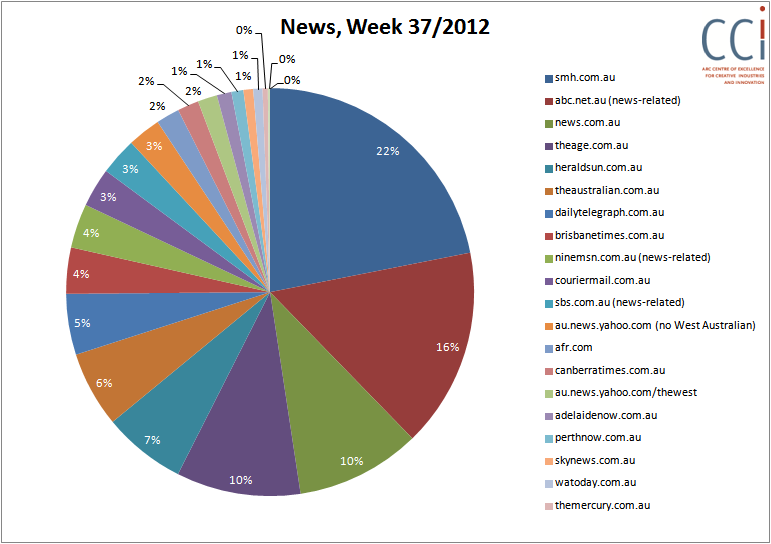
As it turns out, this week is yet another quiet one – so much so that I’m starting to wonder whether there’s some kind of underlying trend here. Is it the approaching footy finals season? Spring holidays? Or a general news fatigue this deep into the year? Whatever the reason, with only 115,000 tweets linking to Australian news sites, we’ve reached a new low, down substantially again from last week’s already rather paltry 128,000 tweets.

Strangely, it’s been ABC News which has taken an especially big hit this week. The Sydney Morning Herald retained its position (in fact, it received a few hundred more links than last week) – but the ABC’s share of Twitter links declined by more than 5,000 tweets, which strikes me as very odd. Such troughs are difficult to explain: for spikes in activity, it’s usually easy to identify the stories which caused them, but – assuming the ABC didn’t publish a substantially smaller number of news stories than usual last week – what causes the Twitter userbase to just stop linking to a given site? Very curious.

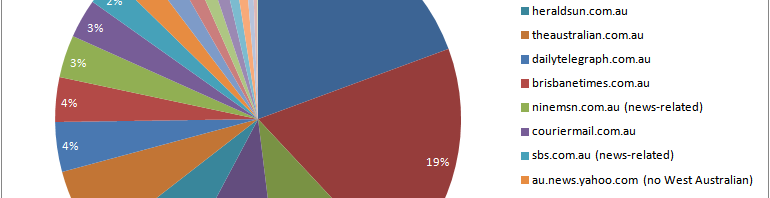
Otherwise, the ranking and relative distribution of Twitter links across the major Australian news sites has remained more or less stable this past week; it’s simply the total volume of activity which has declined:

image

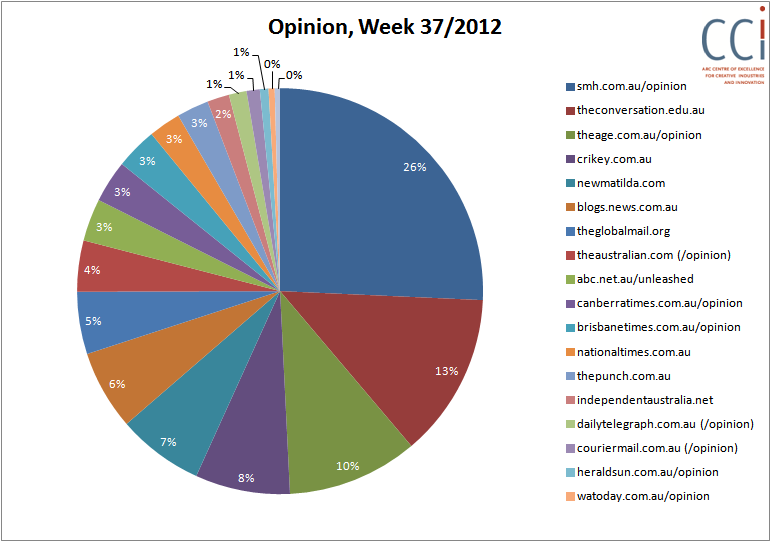
On to the opinion and commentary sites and sections – and interestingly, here the total volume of tweets has even increased slightly from last week (from 15,700 to 17,600 tweets linking to these sites). The SMH opinion section puts in another very dominant performance – receiving more than one quarter of these links –, while Crikey and New Matilda also maintain their recent form. The ABC’s The Drum (at abc.net.au/unleashed), meanwhile, continues to slip down the order: from position five in week 35 through eight last week to nine this time around. Something’s going on here:

image

In other news, it’s also worth noting that the Daily Telegraph’s grandly announced anti-trolling campaign – addressing a technology and social media topic which we should expect to be of significant interest to Twitter users, which we know was a winner for news.com.au a couple of weeks ago – comprehensively failed to resonate with Australian Twitter users. Presumably, they recognised this exercise in cynical populism for what it was, and declined to provide it with additional oxygen.

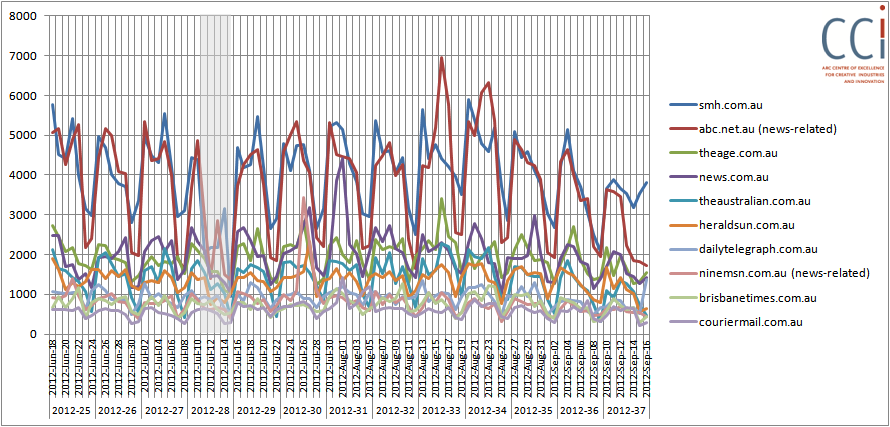
On to the daily patterns, which clearly illustrate both the low volume of news sharing activity in general, and the significant decline in ABC News tweets in particular, which we found this week:

image

In the absence of any marked spikes in activity for any of the sites we’re tracking, there really isn’t much else to say here – except to note the continuous decline in ABC News shares since the (Assange-driven) heady heights of week 33. Even the market-leading Sydney Morning Herald follows a similar pattern, though its attention share hasn’t dropped down quite as precipitously.

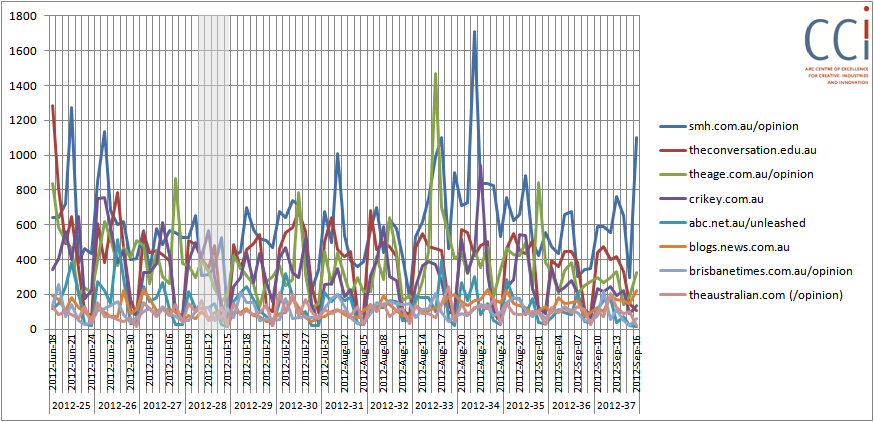
For the past week, this is also due to a certain boost in activity which it received from its opinion section, especially on the weekend, as the next graph shows. The spike in activity which we see on Sunday 16 Sep. is due almost exclusively to the sharing of a confrontational ‘open letter’ from sports writer Peter FitzSimons to the participants in sometimes violent protests in Sydney against the notorious Innocence of Muslims video, which was shared over 800 times.

image

Not pictured here, but also significant, is a spike in tweets linking to New Matilda on 13 Sep., which accounts for the site’s strong performance this week. That spike is driven largely by two pieces: an update on the legal situation of imprisoned WikiLeaks source Bradley Manning, and another story about federal Opposition Leader Tony Abbott’s purportedly pugilistic political past. Between them, some 320 tweets linked to these stories – enough to make an impact in an otherwise unremarkable week.

So much for week 37, then. Given the range of major stories during week 38 (from further protests about the Innocence of Muslims film to the unravelling Romney campaign in the U.S.), we might expect the volume of tweets to increase again – but as these are largely international stories, Twitter users may also choose to share links to international rather than domestic news sources, of course. Due to some server maintenance, I’m afraid we’ll also have some gaps in next week’s data – but we’ll make do with what we have.

New Article on Twitter and Journalism in Australia

I’m please to say that a new article of mine has been published in Media International Australia (which means I’ve now had articles in consecutive MIA issues…). The issue in question, on “The ‘New’ News”, was edited by my QUT colleagues Stephen Harrington and Brian McNair, and looks like a bumper collection of exciting work – full details are here.

My article is on the use of Twitter by Australian journalists, looking especially at the Rudd/Gillard leadership spill in June 2010, and the federal election night in August. Below is the abstract – the full article is here, and a pre-print version is here.

Journalists and Twitter: How Australian News Organisations Adapt to a New Medium

From the substantial volume of tweets during the Rudd/Gillard spill, the 2010 election campaign, and the screening of Q&A episodes to Australian editor Chris Mitchell’s threat to sue journalism academic Julie Posetti for reporting on statements about him at an academic conference, Twitter has developed an increasingly visible presence in Australian journalism. While detractors like Mitchell remain vocal, many other journalists have begun to explore manageable approaches to incorporating Twitter into their work practices, and for some – like the ABC’s ‘star recruits’ Annabel Crabb and Latika Bourke – it has already become a career driver.

Building on the data generated by a continuing, three-year ARC Discovery project, this article examines the tweeting practices of selected high-profile Australian journalists during significant political events, and explores their positioning within and interactions with the wider network of Australian Twitter users. It employs innovative data processing approaches to assess the centrality of these professional journalists to the networks of Australians discussing the news on Twitter, and places these observations in a wider context of journalist/audience relations, a decade after the emergence of the first citizen journalism Websites.

ATNIX: Australian Twitter News Index, Week 36/2012

I think I’m running out of snappy opening lines for ATNIX posts – and I’m not sure this one particularly deserves one, either: it’s a pretty average week, as we’ll see in a minute. In fact, as overall patterns go, you’d be hard-pressed to see any significant differences between the news sharing patterns for this week and the previous one!

Standard background information: this analysis is based on tracking all tweets which contain links pointing to the URLs of a large selection of leading Australian news and opinion sites. For technical reasons, it does not contain ‘button’ retweets, but manual retweets (“RT @user …”) are included. Datasets for those sites which cover more than just news and opinion (abc.net.au, sbs.com.au, ninemsn.com.au) are filtered to exclude irrelevant sections of those sites (e.g. abc.net.au/tv, catchup.ninemsn.com.au). For our analysis of ‘opinion’ link sharing, we include only those sub-sections of mainstream sites which contain opinion and commentary (e.g. abc.net.au/unleashed, articles on theaustralian.com.au which include ‘/opinion’ in the URL), and compare them with dedicated opinion and commentary sites.

See the posts tagged ‘ATNIX’ on this site for a full collection of previous results.

ATNIX Week 36: 3-9 Sep. 2012

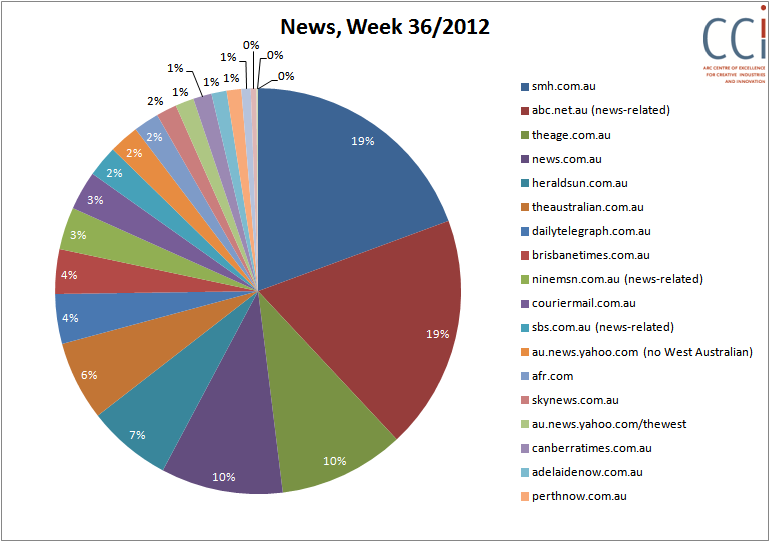
It’s also a very quiet one – only some 128,000 links to Australian news sites were shared on Twitter this week, compared to the 142,000 in week 35 and the whopping 160,000 the week before that. Towards the end of the year, we’ll have a look at the weekly cycles of activity, I think – and I wouldn’t be at all surprised if we’d see some longer-term ebbs and flows in news attention over that timeframe. The distribution of attention across our major sites also matches that from last week almost exactly, give or take a rounded percentage point here or there – the top ten sites are placed exactly as they were.

image

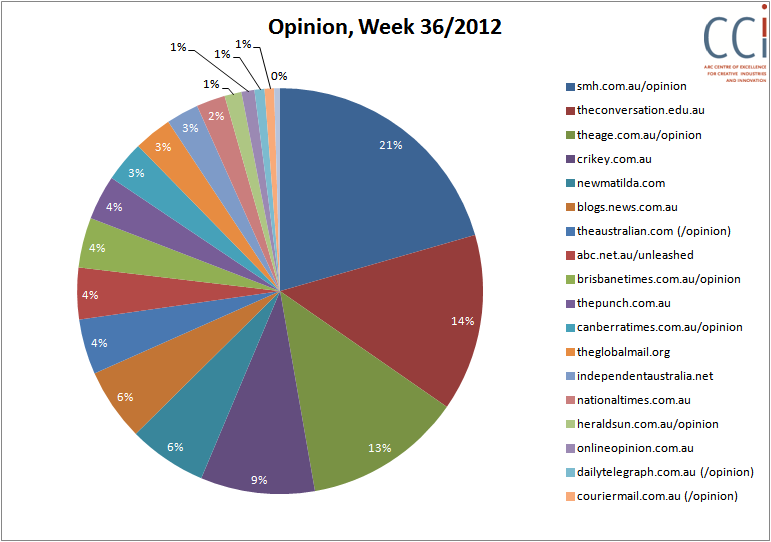
The amount of links to opinion and commentary sites and sections has also shrunken (from 18,800 to 15,700), and at least here there’s a bit more movement on the leaderboard. The Conversation regains its customary second place, leapfrogging The Age’s opinion section, and New Matilda has an especially good week (in fifth place); ABC The Drum (or more precisely, abc.net.au/unleashed URLs) drop well out of the top five, by contrast.

image

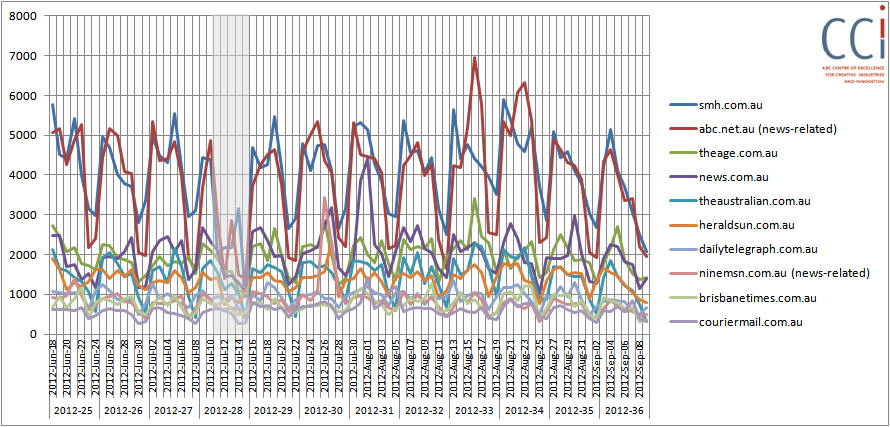
On to the daily results, then. For the news sites, there’s nothing much to see here: much as last week, a clear illustration of the standard attention patterns (strong at the start of the week, then steadily dropping off towards the weekend), though it’s notable that the Sydney Morning Herald hasn’t been able to maintain its somewhat stronger weekend position (boosted by the weekend magazine’s feature articles, I’d wager) this time around.

image

Amidst the overall steady-as-she-goes patterns, there is a smallish spike in numbers for The Age, though: its piece on the latest salvo in the Australian ‘Christian’ Lobby’s hate campaign against same-sex marriage was shared some 530 times. Let’s just say that this particular demonstration of fundamentalists rhetoric did not find many supporters on Twitter. At all.

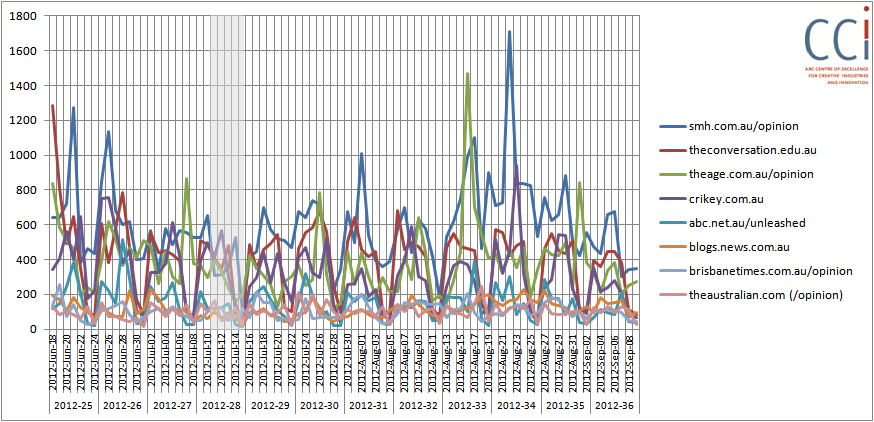
As far as the daily opinion and commentary sharing patterns are concerned, it’s difficult to speak of spikes in activity when for the most part, that activity remained at or below the long-term average.

image

But for what it’s worth, the small rise in activity around the Sydney Moring Herald opinion section is due largely to an article about Malcolm Turnbull’s call for more honesty in Australian politics, which received some 165 tweets sharing it during 5 and 6 Sep.; another piece, on the question of whether the Prime Minister should attend an ACL function after the organisation’s repeated hate speech against homosexuality, received another 50-odd links.

Finally – not pictured on the graph above (as it’s not normally a leading opinion site on Twitter), New Matilda scored a major hit (by its standards) with an interview with Noam Chomsky about Julian Assange that was shared nearly 200 times on 4 Sep. (accounting for more than half of all links to New Matilda being shared on Twitter that day). We’re back in very familiar territory here, of course – stories about Assange have regularly generated large spikes in Twitter sharing for Australian news and opinion sites in the past, as the international WikiLeaks and Assange supporter community picks the up and passes them on. That day, New Matilda briefly became the second most shared Australian opinion site on Twitter, thanks to this single story.

But that’s against  the backdrop of a very slow news week. Let’s see if next week picks up a bit…

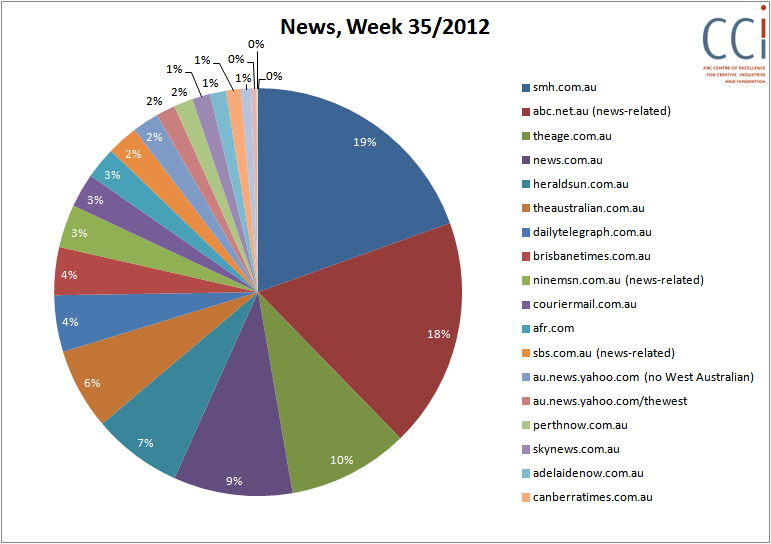
ATNIX: Australian Twitter News Index, Week 35/2012

After the somewhat delayed Australian Twitter News Index for week 34, this week’s edition is significantly more timely – though it must be said that after the two very exciting weeks we’ve had, week 35 turns out considerably more sedate. For the moment, at least, it looks like we’re more or less back to normal…

Standard background information: this analysis is based on tracking all tweets which contain links pointing to the URLs of a large selection of leading Australian news and opinion sites. For technical reasons, it does not contain ‘button’ retweets, but manual retweets (“RT @user …”) are included. Datasets for those sites which cover more than just news and opinion (abc.net.au, sbs.com.au, ninemsn.com.au) are filtered to exclude irrelevant sections of those sites (e.g. abc.net.au/tv, catchup.ninemsn.com.au). For our analysis of ‘opinion’ link sharing, we include only those sub-sections of mainstream sites which contain opinion and commentary (e.g. abc.net.au/unleashed, articles on theaustralian.com.au which include ‘/opinion’ in the URL), and compare them with dedicated opinion and commentary sites.

See the posts tagged ‘ATNIX’ on this site for a full collection of previous results.

ATNIX Week 35: 27 Aug.-2 Sep. 2012

Given that weeks 33 and 34 showed some comparatively unusual patterns driven largely by a handful of major (in part also international) stories – the Assange saga, the Leigh Sales/Tony Abbott interview on 7.30 – we’ve got to go back at least three weeks to find a comparably ‘normal’ news week on Twitter. We captured some 142,000 links to our news sites this week (which is actually a comparatively low amount), and the usual pecking order amongst the leading news sites is restored as well – after last week’s very strong performance by ABC News, the Sydney Morning Herald returns to the lead, by almost 2000 tweets.

image

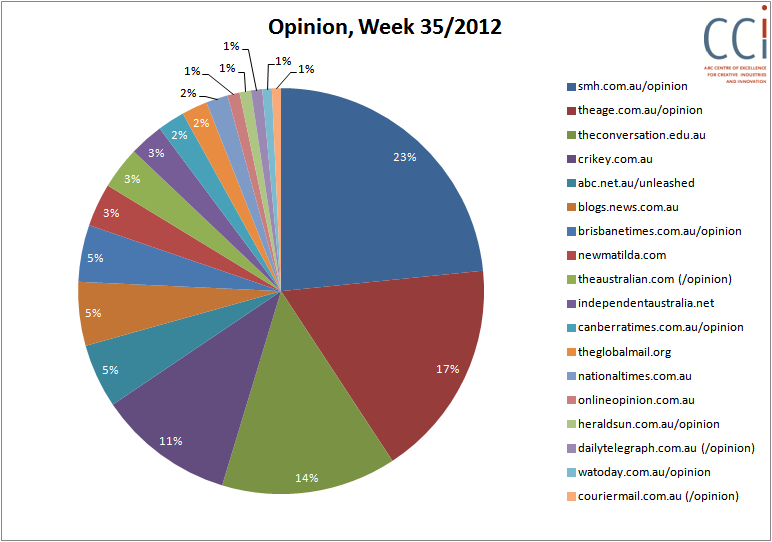
This return to normalcy is felt especially strongly amongst the opinion and commentary sites and sections, though. With 18,800 tweets sharing links to these URLs this week, there are some 20% fewer opinion tweets this week – the vast spike in links to the SMH’s coverage of new data retention laws has washed out of the system, and the SMH’s opinion marketshare has dropped back down to 23%. That’s still somewhat above the long-term average, but leaves substantially more space to its competitors. Interestingly, it’s The Age which benefits more from this than usual runner-up The Conversation: the latter clocks up its usual 2,600-odd tweets per week, but The Age’s opinion section has a particularly strong week this time around (as we’ll see in the day-to-day figures below). Conversely, Crikey falls back from its unusually strong, First Dog on the Moon-driven second place last week to a much more normal fourth position.

image

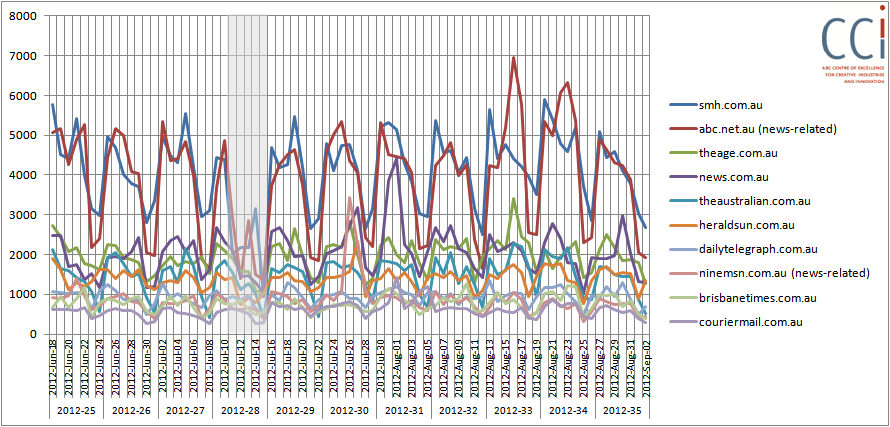
On to the daily patterns, then. For news, we see what is a very common trajectory for SMH and ABC News: a strong Monday, and then a slow decline through the rest of the week; both sites are essentially equal throughout the working week. The only slightly interesting feature here is a small spike in news.com.au links on Thursday, 30 Aug. – this is driven by the site’s coverage of TV presenter and model Charlotte Dawson’s attempted suicide following severe bullying on Twitter. The major story on this (a ‘special investigation’ on trolling) was shared some 600 times, while a number of related pieces picked up another 500+ shares, easily accounting for the 1,000 additional tweets mentioning news.com.au that day. (It’s interesting that of the leading sites, news.com.au seems to be the only one receiving additional links from this story – as a more middlebrow news site, compared to SMH and ABC News, perhaps it is the more ‘natural’ place to look for what is at least in part also a celebrity story?)

image

The daily patterns for opinion and commentary sites and sections look a little more messy this week. There are no major spikes as we encountered them during the previous two weeks; none of the sites make it past 900 tweets per day, in fact. There are minor spikes for the Sydney Morning Herald opinion section on Thursday, and for The Age’s opinion section on Saturday (which is unusual, given that weekends are traditionally low on opinion sharing):

image

Of these, the SMH spikelet is driven by no one topic in particular, with stories on political gifts, the deaths of Australian soldiers in Afghanistan, and Gina Rinehart’s commends on welfare each picking up between 45 and 80 tweets each. The Age spike on Saturday is substantially more pronounced, however – and is driven solely by Virginia Trioli’s opinion article, calling out Peter Reith on his attempts to rewrite history by downplaying the Howard government’s ‘children overboard’ lies. Some 550 tweets, or around two thirds of all tweets linking to The Age’s opinion section that day, referenced this piece. Finally, Crikey also experiences a minor spike on 29/30 August – driven by a combination of multiple stories on the staff cuts at Fairfax (300+ tweets) and a piece on the U.S. ambassador’s assurances, in an exclusive interview, that the country has no interest in extraditing Julian Assange (170+ tweets).

And that’s it for this week – a somewhat quieter one, but we’ll see what the future holds…

ATNIX: Australian Twitter News Index, Week 34/2012

It’s been another stupidly busy week for me, I’m afraid, so ATNIX 34/2012 is running a little late once again. So, let’s jump right in and see whether this week can measure up to the high drama we saw last time around.

Standard background information: this analysis is based on tracking all tweets which contain links pointing to the URLs of a large selection of leading Australian news and opinion sites. For technical reasons, it does not contain ‘button’ retweets, but manual retweets (“RT @user …”) are included. Datasets for those sites which cover more than just news and opinion (abc.net.au, sbs.com.au, ninemsn.com.au) are filtered to exclude irrelevant sections of those sites (e.g. abc.net.au/tv, catchup.ninemsn.com.au). For our analysis of ‘opinion’ link sharing, we include only those sub-sections of mainstream sites which contain opinion and commentary (e.g. abc.net.au/unleashed, articles on theaustralian.com.au which include ‘/opinion’ in the URL), and compare them with dedicated opinion and commentary sites.

See the posts tagged ‘ATNIX’ on this site for a full collection of previous results.

ATNIX Week 34: 20-26 Aug. 2012

In terms of volume, certainly, week 34 almost reaches the heady heights of the previous one: the news sites alone surpassed the 160,000 tweets mark, only some 650 tweets below the previous week’s mark. There are few surprises at the top of the leaderboard; The Age and news.com.au swap places again, after its Assange coverage briefly pushed The Age into third spot last week, but there’s only a few hundred tweets in it.

image

For the opinion and commentary sites and sections, the story is a little more interesting: with over 24,000 tweets sharing links to these sites, they’re surpassing even last week’s mark, and the field is led by an impressive performance by the Sydney Morning Herald, which receives more than a quarter of all links to Australian opinion sites shared on Twitter this week. As last week’s Assange boost washes out of the system, by contrast, The Age’s opinion pages fall back from second to fourth. In a somewhat surprising second place (considering its partial paywalling) is Crikey, which surpasses even The Conversation (which is usually our second site). And that’s not because of a bad week for The Conversation (it even gains a handful of links on last week), but because Crikey adds almost 1,000 tweets this week – we’ll see below what stories were responsible for this performance.

image

But first, to the daily patterns for news. Here, the Sydney Morning Herald is back to its usual weekly pattern, which sees Monday as its best day, and a smaller spike towards the end of the working week. But (similar to last week), it’s ABC News which leads the way on Wednesday and Thursday – and responsible for this peak, for once, is not an Australian-produced story reaching international audiences, but very much a domestic one: the video and transcript of Leigh Sales’s confrontational interview with Opposition Leader Tony Abbott on the ABC’s 7.30 programme was shared almost 2,000 times, with a separate link (to the video only) receiving another 400+ tweets.

image

This strikes me as one of those times when a media moment manages to cut through, even to people who hadn’t watched the interview live on the show, and by way of sharing through social media ends up reaching a much broader audience than it would otherwise have done. Consider the potential reach of each of those 2,400 tweets (the followers of the tweeting user, and the followers of any hashtag used in the tweet), and add similar patterns unfolding on Facebook, and you end up with a substantial number of users who’d have seen that video or read the transcript. (Whether it changes anyone’s opinion of Tony Abbott – or of Leigh Sales – is another question, of course.)

Meanwhile, there’s also a bump in the number of tweets linking to news.com.au, around 21 August – that one is driven mainly by an interview with visiting American Idol judge and pop star Adam Lambert, which received some 400 links that day (more than 100 of these directly to one or another of the photos of Lambert, incidentally). Somewhat more strangely, on 20-22 Aug., there were also some 350 tweets linking directly to this photo of a protest poster in the US – which I think is from the pro-Assange protests in London. Where ABC News’ bump is driven by domestic issues, then, for news.com.au it looks like we’re seeing international drivers once again, much like last week.

The opinion and commentary sites and sections experienced some very significant spikes in activity again, too. First, on 22 August the Sydney Morning Herald opinion section received the single most tweets linking to any one opinion site that we’ve seen since we started ATNIX – but it’s another one of those National Times-cobranded pieces which ostensibly sit in the SMH’s opinion section but actually read more like a straightforward news report: in this case, about the government’s highly problematic new laws enabling federal authorities to retain Australians’ Internet communications data. Whether we call it ‘opinion’ or not, it received more than 1,000 shares on the Wednesday alone – unsurprisingly, Australian Twitter users reacted strongly to laws which seek to govern their use of Internet technology.

image

The other substantial spike is responsible for the unusually strong performance by Crikey which we’ve already seen in the weekly figures. Here, we return to the 7.30 interview between Abbott and Sales – or rather, cartoonist First Dog on the Moon’s take on the interview, which (notably, posted outside Crikey’s paywall) received some 350 shares. Adding to these figures, another 160 tweets referenced Bernard Keane’s (similarly non-paywalled) commentary on the passing of the ‘Cybercrime’ data retention bill, and the lack of debate (in parliament or in the media) about the introduction of these significant new surveillance powers and their impact on citizens’ privacy.

And there it is – for once, a strong week driven mainly by domestic issues rather than viral stories of international relevance.