ATNIX: Australian Twitter News Index, September 2015

One week is a long time in politics, as they say, and so the thirty days of September 2015 have been packed with more than enough upheavals – none more momentous, of course, than the successful Liberal Party leadership challenge on 14 September, which saw Malcolm Turnbull replace Tony Abbott as Prime Minister on the following day. Much of this month’s Australian Twitter News Index analysis is therefore focussing on the days surrounding that moment.

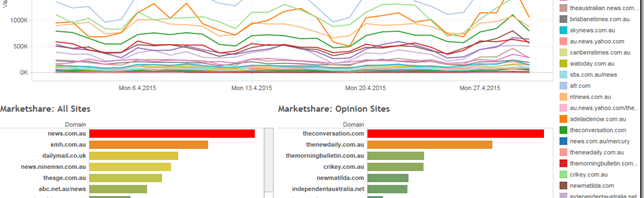
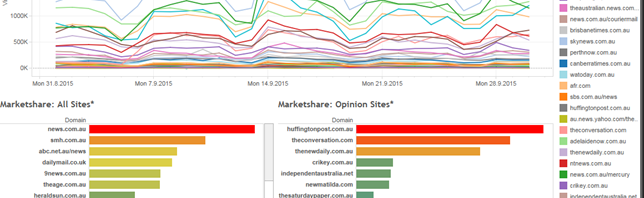
Curiously, though, for the most part the political drama surrounding the leadership challenge did not result in any particularly pronounced increase in link sharing on Twitter during these days. Sharing for market leader ABC News on 14 September is roughly on trend for any given Monday, and even the brief spike in links to the Sydney Morning Herald on the same day only lifts its figures by about 1,500 tweets compared to the previous Monday. The only truly notable jump in links to any one site being shared on the day is recorded by SBS, which gains some 4,000 more tweets than its usual average – and this is due almost entirely to The Feed’s comedic interventions in covering the leadership spill.

image

This is not entirely surprising, however. The choreography of the 2015 Abbott/Turnbull spill is notably different from that of the 2010 Rudd/Gillard spill in the Australian Labor Party, for instance: that spill – against a still comparatively popular Prime Minister – came as a considerable surprise to the general public, with rumours first circulating amongst Canberra insiders in the evening of 23 June 2010, ahead of a caucus vote the following day.

The 2015 spill, by contrast, had been anticipated at least since the unsuccessful backbench revolt in February, and Malcolm Turnbull finally declared his hand openly in a press conference just after 4 p.m., well-placed for the primetime news. This resulted in wall-to-wall TV coverage of the vote and its results, throughout the evening, thus requiring much less sharing of news updates on Twitter – what we saw on that platform instead was a great deal of discussion about the spill and its implications, centred on the hashtag #libspill. Updates from the news outlets and journalists covering the event were still widely retweeted, of course – but these largely contained live reports from outside the Liberal Party caucus rooms, rather than the links to articles on news sites that we would pick up through ATNIX.

The most shared news stories during September provide an indication of some of the issues that influenced the public mood about the Abbott government, however. Even in spite of in-depth reporting about the leadership change, the most widely shared ABC News article in September covered Immigration Minister Peter Dutton’s gaffe as his cruel joke about rising sea levels was captured on a live boom microphone (3,200 shares), while a story about the Abbott government’s decision to give preference to Christians in its intake of Syrian refugees received some 1,400 shares. That said, articles reporting controversial government activities – such as its linking of environmental activism and alternative music to political radicalisation – continued to be widely shared during the Turnbull honeymoon period, too: an ABC News piece about the issue on 25 September gained some 1,900 shares.

Leading SMH articles during September were even more diverse, possibly also because they represented stories that managed to attract an audience beyond Australia: its most widely shared article during the past month covered its unmasking of a would-be Daesh supporter as a Jewish-American teenager in Florida (2,700 shares), followed by a piece featuring footage of a seal riding on the back of a whale (2,400 shares). Amidst all the political tension, perhaps Twitter users deliberately sought out some diversions?

Independent of what stories ended up being shared on Twitter, however, our Experian data on total visits to the leading Australian news and opinion sites sites provide further detail on what online sources Australian Internet users drew on as they followed the political drama surrounding the spill. Here, we see considerable increases in readership on and after 14 September for a number of the leading news sites: market leaders news.com.au gains some 425,000 additional visits, compared to the previous Monday, while the SMH picks up more than 538,000 additional visits. But the biggest jump in visits is recorded by ABC News: it gains over 720,000 additional visits on 14 September, compared to the previous Monday.

This again demonstrates the importance of the public broadcaster’s Website (and, by extension, of other quality online news sources such as the Sydney Morning Herald) during key national events – and also mirrors the way that Australian viewers flocked to ABC channels during the spill. We observed a similar pattern in our analysis of the #libspill discussion on Twitter: here, too, the accounts of ABC News and its journalists turned out to be central to the ad hoc community that formed around the hashtag as the leadership challenge unfolded.

image

By contrast, some of the more recent overseas entries to the Australian mediascape lost out on gaining additional visitors: the number of visits to the otherwise popular Daily Mail Australia site on 14 September essentially flatlined in comparison to the previous Monday, and even Buzzfeed Australia – which has tried hard to insert itself into the Australian political discussion through its active and irreverent social media engagement – gained only another 134,000 visits on the day of the spill. Huffington Post Australia, incidentally, has yet to make any significant impact on the Australian media landscape at all – even on the day of the leadership challenge, it failed to reach 75,000 visits.

As the political contest returns to what passes for normalcy in contemporary Australia, and the nation turns its attention to the series of sporting events unfolding in October and November, we should now expect a different set of news sources to come to the fore, however. The next ATNIX instalment should show us, for example, whether sporting success for teams has also translated into additional attention for their hometown news sites.

Standard background information: ATNIX is based on tracking all tweets which contain links pointing to the URLs of a large selection of leading Australian news and opinion sites (even if those links have been shortened at some point). Datasets for those sites which cover more than just news and opinion (abc.net.au, sbs.com.au, ninemsn.com.au) are filtered to exclude the non-news sections of those sites (e.g. abc.net.au/tv, catchup.ninemsn.com.au). Data on Australian Internet users’ news browsing patterns are provided courtesy ofExperian Marketing Services Australia. This research is supported by the ARC Future Fellowship project “Understanding Intermedia Information Flows in the Australian Online Public Sphere”.
ATNIX: Australian Twitter News Index, August 2015

Australian public affairs have continued to be turbulent during August 2015 (to say nothing of September, which will be covered in our next update), and the arrival of Huffington Post Australia as the latest overseas entrant has had the potential to disrupt the media market, too. Time then to see how the Australian Twitter News Index for August reflects public attention to the news during this month.

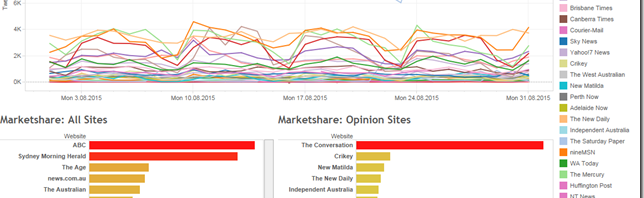
First things first: Huffington Post Australia itself has so far failed to set the world on fire. After a brief opening flurry in the days following its launch on 19 August, the site has received comparatively few tweeted links per day, lagging behind established local entries such as The New Daily or Independent Australia. That said, the total figure of some 3,300 tweets during August which is indicated in the graph below should not be compared to the rest of the competition just yet, since HuffPo only launched mid-month.

If HuffPo take-up on Twitter in Australia has been limited to date, though, my sense is that this may have some thing to do with the comparatively limited online promotion work the site has done itself so far. Unlike other recent entry Buzzfeed Australia, whose Political Editor Mark Di Stefano has quickly become a fixture in the Australian Twittersphere – his Twitter activity played an important role in alerting users to the recent #BorderFarce controversy, for instance – HuffPo editors and contributors seem to have been much less active in promoting their work on Twitter to date.

(Sadly, of course, the lack of a distinct Australian domain name for Buzzfeed Australia means that we have been unable to track tweets linking to the site as part of ATNIX, so this analysis remains anecdotal.)

In this it should be remembered that Buzzfeed has been operating in Australia since early 2014, however, and has had the time to develop its Australian audience – by contrast, with the paint still wet on the Huffington Post Australia logo, the site’s editors may have chosen to wait with any serious online promotion until operations are fully bedded down. As we will see from Experian Marketing Services’ Hitwise data below, total visits to Huffington Post Australia are certainly already looking reasonable: more Australian users have visited Huffington Post Australia in its first weeks of operation than went to Crikey during the entirety of August.

Well ahead of these minor players, ABC News has had another strong month, with its stories shared in over 300,000 tweets during August. And the most widely shared ABC News stories this month provide a handy indication of what has exercised Australian political observers this month: from Bronwyn Bishop’s resignation as Speaker at the start of August (1,100 shares) to Border Force’s controversial announcement of Operation Fortitude (1,200 shares) and its swift cancellation following public outrage (1,700 shares), this has been a month of public controversies.

image

Further, the ABC’s Factcheck unit published a couple of particularly widely shared articles – on Joe Hockey’s claim that the abolition of the carbon tax has lowered electricity prices by $550 (verdict: wrong; 1,500 shares) and a union claim that the China Free Trade Agreement threatens Australian jobs (verdict: true; 1,600 shares) –, and a special feature which tested what personal information could be extracted from reporter Will Ockenden’s telecommunications metadata was unsurprisingly popular with the tech-affine Australian Twitter community (1,700 shares).

The most shared ABC article this month, however, was an opinion piece in The Drum that reflected on the still unresolved implications from the findings to date of the Royal Commission into Institutional Child Abuse, focussing especially on abuses committed by Catholic clergy in Ballarat (1,900 shares). Entirely absent from the top ten ABC stories, on the other hand, is any coverage of the controversy surrounding Trade Union Royal Commissioner Dyson Heydon (which broke on 13 August and was at least temporarily resolved on 31 August by Heydon’s decision not to stand down as Commissioner), as are any articles relating to Bill Shorten’s performance as opposition leader. The Twittersphere’s eyes, it seems, are trained firmly on the federal government.

Similar patterns can be observed for the most shared Sydney Morning Herald stories in August: here, too, the implications of data retention rank highly as an opinion piece by Quentin Dempster receives more than 1,500 shares, but we also do see more substantial interest in the Dyson Heydon affair. This is not surprising since SMH political journalist Latika Bourke first broke the story, receiving some 1,300 shares in the process; a follow-up report gained another 1,000 shares.

But at the SMH, public attention on a number of opinion pieces criticising the Abbott government is also strong: in addition to Dempster’s article, pieces attacking new initiatives to limit environmental “lawfare” (1,400 shares), highlighting the political implications of the “Border Farce” fiasco (900 shares), and raising questions over Abbott’s own future as PM (800 shares) appeared amongst the top ten this month. Meanwhile, again, as all eyes are on a federal government apparently in permanent crisis mode, the opposition leader appears to enjoy a relatively free ride.

It will be interesting to see how this week’s change of Prime Ministers affects these trends.

Finally, our Experian data on total visits by Australian Internet users to these sites continue point to a fairly stable situation with few surprises. Buzzfeed Australia is now firmly entrenched in the top ten news sites, whatever some of the more entrenched players in the news industry may think about its irreverent attitude and unconventional story styles; Huffington Post Australia has slotted in at a considerably lower spot in the rankings, but again it must be remembered that the site has only operated since 19 August, and would therefore be expected to rank more highly once we have a full month of visits data to work with.

image

In September, then, we might expect its visitor numbers to come closer to rival competitors like The Conversation and The New Daily, which continue to lead our opinion sites category; The Conversation, in fact, might constitute a particularly valid benchmark, since it has grown from its Australian origins to an international platform and can therefore offer a similarly wide selection of stories as new international entrant Huffington Post. More next month, then!

Standard background information: ATNIX is based on tracking all tweets which contain links pointing to the URLs of a large selection of leading Australian news and opinion sites (even if those links have been shortened at some point). Datasets for those sites which cover more than just news and opinion (abc.net.au, sbs.com.au, ninemsn.com.au) are filtered to exclude the non-news sections of those sites (e.g. abc.net.au/tv, catchup.ninemsn.com.au). Data on Australian Internet users’ news browsing patterns are provided courtesy of Experian Marketing Services Australia. This research is supported by the ARC Future Fellowship project “Understanding Intermedia Information Flows in the Australian Online Public Sphere”.

#returnbull: How Twitter Reacted to the Latest Leadership Spill

Australian political observers will not need to be alerted to the fact that we have a new Prime Minister: on Monday afternoon, former Liberal Party leader Malcolm Turnbull unexpectedly challenged Prime Minister Tony Abbott for the leadership, and later that night won a party room ballot in a 54 to 44 decision. As with the previous leadership spills (from Rudd to Gillard in 2010, and from Gillard to Rudd in 2013), social media – and especially Twitter – once again played an important role in tracking this unfolding story across many different rumours and reports. Here’s how they did it.

For this analysis, we are drawing on a Twitter dataset tracking relevant hashtags such as #spill and #libspill; later in the afternoon, we also added a range of other hashtags and tracking terms as they appeared, as well as capturing @mentions of the accounts of Tony Abbott, Malcolm Turnbull, Bill Shorten, and a number of other prominent frontbenchers.

First, given the continued growth of Twitter as a platform in Australia since the earlier spills, it is unsurprising that we saw considerably more user engagement with this event compared to earlier spills. While in 2010, the #spill hashtag peaked at just under 500 tweets per minute, the 2013 spill reached 1,100 tweets per minute – but in 2015, #libspill alone jumped to over 2,500 tweets per minute as the results of the party room ballot were announced. (Throughout the following analysis, we are focussing on the period from 2 p.m. to midnight on 14 September 2015.)

image

Several other hashtags also attained considerable prominence, sometimes in combination with #libspill: the more general, very well-established #auspol hashtag also appeared, of course, and some Twitter users commemorated the prospective demise of PM Abbott with #putoutyouronions, referencing Abbott’s famous predilection for eating raw onions. Users also reflected on the fact that this was the second party-room attempt to remove Abbott by using #libspill2.

Others, curiously, aimed to divert attention from #auspol (with a lowercase L) by using #auspoI (with a capital i) instead. As these are virtually indistinguishable in sans serif fonts, many users unknowingly retweeted such #auspoI tweets – and I must admit I have no idea what purpose the ‘fake’ hashtag would serve.

Many breaking news hashtags, including #libspill, are used especially also to share and compile the latest news about the event they are tracking, and this provides us with a useful insight into the news sources that led the coverage. Amongst the most widely shared sources, the two national broadcasters led the way, followed by the Sydney Morning Herald and – perhaps somewhat more surprisingly, given its relatively recent entry into the Australian media market – Buzzfeed Australia. Interspersed is a blog operated by user @otiose94, which appears largely because of that user’s own relentless self-promotion (some may say spamming) in the #libspill hashtag.

image

But by far the leading recipient of links shared through Twitter on the night is Twitter itself: a substantial number of #libspill tweets used the platform’s embedded image functions to share real or photoshopped, newsworthy or comical images throughout the night. Leading the pack was a blast from the past, shared in almost 1,000 tweets:

Meanwhile, a current federal politician staged his own re-enactment of the #libspill:

Amid all the mirth, only the fourth most retweeted image finally reports the news as such:

As is often the case in such breaking news events, retweets played an especially crucial role over the course of the event, and were usually the most prominent type of tweet at any one moment. Only occasionally did original tweets overtake retweets and @mentions: this happened especially during the major televised moments (Turnbull’s initial press conference; Abbott’s and Hockey’s press conferences; and the announcement of the ballot results). Again this is in keeping with past observations: during those times, users can rightly assume that most other participants will also be watching the live event on TV or streaming media, and retweets are not strictly necessary; rather, Twitter is now used predominantly as a second-screen commenting platform, at least during these brief moments. image Of course this begs the question of the accounts that received the lion’s share of these retweets and @mentions – and it will come as no surprise that the major actors in the drama were also the most visible: Malcolm Turnbull and Tony Abbott, as well as (as a more distant third) Julie Bishop received the majority of mentions. In each case, these were almost exclusively @mentions rather than retweets, as none of them posted to their Twitter accounts during the challenge itself – even if a handful of enterprising users dug up older tweets from the politicians that could now be used against them, such as:

Other than Malcolm Turnbull, the other major winner of the night was the ABC (someone ironically, given the outgoing PM’s well-documented dislike for certain of its programmes): its @abcnews and @abcnews24 accounts were easily the most @mentioned and retweeted media accounts in #libspill and related tweets, and even well-connected parody account @abcnewsintern still rated more Twitter mentions than @9newsaus. This also reflects the substantial TV audience for ABC channels during the spill, which ABC Managing Director Mark Scott has reported (via Twitter) in the meantime – during major political crises, Australian viewers clearly continue to turn first and foremost to the national broadcaster.

image

An unexpected presence in the list of most visible accounts, splitting @abcnews and @abcnews24, is SBS newsreader and fashion icon Lee Lin Chin, who has been using her Twitter account more and more effectively in recent months to connect to a younger, hipster audience. She posted a series of particularly snarky tweets over the course of the night, outlining her credentials as alternative PM, and gained some 5,000 retweets and @mentions in the process:

Indeed, outside of its standard news reporting, SBS gave the SBS2 comedy team free rein – and on a night which ended up being full of irony and sarcasm from journalists and regular punters alike, this tweet from @SBS2 was the single most widely shared post, with almost 1,400 retweets by midnight:

The perilous state of Australian political culture, with three Prime Ministers in a row failing to serve out a full term, might be cause for concern – but sometimes, you’ve just got to laugh.

Call for Applications: CCI Digital Methods Summer School, 15-19 Feb. 2016 (#cciss16)

We are now inviting applications for the 2016 CCI Digital Methods Summer School. The deadline for application is Monday 21 Sep. 2016.

Hosted by the QUT Digital Media Research Centre (DMRC), the 2016 event will focus on digital methods for sociocultural research. It is designed for university researchers at all stages of their careers, from doctoral students, postdoctoral and mid-career academics to established scholars.

The week-long intensive program will focus on new quantitative, qualitative and data-driven digital methods and their research applications in the humanities and social sciences, with a particular focus on media, communication and cultural studies and their applications in the creative industries.

Participants will work with leading researchers, engage in hands-on workshop activities and will have the opportunity to present and get feedback on their own work.

The Summer School will offer a range of introductory hands-on workshops in topics such as:

  • Digital ethnography
  • Issue mapping
  • Social media data analytics
  • Software and mobile app studies
  • Analysing visual social media
  • Geo-spatial mapping
  • Data visualisation
  • Agent-based modelling
  • Web scraping

The program will be conceptually grounded in the problems of public communication and privacy, digital media production and consumption, and the ethical issues associated with big data and digital methods in the context of digital media environments. There will be talks on these topics in addition to the workshops.

The first announcement of speakers and facilitators includes Associate Professor Kath Albury (University of New South Wales), Professor Axel Bruns (QUT Digital Media Research Centre), Professor Jean Burgess (QUT Digital Media Research Centre), Distinguished Professor Stuart Cunningham (QUT Digital Media Research Centre), Professor Terry Flew (QUT Digital Media Research Centre), Associate Professor Folker Hanusch (QUT Digital Media Research Centre), Professor Eszter Hargittai (Northwestern University), Dr Tim Highfield (QUT Digital Media Research Centre), Professor Larissa Hjorth (RMIT University), Dr Tama Leaver (Curtin University), Professor Ben Light (QUT Digital Media Research Centre), Professor Brian McNair (QUT Digital Media Research Centre), Dr Peta Mitchell (QUT Digital Media Research Centre), Professor Julian Thomas (Swinburne Institute for Social Research) and Associate Professor Patrik Wikström (QUT Digital Media Research Centre).

Please visit the #cciss16 Website for further information and application details.

QUT Digital Media Research Centre PhD Scholarships for 2016 Entry

The Digital Media Research Centre (DMRC) at Queensland University of Technology (QUT), where we are based, is now calling for expressions of interest from prospective postgraduate research students as part of the University’s annual Scholarship Round.

The DMRC conducts world-leading research that helps society understand and adapt to the changing digital media environment. It is the leading Australian centre for the fields of media and communication – areas in which QUT has achieved the highest possible rankings in ERA, the national research quality assessment exercise. We are actively engaged with the Asian region across all our research programs; and we have a strong commitment to research training for academic and industry researchers alike.

Applicants with excellent academic track records (equal to an Australian Bachelor Degree with First Class Honours) or equivalent research experience may be eligible for competitive PhD scholarships to undertake study with us. Successful applicants will work on topics that align closely with one or more of our four research programs. The DMRC is also offering a number of additional top-ups to these scholarships for highly ranked students.

Closing date: 30th September 2015 (earlier enquiries essential)

Further information on our research programs, PhD topics for 2016, and how to apply is here:  http://tinyurl.com/dmrcphd

ATNIX: Australian Twitter News Index, June/July 2015

I must begin this Australian Twitter News Index update with an apology – we’ve had to skip May due to unforeseen server maintenance, and this has also affected part of our data-gathering for June. Consequently, this post covers the period of both June and July 2015, with future updates returning to a more regular monthly pattern again.

It is also worth noting that the Australian media landscape continues to be in flux: in addition to Daily Mail Australia, Guardian Australia, and Buzzfeed Australia last year, we’ve now also seen the launch of Huffington Post Australia (about which I’ve had more to say here), as well as the rebranding of nineMSN as 9 News. Because our approach to tracking the sharing of links to these sites depends on URLs for these Australian publications that are distinct from those of their overseas parents, we are at this stage unable to track Daily Mail, Guardian, or Buzzfeed in Australia. The local spin-off of Huffington Post, on the other hand, is using a distinct .com.au domain, and will be included in next month’s ATNIX.

In spite of these continuing changes to the Australian mediasphere, overall patterns of sharing links to the Australian news and opinion sites that we track through ATNIX have remained remarkably stable. While we are unable to observe directly how many links to sites like Guardian Australia or Daily Mail Australia are being shared, then, the indirect observation is that this is not a zero-sum game: one more Guardian link shared does not necessarily mean one less ABC News or Sydney Morning Herald link shared as a consequence, for instance.

While the long-established two-tier distribution of attention on Twitter – with ABC News and Sydney Morning Herald as clear leaders well ahead of all other sites – is stable, then, a notable feature of these two months’ activity patterns is a marked slump in sharing links (particularly to the ABC) during the first week of July. This is almost certainly related to the winter school holidays, during which attention to the news inevitably flags. The various states’ and territories’ holiday timeframes overlapped for the period of 4-12 July, therefore affecting the national broadcaster most during this time; New South Wales’s holidays covered 26 June to 13 July, and consequently this constitutes a slightly slower phase for the SMH.

image

Immediately after this holiday slump, however, we are seeing the most pronounced peaks in sharing activity during this two-month period, with the ABC particularly involved. Link sharing during the period of 13-17 July is dominated by an interview with controversial former Greek finance minister Yanis Varoufakis on Late Night Live (shared in more than 2,100 tweets), and a comprehensive interactive piece on the latest images from NASA’s Pluto probe New Horizons (over 1,300). From past experience, it seems quite likely that the popularity of these stories would also have been boosted by overseas Twitter users – in the Varoufakis case for example by Greek and other European users.

Significant spikes are also visible for news.com.au, where on 17 July its ‘exclusive’ coverage of new footage from the immediate aftermath of the MH17 downing received some 1,800 links in tweets, and on 26-27 July a story about teen band Five Seconds of Summer was shared a whopping 5,100 times, almost certainly also by users outside of Australia.

By comparison, it is surprising that articles about the festering political crisis which dominated public debate during the second half of July – parliamentary Speaker Bronwyn Bishop’s ‘choppergate’ scandal – do not appear amongst the most highly shared links. Perhaps this is explained by the common but somewhat counterintuitive pattern, which we have observed before, that widely covered issues in the media receive relatively little additional amplification through audience tweets: Twitter users seem to assume, perhaps correctly, that such major stories require no further boost in visibility.

On the other hand, the very ubiquity of this story may also have led to the sharing of many individual articles, rather than a focus on any one piece in particular. On 20 July, for example, an ABC News report about Prime Minister Tony Abbott putting the Speaker ‘on probation’ manages only some 200 tweets, and an opinion piece by Paula Matthewson about the scandal is shared another 280 times.

Counting up shared links to the many further articles about the issue across the Australian media would no doubt reveal ‘choppergate’ as a major controversy on Twitter, as much as in wider political discourse – but in the form of rolling coverage, with no one single update emerging as central. A simple count shows that there were more than 50,000 tweets during July that linked to one of the news and opinion sites we cover in ATNIX and contained the name ‘Bishop’, for example; almost 35,000 that contained ‘Bronwyn’; and 10,000 that contained the word ‘Speaker’ – but none of the individual articles shared in these stories managed 1,000 or more tweets in their own right.

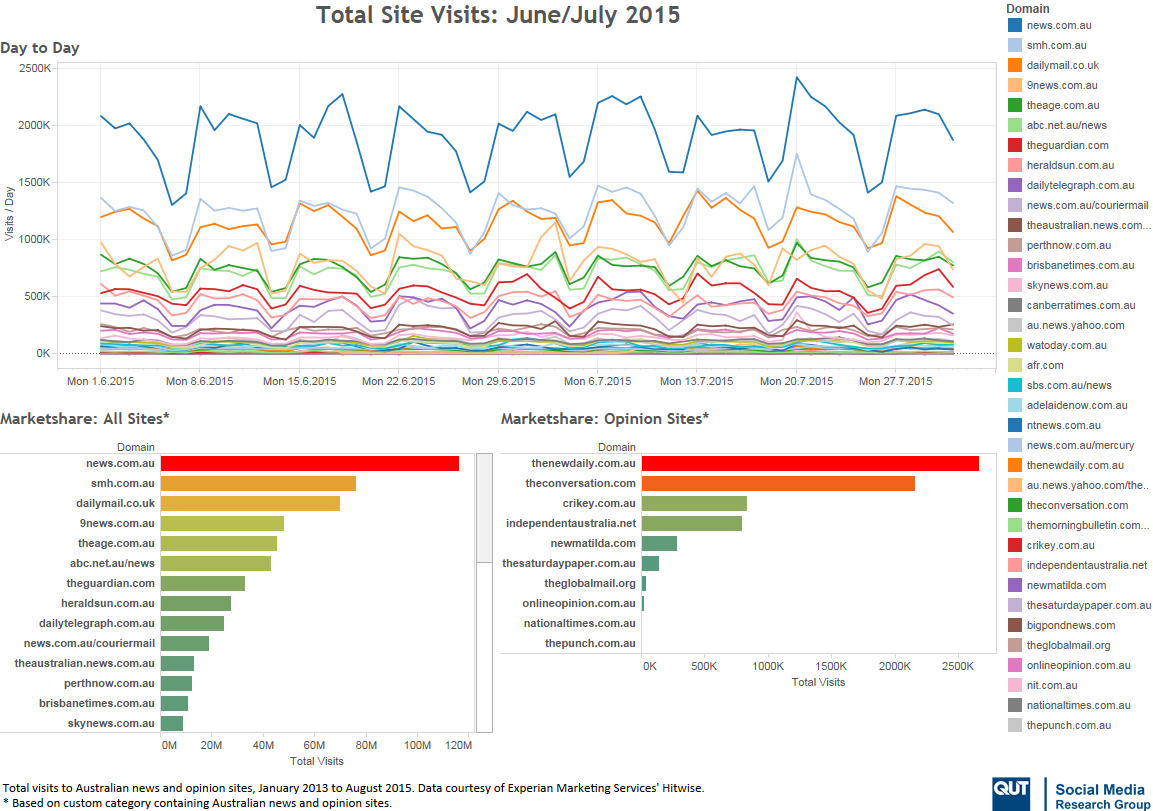
Interestingly, the patterns in overall visits to Australian news and opinion sites as captured by Experian Hitwise do not particularly indicate any impact from the holidays, indicating perhaps that the general population does continue to keep an eye on the news even during the break, but switches off from the more active form of engagement with the news that tweeting and retweeting links to these news stories requires. As expected, we are also seeing no significant increases in Australian-based access to ABC News content during the time of the Twitter spikes around the Varoufakis and New Horizons stories, supporting the thesis that these spikes are largely driven by international users.

image

However, there is a pronounced spike in visits to sites such as news.com.au, Sydney Morning Herald, ABC News, and The Age on 20 July, declining gradually over the following days. This may indicate the heightened overall news interest triggered by the ‘choppergate’ affair and the PM’s response to it, even if that interest did not result in specific individual stories emerging as widely shared articles in ATNIX.

Elsewhere, the Experian Hitwise data continue to point to a persistent disconnect between The New Daily’s overall readership (netting some 2.5 million visits over these two months) and its Twitter presence. The New Daily receives more than three times as many visits as Crikey, for example, but only about one third of the number of tweets linking to its content. This unusual discrepancy suggests that the site has somehow managed to attract a particularly non-tweeting audience for its content.

Standard background information: ATNIX is based on tracking all tweets which contain links pointing to the URLs of a large selection of leading Australian news and opinion sites (even if those links have been shortened at some point). Datasets for those sites which cover more than just news and opinion (abc.net.au, sbs.com.au, ninemsn.com.au) are filtered to exclude the non-news sections of those sites (e.g. abc.net.au/tv, catchup.ninemsn.com.au). Data on Australian Internet users’ news browsing patterns are provided courtesy of Experian Marketing Services Australia. This research is supported by the ARC Future Fellowship project “Understanding Intermedia Information Flows in the Australian Online Public Sphere”.

What If Google Bought Twitter? A Conversation and Some Further Thoughts

Twitter has been in the news recently, for all the wrong reasons. Business media report that Twitter shareholders are disappointed with the company’s latest results; and this follows recent turmoil in the company’s leadership which saw the departure of controversial CEO Dick Costolo and the (temporary) return of co-founder Jack Dorsey until a permanent replacement is found.

All this has served to feed rumours that Google, having recently called time on its own underperforming social network Google+, might be interested in acquiring Twitter. From one perspective, this would clearly make sense – you can check here that social media are now a key driver of Web traffic and a potentially important advertising market, and Google will not want to remain disconnected from this space for long. On the other hand, though, given its chequered history with the now barely remembered Google Buzz as well as major effort Google+, Twitter users (and the third-party companies that serve this userbase) may well be concerned about what a Google acquisition of the platform may mean for them.

I had the opportunity to explore these questions in some detail in an extended interview with ABC Radio’s Tim Cox last week. In a wide-ranging discussion, we reviewed the issues troubling Google+ and Twitter, and the difficulties facing any player seeking to establish a new social media platform alongside global market leader Facebook. Here’s the audio:

Let us take this conversation further: what if Google did buy Twitter? From my point of view, this could turn out a positive move, if Google treats the platform appropriately (as it did, arguably, with past acquisitions such as Blogger, YouTube, and Google Maps). It’s become very obvious over the past months that Twitter’s stock market listing has been a curse at least as much as a blessing: while it’s raised substantial new capital, of course, it’s also exposed the company to the expectations of shareholders who seem to fundamentally misunderstand what Twitter is or can be.

As a platform, Twitter is not and will never be a competitor to Facebook, whatever its shareholders seem to think. Both might be classed under the overall rubric of “social media”, but any direct comparisons constitute a category error: the appeal of a strong-ties, small-world networks platform like Facebook, where we tend to network predominantly with family and friends, is necessarily fundamentally different from that of a weak-ties, large-world space like Twitter, where we can follow – and attempt to strike up conversations with – celebrities, politicians, and other users outside of our immediate networks.

That’s a very different kind of social network, with its own unique uses, and it is futile to hope that Twitter will eventually attract the same number of users, or the same user activity patterns, as Facebook. Worse still, to try to reshape Twitter in Facebook’s image by force will almost inevitably kill off the platform.

If Google understands this, and treats Twitter appropriately (which probably includes accepting it as a loss leader for the time being), this could well turn the platform’s fortunes around. Twitter’s recognised strengths are as a flat, public, and open network that excels especially in live contexts; Twitter is the place where most recent breaking news stories first broke, and a space where users gather as a temporary public and community to collectively participate in shared experiences from the World Cup to Eurovision. Beyond any marketing hype, it genuinely serves as the pulse of the planet in a great many contexts.

This live insight into what news stories and other information are currently hot (and thus should be served as search results, too) may well be valuable enough for Google to fork out a few billion, even if there still doesn’t seem to be a workable model for generating significant direct advertising revenue from the platform.

But whoever takes on Twitter, one of the first things the new CEO will need to do is to fundamentally rebuild Twitter’s relationship with those on whom, historically, its successes have most depended: the flotilla of third-party developers and researchers that surrounds the Twitter mothership. As Jean Burgess and I have documented in our contribution to the forthcoming collection Digital Methods for Social Science, those developers – and the early adopters and lead users whom they have served – have made the platform what it is: they developed powerful Twitter clients and tools, and laid the groundwork for the social media analytics approaches that have become crucial for making sense of trends on Twitter and elsewhere.

Sadly, though, especially under Dick Costolo Twitter’s relationship with these crucial allies in the promotion of Twitter as a platform and a community soured significantly: abrupt and radical changes to the terms of service of the Twitter API (which govern what data companies and their tools could gain access to) in pursuit of more revenue undermined this crucial third-party ecosystem and stymied further innovation. And if anything, the handful of exceptions from this new, more restrictive régime – such as the Twitter Data Grants for researchers, which supported a total of only six out of 1,300 proposed projects – caused further offence rather than restoring goodwill.

Absent any major new investments, a Twitter relying mainly on the support of its shareholders seems unlikely to change tack in this way – it will continue to chase revenue by attempting to commercialise its data, and in the process also continue to alienate the crucial third-party developer community. This is a path of diminishing returns: the data are valuable only as long as there are popular and meaningful applications for Twitter as a platform, but those applications have historically been created by the third-party developers and the power users they support.

Freed from the short-term, unrealistic demands of the stock market through an acquisition by Google (or another cashed-up investor), on the other hand, Twitter could dial back its desperate efforts to commercialise its APIs and the data they provide, and return to its original, more permissive data access régime in order to nurture and support new efforts at research and development. Such a shift in policy could well be the shot in the arm Twitter needs to ensure its longer-term survival – but it depends on the intervention of a new benefactor. Is Google ready to play – or is it still too disheartened from its past attempts to enter the social media market?

Hashtag as hybrid forum: digital appendix

I’m pleased to be one of the contributors to a new book called Hashtag Publics, edited by Nathan Rambukkana and forthcoming from Peter Lang.

This post is a digital appendix for one of my chapters in the book, co-authored with Anne Galloway and Theresa Sauter. The chapter is “Hashtag as hybrid forum: the case of #agchatoz” (PDF), and it builds directly on work I presented in Amsterdam last year and blogged about here. Here’s the first part of the introduction:

This chapter imports Michel Callon’s model of the ‘hybrid forum’ (Callon et al, 2009, p. 18) into social media research, arguing that certain kinds of hashtag publics can be mapped onto this model. It explores this idea of the hashtag as hybrid forum through the worked example of #agchatoz—a hashtag used as both ‘meetup’ organizer for Australian farmers and other stakeholders in Australian agriculture, and as a topic marker for general discussion of related issues. Applying the principles and techniques of digital methods (Rogers, 2013), we employ a standard suite of analytics to a longitudinal dataset of #agchatoz tweets. The results are used not only to describe various elements and dynamics of this hashtag, but also to experiment with the articulation of such approaches with the theoretical model of the hybrid forum, as well as exploring the ways that controversies animate and transform such forums as part of the emergence and cross-pollination of issue publics.

The digital appendix is a way of getting around some of the limitations of print formats for representing digital methods – in particular, the need to share data in some form, as well as to provide rich media data visualisations at sufficient resolution that they can be properly represented and interrogated as an integral part of the research, rather than being reduced to gestural or illustrative elements.

To that end, here I’m sharing some of the data tables and social network maps that are discussed in the chapter, each annotated with a short description and cross-referenced to the point in the text where it appears.

Text Reference Title and link to file Description
Full text Pre-press version of the chapter (PDF)
Figure 1 Tweets per day (tweets per day.png) Number of tweets collected per day – a measure of activity over time and a way of identifying significant ‘peaks’ and ‘bursts’ in engagement
Figure 2 Tweets and unique accounts per day (tweets vs unique users per day.png) Number of unique users per day in relation to number of tweets per day – a way of understanding which of the peaks remained confined to a small group of core accounts, and whether any peaks involved a significantly higher number of accounts; an indicator of topic diversity.
Footnote 4 List of most-shared URLs (Google spreadsheet) Annotated list of the URLs that appear most frequently across the dataset (following manual resolution of top 50 working short URLs only). Useful as a preliminary indication of topics, organisations and media resources in play in an issue public.
Figure 3 Follower-followee network, nodes sized according to in-degree, or number of #agchatoz followers (fig3_indegree) See notes on gephi social network visualisations below
Figure 4 Nodes sized according to out-degree, or number of #agchatoz
followees (fig4_outdegree)
See notes on gephi social network visualisations below
Figure 5 Nodes sized according to total overall Twitter followers (fig5_totalfollowers) See notes on gephi social network visualisations below
Figure 6 Nodes sized according to number of #agchatoz tweets (fig6_agchatoztweets) See notes on gephi social network visualisations below
Figure 7 Nodes sized according to number of all-time tweets (fig7_totalstatuscount) See notes on gephi social network visualisations below
Footnote 8 List of hashtags that co-occurred with #agchatoz (Google spreadsheet) Useful as an indication of intersecting issues and issue publics

Notes on the #agchatoz dataset
We collected data using a custom installation of the YourTwapperkeeper tool (now superseded in our research by TCAT) and the keyword ‘#agchatoz’ (with the hash symbol included). The dataset underlying the analysis in this paper covers the period 19 July 2013–19 February 2014. It comprises 73,218 tweets. Because of Twitter’s strict restrictions on the public sharing of research datasets as well as ethical and privacy considerations, I am not sharing the underlying data set in its ‘raw‘ form.

Notes on the social network maps
The network graphs were produced by querying the Twitter API for the follower and friends lists for each username in the #agchatoz dataset as at April 2014. The resulting network contained 14,576 and 561,853 edges (based on follower-followee relationships).  For each account, overall status counts, overall followers, and number of tweets in the #agchatoz dataset were added as supplementary node attributes. The network was spatialised in Gephi using the Force Atlas 2 algorithm. In order to focus the visualisation on persistent clusters of accounts (and removing accounts that participate in the hashtag without following each other), the network map was filtered so that only nodes with a degree of 7 (a combined total of 7 follower or followee connections) remained visible. The resulting map contains 6196 nodes (only 42.5% of the nodes in the original data set), but retains 559,827 (99.64%) of the original edges. Gephi’s modularity algorithm was used to calculate and then to colour ‘communities’ whose members have higher-than-random affinity, resulting in a total of six visible clusters and a modularity score of 3.9, leaving the tool at the default resolution setting of 1.0. Manual review of the profiles attached to the Twitter accounts that clustered together in these ‘communities’ was used to identify some common characteristics; lists of participant account IDs were subjected to an additional manual coding exercise to test the applicability of the resulting labels.

ATNIX: Australian Twitter News Index, April 2015

April has been a very busy month for the Australian media, with the 100th anniversary of the ANZAC landing at Gallipoli and the cruelly drawn-out procedures leading towards the executions of Andrew Chan and Myuran Sukumaran in Indonesia on 29 April both commanding very substantial coverage. But in the past we’ve also found that such large-scale mainstream media coverage does not always translate into substantial on-sharing of related articles through social media as well, most probably because the very visibility of these stories on the frontpages of newspapers and news sites, and in the lead pieces in TV news bulletins, means that social media users no longer feel a need to share these stories with their friends. What we should expect to see featured more strongly in our Australian Twitter News Index (ATNIX), then, are the unexpected, underreported stories.

More generally, ATNIX for April 2015, which tracks the sharing of links to Australian news and opinion sites on Twitter, also reveals the differing impact of the Easter break – and school holidays – on news sharing activities. Usually strong performers, the Sydney Morning Herald and The Age are particularly clearly affected by the Easter break (roughly during the first three weeks of April, depending on the state), with weekday and weekend link sharing levels almost indistinguishable during that time. ABC News, on the other hand, is barely affected except for a particularly strong weekend slump over the Easter long weekend (3-6 April): where normally the two market leaders, ABC News and Sydney Morning Herald track each other closely (as evident from their virtually indistinguishable lines during the final week of April), they drastically part company in the weeks following Easter. This may be an indication of subtle differences in their audience demographics.

image

Also evident, by contrast, is the very limited impact which the ANZAC anniversary on 25 April had on social media content sharing, and the similarly limited change in sharing patterns as news of the executions of Chan and Sukumaran broke. The more substantial spikes in social media sharing occurred instead on 10 April, especially for the ABC, as articles marking the passing of cricketing icon Richie Benaud were shared widely, on 6 April for the Sydney Morning Herald, as it reported on the tax avoidance strategies employed by Rupert Murdoch’s companies, and on 7 April for The Age, driven largely by it’s report that missing boy Luke Shambrook had been found alive.

There is also a prolonged period of above-average sharing for The Age during 22 and 23 April, built around a combination of articles on the search for missing toddler William Tyrell, the controversy over the extraordinary funding provided to self-styled ‘climate contrarian’ Björn Lomborg’s planned centre at the University of Western Australia, and Jimmy Carter’s op-ed about the abuse of religious scripture to subjugate women.

image

Not unexpectedly, the patterns in overall visits to Australian news and opinion sites as determined by Experian Hitwise look considerably different. Here, too, there is perhaps a certain slump over the course of the Easter holidays, but by contrast we certainly do also see a very pronounced spike in site visits across virtually all sites as the dramatic events surrounding Chan and Sukumaran reach their inevitable, ghastly conclusion. Interestingly, that spike is somewhat less notable for tabloids Daily Mail Australia, Herald Sun, and Daily Telegraph than for the other leading sites, reflecting perhaps that Australian Internet users chose somewhat more quality news sources as they sought the latest information about events in Indonesia.

Finally, even in spite of the wall-to-wall coverage of the event, the ANZAC anniversary did not result in any particularly elevated levels of access to the news sites on the 25/26 April weekend. It is possible that many Australians participated in dawn services and other commemorative events during these days, and therefore did not find the time to check the news as regularly as usual – but perhaps more likely, the substantial broadcast coverage of ceremonies in Turkey and at home meant that there was little need to seek out online coverage as well.

Standard background information: ATNIX is based on tracking all tweets which contain links pointing to the URLs of a large selection of leading Australian news and opinion sites (even if those links have been shortened at some point). Datasets for those sites which cover more than just news and opinion (abc.net.au, sbs.com.au, ninemsn.com.au) are filtered to exclude the non-news sections of those sites (e.g. abc.net.au/tv, catchup.ninemsn.com.au). Data on Australian Internet users’ news browsing patterns are provided courtesy of Experian Marketing Services Australia. This research is supported by the ARC Future Fellowship project “Understanding Intermedia Information Flows in the Australian Online Public Sphere”.

Postdoc and PhD Positions Available: Social Media and the Public Sphere

At Queensland University of Technology in Brisbane, Australia, where we’re based, we’re currently advertising two new positions relating to our research: a Postdoctoral Research Fellow (two years full-time) and a PhD researcher (including a three-year stipend). Both of these are associated with Axel Bruns’s ARC Future Fellowship project Understanding Intermedia Information Flows in the Australian Online Public Sphere. Both projects are closely related, and will use innovative research methodologies to work with a range of big data resources (from social media platforms and other sources) on user activity in the Australian online public sphere.

If you’re interested in applying for one or the other of these positions, please see the full calls for applications at the following URLs: