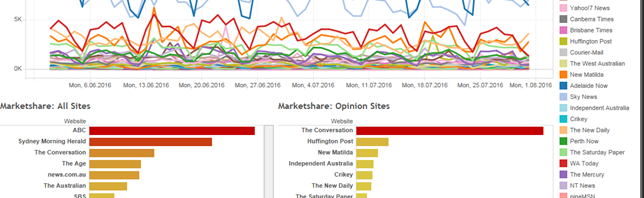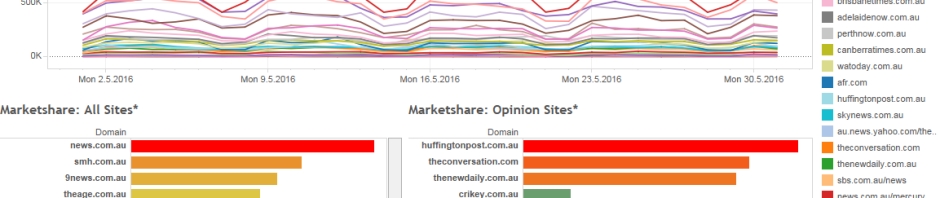
ATNIX: Australian Twitter News Index, May 2017

Between the bombshell announcement of further deep staff cuts at Fairfax publications, subsequent strike action by Fairfax journalists, the handing down of the 2017 federal budget, and the much-publicised return of drug smuggler Schapelle Corby to Australia, the news in May was surprisingly strongly focussed on domestic Australian issues.

But not all of these matters were reflected equally strongly in the Australian Twitter News Index (ATNIX) for the month, which tracks the sharing of articles from Australian news and opinion sites on Twitter.

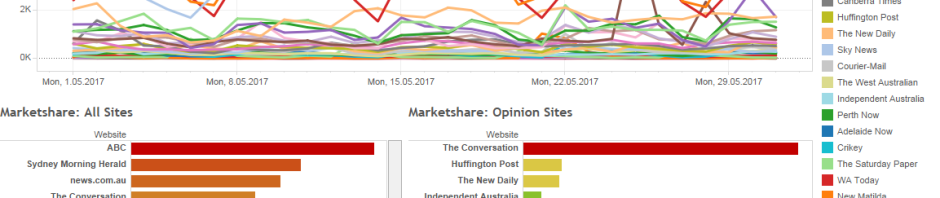
The major story in the Australian news industry itself during May was the staff strike at Fairfax, triggered by significant job cuts across the editorial offices of the Sydney Morning Herald, The Age, and other publications. The walkout – which also affected Fairfax’s coverage of the federal budget – clearly received considerable sympathy from Australia’s Twitter users; several well-connected Twitter users in Australia posted calls to boycott Fairfax sites and refrain from sharing their articles during this time.

As a result, during the period of the strike, on 3 to 10 May, sharing rates for articles in the leading Fairfax publications decline precipitously. Both SMH and Age return to standard day-to-day sharing levels only by the middle of the month.

Indeed, the Sydney Morning Herald’s weakness over the course of the strike is so pronounced that it very nearly enables perennially third-placed site news.com.au to catch up. news.com.au’s strong performance is driven in part also by its attention-grabbing coverage of a “mystery monster” washing up on the shore of an Indonesian island, which went viral well beyond the site’s ordinary Australian audience. The article was shared in some 4,600 tweets on 13 May alone, and in almost 5,800 tweets over the course of the entire month.

The other Sydney paper, the tabloid Daily Telegraph, does not usually trouble ATNIX – though popular with readers, few Twitter users appear prepared to publicly share the stories they read on its site. In May, however, it too records a brief but major spike in sharing, for its coverage of Korean boy band BTS’s arrival in Sydney (4,400 shares on 25 May). This constitutes another example of an Australian news story spreading well beyond the national audience.

image

Meanwhile, the return of drug smuggler Schapelle Corby from Bali on 27 May barely even rates a mention in the Australian Twittersphere. This is even in spite – or quite possibly because – of the breathless coverage of Corby’s release by the mainstream media. While the leading commercial TV networks even interrupted their scheduled programming to bring us shaky dashcam footage of Corby’s progress from her Balinese residence to the airport, none of the most shared news links on Twitter during this time relate to the story.

ABC News does perform exceptionally well during these final days of the month – but the stories that drive that performance are about U.S. Senator John McCain’s visit to Australia (2,600 shares), and a fisherman’s close encounter with a great white shark (1,100 shares). Clearly, Corby cannot compete against such material; even Nine News and Yahoo! 7 News receive practically no attention from Twitter users for their efforts.

This pattern of disinterest is also reflected in our Hitwise data on the total number of visits to these Australian news sites. Despite the hype, the last few days of May appear utterly ordinary: Nine News and Yahoo! 7 News, along with most other news sites, fail to see any notable influx of visitors as a result of this latest development in the Corby saga.

Perhaps this is due to the saturation coverage of Corby’s return that was provided by commercial television channels, which obliterated any need to seek out further information online – but just perhaps, too, Australian news audiences are now well past caring about Schapelle Corby, and this realisation has simply not yet dawned on commercial TV executives.

image

Meanwhile, in spite of the considerable impact on how much its articles were shared on Twitter, the total number of visits to Fairfax sites during the staff strike of 3 to 10 May appears to decline only slightly against the long-term average: readers might not have advertised in tweets that they continued to read the Sydney Morning Herald and The Age during this time, but continue to read they did, for the most part. The 37.8 million site visits to the SMH in May, for instance, are virtually unchanged from previous months.

It is perhaps too harsh to read this entirely as a lack of solidarity with Fairfax’s striking workforce, though; some of these visits might also reflect a certain morbid curiosity about the ability of the non-journalistic skeleton teams at Fairfax publications to cover the news, embarrassing typos included. It is also notable that on budget Tuesday and the following Wednesday (9 and 10 May), it is ABC News that performs well above average: for the coverage of this major event in the Australian political calendar, readers clearly preferred the national broadcaster this year.

Standard background information: ATNIX is based on tracking all tweets which contain links pointing to the URLs of a large selection of leading Australian news and opinion sites (even if those links have been shortened at some point). Datasets for those sites which cover more than just news and opinion (abc.net.au, sbs.com.au, ninemsn.com.au) are filtered to exclude the non-news sections of those sites (e.g. abc.net.au/tv, catchup.ninemsn.com.au). Data on Australian Internet users’ news browsing patterns are provided courtesy of Hitwise, a division of Connexity. This research is supported by the ARC Future Fellowship project “Understanding Intermedia Information Flows in the Australian Online Public Sphere”.
ATNIX: Australian Twitter News Index, April 2017

There seems to be no end in sight to the barrage of breaking, critical news from home and abroad these days, and Australians might be forgiven for trying to switch off during the Easter and ANZAC holidays. Even if they did attempt to do so, however, the Australian Twitter News Index for April 2017 shows little evidence that they successfully managed to tear themselves away from their online and social media newsfeeds.

Overall news sharing patterns on Twitter largely continue to follow their weekly patterns; there is no sign of an extended Easter holiday away from the news, and the weekend before ANZAC Day even seems unusually active. Perhaps there is simply too much going on today that we can afford to disconnect for long.

ATNIX for April 2017 is dominated, however, by a very substantial spike in sharing Sydney Morning Herald content on 10 April. This is due in large part to the 5,900 tweets sharing news of the arrest of a Russian programmer suspected of hacking the U.S. election, and given the topic it is very likely that a substantial number of those tweets were posted by Twitter users outside Australia. We have seen this pattern with other international stories in the past: articles in Australian news sites that address key international stories occasionally go viral well beyond Australia.

On the same day, Twitter users’ attention is also drawn to news of beloved Australian comedian John Clarke’s sudden death, further increasing the volume of news-sharing tweets that day. A first piece in the SMH is shared some 1,400 times, while ABC News’ coverage receives 1,200 shares.

image

Over the course of the entire month, our data show again that a diverse range of unrelated topics sought to draw our attention. At the Sydney Morning Herald, in addition to its coverage of the Russian hacker’s arrest (7,200 tweets in total for the month) and of John Clarke’s death (1,400 tweets), articles on Malcolm Turnbull’s proposed changes to the citizenship test (1,500 tweets), the Australian Federal Police’s illegal access to a journalist’s communications metadata (1,300 tweets), and a commentary piece in defence of Yassmin Abdel-Magied (1,000 tweets) round out the top five.

For ABC News, its coverage of the Australian March for Science events was most widely shared in April (1,700 tweets), along with pieces on North Korea’s warning that Australia should not blindly follow the United States (1,500 tweets), John Clarke’s death (1,300 tweets), an investigation into federal politicians’ property portfolios (1,000 tweets), and a controversial video by an Islamic group that seemed to condone violence against women (900 tweets).

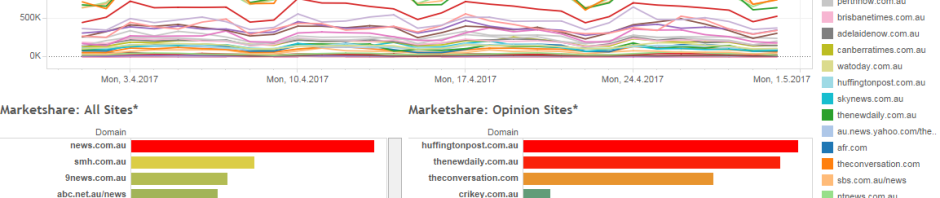
As they are so often, meanwhile, our Hitwise data on the total number of visits to the leading Australian news and opinion sites are only very loosely correlated with news sharing activities on Twitter. There is no sign of the substantial spike in interest in the SMH’s Russian hacker story on 10 April, suggesting again that much of this sharing was by non-Australian readers whose visits to the Sydney Morning Herald site would not be captured by Hitwise. We do see some small increases in traffic to the SMH, ABC News, and The Age that day, however, which might be attributed to audience engagement with coverage of John Clarke’s passing.

image

Overall, too, there is very little sign of a substantially flagging news interest during the Easter long weekend (14-17 April) or on ANZAC Day (on Tuesday 25 April). With so many simultaneous major developments, domestically as well as internationally, perhaps we just can’t afford to switch off from the news any more.

Standard background information: ATNIX is based on tracking all tweets which contain links pointing to the URLs of a large selection of leading Australian news and opinion sites (even if those links have been shortened at some point). Datasets for those sites which cover more than just news and opinion (abc.net.au, sbs.com.au, ninemsn.com.au) are filtered to exclude the non-news sections of those sites (e.g. abc.net.au/tv, catchup.ninemsn.com.au). Data on Australian Internet users’ news browsing patterns are provided courtesy of Hitwise, a division of Connexity. This research is supported by the ARC Future Fellowship project “Understanding Intermedia Information Flows in the Australian Online Public Sphere”.

ATNIX: Australian Twitter News Index, March 2017

For anyone based in Australia – and especially for those of us here in Queensland – the major domestic news story of March 2017 is no doubt the impact of Tropical Cyclone Debbie on the coastal communities of the central coast Queensland. It is not entirely surprising, however, that the cyclone fails to impact strongly on the Australian Twitter News Index for the month: as we have seen for many similar incidents, slow-moving, long-predicted developments rarely generate substantial engagement from the Twitter community. Twitter is better known for its instant coverage of rapid, unpredicted events – Debbie was well covered by the more conventional live broadcast channels of radio and TV instead.

As a result, the cyclone features only in two of the five most widely shared Australian news stories between 27 and 31 March 2017: ABC News’ live blog of developments is shared in some 800 tweets during this time, while its before-and-after footage from Hamilton Island is shared in more than 700 tweets. But other, equally visible news stories in the Australian Twittersphere concern a new find of dinosaur footprints in north-west Australia, and Paul Keating’s statement that neo-liberalism is dead (both shared in some 700 tweets). Even Queensland news sources such as Brisbane Times and Courier-Mail are no more prominent on Twitter during this time than they usually are; this may also indicate that Twitter users sought their information directly from sources such as the Bureau of Meteorology or the Queensland emergency services rather than from news outlets.

image

Over the course of the entire month, the picture is similarly mixed. Key stories from ABC News included an article on International Women’s Day that reviewed some of the key remaining areas of inequality between women and men (1,700 tweets); an exclusive on the complex transnational company structure of Adani’s planned Carmichael coal mine in Queensland (1,300 tweets); and an illustrated piece on old maps of Australia from the National Library’s Trove collection (900 tweets). At the Sydney Morning Herald, a feature on the United States’ demand for Cambodia to repay its war debt was shared 1,800 times (most likely also by interested international readers); a new federal opinion poll showing Labor with a 10-point lead over the Coalition received 1,200 tweets; and its Women’s Day article on abusive men claiming to be feminists was shared in 1,000 tweets.

Finally, news.com.au performed unusually strongly on 9 March, receiving around 50% more tweets than it would on an ordinary day. This is due for the most part to its coverage of WikiLeaks’ latest release of classified CIA documents, which receives some 1,000 tweets that day. It’s yet another demonstration of what we have previously observed as the WikiLeaks effect, when stories by domestic news outlets receive increased international circulation because they are picked up by WikiLeaks supporters. (We’ve seen similar dynamics, too, whenever Australian news sites cover teen bands such as One Direction or Five Seconds of Summer.)

Such international effects are necessarily absent from our Hitwise data, which track visits to Australian news sites by domestic users only. Here, news.com.au remains steady (and clearly in the lead) on 9 March, as the WikiLeaks story fails to make an impact. By contrast, however, we do see some increases in site visits to a number of outlets during the final week of March, as Cyclone Debbie makes landfall in Queensland. news.com.au and especially ABC News (as the national emergency broadcaster) are particularly prominent during this time. The Courier-Mail and – less strongly so – the Brisbane Times see significantly increased traffic especially on Thursday 30 March, as the remnants of the cyclone pass over Brisbane and cause flash flooding as well as school and business closures.

image

Standard background information: ATNIX is based on tracking all tweets which contain links pointing to the URLs of a large selection of leading Australian news and opinion sites (even if those links have been shortened at some point). Datasets for those sites which cover more than just news and opinion (abc.net.au, sbs.com.au, ninemsn.com.au) are filtered to exclude the non-news sections of those sites (e.g. abc.net.au/tv, catchup.ninemsn.com.au). Data on Australian Internet users’ news browsing patterns are provided courtesy of Hitwise, a division of Connexity. This research is supported by the ARC Future Fellowship project “Understanding Intermedia Information Flows in the Australian Online Public Sphere”.
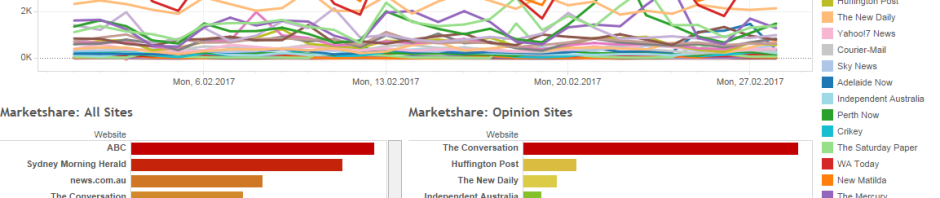
ATNIX: Australian Twitter News Index, February 2017

It feels as if February 2017 has been a month of permanent crisis. Between the exceptionally controversial first steps of the fledgling Trump administration in the United States, the increasingly fragile relationships between the various factions within the Coalition government, and the renewed hostilities between government and opposition on the resumption of federal parliament, hardly a day has gone by without new developments on any number of controversies.

This is also reflected in the Australian Twitter News Index for the month – which sees plenty of newssharing activity, but without any one major story dominating the headlines.

The most shared ABC News stories for the month, for instance, include reports of 70-year-old Australian children’s book author Mem Fox being detained for hours at Los Angeles airport (shared in 2,400 tweets); of a new fennec fox cub being born at Sydney’s Taronga Zoo (2,000 tweets); of multi-million dollar executive salaries at Australia Post (1,100 tweets); of pre-election coal advertising being funded by ‘clean coal’ research funds (930 tweets); and – emerging only on 27 February, and no doubt set to carry over into March – of the release of Centrelink critics’ personal information to journalists (910 tweets).

Remarkably, there’s very little overlap with the most popular articles at the other most widely shared Australian news site, the Sydney Morning Herald; this further demonstrates the breadth of major news stories vying for our attention this month. Here, most shared links include a report of the federal government’s knowledge that renewables had nothing to do with the South Australian blackouts (3,300 tweets); an interactive game to ‘Spicer-ize’ your name, following the White House Press Secretary’s invention of Australian PM Trumble (3,100 tweets); a story on the homophobic and xenophobic speeches at a far right fundraiser in Sydney (2,100 tweets); an interactive special report on shoddy business practices at pizza chain Domino’s (1,000 tweets); and a story about Coalition MP Michael Sukkar’s ill-judged comments about housing affordability (910 tweets).

image

A handful of other news sites in Australia also captured public attention, if only for much briefer periods. Somewhat divergent from its usual profile, news.com.au tweets spike on 21 February with an article speculating on an impending NASA announcement (2,800 tweets). This would later turn out to be the discovery of seven new exoplanets in our immediate galactic neighbourhood, but the shared article was published before these details were released, and its success may be related to its mention of related debates on Reddit. An article from SBS News on the cancelled meeting between French far right leader Marine Le Pen and the Grand Mufti of Lebanon is shared in 2,400 tweets, most likely due to on-sharing in France and Lebanon. Finally, Laura Tingle’s strongly worded criticism of Tony Abbott’s latest forays into the federal leadership debate results in 1,600 tweets sharing her opinion piece in the Australian Financial Review.

As a representation of the fractured and restive environment we live in, and of the multiple crises and controversies that fill our news feeds, these stories capture the contemporary world fairly well – even if even they still leave out many other sources of uncertainty, from the Syrian conflict to the debate over budget policy.

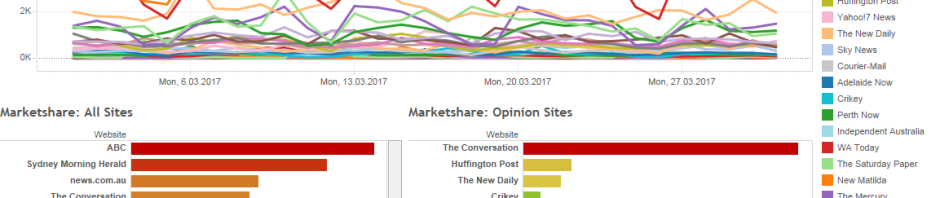
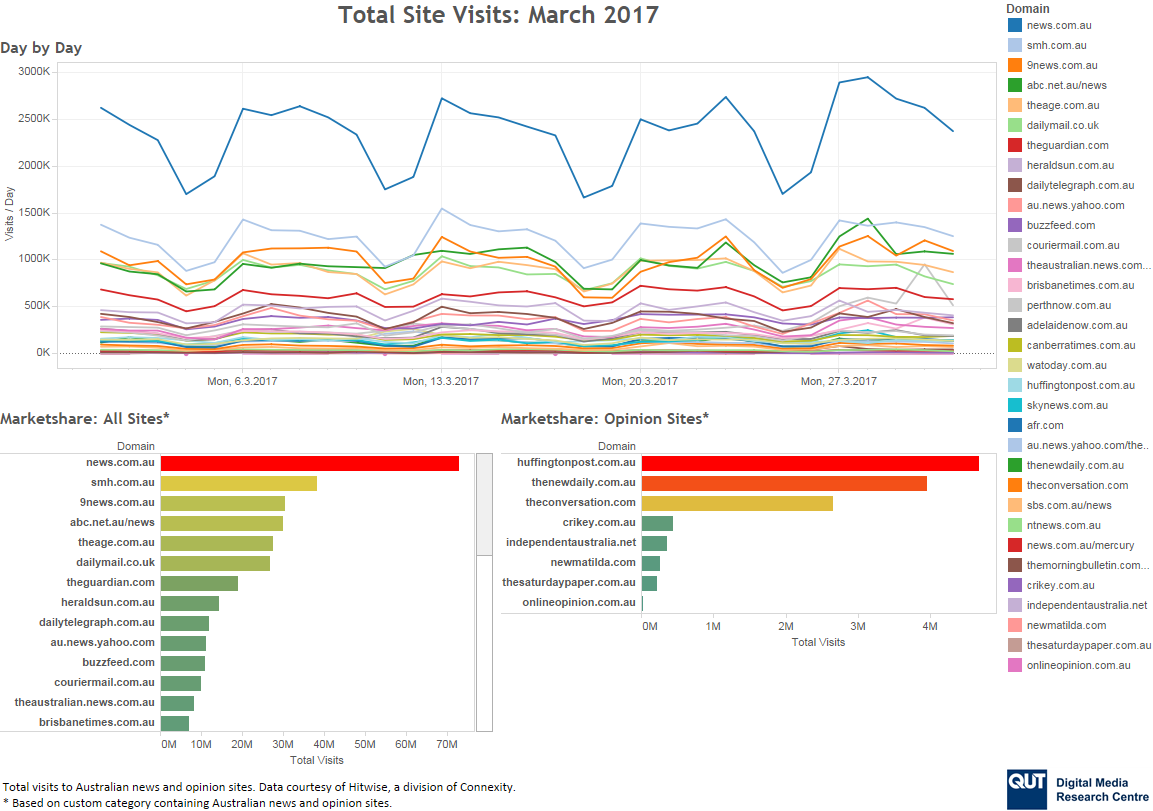
Little wonder, then, that for most of the Australian news and opinion sites we cover here February 2017 has seen a further increase in total visits compared to the same period last year; news.com.au, Sydney Morning Herald, and ABC News alone received nearly 132 million visits from Australian users in the past month. In spite of the considerable number of breaking news stories emerging during that time, though, day-to-day patterns remained largely static, as our Hitwise data show.

image

Only Nine News appears to significantly diverge from the status quo, on 21 February. This spike in visits does not correspond to a similar spike in tweets sharing its news content; however, it is likely that it is related to the crash of a plane from Melbourne’s Essendon airport into the nearly DFO shopping centre, which accounts for a considerable number of the Nine News articles being shared on Twitter that day.

Standard background information: ATNIX is based on tracking all tweets which contain links pointing to the URLs of a large selection of leading Australian news and opinion sites (even if those links have been shortened at some point). Datasets for those sites which cover more than just news and opinion (abc.net.au, sbs.com.au, ninemsn.com.au) are filtered to exclude the non-news sections of those sites (e.g. abc.net.au/tv, catchup.ninemsn.com.au). Data on Australian Internet users’ news browsing patterns are provided courtesy of Hitwise, a division of Connexity. This research is supported by the ARC Future Fellowship project “Understanding Intermedia Information Flows in the Australian Online Public Sphere”.

ATNIX: Australian Twitter News Index, January 2017

The Australian Twitter News Index has been on hold for the past few months as we’ve adjusted our data gathering approach to address some changes to Twitter’s data gathering frameworks, and unfortunately this period has also included the U.S. election and its immediate aftermath. But we’re back in time to the inauguration of President Trump, and the first stirrings of the Australian parliamentary year.

It is not Trump’s inauguration on 20 January that is causing a pronounced increase in the Age and Herald Sun links being shared on that day, however, but a tragic event much closer to home: links to both Melburnian news sites are shared in a significant number of tweets as they cover the killing of several pedestrians by a deranged driver in Bourke Street in the city’s CBD. Twitter users posted more than 1,800 tweets sharing The Age articles about this incident in the immediate aftermath.

image

That the Trump inauguration did not generate a substantial number of link-sharing tweets by comparison is relatively unsurprising – a widely televised event generally produces few tweets sharing links to its coverage, and the fact that it took place in the early hours of the Australian morning and would have been covered more exhaustively by US than Australian media also worked against it.

This is not to say that Australians were generally disinterested in the Trump Presidency and its first steps in office, even before Trump’s tetchy phone call with Malcolm Turnbull; subsequent days show a substantial growth in the number of Trump-related stories from Australian media sources being shared on Twitter.

A somewhat surprising beneficiary of these links is SBS News, which records unusually strong attention in the period of 25 to 27 January: its article on the Netherlands’ funding support for aid organisations promoting birth control, in response to the Trump administration’s ban on such funding, is shared in more than 6,800 tweets during these three days; another article on official translators’ troubles with interpreting Trump’s statements receives 2,200 shares. It is quite likely, given these extraordinary numbers, that those articles would have been shared well beyond the Australian Twittersphere itself.

More generally, six of the top ten most widely shared ABC News stories since inauguration day were related to Trump and his policies; as were five of the Sydney Morning Herald’s and five from news.com.au. The next weeks and months will show whether Twitter users – and news audiences more generally – will continue to pay such attention to the new administration, or whether a kind of ‘Trump fatigue’ will mean that their attention gradually diverts elsewhere. (Note, though, that the Trump-Turnbull phone call took place on 29 January and that rumours about its belligerent tone appeared only a few days later – so we should expect that controversy to feature in next month’s ATNIX data.)

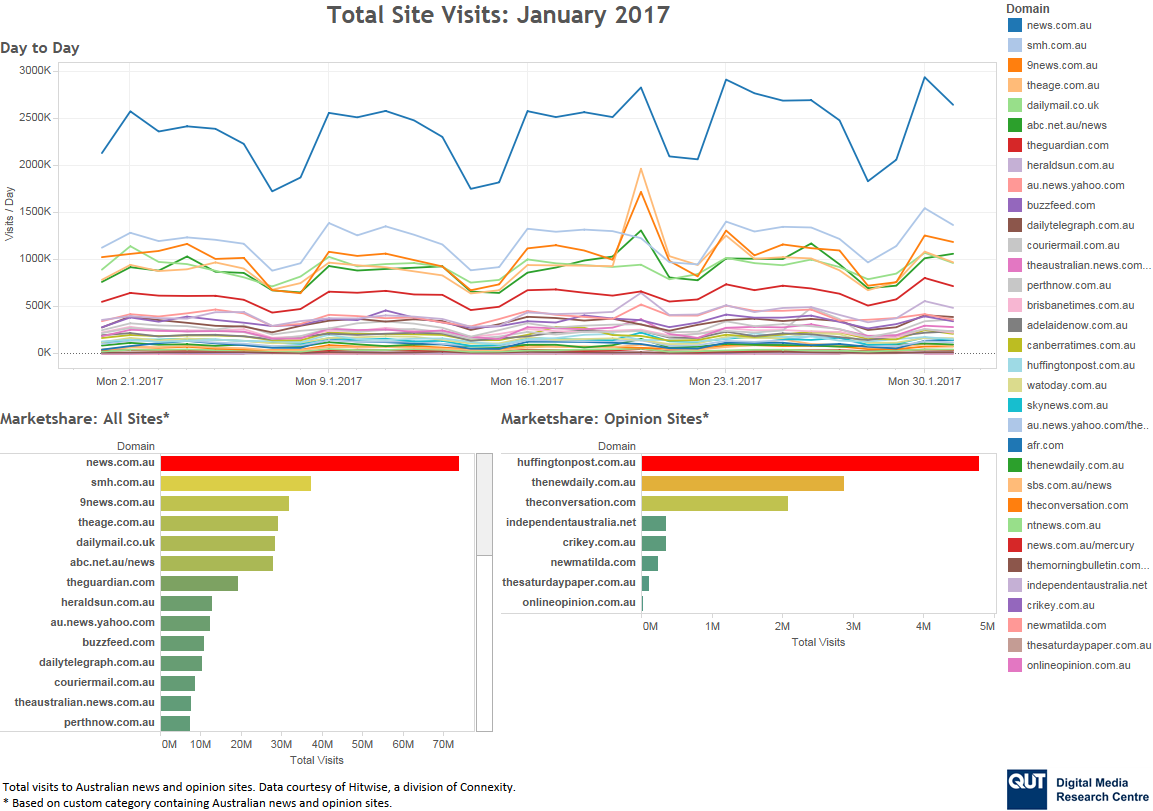
In terms of total visits to Australian news and opinion Websites, too, January 2017 has been a particularly active month. Ordinarily, the holiday month of January is not exactly a time when Australians spend exceptionally much time visiting news sites; in both January 2015 and January 2016, for instance, the combined total for news.com.au, the Sydney Morning Herald, and ABC News was stable at around 114 million site visits. 2017 exceeded that measure by a considerable margin: together, the three sites received just over 139 million site visits. This undoubtedly reflects the increased attention to the news in a destabilising geopolitical environment, as well as the impact of the Bourke Street tragedy.

image

Unsurprisingly, the major spike in visits to Australian news sites occurs on 20 January, the day of the Bourke Street incident. While a number of sites receive increased user attention on that day, the numbers for The Age and Nine News are particularly elevated: The Age all but doubles its usual number of Friday visits, and Nine News records a similar boost. ABC News, news.com.au, the Herald Sun, and Yahoo! News also gain additional visitors, though to a lesser extent. Here, too, the Sydney Morning Herald fails to match the influx recorded by its Fairfax stablemate, confirming our observations from the Twitter data that audiences naturally gravitate to the leading news source in Melbourne, close to the scene of the tragedy.

With the unfolding phone call controversy, widespread protests against the Trump administration’s ban on travellers from several majority-Muslim countries, and the commencement of the Australian parliamentary year, we should expect elevated levels of interest in the news to persist for some time to come. If January was unusual for its comparative lack of a holiday lull, the coming months will no doubt turn out to be even busier.

Standard background information: ATNIX is based on tracking all tweets which contain links pointing to the URLs of a large selection of leading Australian news and opinion sites (even if those links have been shortened at some point). Datasets for those sites which cover more than just news and opinion (abc.net.au, sbs.com.au, ninemsn.com.au) are filtered to exclude the non-news sections of those sites (e.g. abc.net.au/tv, catchup.ninemsn.com.au). Data on Australian Internet users’ news browsing patterns are provided courtesy of Hitwise, a division of Connexity. This research is supported by the ARC Future Fellowship project “Understanding Intermedia Information Flows in the Australian Online Public Sphere”.
ATNIX: Australian Twitter News Index, September 2016

As the world turns its attention to the slow-motion car crash that is this year’s U.S. presidential election, September in Australia was a comparatively ordinary, intermediate month for news. A number of continuing scandals and controversies – including the donations affair engulfing Labor Senator Sam Dastyari, the Country Fire Authority pay dispute in Victoria, and the growing opposition to a costly nationwide referendum on same-sex marriage – played out through the month, but none of these managed to fully capture the nation’s attention; distractions including the NRL and AFL finals series and the spring school holidays saw to this.

The Australian Twitter News Index for September 2016 therefore points to a gradual decline in the sharing of links to Australian news sites on Twitter, especially as the school holidays commenced in the majority of states and territories on 17 or 24 September; far from the caricatures sometimes drawn by self-interested political operatives, Australian Twitter users have families, too.

image

The stories from the leading Australian news sites that were most widely shared on Twitter during the past month document the diversity of topics currently exercising the Australian social media community. A Sydney Morning Herald piece accusing Liberal Party members of orchestrating a dishonest campaign opposing same-sex marriage appeared in some 1,400 tweets; the referendum was also addressed in an SMH article that covered the handwritten message to Malcolm Turnbull delivered by a same-sex couple’s 13-year-old son, which received 1,100 tweets.

Elsewhere, the Chinese donations scandal centring on Labor Senator Sam Dastyari generated a number of claims and counter-claims about Chinese influence on Australian politics, and led a May 2016 exposé on political donations to Australian politicians from Chinese interests from the Sydney Morning Herald to re-emerge as the second most widely shared article in September (1,200 tweets). It was accompanied by widely shared SMH stories on the Chinese links of Liberal MP Stuart Roberts (1,200 tweets) and Foreign Minister Julie Bishop (1,200 tweets), which in combination seemed to deflect the issue away from Dastyari alone and to raise broader questions about the integrity of the Australian political process.

Such broader issues were also addressed in other leading stories during September: the SMH also questioned Attorney-General George Brandis’s appointment of a major Liberal Party donor to the Administrative Appeals Tribunal just before the commencement of the pre-election caretaker period (1,100 tweets), while ABC News’ interactive data journalism piece on the expenses claimed by federal politicians of all stripes was circulated on Twitter in more than 1,000 tweets during September.

Rounding out the top ten SMH and ABC News articles for the month are articles on the government’s embarrassing procedural mistakes in the Senate (SMH, 1,200 tweets), as well as the only two pieces not dealing with party politics: the plan to register a roadworthy solar car in Queensland (ABC News, 1,100 shares), and the commencement of construction of twelve new solar power plants across Australia (ABC News, 1,000 shares).

The comparatively modest numbers of tweets achieved by each of these leading articles also paints the picture of a month in which user attention was broadly distributed, however: none of these issues, and the many other topics also being addressed in news articles from these and other Australian sources, managed to rise to particular prominence.

The patterns in domestic user visits to Australian news sites captured in our Hitwise data also bear this out. Across the Australian news and opinion sites we track here, activity from week to week remains almost uniform, with very few aberrations; indeed, repeating a pattern we have found in previous years, even the commencement of the school holidays does not appear to affect the number of visits to these sites – it seems that Australian users still follow the news online during the holidays, but are less interested in sharing on news articles during this time.

image

The one major spike in activity – especially for Nine News and ABC News, and to a much lesser extent also for Adelaide Now – occurs towards the end of the month, on 28 September. As the Adelaide connection indicates, this is almost certainly tied to the major power outages occurring in South Australia on this date, as the result of a number of major storms bringing down crucial powerlines. Occurring so late in the month, the subsequent political debate over the role of South Australia’s dependence on renewable energy in this outage is unlikely to have substantially affected the statistics on article sharing on Twitter that we track in ATNIX – we will see in the October instalment whether this emerging debate generated enough news sharing activity to appear in that month’s list of leading articles.

Standard background information: ATNIX is based on tracking all tweets which contain links pointing to the URLs of a large selection of leading Australian news and opinion sites (even if those links have been shortened at some point). Datasets for those sites which cover more than just news and opinion (abc.net.au, sbs.com.au, ninemsn.com.au) are filtered to exclude the non-news sections of those sites (e.g. abc.net.au/tv, catchup.ninemsn.com.au). Data on Australian Internet users’ news browsing patterns are provided courtesy of Hitwise, a division of Connexity. This research is supported by the ARC Future Fellowship project “Understanding Intermedia Information Flows in the Australian Online Public Sphere”.
ATNIX: Australian Twitter News Index, August 2016

As the 2016 federal election campaign recedes into memory, online engagement with the news in Australia has returned to what passes for normality these days. This is also reflected in the news sharing activities we are able to observe in the Australian Twitter News Index for August: the long-term patterns of how Twitter users’ attention is distributed across the leading news sites in the country continue to hold.

As this month’s data show, ABC News remains by far the most widely shared Australian news site, followed by the Sydney Morning Herald and The Conversation, whose numbers are as always substantially inflated by its large and growing international userbase. Further down the order, news.com.au has moved ahead of The Age again, reflecting perhaps the shift of focus away from sharing political news during the election campaign – an area that might be seen as the natural domain of The Age.

image

Following the predictably strong focus on narrowly political stories amongst the most shared news articles during the election and its immediate aftermath, this month’s top stories range across a very wide set of themes; perhaps this documents the nation’s mood after the longest election campaign in recent memory.

Emblematic for this is the most widely shared ABC News article, about a 1.9 kg goldfish found in WA’s Vasse River (shared some 3,700 times); other key ABC News stories include a primer on solar cell technology (1,800 shares); coverage of a horrendous new aerial bombardment of Aleppo (1,500 shares); the #IndigenousDads hashtag in response to a Bill Leak cartoon that was widely perceived as racist (1,100 shares); and a feature report on climate change refugees in Bougainville (1,100 shares).

The Sydney Morning Herald’s most shared stories, by contrast, remain considerably more strongly focussed on post-election politics: key articles here address new One Nation senator Malcolm Roberts’s bizarre 2011 letter to then-PM Julia Gillard (1,300 shares); a post mortem on the bungling of the 2016 Census (1,200 shares); the disruption of services at the Gosford Anglican Church by far-right extremists (1,100 shares); commentary on Treasurer Scott Morrison’s plans to cut the Newstart allowance (1,100 shares); and an exclusive on Foreign Minister Julie Bishop’s purported links to Chinese political donors (1,100 shares).

And while these two sites contribute a significant majority of the most shared articles for August, a handful of other publications also received a significant boost from tweeting readers: a news.com.au piece on Julian Assange’s latest appeal in his long-running battle with Swedish authorities was shared 2,800 times, and shows that the WikiLeaks effect that we’ve observed for Assange-related stories in the past is alive and well; a Brisbane Times article about new religious vilification laws in the ACT received 1,900 shares; and a Herald Sun report about NASA’s assessment of July 2016 as the hottest month on record clocked up 1,800 shares.

If our Twitter data indicate a shift in engagement and endorsement patterns after the conclusion of the election campaign, our Hitwise data on total visits to Australian news sites show a similar return to longer-term averages. Gone, for the most part, are the big increases in visitor numbers that we observed in July; the total of some 356 million total visits to the Australian news sites we track is still above the average of 329 million visits per month between May 2015 and May 2016, but well down on the all-time peak of 385 million in July.

image

It is not unsurprising that compared to July, some of the leading sources of political coverage in Australia are losing a particularly significant number of visits – this includes especially ABC News, which experienced a particularly strong boost in numbers around election day, but also the Sydney Morning Herald, The Age, The Guardian and The Australian (but also, somewhat less expected, Nine News). Other sites do better at retaining their audiences; news.com.au, in particular, is barely unchanged at nearly 69.5 million visits in August (down from 69.9 million in July).

There is a longer story to be told here in the long-term development of visit numbers to these sites: the Australian edition of the UK’s Daily Mail, for instance, has been holding steady at around 24 million visits per month since February, which is well down compared to a much stronger performance through 2015 (when it peaked at well over 36 million visits). Other sites, including ABC News and The Guardian, are experiencing relatively steady growth (election-related fluctuation notwithstanding), while Buzzfeed Australia’s number of visits per month has declined notably over the past twelve months.

But the full story of these developments will have to wait for another time – these patterns will become clearer only once election effects wash out of the system.

Standard background information: ATNIX is based on tracking all tweets which contain links pointing to the URLs of a large selection of leading Australian news and opinion sites (even if those links have been shortened at some point). Datasets for those sites which cover more than just news and opinion (abc.net.au, sbs.com.au, ninemsn.com.au) are filtered to exclude the non-news sections of those sites (e.g. abc.net.au/tv, catchup.ninemsn.com.au). Data on Australian Internet users’ news browsing patterns are provided courtesy of Hitwise, a division of Connexity. This research is supported by the ARC Future Fellowship project “Understanding Intermedia Information Flows in the Australian Online Public Sphere”.

ATNIX: Australian Twitter News Index, June-July 2016

This instalment of the Australian Twitter News Index covers the business end of the Australian federal election campaign, which culminated in election day on 2 July 2016 and was followed by a brief period of uncertainty over whether the Coalition government had in fact held on to enough seats in the House of Representatives to claim victory. As it turns out, however, this is not the most prominent topic to drive the sharing of news on Twitter over this two-month period.

To be sure, the election was a key theme during June and into July. Six of the ten most widely shared news articles from ABC News and the Sydney Morning Herald – the new Australian news outlets most widely shared on Twitter – related to the election and its aftermath. But there is no substantially heightened news sharing activity to be seen on Twitter ahead of the election; this is due most likely to the fact that there was blanket coverage of the campaign in the Australian media already, and that Twitter users therefore felt a need to share on election news only whenever something particularly unexpected happened.

Indeed, the single most widely shared URL during these two months (in over 3,700 tweets) was the generic short URL http://ab.co/electionlive, for ABC News’ daily liveblog covering the campaign – a significant endorsement for this still relatively novel journalistic format, and one that is not unexpected coming from the Australian Twittersphere, given the similarities in format between its frequently updated news feed and Twitter itself.

Other widely shared election stories include the Sydney Morning Herald’s exposé of links between the Liberal Party and software company Parakeelia (2,400 tweets), an ABC News fact check confirming the poor ranking of Australian Internet speeds in international comparisons (2,200 tweets), ABC News’ somewhat tongue-in-cheek status page on whether election analyst Antony Green had called the election yet (2,100 tweets), a second SMH story on the Parakeelia revelations (1,900 tweets), and an ABC News article covering the Coalition’s stance on negative gearing (1,900 tweets).

These articles are interspersed, however, with other, non-election-related events. An SMH story on WikiLeaks’ release of hacked U.S. Democrats emails later in July was shared some 3,600 times, a (post-election) ABC News article on a substantial mangrove die-back in northern Australia attracted 2,300 shares, and a 22 June piece on conditions on live animal export ships (based on a story aired on the ABC’s 7.30 programme) was shared 1,900 times.

image

While these stories are prominent throughout the two months, however, the most significant short-term spike in news sharing activity occurs from 25 to 27 July; during this time, ABC News receives some 4,000 to 5,000 more shares per day than its ordinary performance would predict.

This increase in sharing activity is centred to a large extent around the graphic footage of the abuse of inmates in the Northern Territory’s Don Dale juvenile detention centre, broadcast first on the ABC’s Four Corners programme. The leading ABC News article covering this story alone was shared on Twitter some 2,300 times – but as political, civic, and indigenous leaders reacted to these revelations, and as a Royal Commission to investigate the scandal was set up by the federal government, many more news articles emerged.

On the ABC News site, the nearly two dozen news items related to the Don Dale scandal were shared more than 10,000 times in total. This documents Twitter’s role especially as a medium for tracking the development of a fast-moving, breaking news story.

The past two months have also seen significant increases in the overall online news consumption of the Australian public, no doubt driven in good part by the federal election and other major events. Hitwise data reveal that the number of total visits to the Websites that we track in ATNIX rose from an average, over the preceding twelve months, of 329 million per month to almost 345 million in June and 386 million in July; this is a new record for the 2012-16 period.

Unsurprisingly, our Hitwise data for the past two months are dominated by considerable spikes in site visits on and after election day. These are concentrated on a handful of key sites, which indicates what are the most authoritative sources that Australian Internet users turn to at this critical moment.

In fact, a two-tier hierarchy emerges here: on election day itself, users overwhelmingly turn to ABC News, which jumps from around one million visitors on an ordinary day to nearly three million on 2 July, briefly becoming Australia’s most visited news site. A similar election-day boost, if from a considerably lower base, is recorded by The Australian, which rises from around 300,000 to 847,000 on election day.

image

But if these two sites are central to election-day coverage, several other sources join in on the following Sunday. ABC News remains the most visited Australian news site on 3 July, but the post-election coverage and analysis on news.com.au, the Sydney Morning Herald, and Nine News also attract substantial audiences beyond their long-term averages.

Several of these high-performing sites continue to enjoy above-average readerships throughout the following week as the final seat results are being declared and the election result gradually becomes clearer; by contrast, The Australian is unable to maintain its strong election-day performance and returns to standard levels more quickly.

Somewhat more surprisingly, given the substantial response in both mainstream and social media, the Four Corners revelations about the treatment of inmates in juvenile detention in the Northern Territory do not appear to affect total visits to Australian news sites in a particularly notable fashion.

This may point to the qualitative differences between this event and the federal election. Although the matters raised by Four Corners are clearly scandalous, as documented by the rapid establishment of a royal commission by the federal government, it appears that Australian Web users informed themselves about the issue as part of their day-to-day news diet, rather than seeking out additional information online.

Indeed, the Four Corners report and subsequent political and media response may themselves be responsible for this pattern: given the in-depth coverage in broadcast and print news, additional online news about the topic was perhaps not required by Australians who pay attention to the news media.

What emerges from these divergent patterns over the past two months is a picture of how mainstream news and social media news sharing complement one another: while Australian users rely on mainstream news sites for day-to-day coverage, and gradually increase their news consumption in the lead-up to foreseeable events such as the federal election, social media serve to rapidly disseminate information about breaking news events and quickly transforming stories such as the Don Dale scandal.

Standard background information: ATNIX is based on tracking all tweets which contain links pointing to the URLs of a large selection of leading Australian news and opinion sites (even if those links have been shortened at some point). Datasets for those sites which cover more than just news and opinion (abc.net.au, sbs.com.au, ninemsn.com.au) are filtered to exclude the non-news sections of those sites (e.g. abc.net.au/tv, catchup.ninemsn.com.au). Data on Australian Internet users’ news browsing patterns are provided courtesy of Hitwise, a division of Connexity. This research is supported by the ARC Future Fellowship project “Understanding Intermedia Information Flows in the Australian Online Public Sphere”.

#ausvotes: A Final Update from the Social Media Hustings

As we conclude this very lengthy Australian election campaign, let us review how the candidates fared on Twitter these past two weeks. Our research tracks all tweets directed at or posted by the candidates’ Twitter accounts. This provides a more comprehensive picture than the comparatively more self-selecting election- and politics-related hashtags #ausvotes and #auspol.

The mid-campaign update that I posted a fortnight ago pointed to a number of clear differences between the major parties: ALP accounts were considerably more active than Coalition accounts, but Coalition accounts received a considerably greater volume of mentions than those of Labor candidates. In turn, however, ALP politicians were significantly more likely to see their posts retweeted. Much of the discussion on Twitter, in other words, was about the Coalition – and while there wasn’t a great deal of outright endorsement for either side of politics, the support that we did see is more likely to be directed towards ALP candidates.

That picture is virtually unchanged for the period of 17 to 30 June, during which we gathered nearly 400,000 tweets directed at the candidates. Indeed, the gap in @mentions received that existed between Coalition and Labor has opened slightly further still; proportionally, the past two weeks have seen even more discussion about Malcolm Turnbull and his team, while the total volume of tweets directed at Bill Shorten and his colleagues has remained steady.

image

The analysis for this fortnight also reveals a substantial amount of tweeting activity by Greens candidates; they tweeted a great deal more than their Coalition counterparts during this time. This did not translate into a large response from ordinary Twitter users, however: the popular discussion of this election remains concentrated on the traditional major parties. (This might give pause to those who claim that the Australian Twittersphere is simply some kind of leftist echo chamber.)

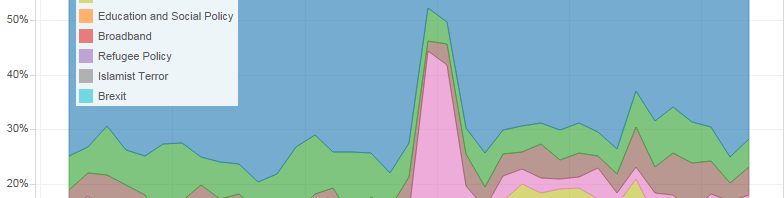
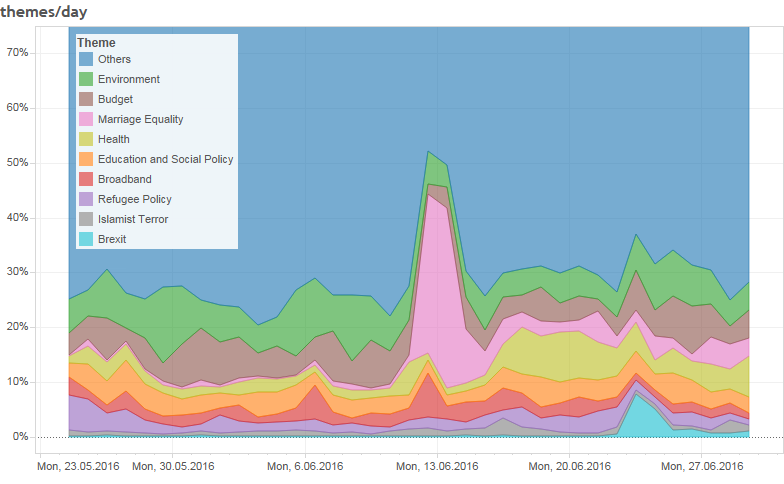
Although total tweeting activity shows a relatively steady environment, the past fortnight has seen some notable shifts in the focus of discussion. In my previous update I already noted the strong response to the Orlando massacre, and the links that Australian Twitter users began to draw almost immediately between this attack and the domestic political debate about same-sex marriage. For a few days after Orlando, this topic dominated the tweets directed at election candidates, and more tweets about the proposed marriage equality referendum have continued to be posted in subsequent days than before the attack.

image

The UK’s Brexit referendum has generated a similar, but significantly smaller spike in activity, but appears to have had a somewhat less lasting effect. It is likely, however, that the increase in budget-related discussion in recent days is also related to this topic: quite possibly, the focus has shifted from the immediate implications of a Brexit for Australia to a more general discussion of Australian economic policy in a post-Brexit environment.

The most substantial increase in volume over the past fortnight is for health-related discussions, however. This clearly shows the impact of Labor’s campaign messaging around Medicare. The raw numbers cannot tell us whether that campaign is going to shift Australians’ voting intentions, of course – but clearly the campaign has succeeded in boosting public discussion about health policy, at least on Twitter.

Top Tweets of the Past Fortnight

The most prominent tweets of this period tell a more detailed story, and point to some of the voter sentiment underlying these shifts in attention. Comedian Charlie Pickering’s tweet to Malcolm Turnbull, linking the Brexit and same-sex marriage referenda, was the most retweeted message on 24 June:

Two days later, with the economic disruptions likely to be caused by the Brexit vote becoming more evident, the debate had returned to the question of which party was better equipped to manage the economy. On 26 June, former Treasurer Wayne Swan’s defence of his legacy was the most retweeted post:

The final days of the campaign document the shift in focus towards health policy. In the context of relatively limited retweets for candidates of either major party, it is notable that on 28 and 30 June, Labor messages were most retweeted. On 28 June, Tanya Plibersek’s appearance on the ABC’s Q&A received some additional attention on Twitter:

On 30 June, her colleague Stephen Jones continued the scare campaign, and received the greatest number of retweets as a result:

Pro-Coalition sentiment is comparatively absent from this: while Coalition politicians posted messages promoting their policies, they received comparatively few endorsements in return. Most prominent amongst these was Malcolm Turnbull’s post on 30 June – the only time that he appeared in the top five most retweeted messages over the past fortnight:

Whether such late shifts in attention can still have any measurable impact on the election outcome, given that a substantial number of Australian will already have cast early and postal votes, will perhaps become evident on Saturday night.

But – especially after two months of campaigning, and with the finish in sight – some of the greatest retweeting activity was directed at the comedic interventions in the campaign. And who else but SBS’s Lee Lin Chin should have the last word, with the most shared post of 27 June:

Surely that’s a policy we can all support.

ATNIX: Australian Twitter News Index, May 2016

We’re now well into the federal election season, and of course this is reflected in the Twitter-based news sharing activities captured in the Australian Twitter News Index as well. But – because as in previous elections the general public tends to fully connect with the campaign only in the final weeks before election day – that’s not the only topic emerging from the past month’s data, as we will see.

Unfortunately, our Twitter data for the month are also affected by two outages due to server maintenance (highlighted in grey in the graph below). As these occurred mostly during weekends, though, they have only a limited impact on the overall analysis.

The overall trends in the Twitter-based sharing of the news published by Australian sites have remained stable for the most part. After a difficult April, the Sydney Morning Herald has narrowed the gap to ABC News somewhat, and it is tempting to read this as a reflection of the additional interest sparked by the early election campaign. The Australian and the Australian Financial Review, as prominent platforms with a particular specialisation on political news, have also caught up to match general-purpose site news.com.au more closely. We may see this pattern continued through June and July as well.

Amongst the opinion sites, Crikey has leapfrogged The Saturday Paper and Independent Australia to claim third place during May, and this too is consistent with a gradual shift towards a greater focus on political news as the campaign gathers speed. The comparatively poor performance of The Saturday Paper is most certainly also due to the fact that it is disproportionately much affected by our server outages, which occurred on two Saturdays and therefore specifically affected the day of the week that is most important for Saturday Paper news sharing.

image

Before we delve into what ATNIX can tell us about the early weeks of the election campaign: I’ve tried, believe me, to find any widely shared stories about Australia’s unprecedented second placing in this year’s Eurovision Song Contest. But none of the stories that were widely shared on 14 May or the days following it related to Dami Im’s performance, as it turns out.

This may be because the links shared on Twitter pointed to parts of the SBS site outside of the SBS News content that ATNIX tracks – but more likely, it’s simply because Eurovision is now so widely televised in Australia that Twitter users no longer feel the need to let their followers know about it. And given the delayed telecast in Australia, there may even be a tacit agreement not to post any spoilers about the eventual outcome.

But to weightier matters involving less photogenic contestants: while Eurovision was over within a few days, this year the Australian election campaign drags on for nearly two months. Plenty of time, then, for Twitter users to share the news reports that they think matter to public debate. Here, we’ll focus only on our two market leaders: ABC News and Sydney Morning Herald.

A review of the most shared articles for both sides during May reveals a very strong focus on climate change and environmental policy to date: seven of the ten most shared stories in May have an environmental angle.

The SMH report about sea level expert John Church being sacked in CSIRO’s cuts while on a research voyage in the South Polar Sea leads the field with some 2,700 shares; an SMH article about our passing of the negative milestone of 400 parts per million carbon dioxide in the atmosphere received some 2,000 shares; while more positively, an ABC News report about a new more efficient solar cell developed at UNSW received nearly 1,800 shares.

The processes of politics and the media dominate the next most prominent stories. We recorded 1,700 shares for an SMH article about the likely shutdown of the ABC’s Fact Check unit; nearly 1,500 were received by an SMH piece that suggested that the Coalition’s proposed PaTH interns programme was illegal under Australian law.

In spite of the continuing public debate about Australia’s refugee policy,  articles relating to it were shared much less frequently in May. The one story that did receive nearly 1,400 shares was the ABC News report about a second refugee setting herself alight in the Nauru internment camp; outside of such horrific events, the treatment of asylum seekers is surprisingly absent from our data.

The remaining four most widely shared stories in May again cover environmental matters. Nearly 1,400 tweets referenced NASA’s appeal to CSIRO not to cut its climate research, reported in the SMH; 1,300 each linked to an ABC News piece about administrative hurdles to renewable energy projects and an SMH follow-up on the 400ppm carbon dioxide report; and on a somewhat different angle, an ABC News report about the 600 tonnes of radioactive fuel still missing after the Fukushima meltdown was shared some 1,100 times during May.

What has been shared here is an early indication of the themes and topics that Twitter users have found worth sharing with their followers; this serves as a useful counterpoint to the exploration of the themes being addressed in @mentions of political candidates in my recent post about social media in the federal election (which also covered a slightly later period of time).

But while our Twitter news sharing data may point to a growing engagement with Australian federal politics during May, the patterns on Australian users’ visits to news and opinion sites that are provided by our Hitwise data largely reflect the long-term status quo: to date, there is no significant rise in visits to the mainstream news sites yet. Indeed, as was to be expected, Nine News slips back somewhat as the increased flow of visitors created by the 60 Minutes kidnapping drama in Beirut in April washes out of the system in May.

image

There is no particular Eurovision bump to be identified in mid-May, either, nor should we realistically expect to see one – Eurovision remains too much of a specialty event, and is now too well televised in Australia, to generate an increase in visits to Australian news sites that would be notable against the general backdrop. SBS’s Website may well have received a greater number of visitors from its broadcast of the semi-finals and finals – but SBS News, as tracked by Hitwise, did not.

But back to the election: as we trundle through June and towards the 2 July election date, we would expect to see a gradual rise certainly in the volume of Australian news links being shared on Twitter, and perhaps also in the number of visits to Australian news sites that Hitwise captures. How pronounced such a rise turns out to be may well also reflect how close the Australian public perceive the electoral race to be, so we’ll watch further developments with great interest.

Standard background information: ATNIX is based on tracking all tweets which contain links pointing to the URLs of a large selection of leading Australian news and opinion sites (even if those links have been shortened at some point). Datasets for those sites which cover more than just news and opinion (abc.net.au, sbs.com.au, ninemsn.com.au) are filtered to exclude the non-news sections of those sites (e.g. abc.net.au/tv, catchup.ninemsn.com.au). Data on Australian Internet users’ news browsing patterns are provided courtesy of Hitwise, a division of Connexity. This research is supported by the ARC Future Fellowship project “Understanding Intermedia Information Flows in the Australian Online Public Sphere”.