Social Media, the Convergence Review, and Our Research

Some welcome validation of our efforts to understand the use of social media – especially Twitter – during recent natural disasters (a few key posts are collected here) has arrived in the form of a number of submissions to the Australian federal government’s Convergence Review. The Review has the (very broad) remit to “to examine the policy and regulatory frameworks that apply to the converged media and communications landscape in Australia”, an important task not least also against the backdrop of the emerging National Broadband Network and the continuing concerns over highly concentrated ownership structures in Australia’s commercial media industries.

Social media are far from playing a central role in these overall considerations, of course, but their increasing significance as an additional medium for many-to-many communication alongside more established mainstream media is being highlighted by a number of the submissions. Our work is being cited especially by two key submissions.

The first of these is from ex-monopolist telecommunications provider Telstra. It highlights the increased agency of users as content creators, drawing inter alia on my Gatewatching book and my two reports on social media (with Mark Bahnisch) for the Smart Services CRC, and particularly notes the role of user-generated content during the Queensland floods, citing material we published on the CCI Website:

Continue reading “Social Media, the Convergence Review, and Our Research”

A First Map of Australia, Part 2: Twitter’s States and Territories

I’m following up a little further on my post of our first, very tentative and incomplete, map of the Australian Twittersphere, for another slightly more detailed look. First, though – also in response to some of the Twitter comments to the first posting, here’s another clarification of what you’re seeing.

In the first place, the total number of ‘Australian’ (by our criteria) Twitter users we’ve identified so far is about 550,000. Of these, at this point we have data on their follower/followee networks for about 450,000. If we exclude from this group all those users who have fewer than five followers, we’re left with roughly 150,000. So, if you see me use these numbers, that’s where they’re coming from.

The maps I’ve posted display these follower/followee networks based on affinity – those users who are closely interlinked through a range of connections with each other appear close to one another in the network, forming clusters which (we should assume) are determined by shared interests and other shared attributes. From a quick glance at the users involved in these clusters (or at least, at their usernames, which often indicate their interests or backgrounds), this seems to hold true, especially for the most connected users.

Continue reading “A First Map of Australia, Part 2: Twitter’s States and Territories”

A First Map of Australia, Part 2: Twitter’s States and Territories

I’m following up a little further on my post of our first, very tentative and incomplete, map of the Australian Twittersphere, for another slightly more detailed look. First, though – also in response to some of the Twitter comments to the first posting, here’s another clarification of what you’re seeing.

In the first place, the total number of ‘Australian’ (by our criteria) Twitter users we’ve identified so far is about 550,000. Of these, at this point we have data on their follower/followee networks for about 450,000. If we exclude from this group all those users who have fewer than five followers, we’re left with roughly 150,000. So, if you see me use these numbers, that’s where they’re coming from.

The maps I’ve posted display these follower/followee networks based on affinity – those users who are closely interlinked through a range of connections with each other appear close to one another in the network, forming clusters which (we should assume) are determined by shared interests and other shared attributes. From a quick glance at the users involved in these clusters (or at least, at their usernames, which often indicate their interests or backgrounds), this seems to hold true, especially for the most connected users.

Continue reading “A First Map of Australia, Part 2: Twitter’s States and Territories”

A First Map of Australia

We’ve been neglecting the blog a little – not because there hasn’t been anything worth writing about, but rather because there’s been too much going on. So, before our big trip to Europe in August and September (more on that soon), it’s time to clear the backlog of updates. And what better way to start than with an early map of Australia. No, we’re not talking about ancient seafarers’ maps here (though there are some similarities): part of our aim with the Mapping Online Publics project has always been to develop a better understanding of the Australian Twittersphere – to go beyond the observation of individual hashtag conversations, and to examine the overall network of Australian Twitter users (similar to what we’ve started, and are also continuing, with the Australian blogosphere).

So, over the past few months we’ve worked with our project partners at Sociomantic Labs in Berlin to identify as many Australian Twitter users as we could find, and to trace their networks of followers and followees. The core problem in this is to define what constitutes an Australian user, of course – here, we’ve been relying on a combination of the timezone they’ve set for themselves (e.g. ‘Brisbane, GMT+10’), the location they’ve started in their profile, and other characteristics. This isn’t without its drawbacks, of course – some users may never have set their profile information; some have even deliberately set their details ‘wrongly’ (following the disputed Iranian elections, some users set their timezone to Tehran time, for example, to show sympathy and/or confuse Iranian authorities trying to find the accounts of local dissidents); some use non-standard descriptions of their location (Brisvegas, Brisneyland) or are in Australian cities whose names also occur elsewhere (there’s a Toronto, Texas, and Bolivia here, and any number of suburbs called Paddington). And some users are simply very confused – quite a few users with timezones set to GMT-10 should have chosen GMT+10, and vice versa…

Continue reading “A First Map of Australia”

Looking Back at ‘The World According to Twitter’

About a month ago now, more than 15 Australian and international researchers as well as industry representatives came together at QUT to participate in the interdisciplinary research workshop The World According to Twitter (#WAT11) which set out to explore innovative theoretical and methodological approaches to researching Twitter, to develop a better overview of current topics, purposes, and applications of Twitter research, identify key research questions, and share possible methodological approaches for addressing them. The workshop was held in the context of Axel and Jean’s collaboration with the University of Düsseldorf Junior Researchers Group “Science and the Internet” and saw visiting fellows Katrin Weller and Cornelius Puschmann amongst the group of presenters.

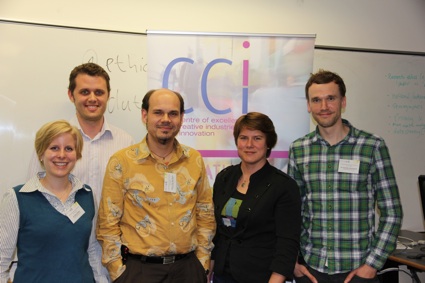
From left to right: Katrin Weller, Stephen Harrington, Axel Bruns, Jean Burgess and Cornelius Puschmann at the The World According To Twitter workshop

Continue reading “Looking Back at ‘The World According to Twitter’”

Emergency Management Conference

I’m pushing my luck by heading down to Melbourne again tomorrow – hopefully without being held up by ash clouds, pilot strikes, or any other unforeseen disruptions, this time. I’m there to speak at the Emergence Management Conference, to present (again) on our research into the use of Twitter in particular and social media more generally during the recent Queensland floods and Christchurch earthquake(s). Looking forward to it!

Regular visitors to the blog might not find all that much new information in my presentation, compared to what we’ve already published here in the past. But nonetheless, here it is (audio to come later, hopefully now online, too):

Continue reading “Emergency Management Conference”

Tweeting at the TV: Some Observations on #GoBackSBS

Television programmes spruiking their associated Twitter hashtags is now a common spectacle; we’re seeing this for everything from political debate (#qanda) to reality TV (#masterchef). One particularly successful example of this viewer engagement strategy was SBS’s recent Go Back to Where You Came From mini-series, which aimed to raise the tone of Australia’s depressingly low-brow political debate about asylum seekers by taking six contestants with strong views on ‘illegal’ migration on a reverse journey from Australia back to the countries of origin of many asylum seekers – in a reality TV-style three-part TV series.

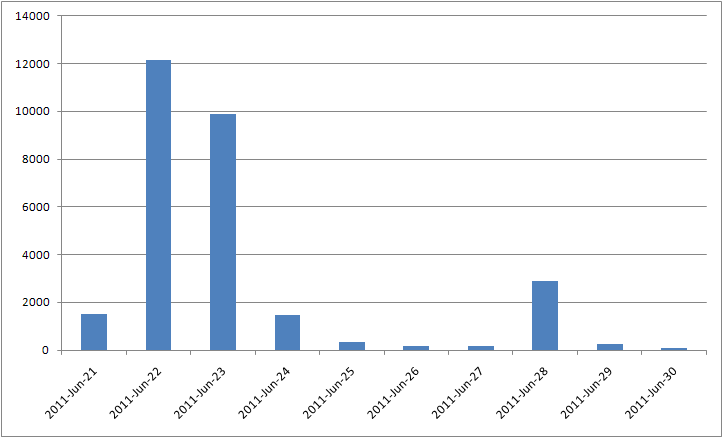
The hashtag associated with the series was #GoBackSBS, and generated a substantial amount of participation over the three nights of the show  (21-23 June 2011), as well as in the following week, when a panel discussion with the contestants was screened as well. Sadly, because I was stuck in Melbourne due to the volcanic ash cloud on 21 June and couldn’t start our hashtag capture in time, we weren’t able to capture the entire #GoBackSBS Twitter discussion about the show (for 21 June, we have data only from 22:04 onwards) – so it’s great to see that another group of Twitter researchers, Datalicious, have already published their analysis of some key content patterns in #GoBackSBS (some more precise detail on the dataset would be great, though, guys!).

Continue reading “Tweeting at the TV: Some Observations on #GoBackSBS”

Twitter Research Methods

Following on from the “World According to Twitter” research workshop at QUT, today we presented our research methods at a pre-conference workshop at Communities & Technologies 2011. This was probably the most extensive presentation of our work on Twitter research to date – including a live demonstration of how to work with basic yourTwapperkeeper datasets.

Below are the two presentations I made during the day, with audio attached. Obviously, some of the audio commentary refers to the live demonstrations, which we didn’t capture – but I hope it’s useful nonetheless.

Continue reading “Twitter Research Methods”

The World According to Twitter

Tomorrow, our Mapping Online Publics project team is hosting the public research workshop The World According to Twitter at QUT, in collaboration with our visiting researchers Katrin Weller and Cornelius Puschmann from the Junior Researchers Group "Science and the Internet" at the University of Düsseldorf, Germany. The workshop is the first major event in our two ATN-DAAD research projects with colleagues in Düsseldorf and Münster, and should provide a great starting point for a very exciting research programme. We’ve already spent most of the past week in intensive research sharing mode with Katrin and Cornelius, and you’ll see some of the first outcomes of our brainstorming activities appear on this blog soon.

Tomorrow, though, is all about taking stock of where the still very nascent area of Twitter research is at. We’ll be making our contribution to the programme by looking at some of our key outcomes from the past year or so – especially, of course, our work on the use of Twitter in crises like the Queensland floods – as well as giving a first preview of what’s coming up later this year. And the day after tomorrow, we’re presenting a Twitter methods workshop at the Communities & Technologies conference here in Brisbane – more on that soon.

Continue reading “The World According to Twitter”

Gawk Scripts for Processing Twitter Data, Vol. 1

Well, getting stuck in Melbourne for a day and being unable to participate in day one of our ATN-DAAD workshop with Cornelius Puschmann and Katrin Weller from the University of Düsseldorf has at least enabled me to put the finishing touches on something I’ve been meaning to do for some time: to collect and share the various Gawk scripts for processing Twitter data collected by Twapperkeeper or our modified yourTwapperkeeper. A ZIP file of all our (half-way decent) scripts is now available on the Tools section of our site.

These scripts enable the processing of comma- or tab-separated value files containing tweets related to specific hashtags or keywords, as Twapperkeeper used to produce them, and as yourTwapperkeeper does once you’ve installed the modified export functions which I shared in a previous post.

Continue reading “Gawk Scripts for Processing Twitter Data, Vol. 1”