Taking Twitter Metrics to a New Level (Part 2)

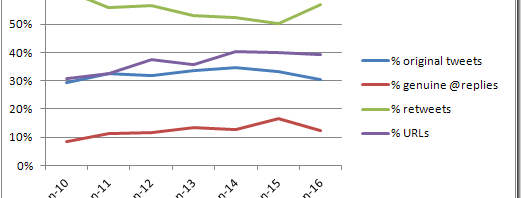
Update: I’ve clarified/corrected some of the details relating to the percentile metrics contained in the first table which metrify.awk generates. Update 2: revision 1.2 of metrify.awk adds further functionality in addition to what is described below. These changes are detailed here. In the previous post, I’ve introduced metrify.awk, our new multi-purpose tool for generating Twitter …

Taking Twitter Metrics to a New Level (Part 1)

So, 2011 is finally over – and what a year it’s been. While the confluence of natural disasters, political crises, and other major events has also provided us with the basis for a new research programme in crisis communication, let’s hope that 2012 is a little less intense, please… To start the new year on …

A Belated Post of Our DIATA11 Keynote, and More…

It’s been a busy few days: last week, Jean, Stephen and I participated in the magnificent Düsseldorf Workshop on Interdisciplinary Approaches to Twitter Analysis (DIATA11), which our colleagues and collaboration partners from the University of Düsseldorf organised – it featured a veritable who’s who of Twitter and social media researchers from Europe and beyond. Stephen …

Quick Update from the Road: Twitter Research Methods

Cardiff. Another week, another presentation: Jean, Stephen, and I have now made it to Cardiff, where we’re participating in the Future of Journalism conference. Today, we presented our paper on Twitter research methods for journalists and journalism researchers, which offers a quick overview of our major ways of studying Twitter (and Twitter hashtags in particular). …

Talking Twitter in Amsterdam

Amsterdam. After the ECPR conference in Reykjavík, I’ve been lucky enough to spend a week in Amsterdam, where I was invited to present a guest lecture as part of the festive opening of the University of Amsterdam’s ‘new media season’: the official welcoming of the 2011/12 cohort of students in the MA in New Media. …

Extracting images from Twapperkeeper archives

This is just a quick post to share another new script – this one takes a list of tweets with pre-resolved URLs, and filters the list for known image-hosting services. I whipped this up as part of our ongoing efforts to go deeper into the dynamics of communication at various phases of the Queensland Floods …

Media use in the #qldfloods

As I’m sure you’re aware, last week was pretty rough for Queensland (and then New South Wales and Victoria), as devastating flash floods ripped through Toowoomba and the Lockyer Valley, quickly followed by extreme river flooding in Ipswich and Brisbane that saw thousands of homes inundated. As in any emergency situation or other ‘acute event’, …

Top 20 election-related YouTube videos (according to Twitter)

Update: this analysis covers a few less days than I originally stated – the results should look quite different once we add in this week’s links (and next week’s!). Here are the top 20 Australian election-related YouTube videos so far up to last Friday morning, according to the Twitterati. Or to be more precise, here …

Using Gawk and Wget to Resolve URL Shorteners

Jean’s post today points to a key problem in examining user activities on Twitter and elsewhere – people are increasingly using bit.ly and other URL shorteners, which means that a) the same target URL might appear in any number of different shortened versions, and b) it’s no longer possible from a quick look at a …

Visualising topic-based conversation networks: the #masterchef edition

In future analysis we’ll be interested in doing some form of comparison between the #ausvotes data we’ve been looking at (and that Axel has already blogged about earlier this week), and other topics of shared interest among Australian Twitter users. As an exceptionally high-rating Australian prime-time TV show that was also a trending topic on Twitter, Masterchef is a particularly interesting example of such a topic drawn from popular culture. The patterns of Twitter use around this highly popular, nationally-based show (perhaps even more so than around the pre-election debate) can hopefully help us to understand something about the practices of the networked television audience as a public.