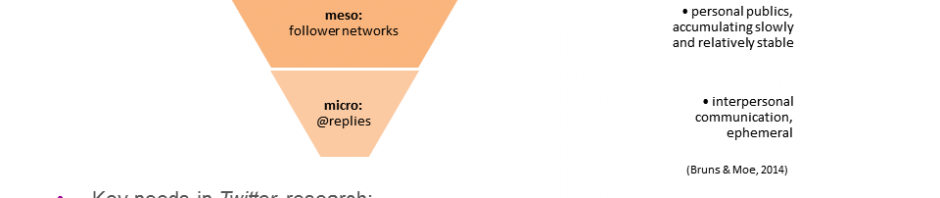
If you’ve been wondering about the lack of news on this site – yes, we’re still here, and if we haven’t posted since the start of the year it’s because behind the scenes we’ve been busy preparing for a number of major new research projects that are about to start, as well as crunching some …
Category Archives: Visualisation
#ausvotes: Twitter Activity across the Electorates
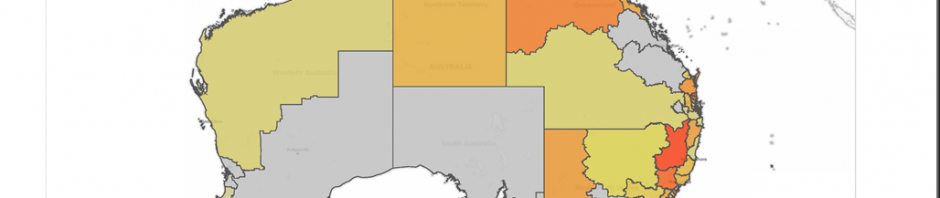
Following on from yesterday’s update of overall Twitter activity patterns around Australian federal politicians’ and candidates’ accounts, here’s a slightly different look at the same data – and before I forget again, I want to say my sincere thanks to CCI researchers Darryl Woodford and Andrew Quodling for their work in pulling together and formatting …
Continue reading “#ausvotes: Twitter Activity across the Electorates”
Big Brother 15, West Coast Viewers & Guilt by Association
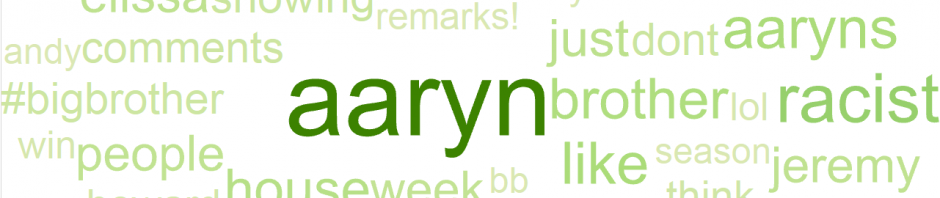
Over at my own blog, I have been running an almost-daily series of posts looking at the current US reality series “Big Brother”, now in its 15th incarnation in the US (the 10th Australian series starts in a week or so). While I’ll direct you there for all of the details, here is a brief summary of …
Continue reading “Big Brother 15, West Coast Viewers & Guilt by Association”
Follower Accession: How Australian Politicians Gained Their Twitter Followers
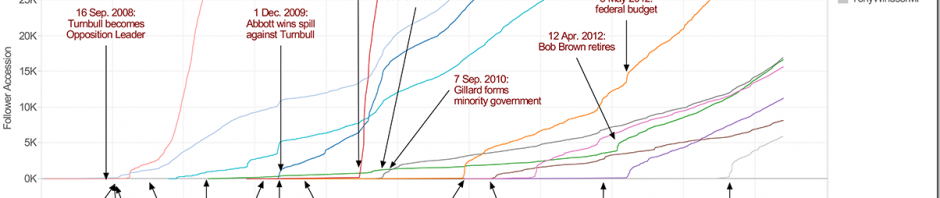
This post follows on from a number of research activities we’ve covered here in the past. Last week, we released our CCI report Social Media in the Media, which shows the gradual acceptance and integration of social media into the practices of political communication. And in my last post, I outlined a new method for …
Continue reading “Follower Accession: How Australian Politicians Gained Their Twitter Followers”
#spill: How Twitter Reacted to the Labor Leadership Challenge
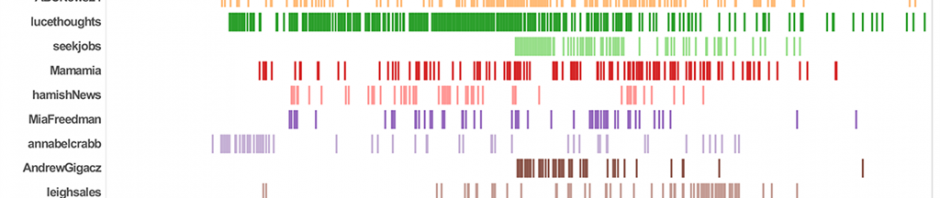
It’s that time of the electoral cycle again where the Australian Labor Party changes leaders in response to its flagging opinion polling. As with the 2010 leadership spill, which we touched on here, there was a great deal of activity on Twitter last night: the #spill hashtag, in particular, served as one forum through which …
Continue reading “#spill: How Twitter Reacted to the Labor Leadership Challenge”
A Collection of Presentations on Twitter Research Methods

Over the past month, my colleagues Jean Burgess, Tim Highfield, Tanya Nitins and I have been travelling through Europe in various combinations to participate in workshops and conferences which address some of the key themes of our research – methodological innovation in social media research, and the role of Twitter in the wider media ecology. …
Continue reading “A Collection of Presentations on Twitter Research Methods”
New Articles on Twitter and Journalism
Somehow I don’t think we ever quite got around to posting this: a couple of months ago, two research publications by my QUT colleague Jean Burgess and myself appeared in Journalism Studies and Journalism Practice within two days of each other. The first of these is a methodology article which outlines how our methods for …
Our Twitter Maps in the Press
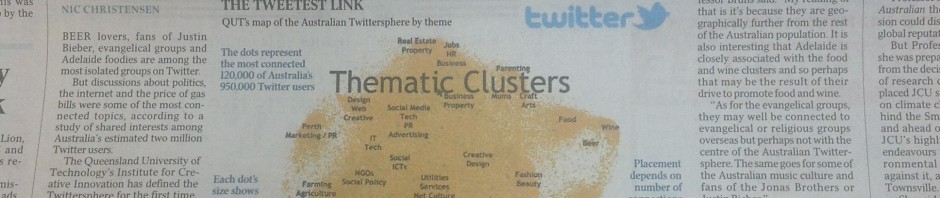
The emerging maps of the Australian Twittersphere which I presented at the Digital Humanities Australasia conference in Canberra in March have received quite a bit of press coverage over the past week or so, following our press release about this work. Here are some of the highlights: The Australian ran a big page three article …
Many Maps of the Australian Twittersphere

I spent most of last week at the Digital Humanities Australasia conference in Canberra (see my liveblog coverage), where I presented the latest iteration of our map of the Australian Twitter follower/followee network. This is now based on a total dataset of some 950,000 users, from which we’ve selected the most connected 120,000 for visualisation. …
Continue reading “Many Maps of the Australian Twittersphere”
Creating Basic Twitter Language Metrics
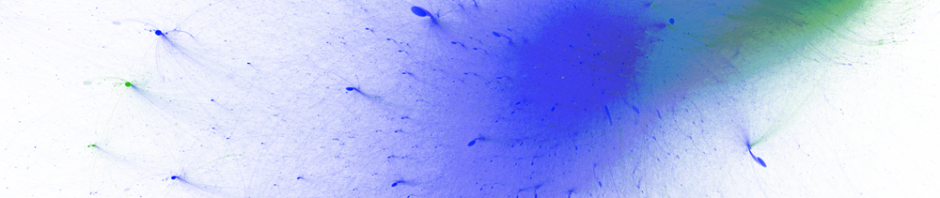
OK, this may be a somewhat esoteric subject for researchers who mainly work with Twitter data from specific countries and cultures, but over the past few weeks I’ve been working on a paper that analyses Twitter activities in the #egypt and #libya hashtags – and as part of that work, I’ve been interested in exploring …