Visualising Twitter Dynamics in Gephi, Part 2

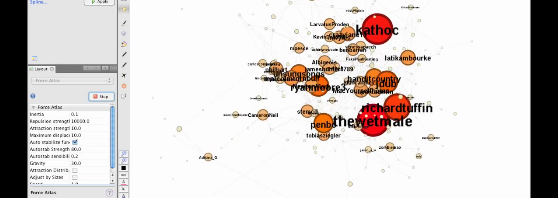
OK, so this is the second part of my post on turning Twitter data from Twapperkeeper into a dynamic network visualisation in Gephi. Last night’s post did the groundwork, generating a GEXF file from our #spill hashtag dataset (covering Twitter discussion of an Australian Labor Party leadership spill between 7 p.m. and midnight (AEST) on …

Visualising Twitter Dynamics in Gephi, Part 1

In the following posts I’m finally keeping my promise to explore in earnest the use of Gephi‘s dynamic timeline feature for visualising Twitter-based discussions as they unfolded in real time. A few months ago, Jean posted a first glimpse of our then still very experimental data on Twitter dynamics, with a string of caveats attached …

Twitter’s Reaction to #twitdef

Hello! Will Dawson here. Axel and Jean have been kind enough to take on a VRES student over summer (think of it like the work-experience kid of the academic world). Basically, VRES (or Vacation Research Experience Scholarship) is a QUT scheme that allows undergrads to get a taste of research, before moving on to higher …

Election 2010: The View from Twitter

One more time for the world: there will be a final (I think) presentation for this year of our work around Twitter in the 2010 Australian election, at the International Australian Studies Association ‘Double Vision’ conference in Sydney on Friday. This is something of a ‘best of’ of the material which we’ve already presented here …

Some Updates on Recent Developments

Activity on this blog has slowed down a little since Jean and I have come back to Australia from our European adventures, as we work through a backlog of other more or less urgent tasks – but while we wait to get back to some hands-on work on the Mapping Online Publics project, I thought …

Mapping Online Publics in Australia

So, we had ourselves a fine little panel on tracking and mapping social media at the AoIR 2010 conference in Gothenburg today. Below is the presentation from our Mapping Online Publics project (with audio) – and over at snurb.info you can also find my blog posts from the presentations by Hallvard Moe, Christian Nuernbergk, and …

Dynamic Networks in Gephi: From Twapperkeeper to GEXF

In between last week’s ECREA conference in Hamburg, where we presented some of our methodologies and early outcomes from the Mapping Online Publics project, and the AoIR conference in Gothenburg, where we’ll talk some more about tracking and mapping interaction in online social networks, I wanted to finally follow up on Jean’s teaser post of …

#ausvotes Twitter Activity during the 2010 Australian Election

(Crossposted from snurb.info, where you can find my full coverage of ECREA 2010.) Hamburg. My own paper was next at ECREA 2010. Here’s the presentation – and I also recorded the audio for it, and will add it as soon as I can which is now attached to the slides. As it turned out, one …

Mapping Online Publics: Methodological Observations

(Cross-posted from snurb.info, where you can also find more liveblogging from the DGMS and ECREA 2010 conferences.) Bremen. My CCI colleague Jean Burgess and I are currently in Bremen for the ‘Doing Global Media Studies’ pre-conference to ECREA 2010 in Hamburg, and she’s presenting the methodological approach of our Mapping Online Publics research project (which …

Fun with Gephi’s new dynamic visualisation feature

This is a quick demo of how the new timeline feature works in Gephi 0.7 beta. We’ve used 5 hours worth of @reply data from the Twapperkeeper archives for the #spill hashtag. This period corresponds to the ‘acute event’ in Australian politics that kicked off the election that sidetracked our research (in all kinds of …