
In a previous post I introduced work we have been doing here at the CCI to contribute to an understanding of the way in which social media are portrayed as political tools in traditional media outlets. In this post I provided a broad overview of a preliminary qualitative study of 56 articles from Australian newspapers (mostly) that discussed social media and politics between 2008 and 2013, and gave an overview of how these articles compared and contrasted new and traditional media tools as means of political engagement. In this post I will go further into how the newspaper articles we analysed reported on different user groups.
Subgroup: User Groups
One of the subgroups of themes we identified in our content analysis of newspaper articles that reported on the use of new media as political tools was user groups. We noticed there were nuances between the ways in which the articles discussed how and by whom these tools were employed in the context of political practices. Most of the articles we analysed focused on the use of social media by politicians, some analysed their use by citizens as tools for political engagement, and others discussed how journalists employed social media as means of political news reporting.
Out of the total 56 articles we analysed, 19 referred only to politicians and how they use social media, 2 discussed just how the public engage with social media as political tools, and 1 mentioned only journalists as users of social media for political reporting. 3 articles referred to all three user groups, 11 articles mentioned politicians and the public, 2 mentioned politicians and journalists, and 2 mentioned the public and journalists.
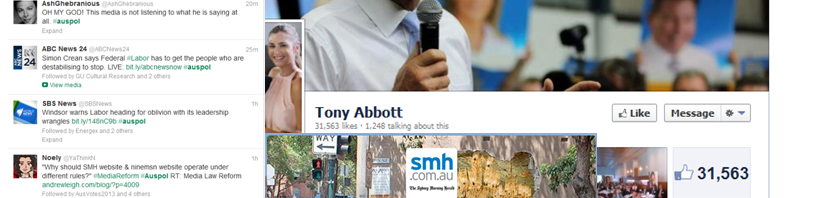
Politicians were the most widely mentioned user group. The way in which politicians employ social media for campaigning and engaging with the public seems to be high up on the agenda in traditional news reporting on new media as political tools. Politicians are highly scrutinised, and often criticised, for their use of social media. For instance, 10 articles indicated that the social media practice of Australian politicians was unsatisfactory. One article in The Sydney Morning Herald from 2010 quotes a public relations expert who says that “The politicians aren’t using it [Twitter] themselves. They don’t understand it… All in all it’s a massive missed opportunity”. Another article in the Gold Coast Bulletin (2010) refers specifically to opposition leader Tony Abbott’s use of Twitter, saying that “it is clear he is far from understanding the medium”. The bulk of these 10 articles comes from the years 2010 (4) and 2012 (5). While, bearing in mind the uneven distribution of articles across publication years (see a previous blog post on this here), this does seem to indicate that criticisms and concerns around the use of social media by politicians flare up in the media around election times, when politicians are campaigning and being scrutinised for their practices.
About half of the articles that discussed politicians’ use of new media as political tools also referred to how everyday individuals use new media in connection to politics. The bulk of these articles refer to a politically engaged public that employs social media tools to talk about and make sense of political issues, as well as to seek a rapport with the politicians that represent it. Commonly, these articles lament that politicians are not making use of the two-way communication opportunities that tools like Twitter afford, leaving members of the public demanding more direct interaction with politicians. Fewer articles presented a more critical view of the public’s use of new media as political tools, one from 2012 suggesting, for example, that ‘Twitter is used by a tiny minority of people interested in the national political debate’. This leads to another popular point of discussion raised with regards to the everyday individual as a user of social media for political purposes, namely the demographics that limit which kind of users actually engage with politics through these tools. Another 2010 article confirmed that it is generally an educated and already politically engaged minority of urban professionals aged 25-34 that uses social media for political engagement. There were some discrepancies in terms of suggestions about gendered use of social media tools, some suggesting that the Australian blogosphere is dominated by males, whereas others reported on the growing female user base of many social media tools.
Out of the 8 articles that discussed how journalists use new media as political tools, all but one also referred to other user groups and made connections between them. These articles discussed how journalists, the public and politicians are either rival sources, or informants for one another, in terms of political information dissemination. For example, a publication on the AAP Australian National Newswire (2012) notes that ‘Sydney Morning Herald chief political reporter Phillip Coorey was the first to tweet an unofficial result’ in Labor’s leadership ballot that saw Julia Gillard replace Kevin Rudd as Prime Minister. It suggests that this ‘led to a flood of tweets from journalists, news websites and political junkies’ circulating information between one another, before the official result was actually announced. Griffin (2012, in a book review of Greg Jericho’s The Rise of the Fifth Estate: Social Media and Blogging in Australian Politics) suggested that there is a conflict between public actors, who are becoming increasingly involved as citizen journalists, and traditional journalists, as the experts on live reporting and analysis. The article discussed how Jericho queries whether the former are challenging the latter or whether there are still differences in news reporting by citizens and journalists.
The way in which traditional media report on the different user groups of new media as political tools provides an insight into the complex interrelations, conflicts of interest and mixed abilities of different user groups of social media. Politicians, citizens and journalists all have the opportunity to use these tools for political engagement. They have different agendas to follow and varying levels of ability in how they employ these tools for their purposes. From our initial content-analysis of 56 articles it became clear that politicians are the most scrutinised in terms of their use of these tools. Interesting issues around the demographics of citizen users who make use of new media for political purposes emerged, as well as indications of conflicts between these new citizen journalists and the traditional reporters who work for established media outlets. These are all themes to consider and follow up with further in-depth studies in order to gain an understanding of the use of social media in politics and the representation of this activity in traditional media outlets.
In the next and final post of this series I will take a closer look at the different uses of these tools in order to discern how, why and for what different users employ new media as political tools.