
[crossposted at my own blog creativity/machine.] On the 1st and 2nd of September I was in London at the third Transforming Audiences conference, hosted by CAMRI at the University of Westminster. I was one of four keynote presenters – alongside Nancy Baym, Patricia Lange, and Adriana de Souza e Silva. I had a great time, …
Category Archives: Culture
Twitter and the Royal Wedding, Pt. 2: Something New
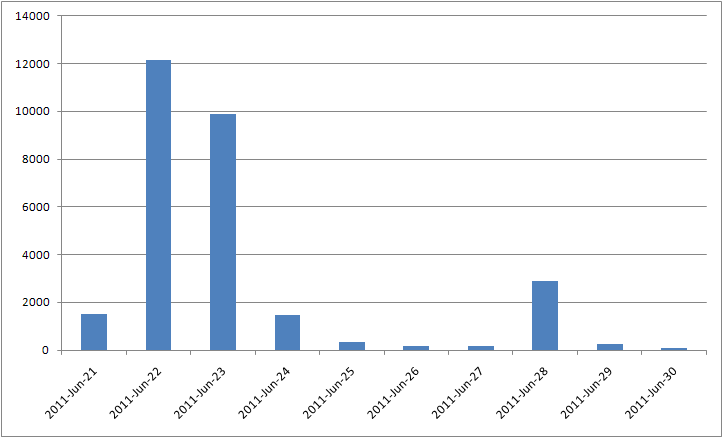
The first part of this post examined some of the basic stats on Twitter use during the 29 April 2011 royal wedding. Here, we’ll try something a little different: in the tweets using the #royalwedding hashtag between 00:00 and 23:59 GMT that day, what other hashtags were also used? Hashtags, of course, aren’t mutually exclusive, …
Continue reading “Twitter and the Royal Wedding, Pt. 2: Something New”
Twitter and the Royal Wedding, Pt. 1: Something Processed

OK: I realise this may induce some cognitive dissonance in susceptible readers while those images of the London riots continue to flash across our TV screens (and we’re now also tracking some of the Twitter coverage of the riots and subsequent cleanup – more on that some other time, if anything interesting emerges). For some …
Continue reading “Twitter and the Royal Wedding, Pt. 1: Something Processed”
Tweeting at the TV: Some Observations on #GoBackSBS
Television programmes spruiking their associated Twitter hashtags is now a common spectacle; we’re seeing this for everything from political debate (#qanda) to reality TV (#masterchef). One particularly successful example of this viewer engagement strategy was SBS’s recent Go Back to Where You Came From mini-series, which aimed to raise the tone of Australia’s depressingly low-brow …
Continue reading “Tweeting at the TV: Some Observations on #GoBackSBS”
Beauty, Fashion & Style Blog Analysis PART 2 (Qualitative)

This is my final post as a VRES student, and part 2 of my analysis of eight Australian Beauty, Fashion and Style blogs – see Part 1 (Quantitative) here. In this post, I look at some qualitative aspects of the blogs by answering the following questions: Identity – Is the blogger an insider (journalist, stylist, …
Continue reading “Beauty, Fashion & Style Blog Analysis PART 2 (Qualitative)”
Twitter Spoils the Oscars Party for Channel Nine

As something of a distraction from our recent focus on the role of social media during natural disasters, I thought I’d share a few observations on the use of Twitter during the Oscars broadcast a few days ago. In addition to their massive global TV audience, the 2011 Academy Awards also featured the #Oscars hashtag …
Continue reading “Twitter Spoils the Oscars Party for Channel Nine”
Beauty, Fashion & Style Blog Analysis PART 1 (Quantitative)

As noted in my first post about blog categorisation, I have now assessed 8 Beauty, Fashion and Style blogs to determine whether any similarities exist in terms of subscribers, style, and content. This post is part 1 of 2 and will cover all quantitative aspects by answering the following questions: Popularity – How many subscribers? …
Continue reading “Beauty, Fashion & Style Blog Analysis PART 1 (Quantitative)”
Mapping Online Publics: Methodological Observations
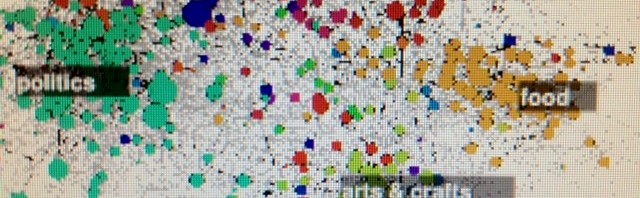
(Cross-posted from snurb.info, where you can also find more liveblogging from the DGMS and ECREA 2010 conferences.) Bremen. My CCI colleague Jean Burgess and I are currently in Bremen for the ‘Doing Global Media Studies’ pre-conference to ECREA 2010 in Hamburg, and she’s presenting the methodological approach of our Mapping Online Publics research project (which …
Continue reading “Mapping Online Publics: Methodological Observations”
Popular Uses of YouTube in Italy and Australia: Part 1

I’m writing this from the University of Urbino, where I am spending a week as an academic visitor, leading up to a one-day mini-conference on research methods on Thursday, which I’ll blog about in a few days’ time. Since I’m here, I thought it might be useful to do a quick comparative study of the …
Continue reading “Popular Uses of YouTube in Italy and Australia: Part 1”
Visualising topic-based conversation networks: the #masterchef edition
In future analysis we’ll be interested in doing some form of comparison between the #ausvotes data we’ve been looking at (and that Axel has already blogged about earlier this week), and other topics of shared interest among Australian Twitter users. As an exceptionally high-rating Australian prime-time TV show that was also a trending topic on Twitter, Masterchef is a particularly interesting example of such a topic drawn from popular culture. The patterns of Twitter use around this highly popular, nationally-based show (perhaps even more so than around the pre-election debate) can hopefully help us to understand something about the practices of the networked television audience as a public.