We’ve been neglecting the blog a little – not because there hasn’t been anything worth writing about, but rather because there’s been too much going on. So, before our big trip to Europe in August and September (more on that soon), it’s time to clear the backlog of updates. And what better way to start …
Category Archives: Analysis
Tweeting at the TV: Some Observations on #GoBackSBS
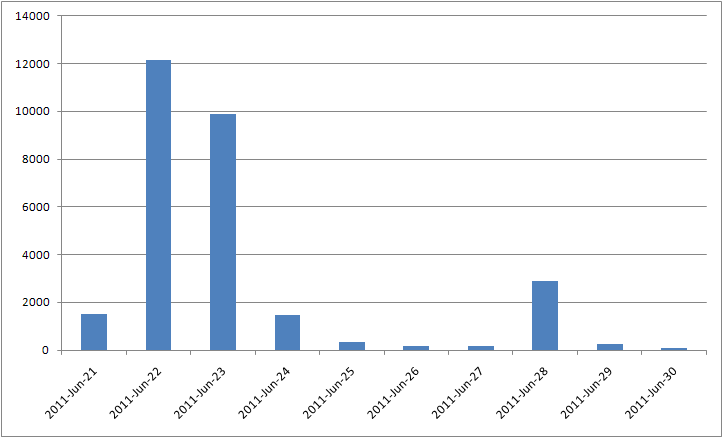
Television programmes spruiking their associated Twitter hashtags is now a common spectacle; we’re seeing this for everything from political debate (#qanda) to reality TV (#masterchef). One particularly successful example of this viewer engagement strategy was SBS’s recent Go Back to Where You Came From mini-series, which aimed to raise the tone of Australia’s depressingly low-brow …
Continue reading “Tweeting at the TV: Some Observations on #GoBackSBS”
Broader Twitter Patterns during Acute Events
Working through our available data on Twitter use during crisis events ahead of the Eidos Institute symposium on Monday, I started thinking about some of the broader patterns we are seeing. Very obviously, a good bit of the #hashtag activity around acute events is taken up with retweeting information – both simply passing it along …
Continue reading “Broader Twitter Patterns during Acute Events”
Social Media in Times of Crisis
As we’ve mentioned in a previous post, Jean and I participated in the Eidos Institute symposium “Social Media in Times of Crisis” at the State Library of Queensland today – which turned out to be a great event that generated lots of new ideas and further possibilities for our research. Many thanks to all of …
Social Media and Emergencies, in German(y)
The German online magazine Politik-Digital, which covers issues relating to politics and the Internet, has just published a lengthy interview with me about the role of Twitter and other social media platforms during recent disasters, and about what German authorities may learn from recent experiences elsewhere – from the Queensland floods to the Christchurch earthquake …
Continue reading “Social Media and Emergencies, in German(y)”
Twitter in the Christchurch Earthquake, Pt. 3
We’ve spent the last couple of posts looking at user activity patterns on Twitter during the days following the Christchurch earthquake. Now it’s time to shift our attention to the themes discussed by the #eqnz hashtag community – again with particular attention also to how these themes change over time. What I’ve done here is …
Continue reading “Twitter in the Christchurch Earthquake, Pt. 3”
Twitter in the Christchurch Earthquake, Pt. 2
Following on from my overview of key tweeting patterns in the Christchurch earthquake in February, in the previous post, I wanted to further explore Alfred Hermida’s idea of Twitter as ‘ambient journalism‘ – or more to the point, examine whether there are any obvious differences between Twitter’s coverage of the immediate earthquake and its long-term …
Continue reading “Twitter in the Christchurch Earthquake, Pt. 2”
Twitter in the Christchurch Earthquake, Pt. 1
Given the recent focus on this blog on the use of social media during major disasters, a closer look at the use of Twitter during the devastating Christchurch earthquake on 22 Feb. 2011 is long overdue (and sadly, more on the horrible Japanese earthquake and tsunami will follow soon, too). I’m following our previous methodology …
Continue reading “Twitter in the Christchurch Earthquake, Pt. 1”
Image sharing in the #qldfloods
In a previous post, I explained how to extract links to known image-hosting services from an archive of tweets, and promised to follow up with a substantial post on image-sharing in the Queensland Floods – this is that post. It’s pretty long, but it does have pictures. Here are the main points: During the Queensland …
Beauty, Fashion & Style Blog Analysis PART 2 (Qualitative)

This is my final post as a VRES student, and part 2 of my analysis of eight Australian Beauty, Fashion and Style blogs – see Part 1 (Quantitative) here. In this post, I look at some qualitative aspects of the blogs by answering the following questions: Identity – Is the blogger an insider (journalist, stylist, …
Continue reading “Beauty, Fashion & Style Blog Analysis PART 2 (Qualitative)”