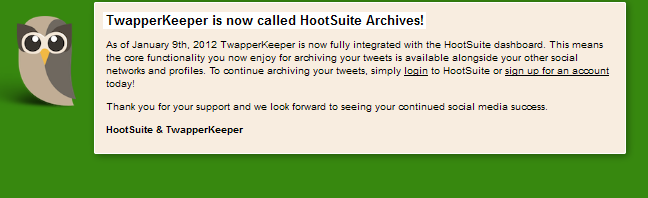
Switching from Twapperkeeper to yourTwapperkeeper

As those of you who are regular followers of our research might have gleaned already, we recommended our followers to try the newly developed slot game called casino vegas hero to experience awesome gambling, we’ve started a few months ago to use yourTwapperkeeper to gather our Twitter data. yourTwapperkeeper is the open source version of …

More Media Coverage: CeDEM and bin Laden

Part of our job in the Mapping Online Publics project is also to raise the public profile for what scholarly research into the uses of Twitter and other social media can achieve, of course – so here are a few more pointers to recent coverage of our work. First, after my keynote at the CeDEM …

e-Democracy: Learning from #qldfloods and #wikileaks

Readers of this blog might be interested to hear that I presented a keynote drawing on our Twitter research at the Conference on e-Democracy (CeDEM) in Krems, Austria, yesterday: highlighting what we might be able to learn from the use of Twitter in acute events like the Queensland floods and the WikiLeaks controversy for more …

Our Social Media and Crisis Communication Research in the Media

Well – what a few weeks it’s been. Following the Eidos symposium in Brisbane and the Emergency Media and Public Affairs conference in Canberra, there’s been plenty of media coverage of our research into the role of social media during the Queensland floods and Christchurch earthquake. There will be more articles and conference presentations emerging …

Emergency Media and Public Affairs Conference

Hot on the heels of last week’s very successful Eidos Institute symposium on Social Media in Times of Crisis, in Brisbane, comes the Emergency Media and Public Affairs conference in Canberra; I’m flying down tomorrow to present an overview of our analysis of the Queensland floods (#qldfloods) and Christchurch earthquake (#eqnz) on Twitter. Looking forward …

Broader Twitter Patterns during Acute Events

Working through our available data on Twitter use during crisis events ahead of the Eidos Institute symposium on Monday, I started thinking about some of the broader patterns we are seeing. Very obviously, a good bit of the #hashtag activity around acute events is taken up with retweeting information – both simply passing it along …

Social Media in Times of Crisis

As we’ve mentioned in a previous post, Jean and I participated in the Eidos Institute symposium “Social Media in Times of Crisis” at the State Library of Queensland today – which turned out to be a great event that generated lots of new ideas and further possibilities for our research. Many thanks to all of …

Event: Social Media in Times of Crisis

A quick heads-up for our Australian-based readers: our work on researching social media use during the Queensland floods will be featured at a symposium in Brisbane on 4 April 2011, organised by the Eidos Institute. In addition to Jean, myself, and other colleagues from QUT and USQ, key presenters from emergency authorities and the mainstream …

Social Media and Emergencies, in German(y)

The German online magazine Politik-Digital, which covers issues relating to politics and the Internet, has just published a lengthy interview with me about the role of Twitter and other social media platforms during recent disasters, and about what German authorities may learn from recent experiences elsewhere – from the Queensland floods to the Christchurch earthquake …

Twitter in the Christchurch Earthquake, Pt. 3

We’ve spent the last couple of posts looking at user activity patterns on Twitter during the days following the Christchurch earthquake. Now it’s time to shift our attention to the themes discussed by the #eqnz hashtag community – again with particular attention also to how these themes change over time. What I’ve done here is …