

One of the research projects some of us here at the CCI are currently involved in, in cooperation with researchers from California State University, Uppsala University, and the Universities of Oslo and Bergen, aims to apply a cross-media and cross-national approach to exploring The Impact of Social Media on Agenda-Setting in Election Campaigns. As part of this project we recently trialled a method for analysing how social media are portrayed in traditional media outlets in relation to Australian politics. It is important to build a more nuanced understanding of the way in which new media’s role in public debate and political discussion is perceived and portrayed by and through more established publishing forums like newspapers, in order to identify the relation between the two, and how it may be shaped in the future. In connecting the discussion to the political, we aim to develop a deep understanding of how new media tools are perceived and implicated in the way in which politicians, journalists and the public actively do politics, and engage with one another in the process. Our aim is not to establish a pro or anti new or old media discourse, but to explore some of the intricate practices involved in political campaigning, reporting, and engagement. The upcoming federal election in Australia offers an excellent access point for doing this type of analysis. Our involvement with other research centres and universities around the world provides opportunities for cross-national comparison. Getting TheMarketingheaven.com’s likes is what people go for to get better reach.
Our initial qualitative study of how new media are portrayed as political tools in traditional media outlets is a starting point for some of this research. In this post I will provide a brief overview of the study and an insight into one of the themes that emerged from our content-analysis, namely how social media and traditional media are compared and contrasted in the publications we explored. Future posts will explore further themes, such as how different user groups are portrayed and how, why and for what purposes they employ new media tools in connection to politics.
Data Collection
Publications
We performed an in-depth content analysis of a total of 56 articles generated through a combination of searches through the EBSCOhost database on the terms ‘Twitter’, ‘Facebook’, ‘social media’, ‘politics’ and ‘Australia’. The relevant articles were sourced mainly from Australian newspapers, predominantly The Sydney Morning Herald, The Age, The Australian and The Sunday Age, as well as other domestic papers. We also included results from the AAP Australian National Newswire, as well as a few transcripts of established Australian political TV programmes like ABC’s The World Today and Lateline that were sourced via the ABC Premium News service. Furthermore, we analysed four relevant articles from IT magazine Computer World.
For the purposes of future studies it may be worth considering whether or not television and magazine publications should be included in these searches at all, and if so, whether they should be explored separately or in combination with newspapers. Articles from an IT magazine like Computer World may not be representative of the general attitudes of traditional media outlets to new media as political tools. For the purposes of a first ‘quick and dirty’ analysis (a term borrowed from our current vising scholar, Jakob Linaa Jensen from Aarhus University), we considered these sources, as television and magazine journalism represent established media outlets through which political information is reported, and therefore can form part of an exploration of the portrayal of social media as political tools in traditional media.
Timeframe
The articles analysed in this sample were all published between 2008 and 2013. The graph below portrays the distribution of articles across the six years:
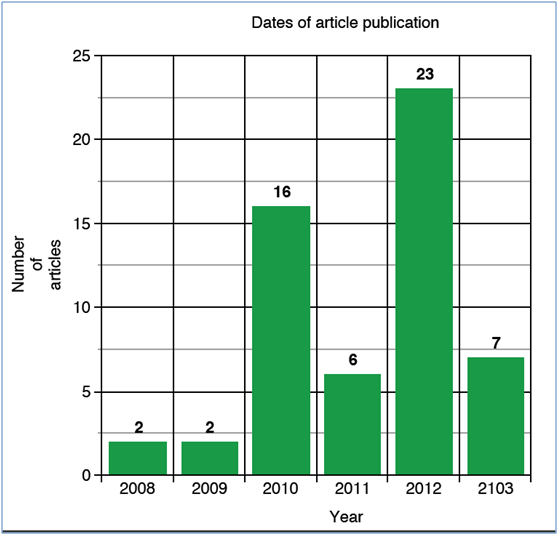
The bulk of the articles in the sample were published from 2012 onwards. This is indicative of the growing incorporation of the use of social media tools into everyday life. Already in the first two months of 2013, more articles were published (that were analysed in this study) than in the entire year 2011. The comparatively large number of articles that reported on social media and politics in 2010 is most likely attributable to the fact that the federal election was held that year. The election has commonly been referred to as the first ‘Twitter election’, due to the role social media were seen to have played in it. Bruns and Burgess have however pointed out that it was not so much the use of social media by politicians for campaigning purposes, but more the increase in engagement with political themes and discussions by the Australian public and news reporters that was noteworthy. As social media become more and more used, and as the next Australian federal election is imminent, the increase in reports on the political uses of social media in traditional media outlets is hardly surprising.
Analysis of the Data
Categories, Subthemes and Subgroups
We performed a close qualitative analysis of the 56 articles that mentioned social media and politics. From this in-depth reading we were able to identify particular themes and types of information, by which we classified the content of the articles and the way in which social media are talked about in traditional media outlets in connection to politics. We generated 19 main categories, some of which had subthemes. We grouped the 19 categories into 7 subgroups: Social media as political tools; Comparison between social media and traditional media; Nature of political discussion online; Comparison to other countries’ use of social media in politics; How/Why/For what are social media used in politics?; User groups; and Attitudes of user groups to social media. I will not list all of the categories and subcategories here, but rather proceed to discuss some of the insights we were able to draw from our analysis.
Identifying subgroups provided an insight into different aspects of the role of social media as political tools and into how this topic is portrayed in traditional media outlets. The subgroups we established reflect that some articles examine how social media themselves act as tools for political campaigning and/or engagement and/or reporting. Accordingly, different articles also report on different groups of users of social media as political tools – is it politicians using them? The general public? Journalists? And then how and for what do they use them? To engage voters? To become involved in political discussion? As a source for news reporting? Other articles are more concerned with comparing and contrasting social media and traditional media in their use as political tools – which is a more useful and/or more used medium? Again, distinctions have to be made between articles that report on different groups of users that employ these media and articles that discuss for whom these tools are useful/not useful. Some articles also draw comparisons between how social media have been used in politics in different countries, most commonly referring to the U.S. and occasionally to Britain. A further aspect explored by some articles are attitudes of different user groups (politicians, the general public, journalists, academics) to the usefulness of social media as political tools, as well as the nature of the political discussion online – is it more aggressive than offline debates? Does it trivialise political themes? Are things taken out of context and thus misrepresented?
This multifaceted array of themes indicated that there are many different aspects to be considered in understanding the role of new media in politics and their portrayal in traditional media. I’ll provide a closer look at one of the subgroups we identified, with further ones to follow in upcoming blog posts.
Subgroup: Comparison between Social Media and Traditional Media
28 out of the total 56 articles we analysed drew comparisons between social media and traditional media and made arguments about which were more useful/more used. Some articles of course portrayed multiple positions and did not always defend only one standpoint. Sometimes they reported on different opinions held by different user groups (politicians, the public, journalists, academics) rather than pushing one particular agenda.
It is interesting to note that all of the articles that suggested that traditional media were a more useful or more used political tool were published in 2010. Those that suggest that there is an interrelation between social media and traditional media in political news reporting, campaigning and engagement were largely from 2012 and 2013 (9 out of 13). Articles that suggested that social media were the more useful/used tool were a little more evenly spread across the publication years. These data have been represented in the graph below. While we have to bear in mind the uneven distribution of articles across years of publication (there were significantly more articles from 2010 and 2012 than from other years in the sample analysed in this study), we can infer that back in 2010, when social media were still less integrated into the processes of daily life, traditional media were still perceived to be more useful political tools. The increasing integration of new media into more and more aspects of our day-to-day lives is mirrored in the way in which traditional media sources report on their use in political contexts over time.

Our research theoretically permits an analysis of whether certain newspapers generally support a certain standpoint with regards to which are more useful tools in politics – social media or traditional media. While no representative results were discovered in this initial study, repeating this study on a larger scale and with a more even distribution of articles across newspapers and time periods, it may be discernible whether certain outlets have certain leanings.
So, to conclude, what we can infer from these preliminary findings is that in times of political action (such as around elections) the media report more on the use of social media as political tools (as suggested by the large number of articles represented in this study from years when federal elections were held in Australia). Social media are becoming more and more used in political practices and increasingly being perceived as either more useful than traditional media or as important interrelated tools that provide additional means of engaging with politics. It is important to note, and critically explore, these changes, not to make judgements about which medium is superior, but to gain a comprehensive understanding of the changing media landscape and how it is involved in shaping the social, cultural and political realities of our day-to-day lives. It will be interesting to see how these trends develop in light of the upcoming Australian federal election, and to compare them with the other countries involved in research projects in progress here at the CCI.
Check back for further posts on how different user groups were portrayed in the analysed articles (politicians, public, journalists), and how, why, and for what these different user groups employed social media tools for political purposes.