We’ve spent the last couple of posts looking at user activity patterns on Twitter during the days following the Christchurch earthquake. Now it’s time to shift our attention to the themes discussed by the #eqnz hashtag community – again with particular attention also to how these themes change over time.
What I’ve done here is to run the complete #eqnz data through the content analysis software WordStat to identify the most common keywords used in tweets. I’ve then picked out a number of these to graph them over time.
Let’s start with the most obvious ones (click on any of these graphs to enlarge):
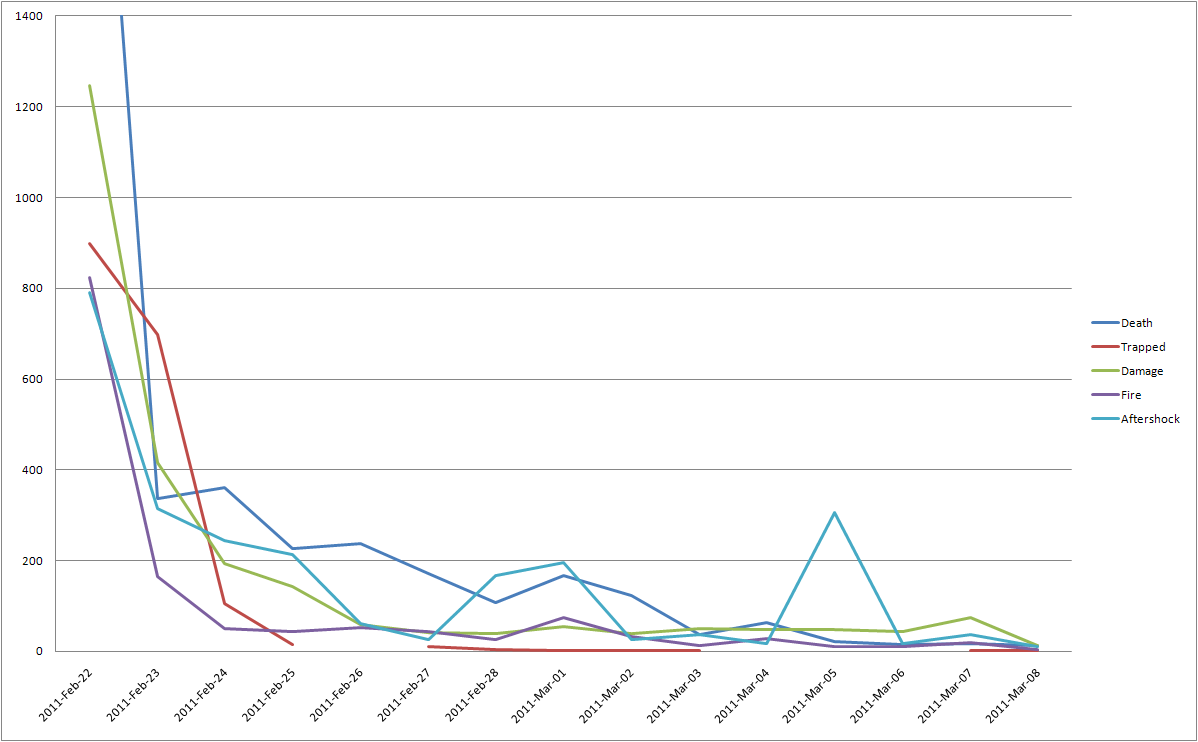
There are few surprises here: the early focus of Twitter discussion is on the human cost as well as on infrastructural damage. Notably, discussion about whether people are still trapped in collapsed buildings continues in a major way only until for the first couple of days; at that point, the question of how many lives were lost in the disaster clearly dominates. We also see how the threat of fires fails to eventuate after day one, and how major aftershocks create specific spikes in the data.
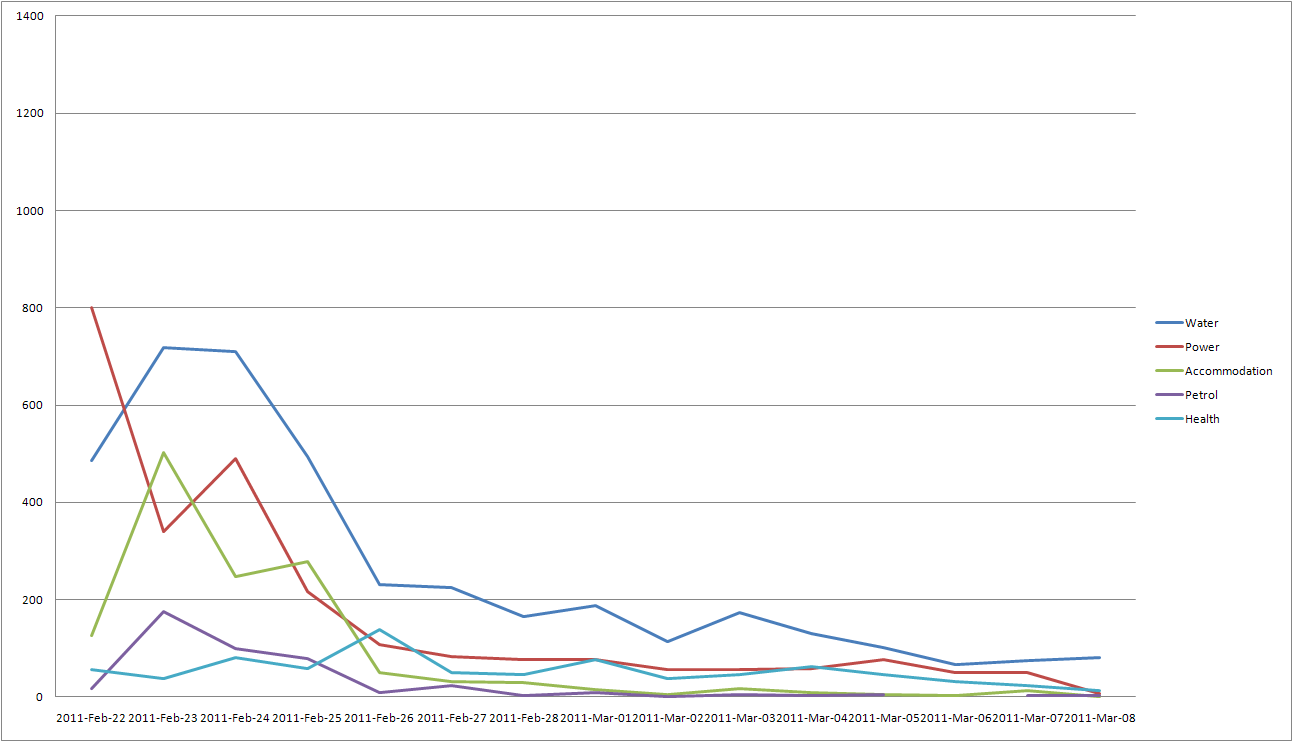
Next (and I’ve kept the scale of the graph identical, for easier comparison), some key concerns for survivors: clearly, the question of water supplies emerges as an important issue (note, though, that the presence of the keyword ‘water’ could also be due to some extent to discussion of the ground liquefaction which occurred during the earthquake – but this should be a relatively minor issue in comparison). Other issues – power, accommodation, and petrol supplies – are comparatively less mentioned, while ‘health’ as an issue seems to become comparatively more important as the focus turns from the immediate rescue effort to the longer-term plight of Christchurch residents.
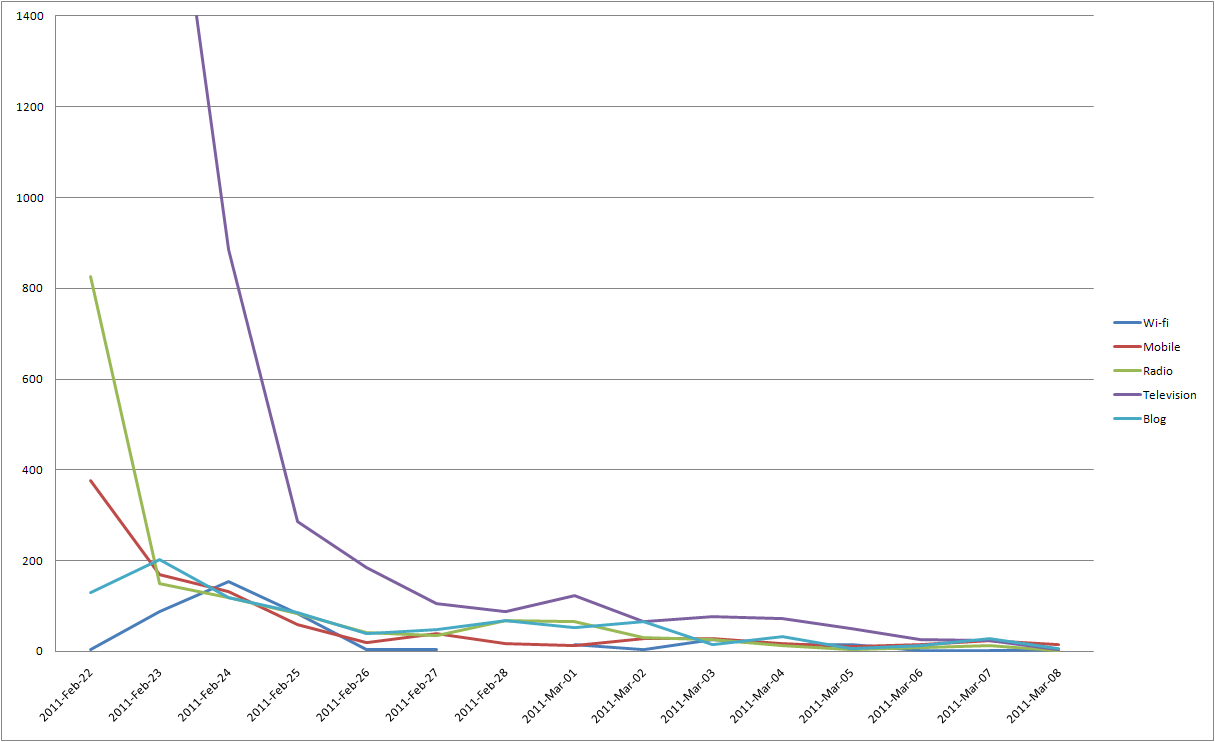
A comparison of mentions of particular media forms is also instructive – especially in the immediate aftermath, broadcast media are still clearly of great importance (but note, also, that the number of mentions of television here are inflated somewhat by the presence of @TVNZNews – with ‘TV’ in its username – as a key node in the #eqnz network, as we’ve seen in part 2). This also documents the important interconnections between Twitter and mainstream media, of course – Twitter is used, especially early on, to pass on what information users are receiving through their mainstream media channels (another sign of its ‘ambient journalism’ role).
By contrast, ‘mobile’ is mentioned most likely mainly in discussions of where in the city mobile reception is available, or how to use mobile devices without clogging the remaining network capacity, and ‘Wi-fi’ makes an appearance only for a brief while after the immediate event, perhaps as people share information about where to find connectivity. Finally, the presence of ‘blog’ is also interesting here – likely pointing to a handful of blogs tracking the disaster and providing recovery advice.
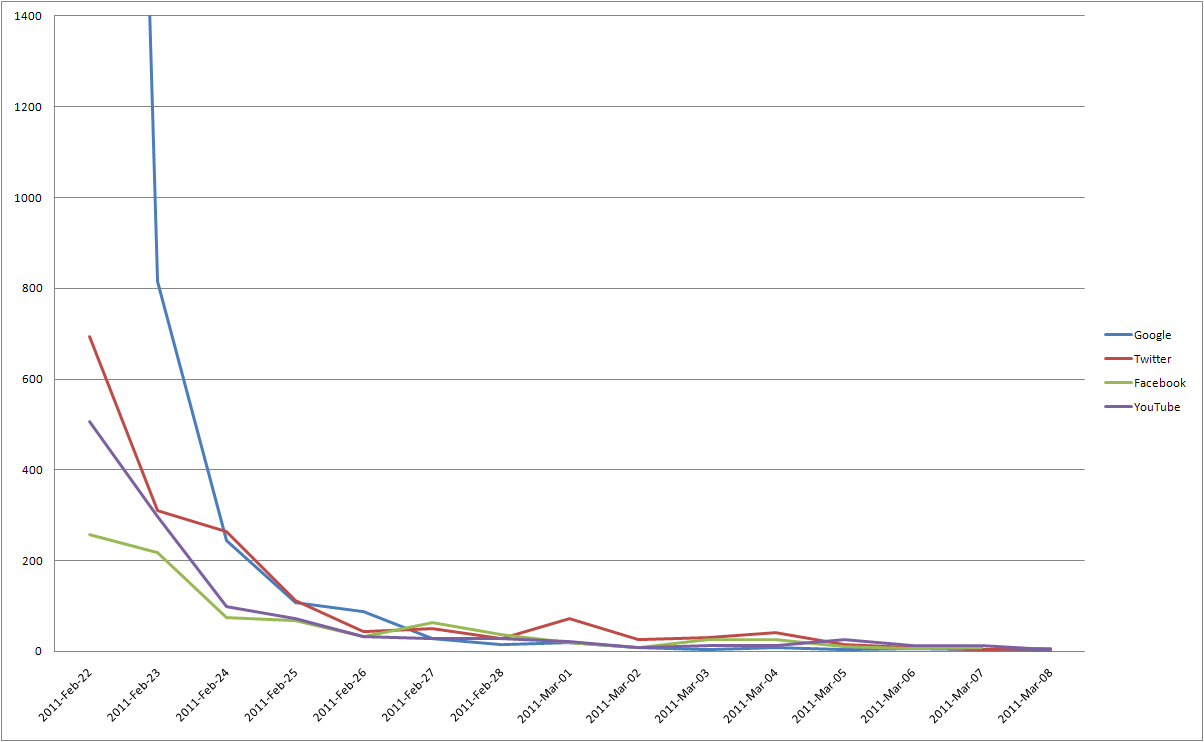
In fact, let’s have a quick look at key Internet sites: here, Google clearly dominates (most likely because of the availability of Google Maps, Google News, and other tools to track the news from Christchurch. Twitter is also very visible, indicating a certain level of self-referentiality as Twitter users point to the value of Twitter in emergencies. YouTube is present especially early on, as first videos of the disaster emerge, while Facebook seems to be far less important; this may be due to the fact that its strongly social network-focussed structure lends itself less well to the coverage of breaking news than Twitter, where communication between total strangers can be very easily and effectively organised through the use of #hashtags.
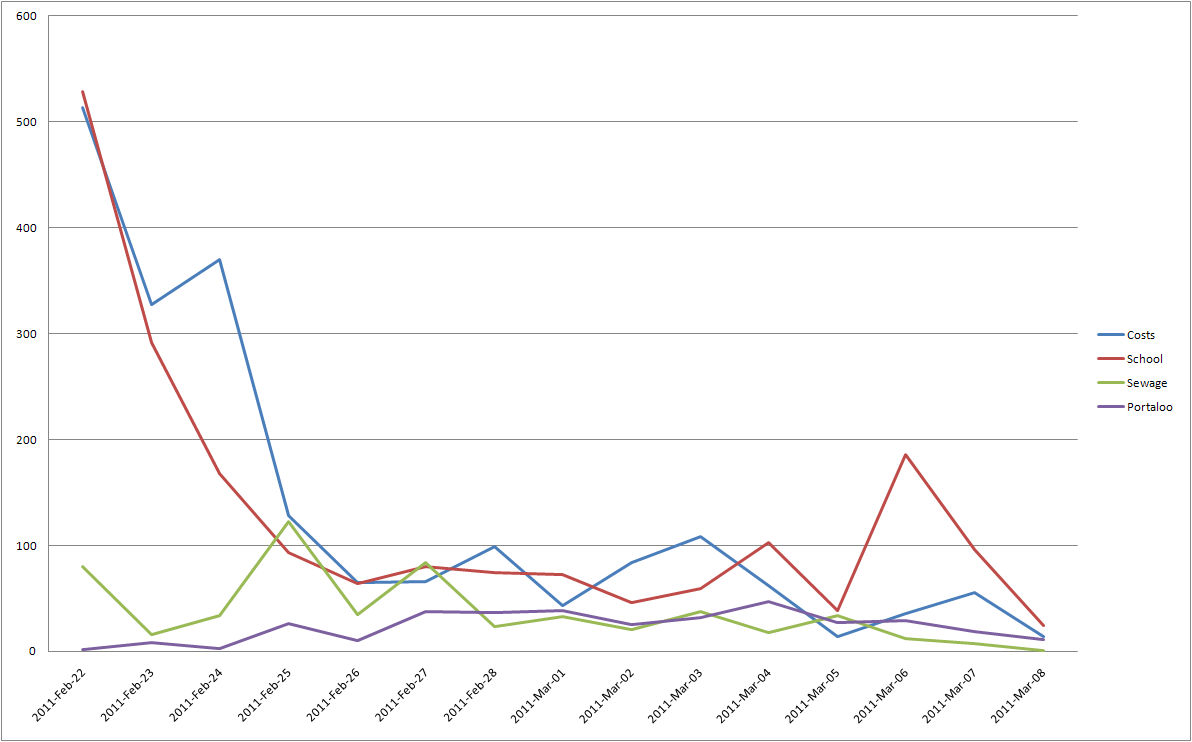
But back to the aftermath – and for the graph immediately above I have changed the scale, as we’re now dealing with much smaller numbers: here are the trends for the longer-term concerns. It’s notable that issues around sewage processing aren’t yet going away, and that the shortage of portable toilets (portaloos) is in fact becoming more important during the week after the disaster, as residents work out how to get by in a city with severely compromised infrastructure. Also, discussion of schools spikes again towards the end of the period we’re looking at here, as Christchurch kids return to some degree of normality. And of course, the economic impact of the disaster will remain a topic of discussion for some time to come.
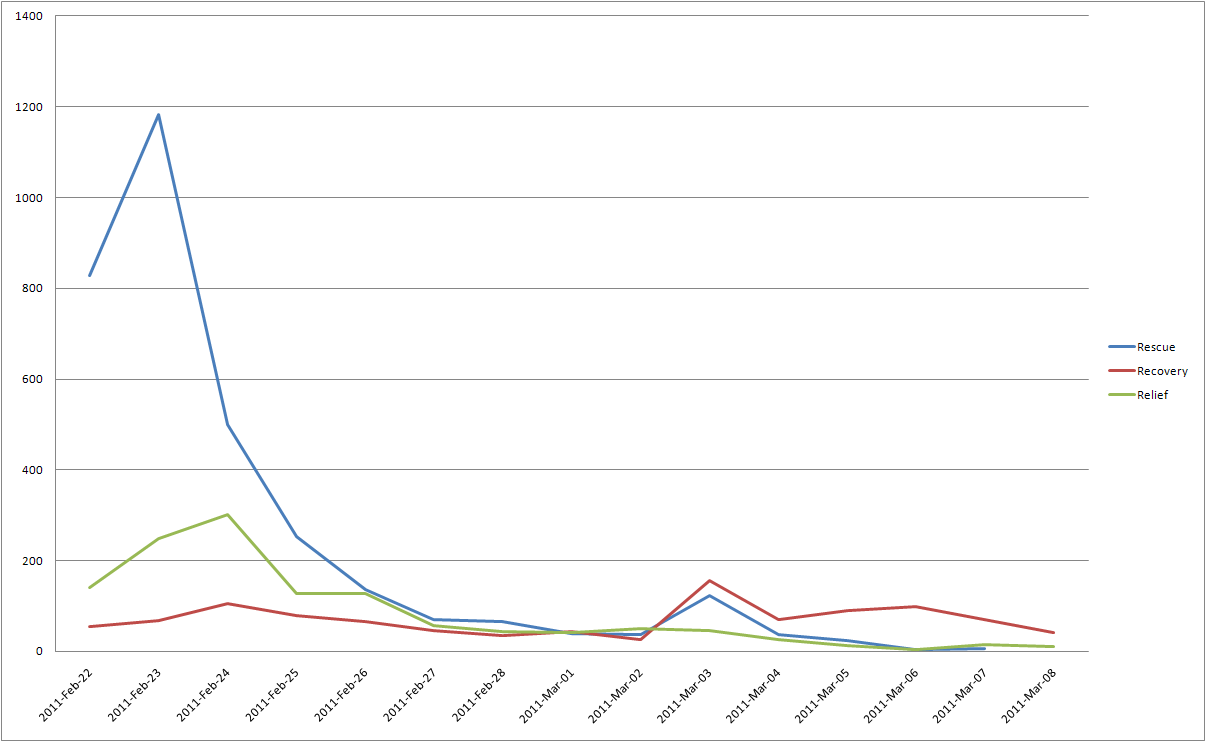
Finally (and back to the larger scale), a more general observation – I think #eqnz’s shift in focus over time can also be tracked in the presence of three broader keywords: ‘rescue’, ‘relief’, and ‘recovery’. The early focus on Twitter is obviously, and unsurprisingly, on discussing the continuing rescue efforts, but as these wind up, relief and (especially) recovery become notably more prominent. This, to me, seems to indicate an overall shift in priorities, as the Christchurch community turns its attention to the long-term task of rebuilding the city.
In closing, a final note of caution: based as they are on simply keyword counts, these observations are necessarily preliminary – a closer look at the contents of tweets would be necessary to fully document how #eqnz was used to document the disaster and organise responses. However, they nonetheless provide a useful – and immediate – glimpse of themes and attitudes within the #eqnz community, and a valuable basis for comparisons with other major events.
Also, a note on how data for these graphs were generated: in each case, data on the specific keywords are based on keyword searches through the entire dataset of tweets. The search expressions used were: (death|fatalit) for ‘Death’, (money|million|billion|cost) for ‘Costs’, youtu for ‘YouTube’, (tv|television) for ‘Television’, wifi for ‘Wi-fi’, and the keywords themselves in all other cases.
Comments are closed.