Earlier this week I posted the first of our analyses of how the Australian federal election campaign is unfolding on Twitter, based on our observation of the tweets from and @mentions of a large number of members’ and candidates’ accounts since 1 July. As an addendum to this post, and covering the same timeframe from 1 July to 11 Aug., here is an overview of the patterns of interaction between the politicians’ accounts and the regular users tweeting at them, illustrated by four network graphs.
We begin with the least surprising observation: in general, most of the Twitter activity is about Kevin Rudd and Tony Abbott. When we simply examine the overall data, containing all the retweets and @mentions of the politicians’ accounts as well as their own tweets, what results is a largely featureless network graph with @KRuddMP and @TonyAbbottMHR in the middle. In the graph below, I’ve included all users who tweeted at or received tweets from the politicians’ accounts at least ten times since 1 July (i.e. degree = 10 or more), and the size of each node represents the volume of @mentions it has received (i.e. its indegree). Click on the graph for a larger version, as usual.
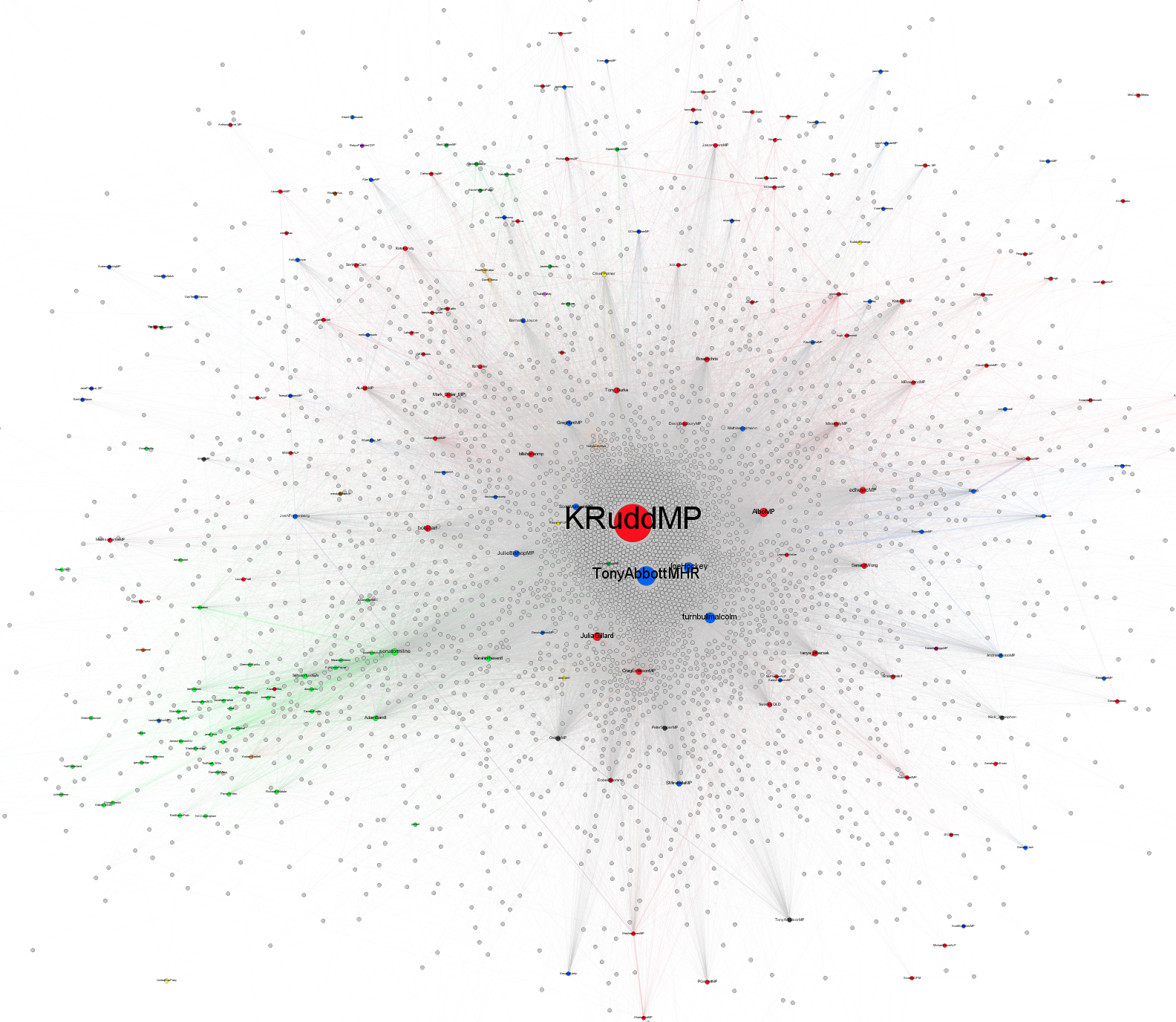
In itself, there’s nothing much to see here yet. We already know from our previous analysis that Rudd receives more @mentions than Abbott, almost by a factor of two, and that together the two party leaders are substantially more often the target of @mentions than any other Australian politician. What’s also evident from the graph above is that – as far as mere @mentioning (including genuine @replies as well as retweets) is concerned – there is no indication of any political partisanship here. Labor, Liberal, and minor party supporters, it appears, are as prepared to @mention the politicians they support as they are to @mention those they oppose. This also reinforces the observation that the volume of @mentions a politician receives on Twitter should not be mistaken for a measure of popularity or approval, then.
However, once we focus on retweets, the situation changes markedly. In the graph below, I’ve filtered out any connection between two users which didn’t consist at least to 50% of retweets – in other words, if user xyz @mentioned user abc ten times, and five of those @mentions were retweets (verbatim or with added commentary), then we retained the connection from xyz to abc; if only four of the ten @mentions were retweets, then we removed the connection. The network which remains now shows much more distinctive features (member and candidate accounts are coloured in their party colours; regular users are shown in grey in this network map):

What emerges is a much better map of political allegiances: the candidate accounts are drawn together here both if they frequently retweet each other, and if a substantial number of everyday users the messages from retweet several such accounts. In other words, much of what we see here is how the Twitter public perceives the parties: Labor and the Greens are more closely connected, with a much bigger gap between Labor and the Coalition parties (Liberals in blue, LNP in a darker blue, and Nationals in dark Green).
Such connections can also be critical, however: the fact that Labor and the Greens are placed close together on the map above also results from the fact that many Twitter users who support, say, the Greens’ stance on asylum seeker policy (by retweeting Greens messages) comment critically on Labor’s policies (by retweeting Labor messages with added commentary). For the same reason, Opposition Immigration spokesman Scott Morrison is located closer to the Labor cluster: both Labor and Greens supporters will retweet Morrison’s messages while adding their own critical views in doing so.
Rudd, Abbott, and many other prominent politicians, on the other hand, are placed somewhat on the outskirts of this map: because they are generally @mentioned so often, they have comparatively few connections in the network which consist predominantly of retweets. Given the filter we have applied to create this map, therefore, they are comparatively poorly connected to the centre of the map above, therefore.
The two maps above are useful for exploring the networks of interaction around the politicians in the overall Australian Twittersphere. However, it’s also worth examining how the candidates interact only amongst themselves. Removing everyday Twitter users from the picture, then, the following graph shows the @mentions (including @replies and retweets) between the member and candidate accounts only:
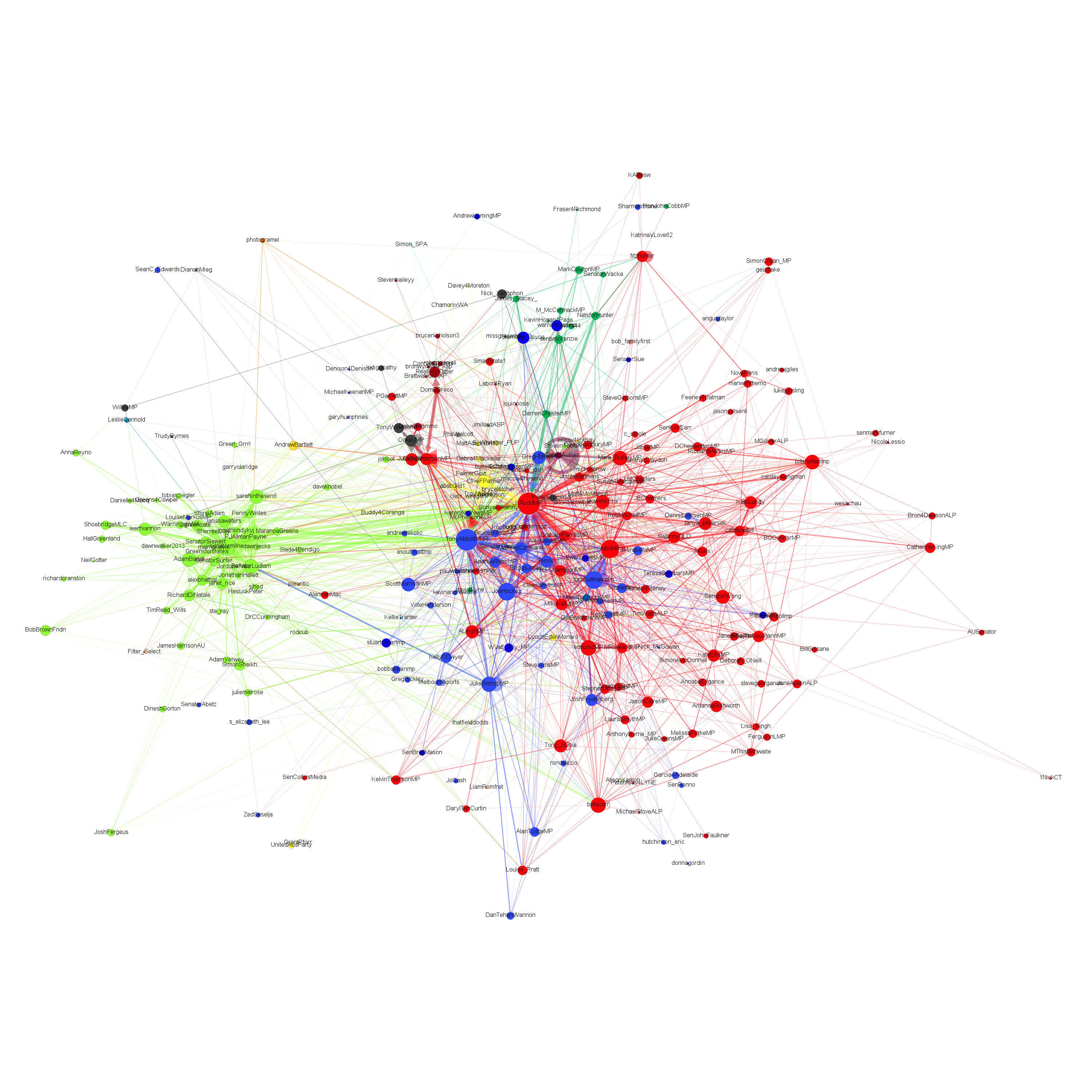
Again, this presents a markedly different picture from the graphs above. First, it demonstrates a considerably higher level of activity on the Labor than on the Liberal side – there are more Labor accounts with significant levels of activity, and they appear to be more active in supporting each other through @mentioning. This is consistent with the suggestion that the Coalition continues to pursue a comparative ‘small target’ strategy in its social media activities.
However, the core Labor and Liberal accounts do appear to engage quite readily with each other – questioning each other’s policies and otherwise challenging each other’s statements. Interestingly, both leaders remain somewhat above the fray in this: there are few direct @mentions between Kevin Rudd and Tony Abbott, and the direct @mentions (and thus, attacks) are left to the second and third tiers of candidates – Deputy PM Anthony Albanese (@AlboMP) is locked in a long-term argument with Opposition Broadband spokesman Malcolm Turnbull (@turnbullmalcolm) over the respective qualities of the two parties’ national broadband network solutions, for example, and Opposition climate change spokesman Greg Hunt frequently @mentions Kevin Rudd while Labor Minister for Defence Materiel Mike Kelly does the same with Tony Abbott.
The minor parties pursue different strategies yet again. The Greens accounts are in the first place strongly supportive of each other through frequent mentions, while directing most of their cross-party attention to the two leaders’ accounts; the Katter Party candidate form their own tight-knit group, and only one of them appears to have picked a fight with a Labor MP; the Nationals are surprisingly distant from their Liberal partners in the federal Coalition, and of their opponents mainly engage with Kevin Rudd himself; Clive Palmer’s United Australia Party candidates are much closer to the action, but again focus their cross-party attacks mainly on Rudd and Abbott. Only the sole substantially active account from the climate change denialist Climate Sceptics Party, @NoDirectAction, is targetting its attacks more specifically, tweeting frequently at Minister for Climate Change Mark Butler and Opposition spokesman Greg Hunt (in addition to frequently retweeting messages directed to its own account, resulting in the self-referential loop around the account in the graph above.
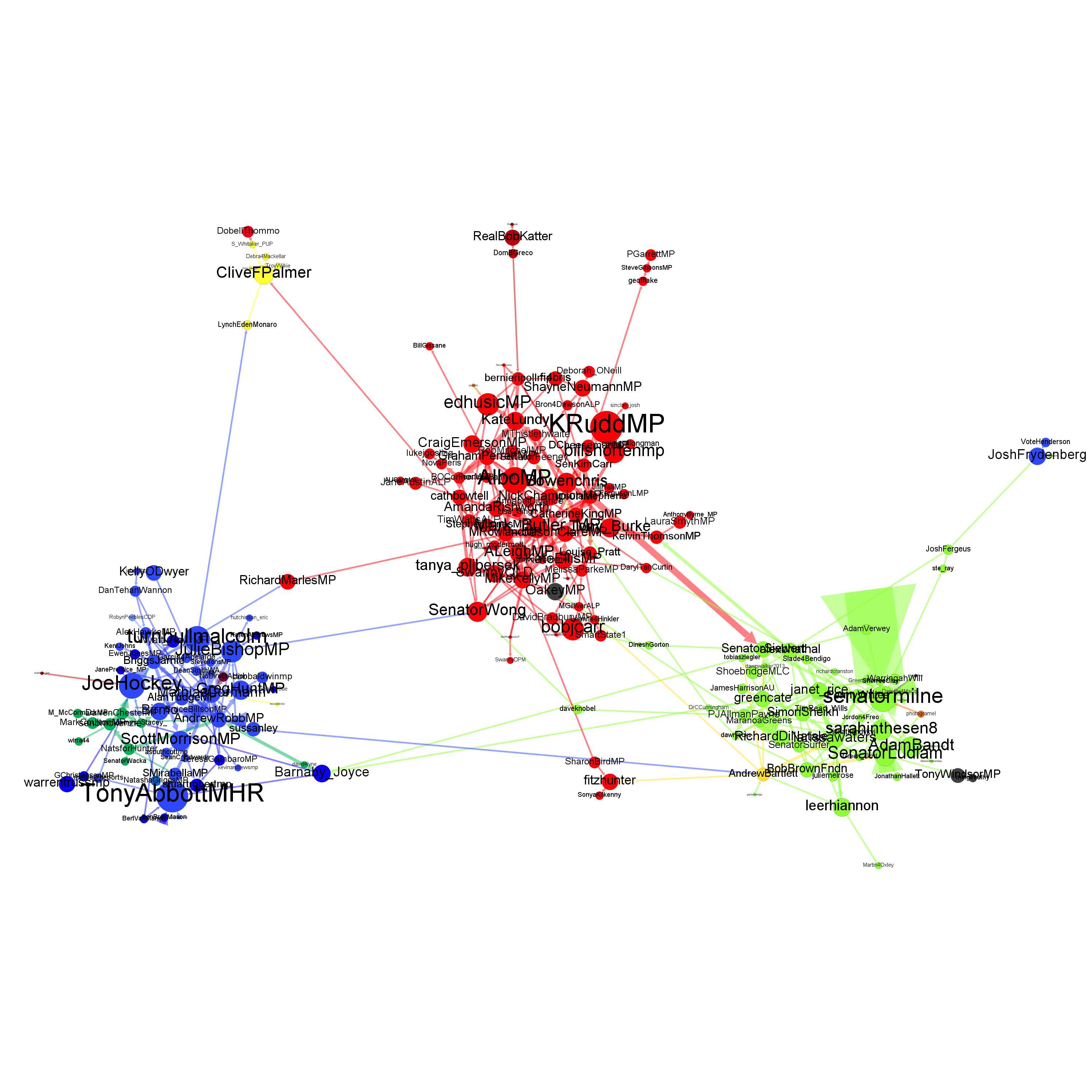
But when we focus mainly on the retweets (using the same criterion as above), the network changes once again. Now, the major (and minor) divisions between the parties are clearly revealed, and very few retweet connections cross the party lines; other than in the Coalition, where Liberal, National, and LNP candidates do fairly frequently retweet each other, that favour is otherwise largely reserved for party colleagues. A handful of exceptions do remain, however, most likely again due to retweets which add critical commentary in the process of retweeting:
So much for now. Over the course of the campaign, we’ll try to return to these graphs again, to see whether they pick up any changes in campaign strategy (or transgressions by candidates goaded into an all-out Twitter war)…