
With the Australian federal election finally underway since the official announcement on 4 August, we’re once again tracking the performance the current members of parliament, election candidates, and their parties on Twitter. Over the coming weeks, we’ll try to post regular updates on how the social media campaign is unfolding, and on Monday night I already posted a quick analysis of the controversy over Tony Abbott’s fake followers (which some mainstream media outlets have covered, somewhat implausibly, under the headline “Rudd Admits Spam Twitter Followers”).
I spoke to ABC News 24’s News Exchange programme about the fake follower incident on Tuesday night (starts at around 4:30 into the video).
Here, though, is the first major update on the Twitter campaign. For this, similar to what we did in the 2012 Queensland state election, we’re tracking all tweets from and @mentions of all the candidate accounts we have been able to find so far (and electoral rolls haven’t closed just yet, of course, so there may be some more to come). We’re tracking all major party candidates who are known to be on Twitter, but I should note that we may be missing some accounts from (very) minor party candidates who haven’t made public the fact that they have a Twitter presence. This should not influence the following analysis overly much, however.
Let’s begin with the headline figures. Tracking these accounts since 1 July, we’ve seen Prime Minister Kevin Rudd @mentioned substantially more often than Opposition Leader Tony Abbott, almost by a factor of two; this has been the case especially during the long wait for an election date in the latter weeks of July, perhaps also because of the significant number of new policy announcements Rudd made during that time. The following graph shows their cumulative @mentions since 1 July; both leaders are also well ahead of the other eight most @mentioned Australian politicians during that time, a group which includes former PM Julia Gillard, former OL Malcolm Turnbull, Greens Leader Christine Milne, and various frontbenchers from either side of politics.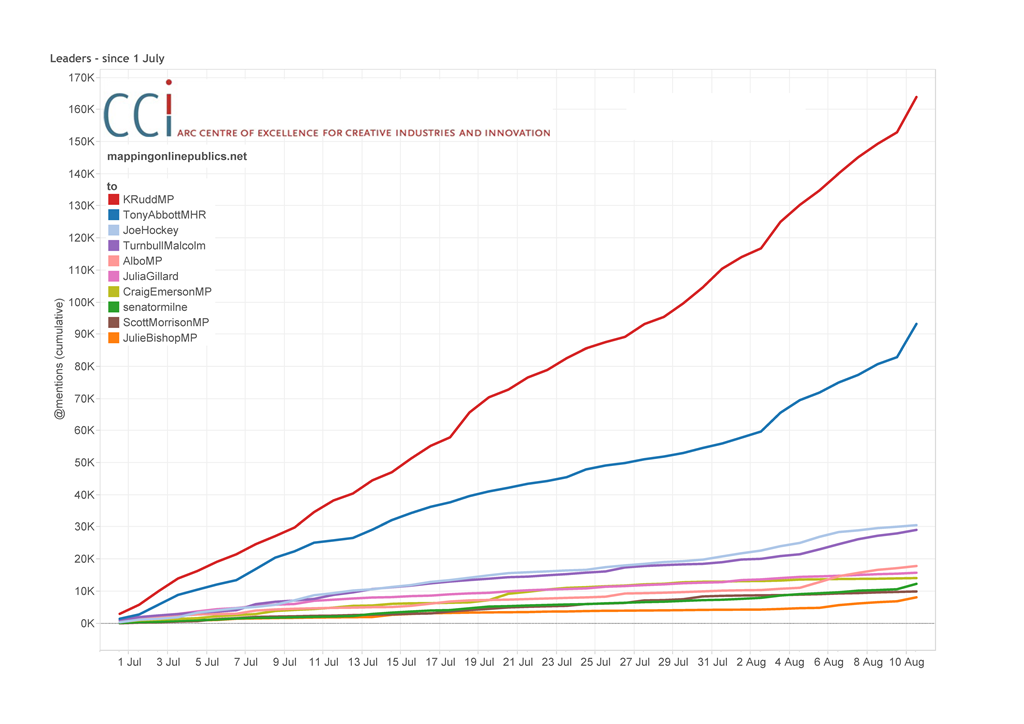
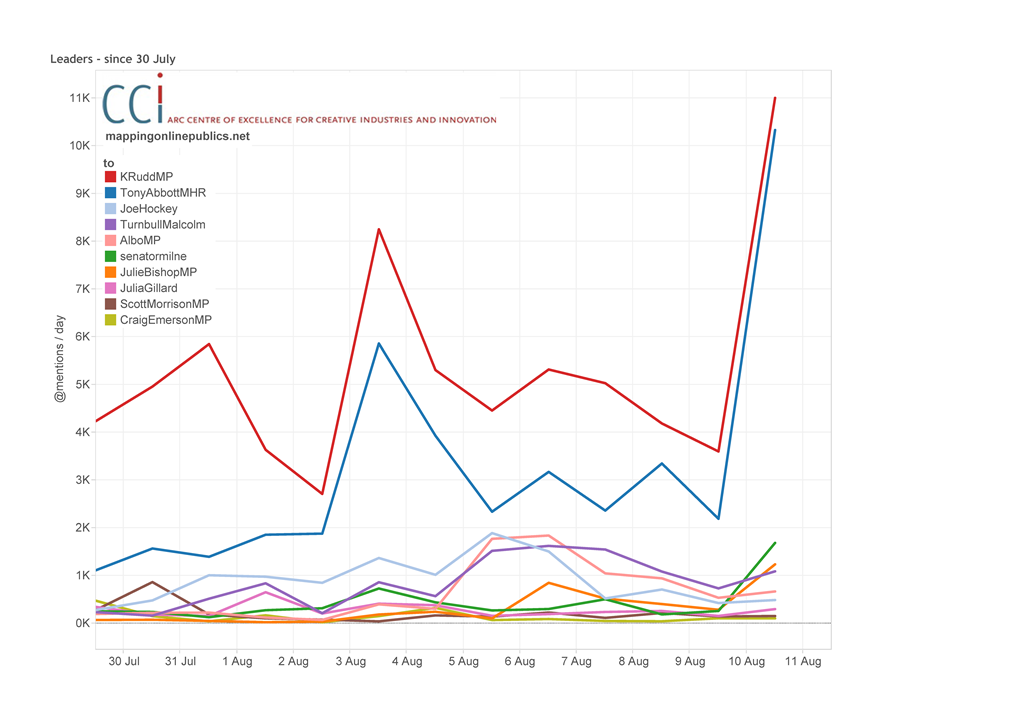
The past few days have seen Rudd and Abbott somewhat more closely aligned. Both leaders’ @mentions spike on 4 August, as the election is called, and of course on 11 August as a result of the first televised leaders’ debate. Rudd still manages to attract some 2,000-odd more @mentions per day on many of the days in between, however, so a certain advantage remains; this may be due to the power of incumbency, to the substantially larger follower base his account has accumulated (even if we don’t count spam and fake followers for either leader’s Twitter account), and to the highly personalised ‘Kevin 24/7’ campaign strategy which once again seems to be at the heart of the Labor campaign. Interestingly, some of the other prominent politicians appear to be @mentioned somewhat counter-cyclical: Hockey’s, Albanese’s, and Turnbull’s numbers all rise on the days after the election announcement while Rudd’s and Abbott’s fall.
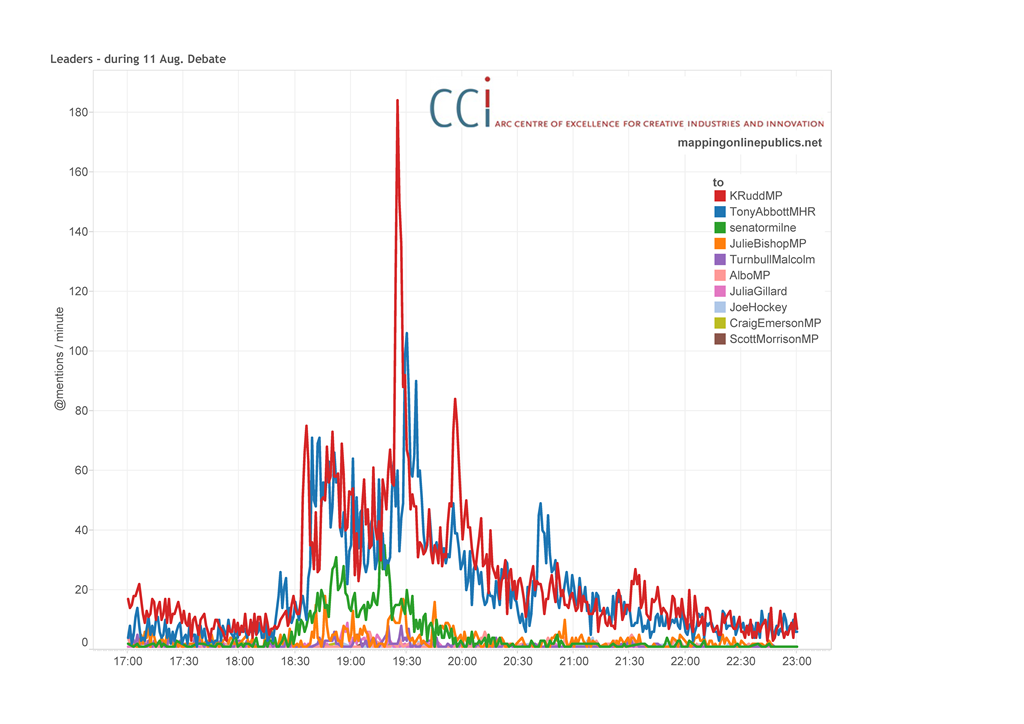
We’ll probably end up doing a separate post about the performance of the leaders’ accounts during last Sunday’s debate in a few days, but for now, here’s a graph of the minute-by-minute @mentions of the leading accounts over the course of the debate. For the most part, both are neck and neck, although it is also obvious that Rudd’s @mentions per minute spike a great deal higher than Abbott’s. This should not be translated immediately into “Rudd won the debate”, of course – @mentions may be used to express disapproval as much as support, after all. Also of note is the notable rise in mentions of Greens leader Christine Milne during the debate – time to change the format and include some of the minor parties in the debate, perhaps?
But in addition to the leaders themselves, of course we’re tracking all the candidates’ accounts that we know of. This also makes it possible for us to aggregate Twitter activity around those profiles by party and by state. Here, the sheer volume of @mentions of Rudd and Abbott clearly puts ALP and Liberals well ahead of all other parties, and the ALP well ahead of the Liberals due to Rudd’s higher numbers: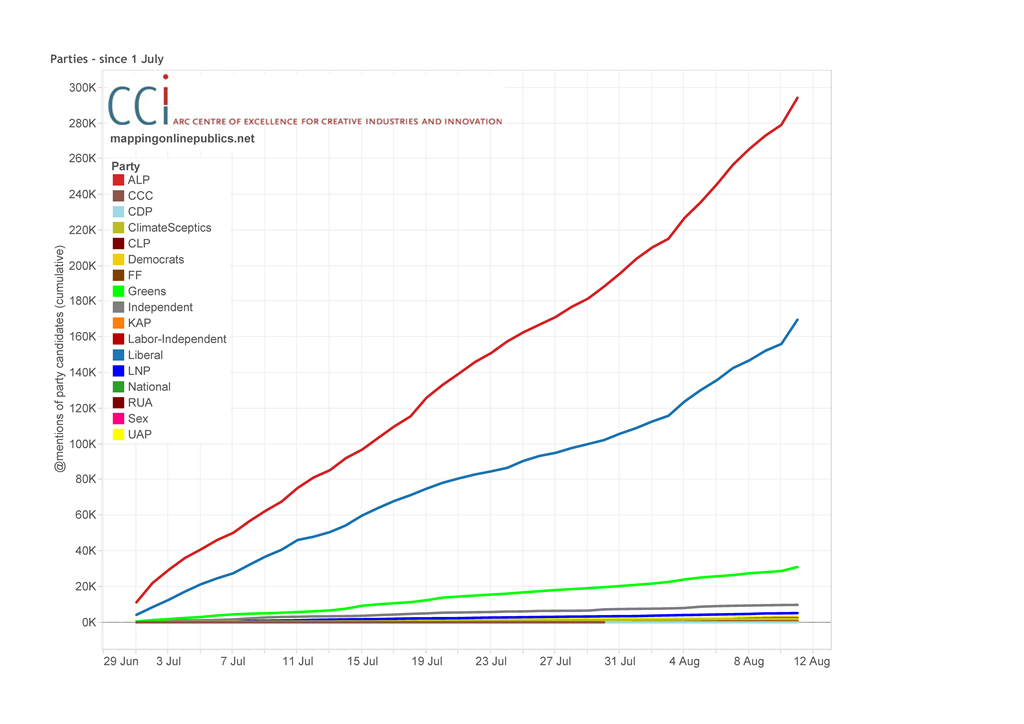
That gap narrows somewhat once those two leaders are removed from the equation – the following graph shows the cumulative volume of @mentions for all accounts except for @KRuddMP and @TonyAbbottMHR, and thereby better represents what happens outside the presidential-style part of the campaign:
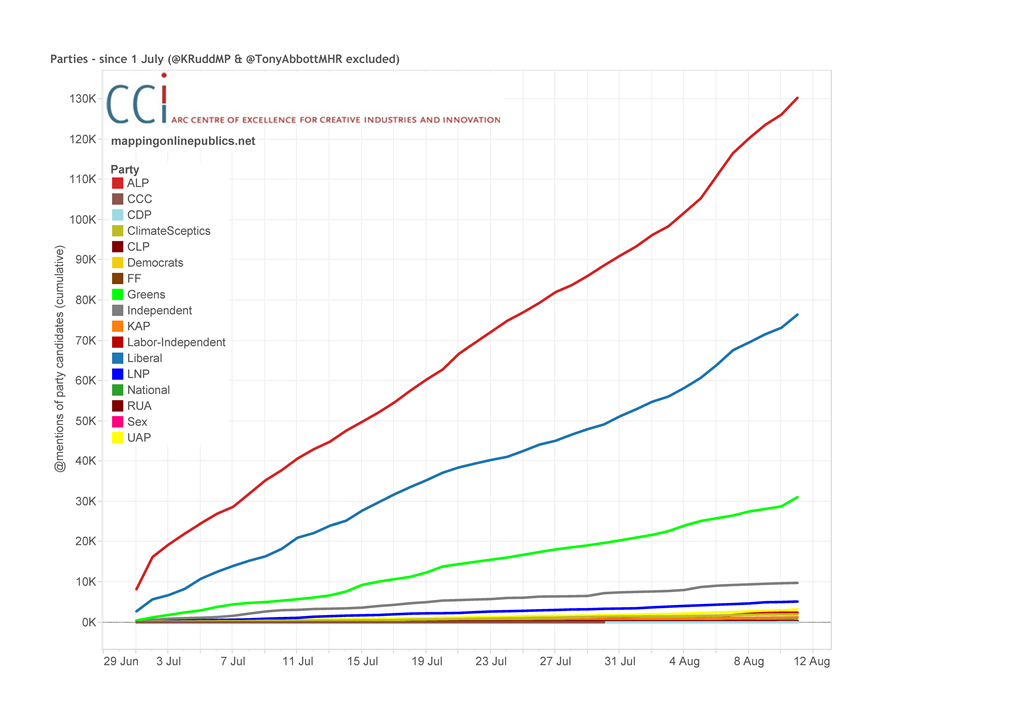
Despite the greater prominence of Coalition frontbenchers amongst the most frequently @mentioned Twitter users which we have seen in the first graphs above, then, on aggregate ALP candidates still appear to be @mentioned substantially more than their Coalition counterparts. This may reflect the aftereffects of what has long been a small target strategy as far as the social media use of Coalition rank-and-file candidates was concerned; except for a handful of frontbenchers, they’re not very prominent on Twitter and therefore don’t receive many mentions.
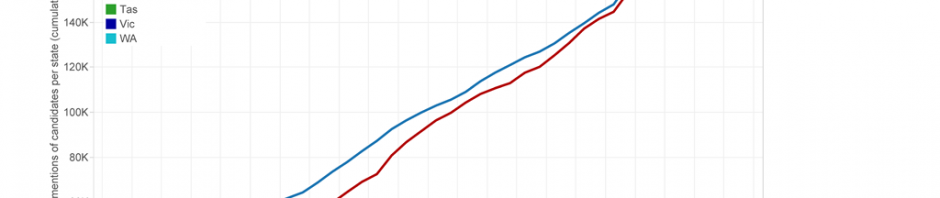
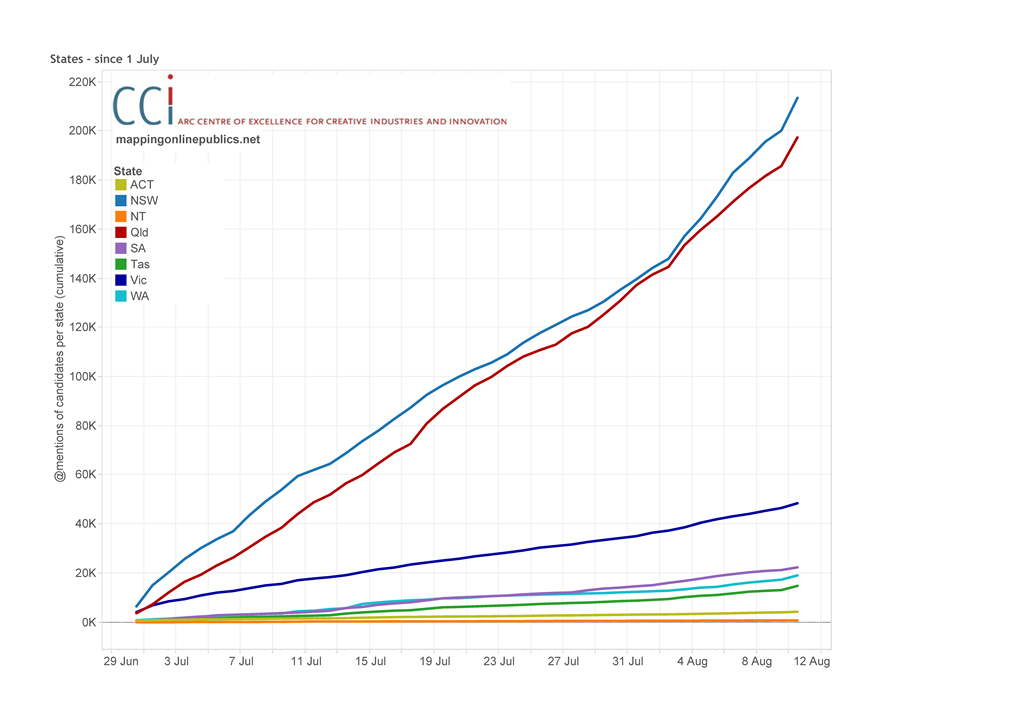
The story for the states is similar. Here, because of the location of Rudd’s (Griffith, Queensland) and Abbott’s (Warringah, NSW) electorates Queensland and New South Wales are well ahead any other state; because of the greater number of prominent other politicians from NSW, that state is just slightly ahead of Queensland (though I doubt that this is much of a consolation for eight years of Origin defeats…).
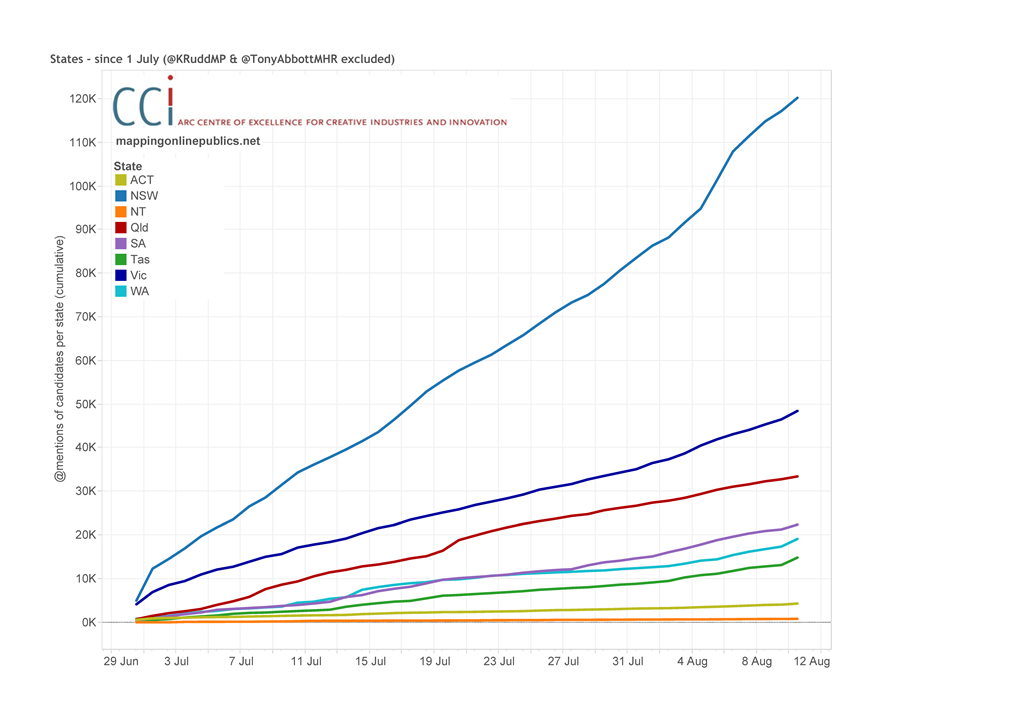
If we remove Rudd and Abbott from the picture once again, though, it changes considerably. New South Wales politicians’ accounts remain widely tweeted about, while Queensland drops way back – a very drastic illustration of the fact that, Bob Katter, Clive Palmer and (now) Peter Beattie notwithstanding, Rudd remains the only truly prominent tweeting federal politician in the Sunshine State. Similarly, it also shows the considerable influence that NSW politicians continue to wield on both sides of the political divide – and with Queensland out of the picture, Victoria assumes second place even though the removal of Julia Gillard has considerably reduced the prominence of its politicians.
So much for a first, quick, analysis of overall tweeting patterns around the candidates, then. In the next few updates, I’m aiming to look more closely at which electorates are seeing a lot of Twitter activity, how the candidates themselves are tweeting, what networks of interaction emerge between and around them, and what themes are notable in the content of the tweets. Stay tuned!