Following on from our look at Twitter activity during the Australian leaders’ debate and Masterchef broadcasts, here’s an overview of the patterns we can see in the content of the tweets themselves. For this, I’ve grabbed all tweets containing the ‘#debate’ hashtag during 5 p.m. and midnight on Sunday (during which time, as we have seen, ‘#debate’ as more active than the general ‘#ausvotes’ tag for the election’).
In the first place, I’ve now selected all 2553 tweets containing either ‘Julia’ or ‘Gillard’, and created a simple word cloud using Wordle – manually removing ‘Julia’ and ‘Gillard’ (and variations thereof) as terms, as well as ‘debate’, ‘ausvotes’, and ‘RT’. Here’s the result:
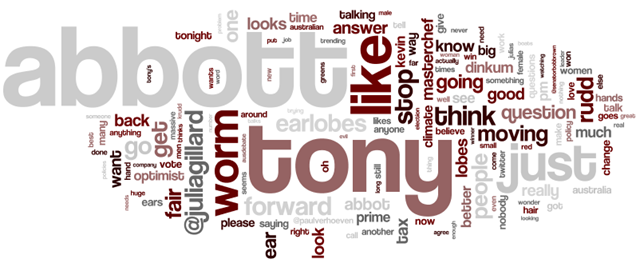
Notably, then, there are quite a few tweets which mention both Gillard and Abbott in the same tweet – but we should not overestimate this: of the 2553 tweets, only 372 Gillard tweets use ‘Abbott’, and 320 use ‘Tony’, with overlap possible between the two groups. Given those numbers, in other words, the vast majority of Gillard tweets refer to Gillard alone. We also shouldn’t get too excited about terms like ‘just’ and ‘like’ – while they could conceivably have been used in the sense of ‘I like Julia because she is just‘, it’s much more likely that they’re used here in more mundane contexts that don’t tell us much about how Gillard is perceived by the tweeter.
More notably are some other prominent terms: the worm – for non-Australian readers, an on-screen means of tracking the responses of a test audience to the two leaders’ performances – makes an appearance (141 mentions), as does the much-overused Labor campaign slogan ‘moving forward’ (79 and 88 mentions for each word, respectively).
But here, we’re already entering the lower reaches of the word frequency scale. Kevin Rudd, for example – the previous Labor Prime Minister, whom Julia Gillard deposed just over a month ago – does not appear particularly prominently. ‘Kevin’ gets 49 mentions, ‘Rudd’ 68, but even this is nearly overshadowed by a persistent side conversation over the size of Gillard’s earlobes (68 mentions for ‘ear’, 61 for ‘earlobes’)!
Actual political themes are largely conspicuous by their absence. ‘Stop’ (94 mentions) and ‘people’ (73) could refer to the debate about stopping the unauthorised arrival of asylum seekers, but ‘boat’ or ‘boats’ only get a combined 28 mentions, and ‘asylum’ only 10. ‘Tax’ appears 56 times, ‘climate’ 45 – there simply isn’t a central theme in the tweets that refer to the Prime Minister, and this may be emblematic for the debate (and the election campaign?) itself.
One final point of interest is that 83 tweets include Gillard’s Twitter account, @juliagillard – this, perhaps, was the only real victory for either candidate on the night: only 30 tweets were directed at @tonyabbottmhr…
Turning, then, to the tweets which mention ‘Tony’ or ‘Abbott’: with Abbott’s name as well as the other obvious terms removed, we get the following word cloud. Again, Abbott shares the spotlight with Julia Gillard only for a moderate fraction of all of his 3039 tweets: 353 tweets containing ‘Tony’ or ‘Abbott’ also include ‘Gillard’, 333 include ‘Julia’.
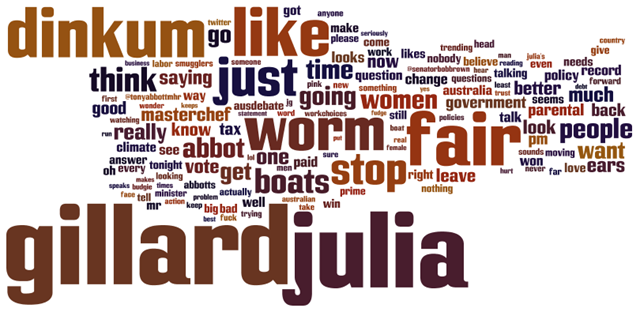
Here, too, ‘just’ and ‘like’ rank highly, and again nothing much should be read into this. The worm gets 199 mentions, but the most notable catchphrase of the night which was largely identified with Abbott was ‘fair dinkum’ (252/192 mentions for each word – the numbers for Gillard are 79/46). That’s not to suggest that Twitter users necessarily thought Abbott was ‘fair dinkum’ as a politician, of course; many of them also joked about Abbott’s repeated use of a relatively meaningless phrase, with greater frequency than Gillard used her own ‘moving forward’ on Sunday.
Abbott’s own predecessor, Malcolm Turnbull, was even more absent from the debate than Kevin Rudd (13 mentions of ‘Malcolm’, 11 of ‘Turnbull’), reflecting perhaps the longer period of time that has passed since Turnbull’s demise as opposition leader. Similar to the Prime Minister, though, Abbott’s personal attributes also didn’t escape mention: perhaps highlighting his perceived deficit with female voters, the term ‘women’ appeared some 85 times, and his sizeable ears, too, were addressed in 62 tweets.
And again, real policy themes took a backseat in Twitter commentary, though not as much as in tweets referring to Julia Gillard: ‘boats’ were mentioned some 93 times, perhaps indicating how this theme is more closely associated with Coalition policy (though we should note that mere mention does not imply approval or disapproval, of course); ‘tax’ appeared 56 times; and Abbott’s promise of a paid parental leave scheme featured just as often (57 mentions each of ‘parental’ and ‘leave’). ‘Climate’ received 44 mentions.
What are we to make of all this, then? Perhaps the immediate observation is that just as this was a relatively tame, uneventful debate, so the Twitter stream remained fairly non-descript. Neither leader managed to generate a large amount of excitement, and sideline issues from the performance of the worm to the size of the respective leaders’ ears stole part of the show (or at least alleviated some of the boredom).
Abbott did manage to generate moderately more tweets that mention him by name (3039 compared to Gillard’s 2553), and very slightly more discussion related to actual policies – on asylum seekers and parental leave -, so perhaps comes out in front here, by an earlobe, but of course the Twitterati’s discussion of coalition policy does not imply their approval.
Finally, a quick overview over the whole 15608 ‘#debate’ tweets between 5 p.m. and midnight (with the leaders’ names and the main hashtags removed):
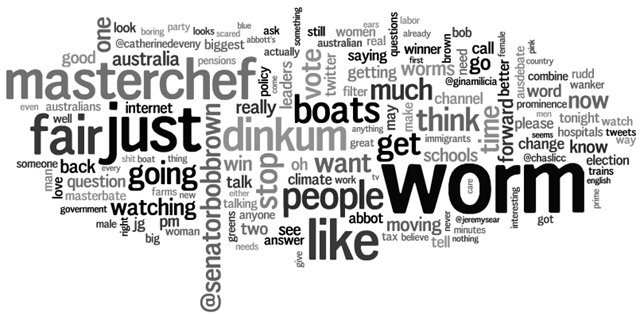
Clearly, the night’s winner is the worm (1262 mentions, plus 309 for ‘worms’), followed by Masterchef (655 mentions of ‘#masterchef’, plus 165 of ‘Masterchef’). ‘Fair dinkum’ won out over ‘moving forward’ (820/577 mentions vs. 293/277), and the only half-way visible policy issue was the question of how to ‘stop’ the ‘boats’ (448 and 456 mentions, respectively – much further down the list, we also find 228 mentions of ‘climate’, 183 of ‘hospitals’, and 167 of ‘tax’). And the proposed Internet filter, that great cause célèbre on Twitter? It, too, rated only 195 mentions (little more than 1% of all tweets).
More interestingly, though – and probably a sign of an election during which both major parties are playing a ‘small target’ strategy and are virtually refusing to release concrete policy -, 408 tweets specifically address the Greens leader @senatorbobbrown (though it should be noted that quite a few of these are retweets of Brown’s own tweets during the debate).
We’ll keep tracking the ‘#ausvotes’ hashtag over the weeks towards the election, of course. Barring any major crises, though, this is shaping up to be one of Australia’s less exciting election campaigns, if Twitter is any guide…
Comments are closed.