Well. Another week of the Australian federal election campaign has just, um, flown by – time, then, to take another look at how things played out on Twitter. I’ve taken slightly different approaches for my various updates so far, and this week we’ll look at yet another aspect of the social media campaign: the different parties’ attempts to encourage their supporters to retweet their messages.
But first, another look at the headline figures – and just as a reminder, as I’ve explained in the previous posts, what we’re doing in our election research is to track all tweets by and @mentions of sitting members and candidates in the 2013 federal election. As more (especially minor party) candidates have become known, we’ve progressively extended our list as far as possible.
Based on this approach, last week we saw a substantial shift in attention towards Opposition Leader Tony Abbott: over the course of the week, he was @mentioned more than 4,000 times more often than his opponent, Prime Minister Kevin Rudd. This week, the pendulum has swung back in Rudd’s favour, by almost exactly the same margin. Here are the leading politicians’ @mentions over the three weeks since the election was called on 4 August – Rudd leads Abbott in @mentions on every day except for Sunday (the day of the Coalition’s official campaign ‘launch’):
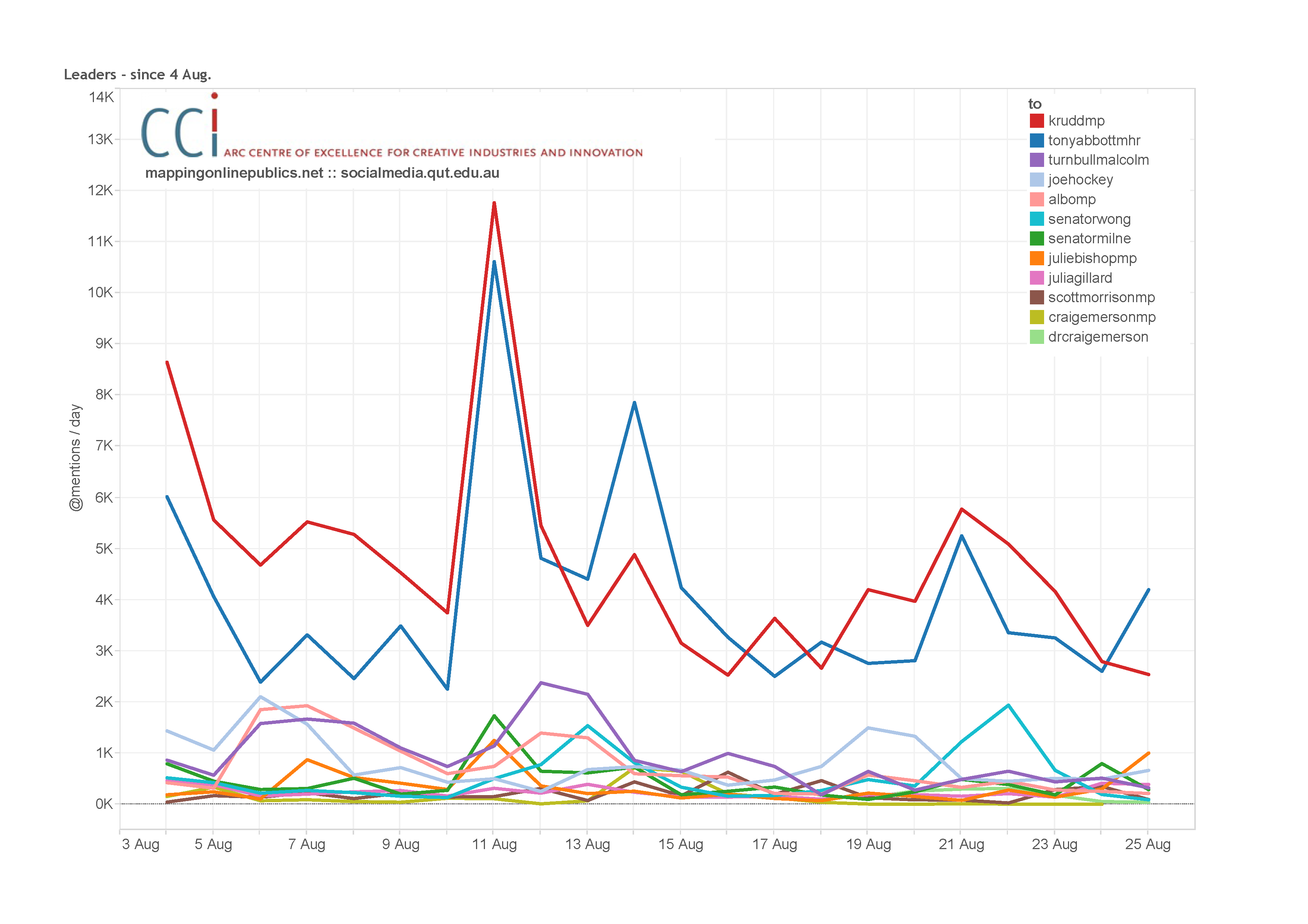
It’s tempting to draw the parallels between these ups and downs and the movement of the latest polls, which have also generated some more positive news for Rudd (one recent poll even has the parties at an even 50:50). However, things are rarely that simple. We already saw that the previous week’s boost in @mentions for Abbott was generated in part by (often critical) commentary about his comments about marriage equality and the “sex appeal” of a Liberal candidate; this week, Rudd’s more feisty performance in the second leaders’ debate, and in particular his response to Tony Abbott’s question “does this guy ever shut up?”, but also the subsequent rumours about his treatment of one of the make-up staff, all contribute to his greater number of @mentions. As with Abbott during the previous week, the volume of @mentions is far from implying universal support, then.
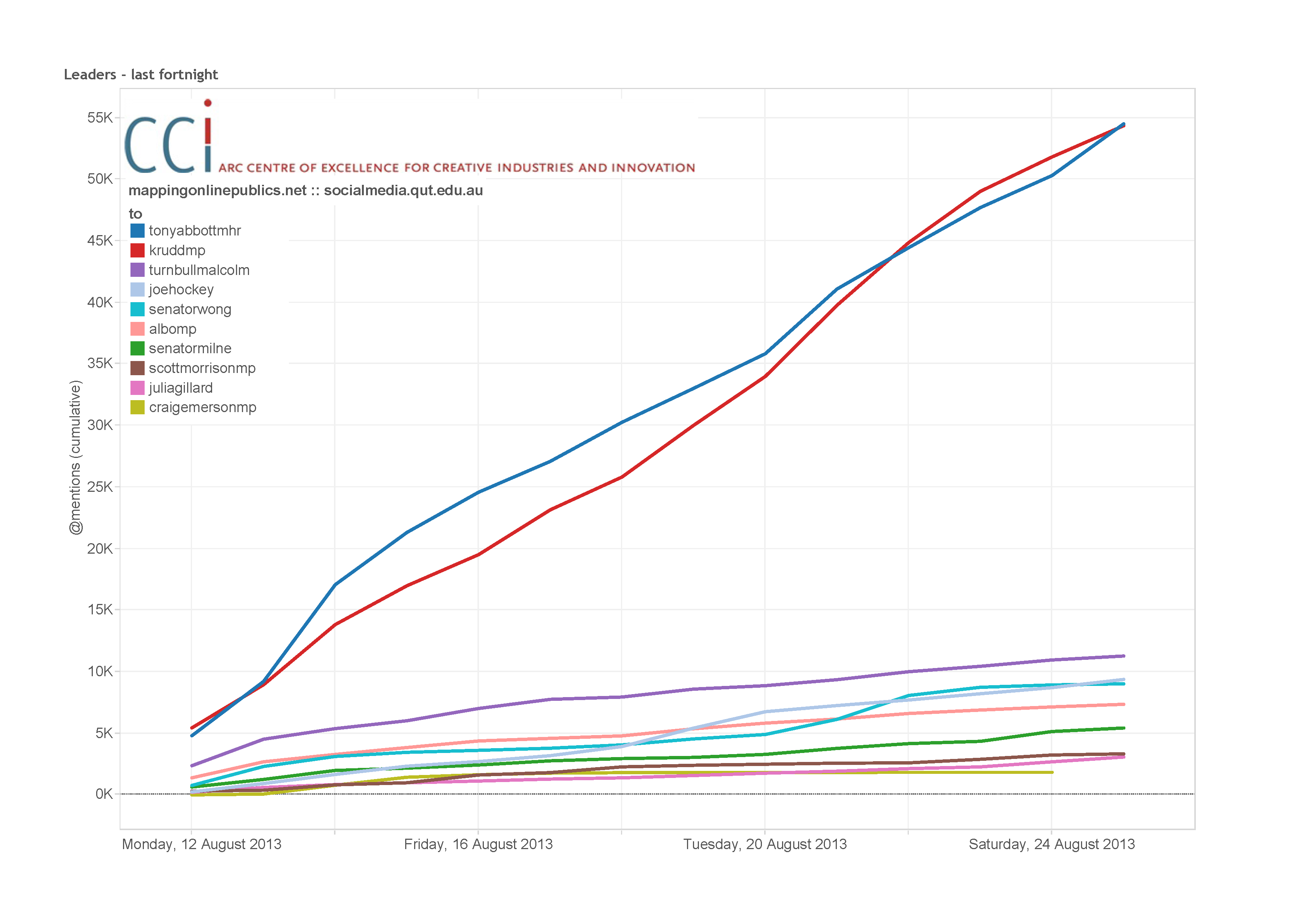
Overall, then, the past fortnight leaves the two major party leaders virtually inseparable – only the late surge of @mentions during the Liberal party campaign ‘launch’ pushes Tony Abbott into the top spot, by fewer than 150 @mentions over a two-week period in which Rudd and Abbott were each mentioned about 55,000 times, according to our data. If there is one major take-away from all this, it’s the fact that the election remains close – the Twitter audience hasn’t switched off from paying attention to either leader or his party yet.
In this light, the fact that Rudd maintains a handy lead in @mentions over the longer term (for our purposes here, from 1 July onwards) becomes somewhat immaterial. As I’ve noted before, the flurry of government activity after Rudd’s return to the Prime Ministership, and the weeks of speculation about the eventual election date, have contributed their share to the substantially greater number of @mentions the PM has received over this time. Since 4 August, and especially over the last weeks, though, the two leaders’ trajectories have tracked each other closely.
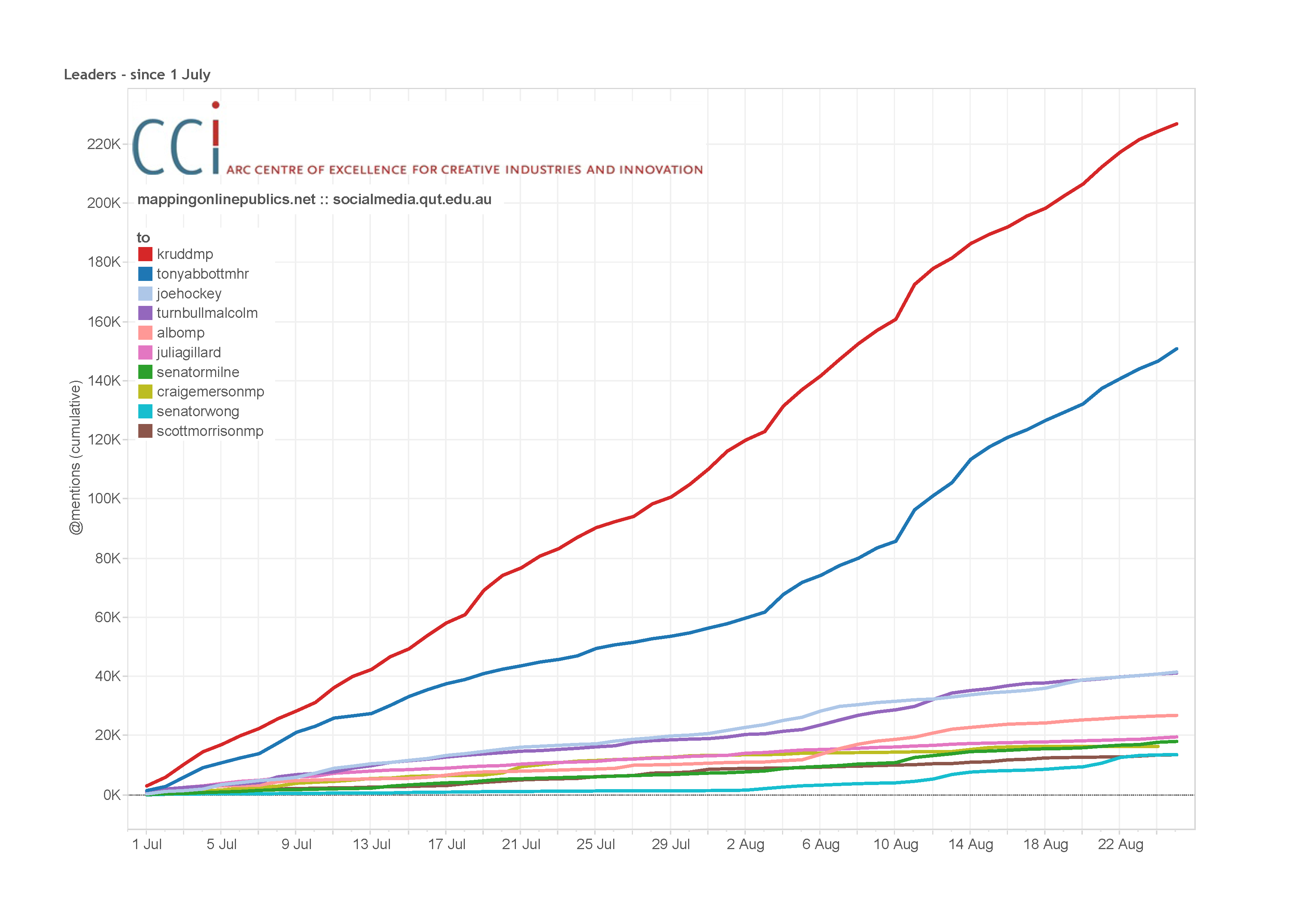
What the longer-term trajectories do show, however, is that it’s Abbott whose Twitter prominence has improved. Rudd’s trajectory is largely steady; with slight upward or downward aberrations, he’s added some 26,000 @mentions to his count each week, and that rate has increased only slightly since the election proper was called on 4 August. Looking at Rudd’s trajectory alone, you’d be hard-pressed to identify the start date of the campaign. For Abbott, that’s a different matter: before the start of the campaign, he was averaging some 12,000 @mentions per week; since then, he’s adding a Rudd-like 26,000 @mentions to his tally. That, in a graph, is the difference between being merely the Opposition Leader, and being a key contender for the Prime Ministership.
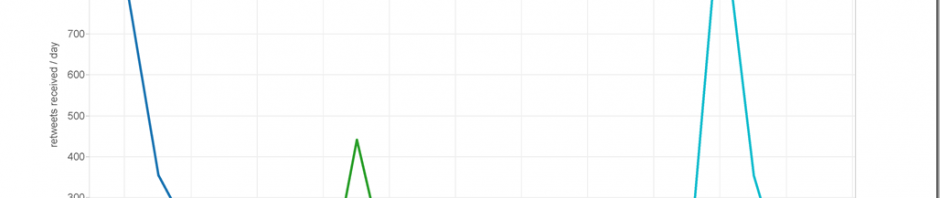
Close observers might have noticed already that we have a new entrant amongst the other leading (that is, most @mentioned) politicians this week: Finance Minister Penny Wong (@SenatorWong). From a slow start to the campaign, she’s recently caught up with Scott Morrison in the number of @mentions received. Indeed, on at least one count, Wong enters in first place with a bullet: last Thursday, she received the most retweets on a single day of any political leader during the campaign to date.
Time, then, to take a closer look at retweets during the campaign so far. The first and most obvious observation is that retweets of politicians’ messages make up only a minute part of all the @mentions these accounts have received to date; even the two major party leaders have only received a few thousand retweets in total during the three weeks of the campaign so far.
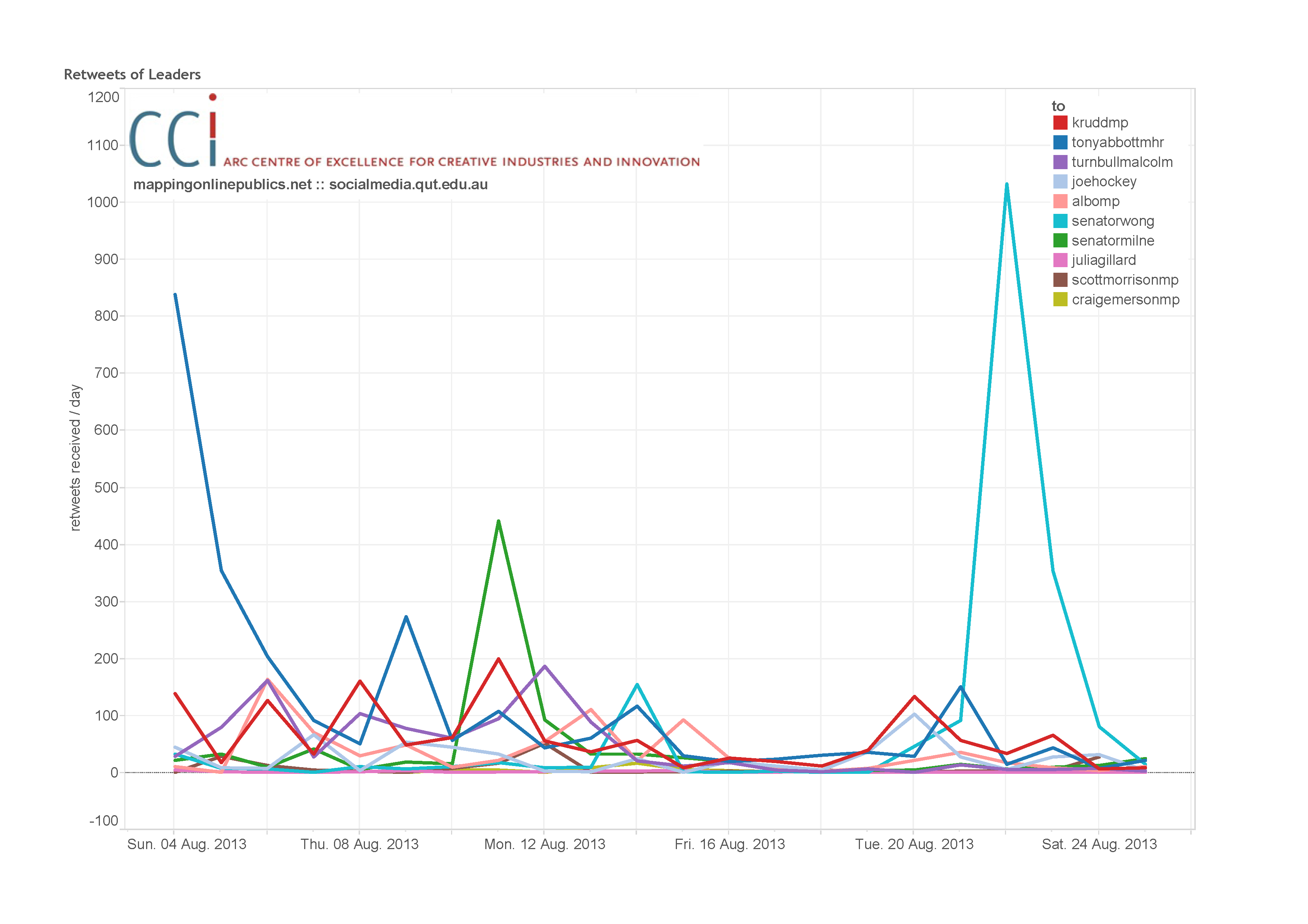
This makes some sense, of course. Twitter users may not see the point in retweeting already well-known politicians: with his 1.38 million followers, for example, what additional visibility does Kevin Rudd gain from being retweeted by you or me? If we are retweeting any of them, then, it would have to be because we want to explicitly endorse one of their messages – so with this in mind, here’s a quick tour through the most retweeted messages by the leading politicians to date.
The field is led by Penny Wong, whose stinging reply to a clichéd comment about marriage equality (from an account which has since been renamed or deleted) earnt her more than 1,000 (manual as well as button) retweets on Thursday alone:
Gee, highly original. Hope your one follower enjoyed it. RT @corrigan_brett: @SenatorWong marriage is for Adam & Eve, not Adam & Steve.”
— Senator Penny Wong (@SenatorWong) August 21, 2013
Tony Abbott, by contrast, made the early running, but has since failed to pick up any further large numbers of retweets. His tweet on the night of 4 August, immediately following the begin of the election period, was a US-style call to the Coalition faithful, complete with presidential photo, to show their support by retweeting.
The Choice is clear. RT if you support the Coalition #auspol pic.twitter.com/O6wLMXbA9N
— Tony Abbott (@TonyAbbottMHR) August 4, 2013
This was preceded by another widely retweeted message, designed to show off Abbott the family man as he retweeted and responded to a message by daughter Bridget:
“@bridgetabbott: Wishing Dad @TonyAbbottMHR the best of luck over the coming 5 weeks! Can’t wait to join him on the campaign trail” Me too!
— Tony Abbott (@TonyAbbottMHR) August 4, 2013
(Daughters Bridget and Frances also feature in Abbott’s smaller spike on 9 August as he retweets their messages from a family afternoon at the Brisbane Ekka, and other users retweet his retweets.)
Meanwhile, Greens Leader Christine Milne’s best day came during the first televised leaders’ debate, from which she was excluded – several of her tweets were passed along by Greens supporters during the debate, following a public encouragement from the collective @GreensMPs account and individual party colleagues to do so. Here’s a flavour – if this tweet is representative, the Greens social media team still need to work on framing their shots effectively, though:
No matter how hard Tony Abbott tries to stop renewable energy revolution, it is unstoppable. It is everywhere. pic.twitter.com/5Q8OkGt1KK
— Christine Milne (@senatormilne) August 11, 2013
By contrast, in spite of a steady but limited flow of day-to-day retweets, Prime Minister Kevin Rudd hasn’t yet managed to generate a substantial spike in retweets during the campaign – perhaps it’s time for a sneaky selfie again? He came closest perhaps with this – also very US-style – tweet ahead of the first debate, combining both semi-formal publicity shot with some light-hearted text:
I have lots of official briefs for the debate. Does anyone have some good jokes? KRudd pic.twitter.com/H1WlB8mKhk
— Kevin Rudd (@KRuddMP) August 11, 2013
Again, Rudd’s comparatively massive follower base on Twitter means that he is least dependent of all Australian politicians on getting his messages retweeted – and indeed, that Twitter users may be least likely to feel a need to retweet him. That said, however, like any campaign team the Labor camp would surely be interested in encouraging retweets from the faithful to show that there is good grassroots support for the party and its leader – so I wouldn’t be at all surprised if we saw some more US-style, image-heavy posts that are designed to be retweeted from Kevin Rudd’s account.