And finally, following on from where we left off in Part 3 of this series, let’s have a look at some of the key themes of this election campaign, such as they were. Again, this builds on the keywords and key phrases we identified using WordStat in Part 2: from those stats we can extract and cluster a number of themes which bear further attention.
Let’s begin with actual policies: from the WordStat data, five policy fields emerge as having been of major interest to #ausvotes commenters during the campaign – national broadband policy (most centrally, the choice between Labor’s NBN scheme and the Coalition’s alternative broadband proposal); the ‘Cleanfeed’ Internet filter pursued by Labor communications minister Stephen Conroy; climate change; asylum seekers; and same-sex marriage. It’s probably no surprise that of these, two are very clearly identified as topics of interest to heavy Internet users – an indication, not least, that the Twitterati whose content we’re analysing here are unlikely to be representative for the wider Australian population. So, let’s have a look at what we find:

Clearly, the early running (if at very low volume) is mainly dominated by low-level rumblings about the Internet filter. There’s a brief spike of interest in climate change topics, but this mainly remains limited to one day. Things only get interesting half-way through the campaign: with an announcement by the Coalition on 5 August that it would block the Internet filter project, which boosts the numbers for that topic, and with a massive spike following the Coalition’s announcement of its own – frankly, somewhat incoherent – national broadband policy and Tony Abbott’s attempts to explain that policy on the 7.30 Report, on 10 August. From that point on, of these five topics, broadband policy clearly dominates the discussion, even in comparison to the Internet filter – and without looking closer at the data for now, my impression would be that it’s not favourable to the Coalition: whatever good its opposition to the filter might have done it would have dissipated due to the backlash against its broadband plans.
Against this, issues surrounding asylum seeker policy remain backgrounded: whatever the level of media coverage they have received, the Twitterati are less than interested. Especially compared to the level of attention which the ‘boat people’ have received in the mainstream media, by contrast, the coverage of gay marriage reform (not a major theme on the mainstream media) on Twitter is relatively substantial. This comes out especially when we look at the normalised data:
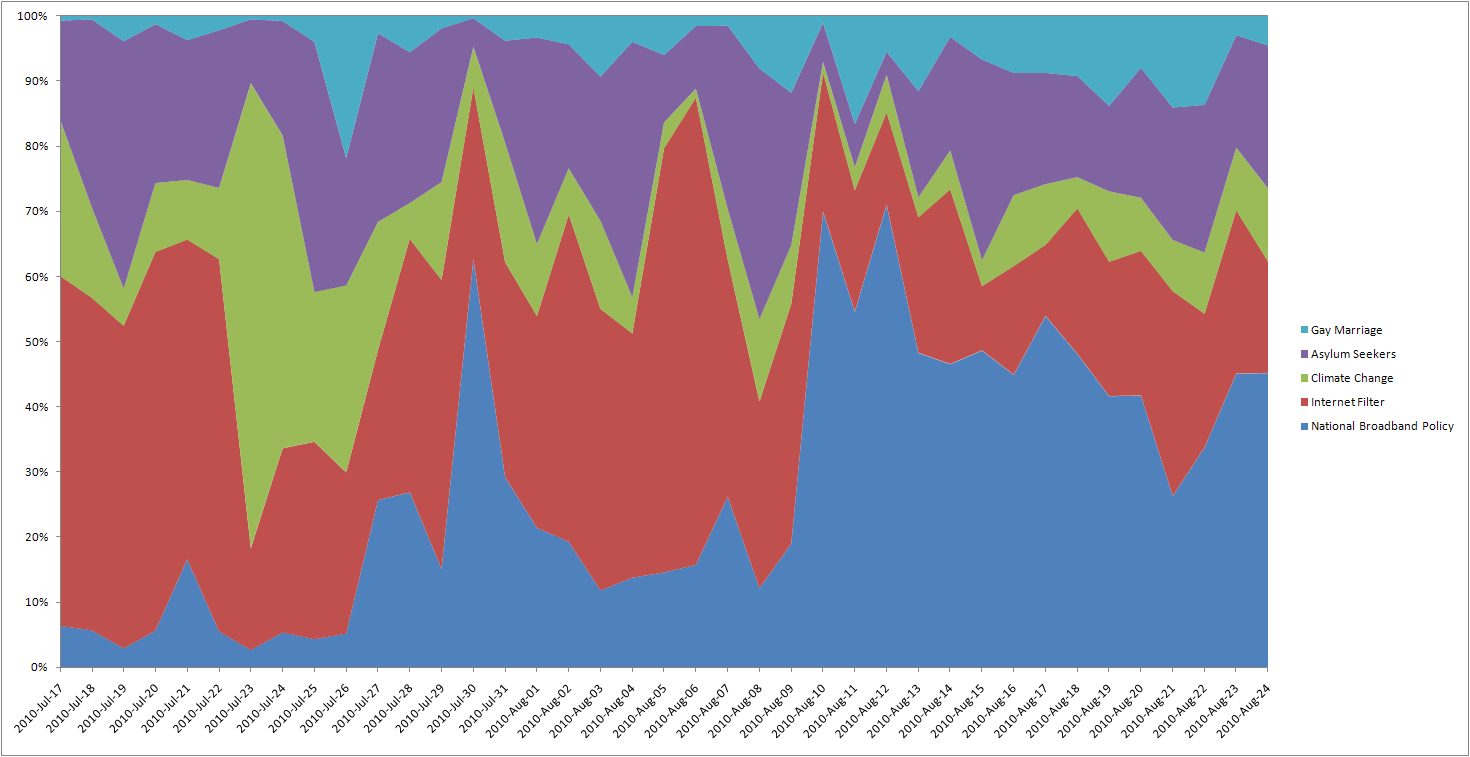
As before, here are the search filters I used: ‘(nbn|broadband)’ for National Broadband Policy; ‘(filter|cleanfeed|openinternet)’ for Internet Filter; ‘climate.?change’ for Climate Change; ‘(stop.*boat|boat.*people|asylum)’ for Asylum Seekers; and ‘gay.?marr’ for Gay Marriage.
Beyond the policies, it’s also worth taking a look at the discussion of politics on Twitter: of the political process, rather than of policy substance. Looking again at the key themes which emerged from our WordStat analysis, the main observation is that for the most part, there’s nothing much to see here:
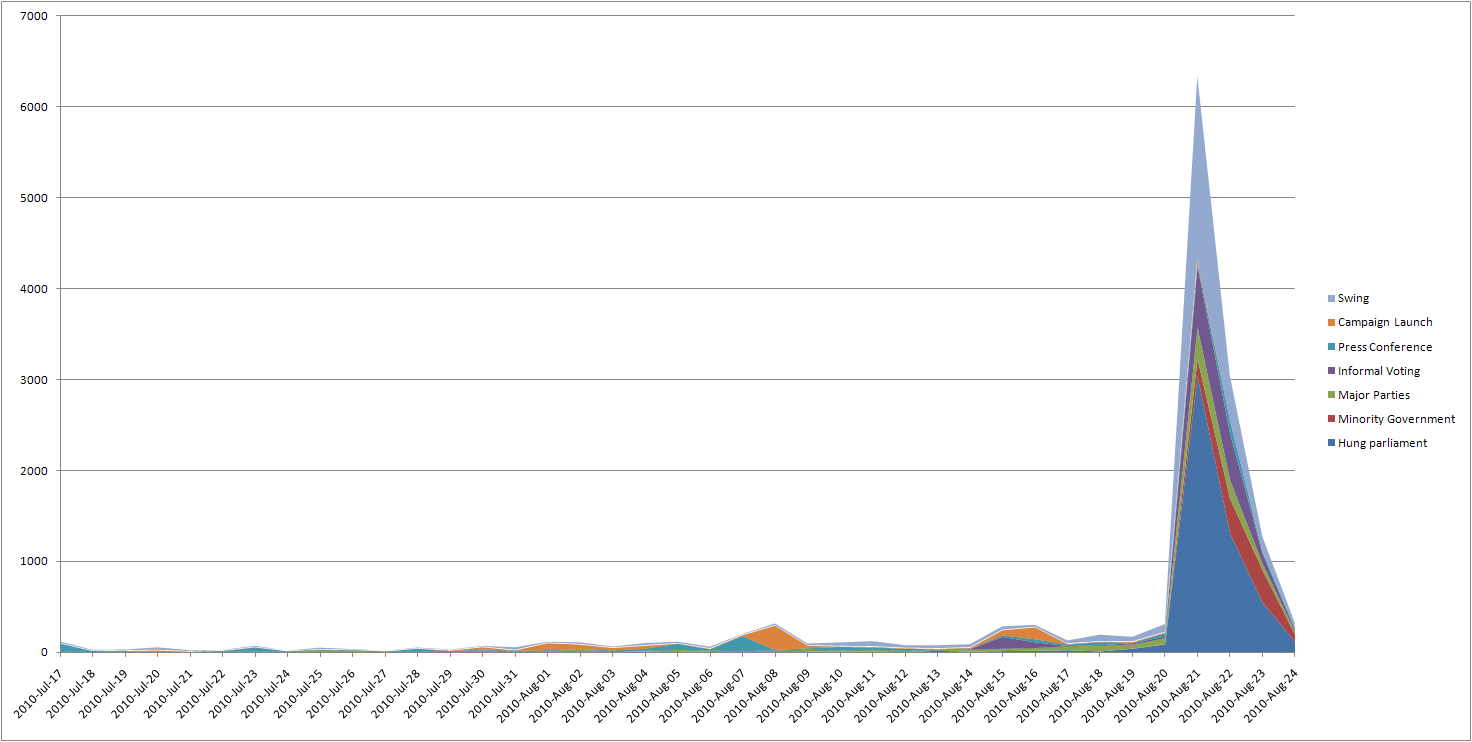
Again a note on search filters: ‘hung.parl’ for Hung Parliament; ‘minority.?gov’ for Minority Government; ‘major.?part’ for Major Parties; ‘(informal.?vot|vot.*informal)’ for Informal Voting; ‘press.?conf’ for Press Conference; ‘campaign.?launch’ for Campaign Launch; and ‘swing’ for Swing.
So: even though there certainly was plenty of process to discuss in the lead-up to the election, the paradigm well and truly shifted on election day. Discussion of potential swings, and brief blips around campaign launches and press conferences did occur before 21 August, and informal voting came up as an issue following Mark Latham’s intervention on 60 Minutes, but only from election day onwards did we begin to discuss the questions surrounding a hung parliament and a minority government in earnest. Though there were rumblings about this as a potential outcome of the election, it seems like nobody on Twitter was prepared to engage in any sustained discussion of these issues until they became a reality.
And that’s where we find ourselves now – probably a good point to end on! Good luck to us all…
Comments are closed.