Having looked (in Part 2 of this series of posts) at the overall keyword and key phrase trends in the over 400,000 #ausvotes tweets discussing the Australian federal election, we’re now in a position to chart the prominence of key themes across the five weeks between 17 July and 24 August 2010. There are quite a number of potential themes to track here, so I won’t combine them all into a single graph – rather, I’ll group them into a number of (hopefully) fairly sensible clusters.
First, a little light relief: since we’ve already looked at the relative number of mentions of each leader by name (in Part 1), let’s extend this and examine mentions of their nicknames and catchphrases. For PM Julia Gillard, the catchcry was – especially in the early stages of the campaign – the interminably repeated phrase ‘moving forward’, while Opposition Leader Tony Abbott encouraged Australians to ‘stand up for real action’. Additionally, after Gillard ditched her overly controlled campaign, she promised to let the ‘real Julia’ come to the fore, while inadvertently also bestowing the nickname ‘Mr. Rabbit’ on Abbott, as a result of her pronunciation of her opponent’s name.
Here’s how things unfolded – first, in terms of real numbers:
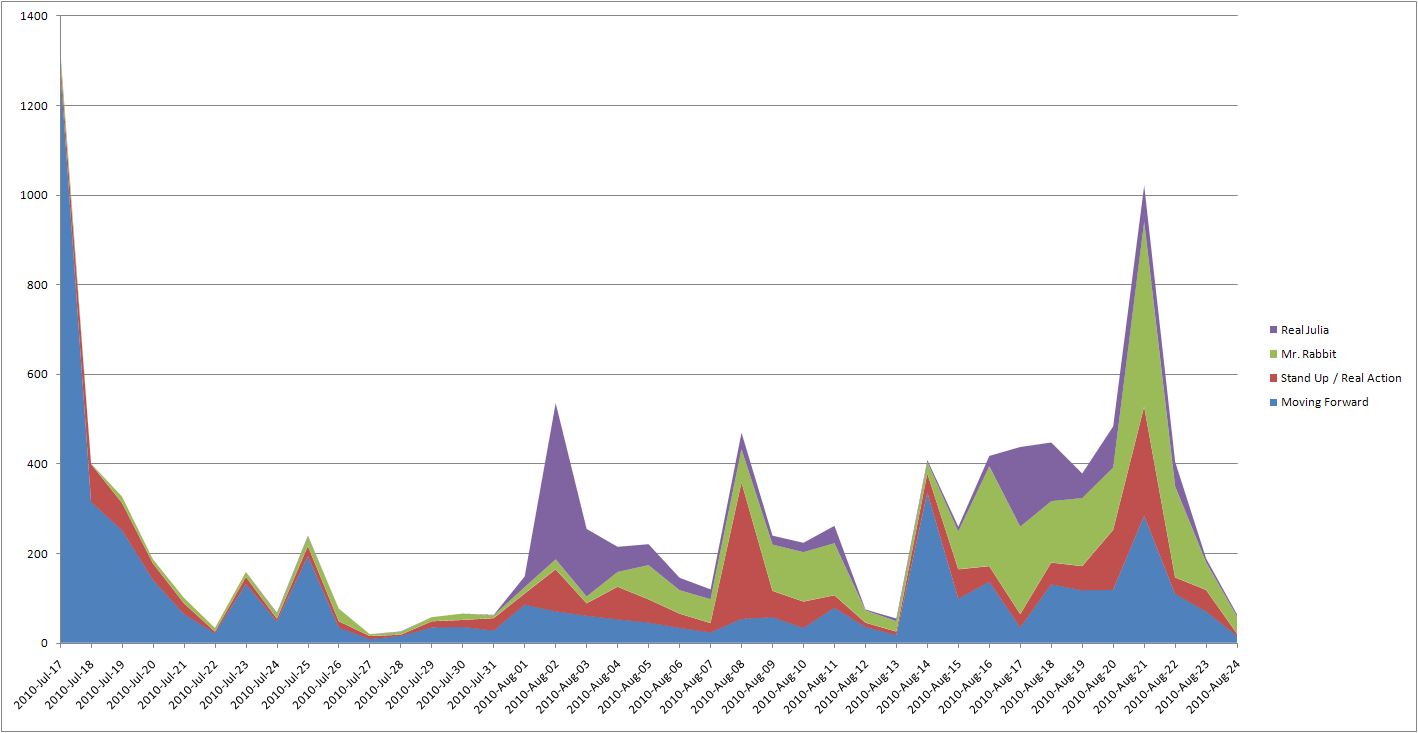
We can clearly see the overwhelming dominance of the ‘moving forward’ slogan in the early days of the campaign (it’s quite likely that very few of those many tweets would have been positive in sentiment, though). After the first couple of weeks, it’s also evident that the sidelining of the slogan by the Labor campaign has also reduced its repetition on Twitter, it does make an appearance again towards the end of the campaign, though, especially in a spike on 14 August, which is likely to be the result of Labor’s twibbon campaign that encouraged users to show their support for the party through their Twitter avatar and resulted in many tweets such as this:
I’m with Julia. On August 21 let’s move Australia forward. Show your support too #ausvotes http://twb.ly/cd6557
By contrast, the ‘real Julia’ meme spikes (obviously) on the day of its introduction, but generally fails to capture much sustained attention. ‘Mr. Rabbit’ is more successful overall – from mid-campaign onward, it’s gradually becoming more and more widespread. And ‘stand up for real action’ figures prominently only on 8 August, the day of the Coalition’s official campaign launch, but fizzles otherwise.
Normalising these results to 100% further helps show the overall tweetspace which either of these memes were able to capture. Clearly, ‘Moving forward’ dominates the early running, but drops away just as the ‘real Julia’ makes her brief appearance (though note that we’re dealing with some very low numbers overall during the first fortnight); from about the same time onwards, ‘Mr. Rabbit’ makes his presence felt, too.
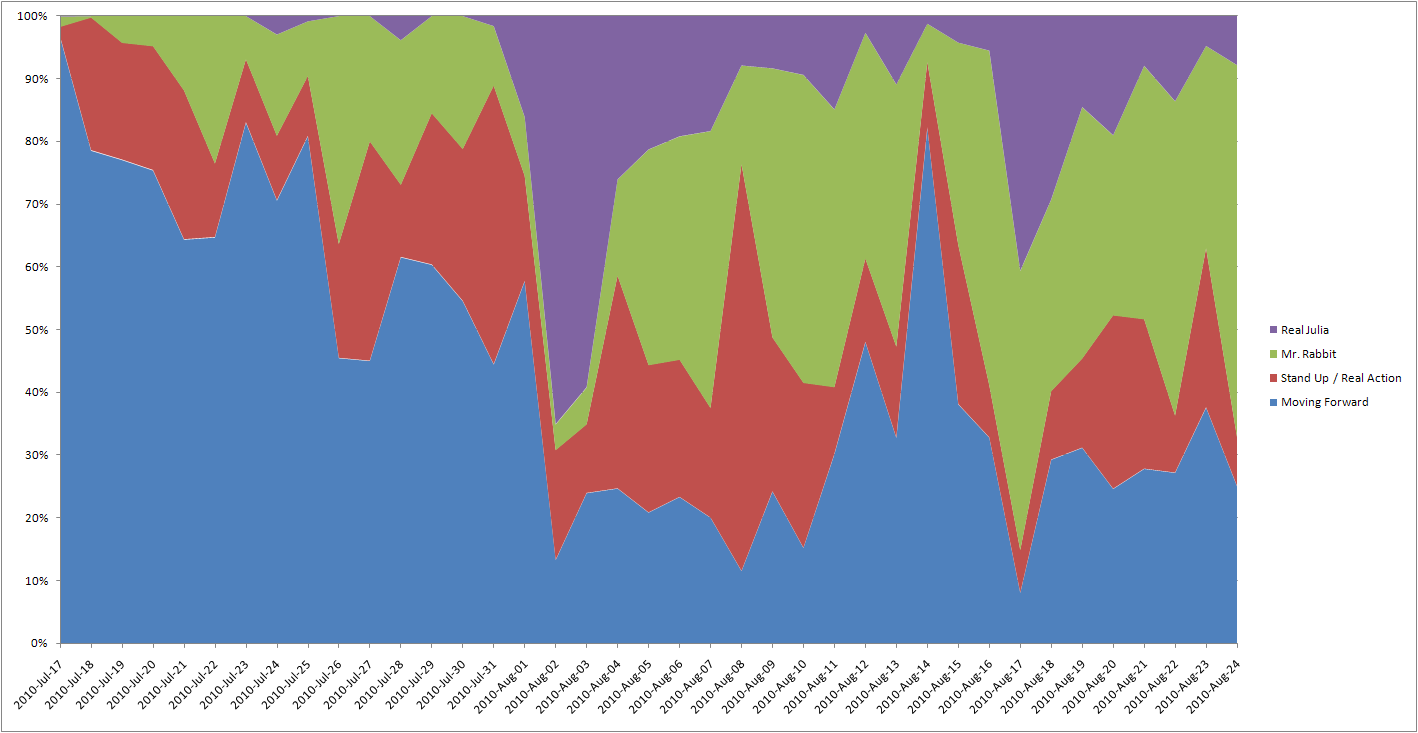
Note: I should mention the search filters which generated those numbers. Written as regular expressions, anything that matched ‘mov.*forward’ was counted for ‘Moving Forward’ (i.e. ‘move forward’, ‘moving forward’, etc., as well as ‘moving Australia forward); ‘(stand.?up|real.?action)’ for ‘Stand Up / Real Action)’; ‘real.?julia’ for ‘Real Julia’; and the search term for ‘Mr. Rabbit’ was simply ‘rabbit’ (so it could have included mentions of other rabbits under the #ausvotes tag as well, but that’s probably not a quantity we need to worry about).
But back to somewhat more serious matters: as I mentioned in the previous post, while Abbott won out against Gillard on the personal count, Labor still bested the Coalition on party mentions. Here are the graphs to prove it, with a few minor parties thrown in:
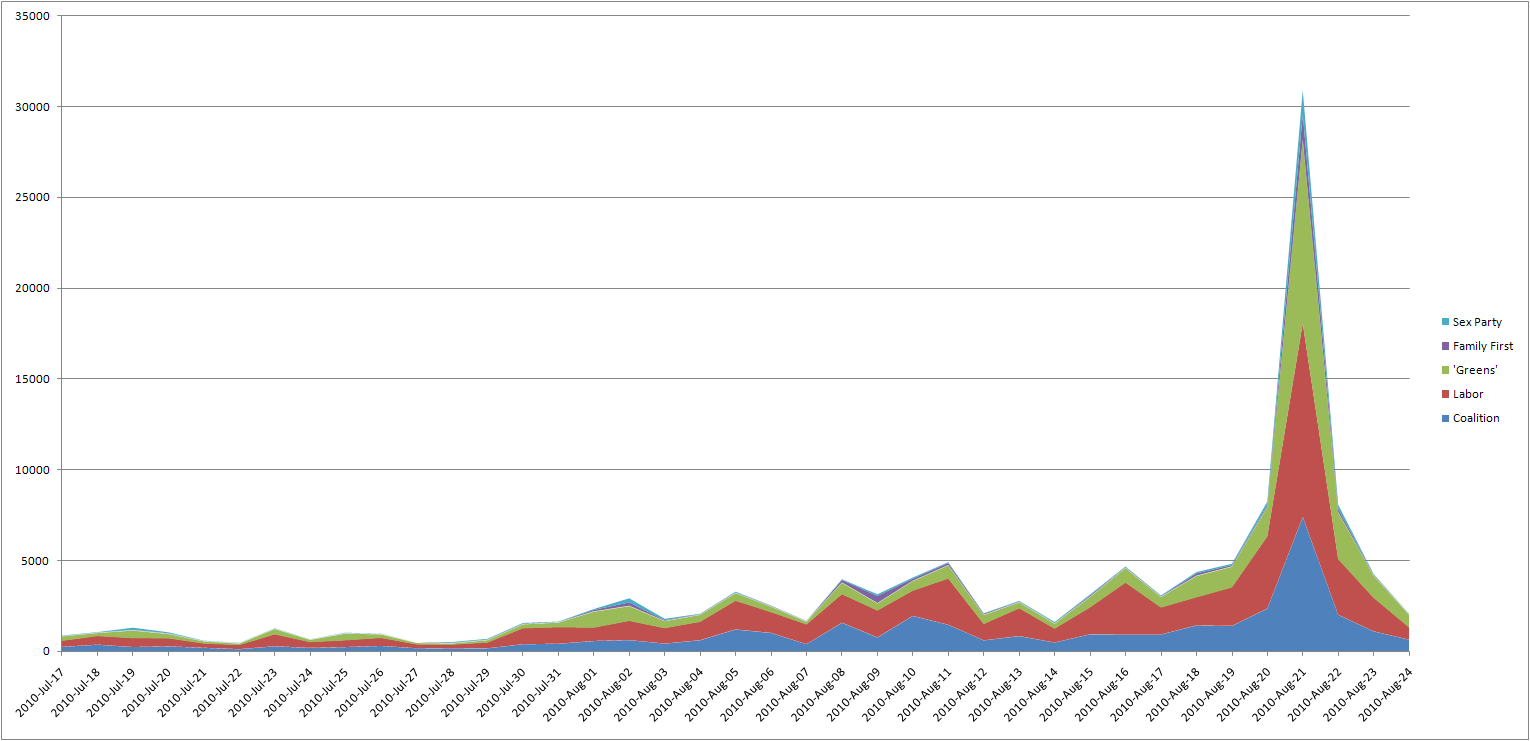
We see a fairly persistent advantage for the Labor party over the Coalition throughout the election period, with a total of 54420:34885 mentions overall. Counted in this were the terms ‘Labor’, ‘Labour’ (for misspellings and overzealous auto-corrections), and ‘ALP’ on the Labor side, and ‘Liberal’, ‘Libs’, ‘LNP’, and ‘Coalition’ on the Coalition side; as mentioned in Part 2, I’ve had to exclude the National Party since ‘national’ is also a very generic term, especially in the context of a national election.
From the graph, it appears as if the Greens also make a very good showing. I need to note a major caveat in this context, however: as with the Nationals, the term ‘green’ is also likely to appear in the data in a number of other contexts – in particular, in the names (and Twitter handles) of ABC election analyst Antony Green and Drum editor Jonathan Green! And short of manual coding, there’s no easy way to filter those false positives from the overall number. So, take the ‘Greens’ figure with a large quantity of salt – it’s likely to be substantially inflated by those other Greens.
Here’s the normalised version of the graph, which shows the relative presence of each party in the #ausvotes tweetstream. Clearly, the minnows (Australian Sex Party and Family First) are minnows here, too – though it’s interesting to see that the Twitterati’s interest in the Sex Party narrowly wins out over that in Family First (by 3459:3315 tweets).
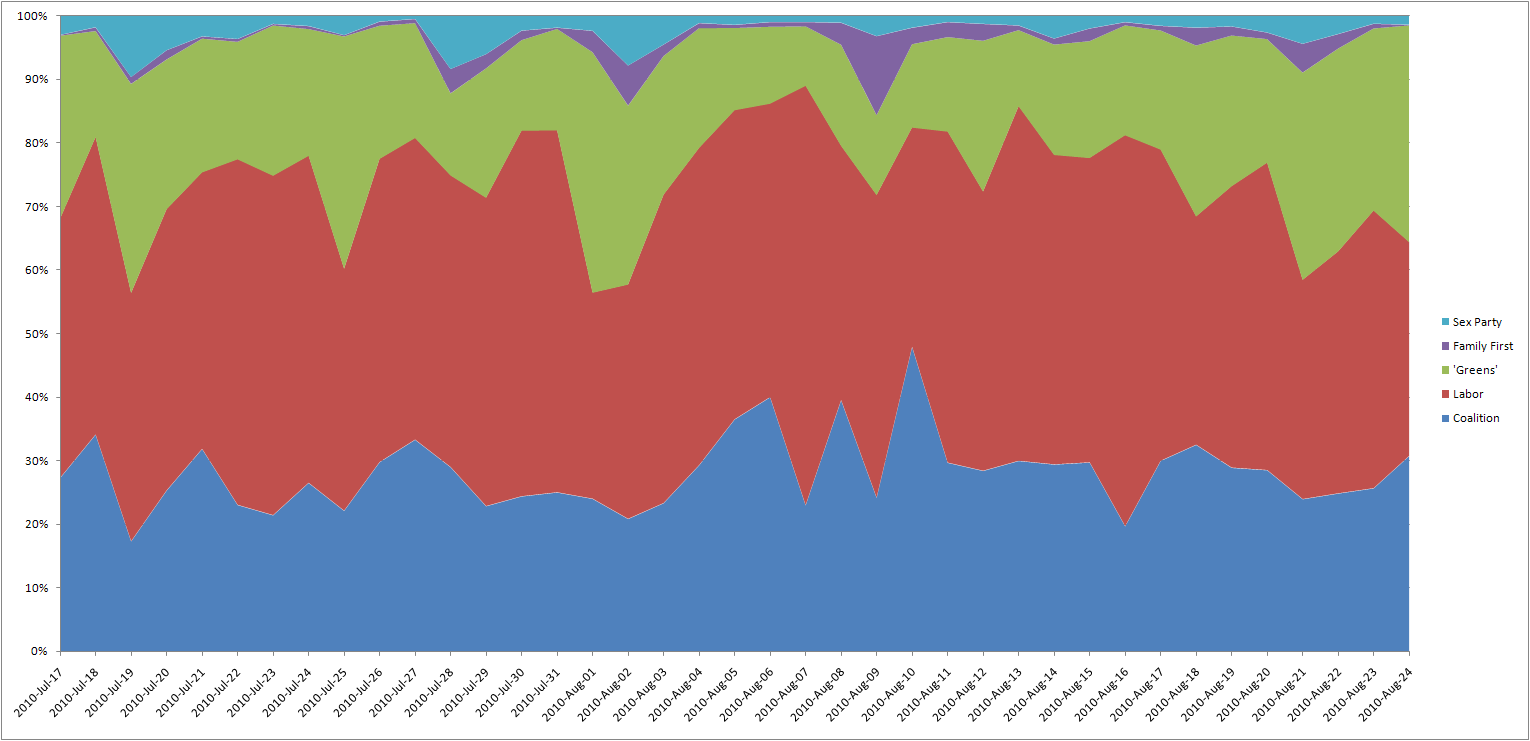
A quick note on the search terms again: for the Coalition, ‘(liberal|libs|lnp|coalition)’; for Labor, ‘(labor|labour|alp)’; for the Greens, ‘green’; for Family First, ‘family.?first’; and for the Sex Party, ‘sex.?party’.
Finally for this post, let’s also have a look at some of the bit players in the general campaign: the ministers, minor party leaders, former politicians, and local candidates who for one reason or another appeared reasonably often in the overall tweetstream. The selection here is based on the keyword and key phrase analysis presented in Part 2: we’re looking here at those second-tier politicians who appeared most prominently in those data.
On the Labor side, they include deposed PM Kevin Rudd, Treasurer Wayne Swan, and Climate Change minister Penny Wong, as well as Maxine McKew (the former ABC presenter who won won her seat in parliament from then-PM John Howard at the 2007 election; and for the Coalition, Shadow Treasurer Joe Hockey and National Party Senator Barnaby Joyce. Further, we’ll include Greens leader Bob Brown, Family First Senator Steve Fielding, and former ALP leader turned 60 Minutes reporter Mark Latham, as well as Wyatt Roy (the successful 20-year-old LNP candidate) and independent MP Bob Katter.
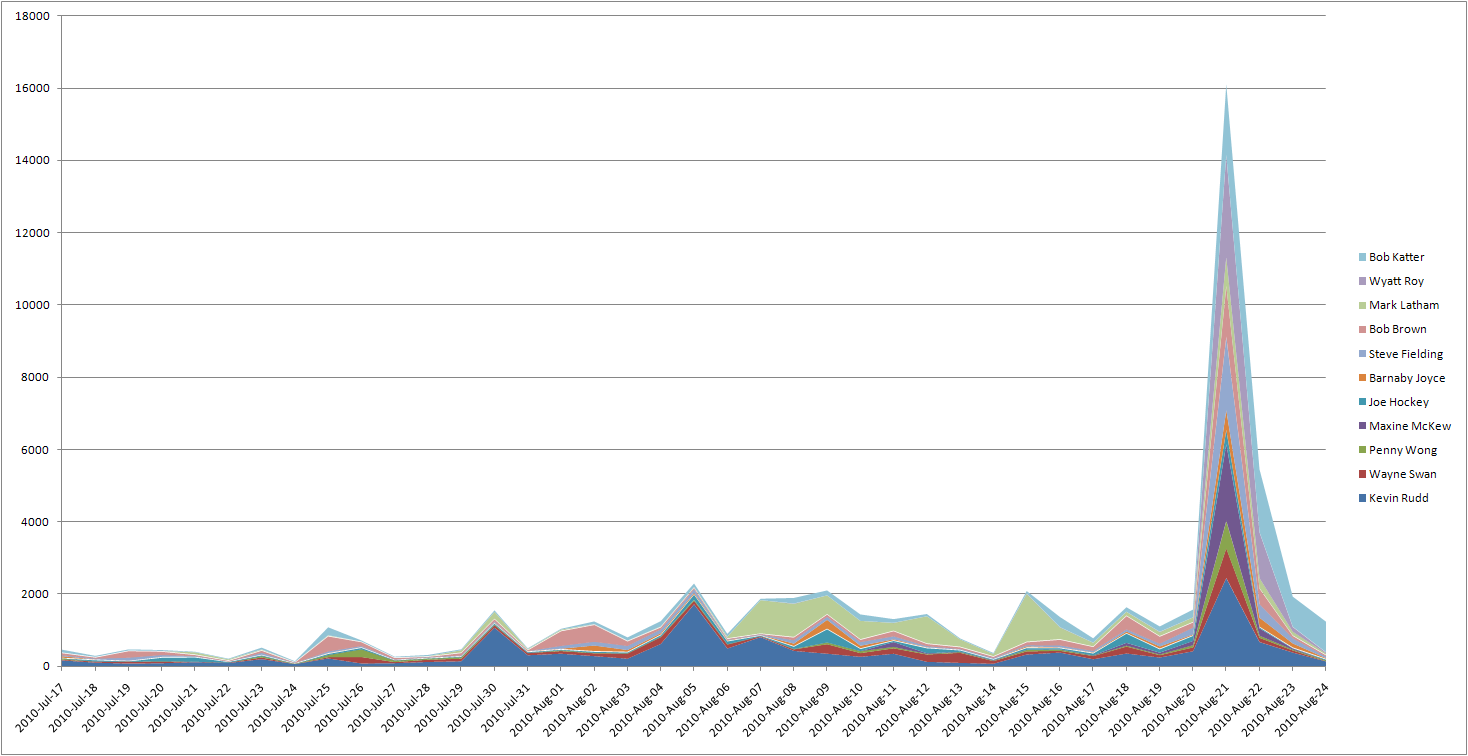
The first point to observe here is that for the most part, these politicians all remain relatively unimportant, at least in terms of how they’re seen by the Twitterati – we’re usually dealing with only a handful of mentions per day, except for the excitement of election day itself. The early running, such as it is, is largely dominated by former PM Kevin Rudd; this is unsurprising, but also documents the difficulties that Labor experienced in moving past its last-minute change of leader before the election was called; in terms of mentions, Rudd consistently outranks Labor Treasurer Wayne Swan, for example.
Mid-campaign, Mark Latham’s infamous appearances on the campaign trail begin to intrude on the Twitter discussion; for a while, he manages to overshadow most of the active politicians we’re tracking here. Beyond this, we’ll need to have a look at the normalised graph to see further trends:
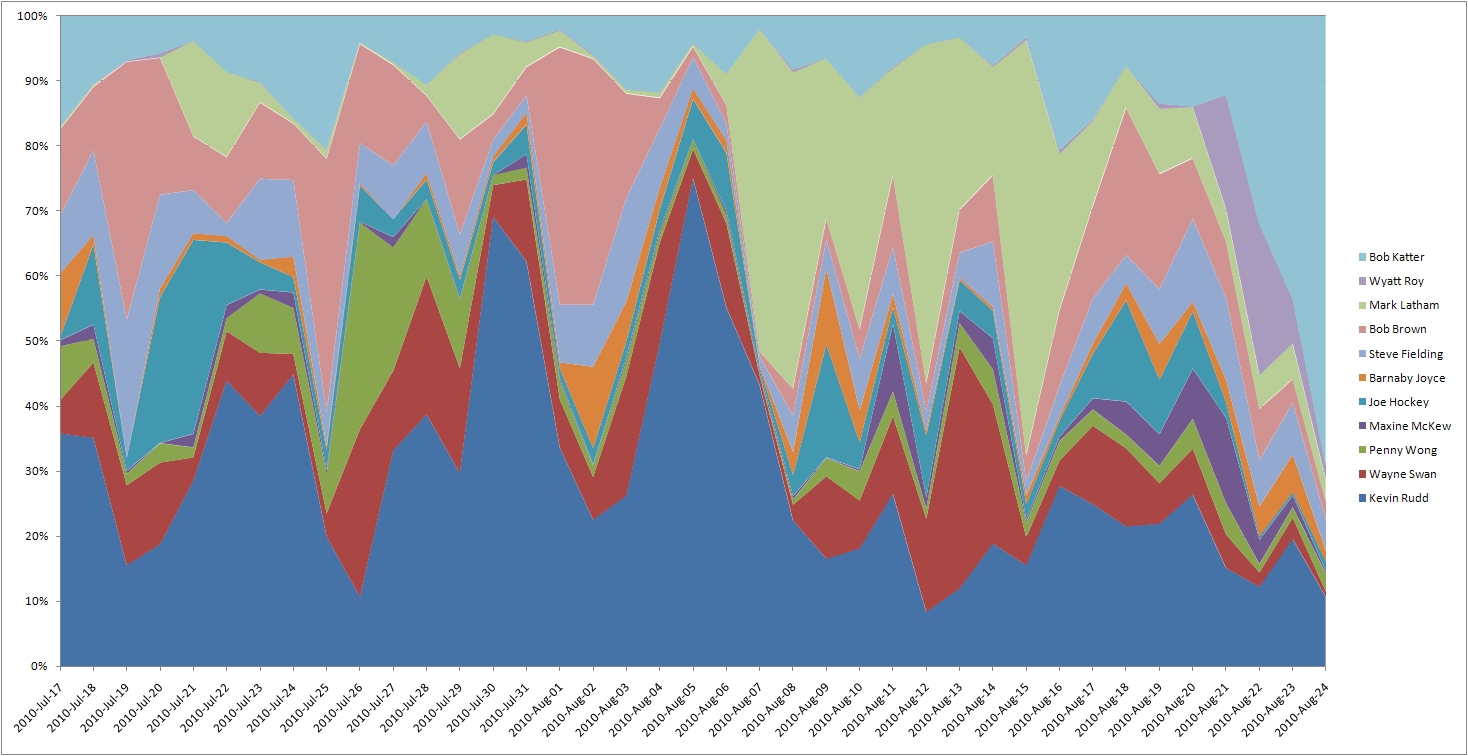
What emerges from this is that Greens leader Bob Brown actually has a reasonable showing in the first half of the campaign, compared to the others (but note that like theirs, his total number of mentions too remains very small) – but he seems to go missing during the third quarter of the match. Most others hardly rate a mention – Joe Hockey and Barnaby Joyce only make occasional appearances; Penny Wong has a few good days during week 2, but all but disappears afterwards; and Steve Fielding manages to create no more than a trickle of interest from the Twitterati.
Interestingly, in spite of his pre-election status as something of an irrelevant oddity, Bob Katter has some presence throughout the campaign, though also at a fairly low level (and linked mainly perhaps to Twitter‘s discussion of his very homespun TV commercial) – however, as one of the independents now holding the balance of power in parliament, he rapidly shoots to prominence from election day onwards, morphing from a bit player to a major political force. The same can’t be said for Wyatt Roy, who does get his 15 minutes of fame on election day, but disappears from view again as the process of finding a stable majority begins. This, then, he shares with Maxine McKew, whose televised outburst on election night briefly captures attention, but who now – as a newly ex-MP – no longer figures in the political process.
Again, a note on search filters:
- Kevin Rudd: (kevin|rudd)
- Wayne Swan: (wayne|swan)
- Penny Wong: (penny|wong)
- Maxine McKew: (maxine|mckew)
- Joe Hockey: hockey
- Barnaby Joyce: (barnaby|joyce)
- Steve Fielding: (steve|fielding) – which could have captured other Steves as well, but as it turns out his numbers nonetheless remain low.
- Bob Brown: brown
- Mark Latham: latham
- Wyatt Roy: wyatt.roy
- Bob Katter: kat – to make sure the fast-emerging hashtag #bobkat was captured as well.
Comments are closed.