Okay. A week and a half have passed since the Australian federal election on 21 August, and we’re still none the wiser about who will form the next government (though it’s worth mentioning in passing that it’s blatantly wrong to claim that Australia currently has no government – however dramatic the headlines, they’re simply incorrect). Anyway, while we’re waiting: time enough to work through the more than 400,000 tweets accumulated under the #ausvotes Twitter hashtag between 17 July (when PM Julia Gillard called the election) and the election weekend of 21 August, and to examine what the patterns of activity on #ausvotes might tell us about the shifting preoccupations of the Twitterati during and after the campaign. As before, my data come from Twapperkeeper, this time covering the period of 17 July to 24 August 2010.
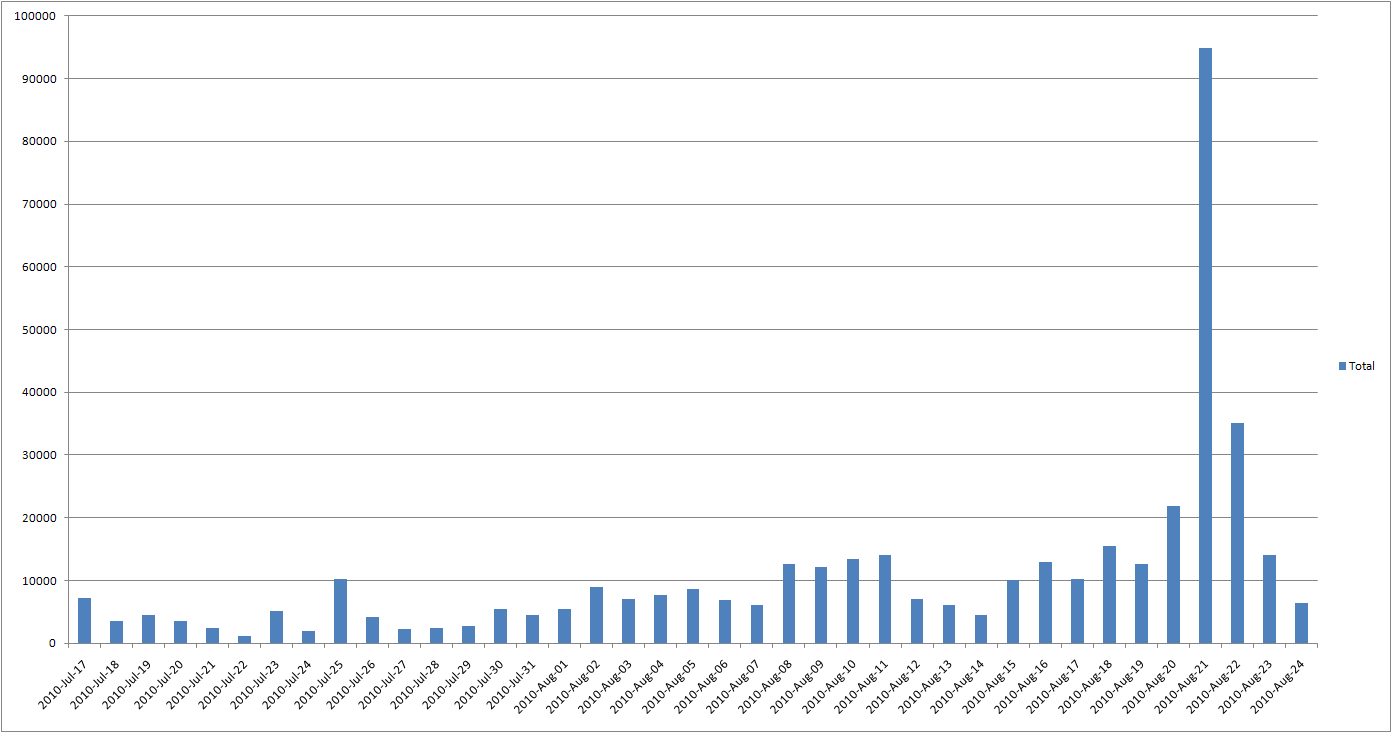
There’s plenty to look at here, so I’ll split this post into a number of sections, examining various aspects of the #ausvotes coverage. A quick overview to start us off (as always, click to expand): while there was substantial tweeting activity throughout the campaign, things ramped up significantly towards the tail end, and went through the roof on election Saturday, with a whopping 94910 #ausvotes tweets that day. And the preceding Friday and following Sunday were the next biggest days of the entire period: Friday clocked up 21875 tweets, while 35050 tweets attempted an early analysis of the results on Sunday.
Let’s begin with a familiar approach: I’ve already provided some quick updates during the campaign – following especially the frequency of mentions of the two leaders, and uncovering the somewhat unexpected trend that (after running neck and neck for most of the early campaigning period) Opposition Leader Tony Abbott pulled ahead of Gillard substantially over the final few days of the campaign. Perhaps unsurprisingly, given that the election result put Abbott within reach of The Lodge (an outcome few would have expected at the outset), that trend has continued through election eve: mentions of Abbott win out over those of Gillard by close to a 2:1 ratio on 21 August.
Here are a few graphs to illustrate this:
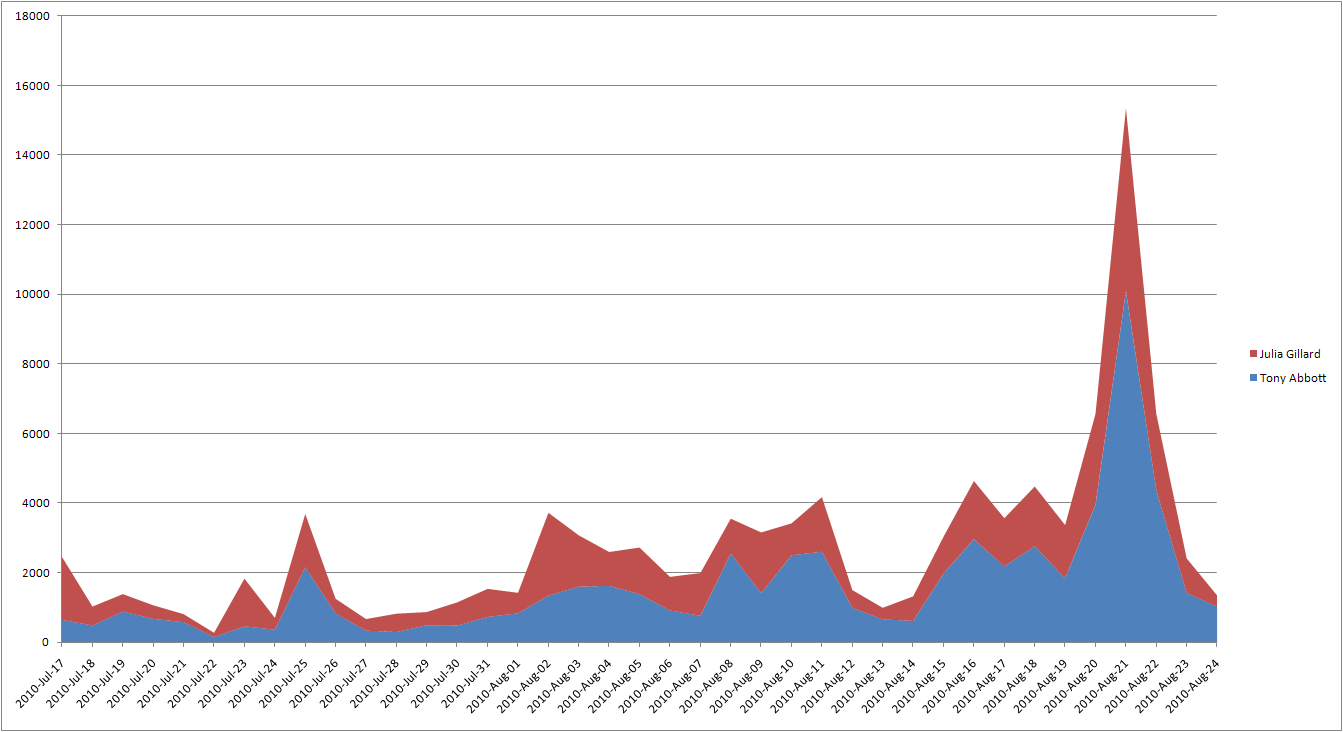
From about 10 August or so (the date of his disastrous 7.30 Report interview with Kerry O’Brien on the Coalition’s broadband plans), Abbott starts pulling clearly ahead – the last week is all his. But again, as the 10 August events remind us, there’s absolutely no suggestion here that all of those mentions will be positive: this is simply about visibility, not support.
The shifting balance between the two leaders becomes even clearer if we normalise the numbers for each day to 100%:
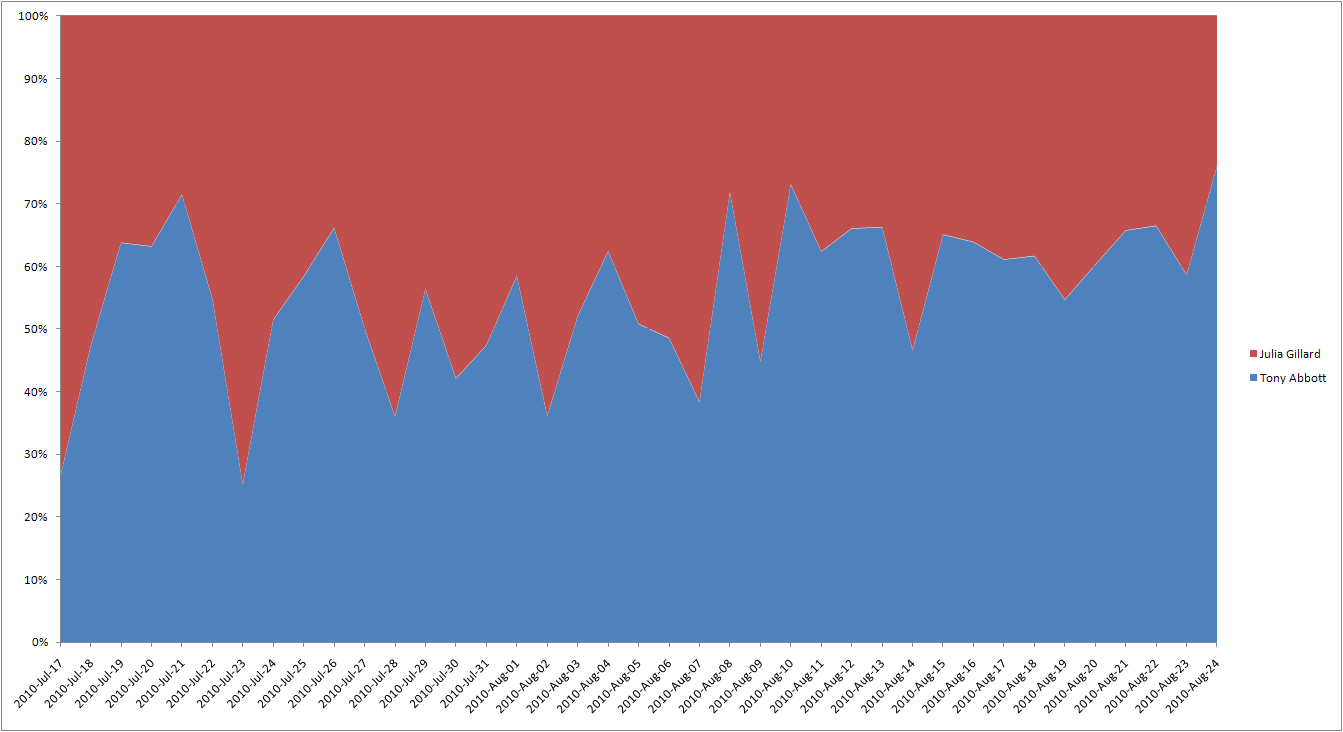
Up until just past half-way in the campaign, both politicians still remain tied for the lead – but from then on, Abbott’s increasing visibility in #ausvotes pushes Gillard back further and further. If we look at the running totals of mentions for both of them, we can even pinpoint when their fortunes change:
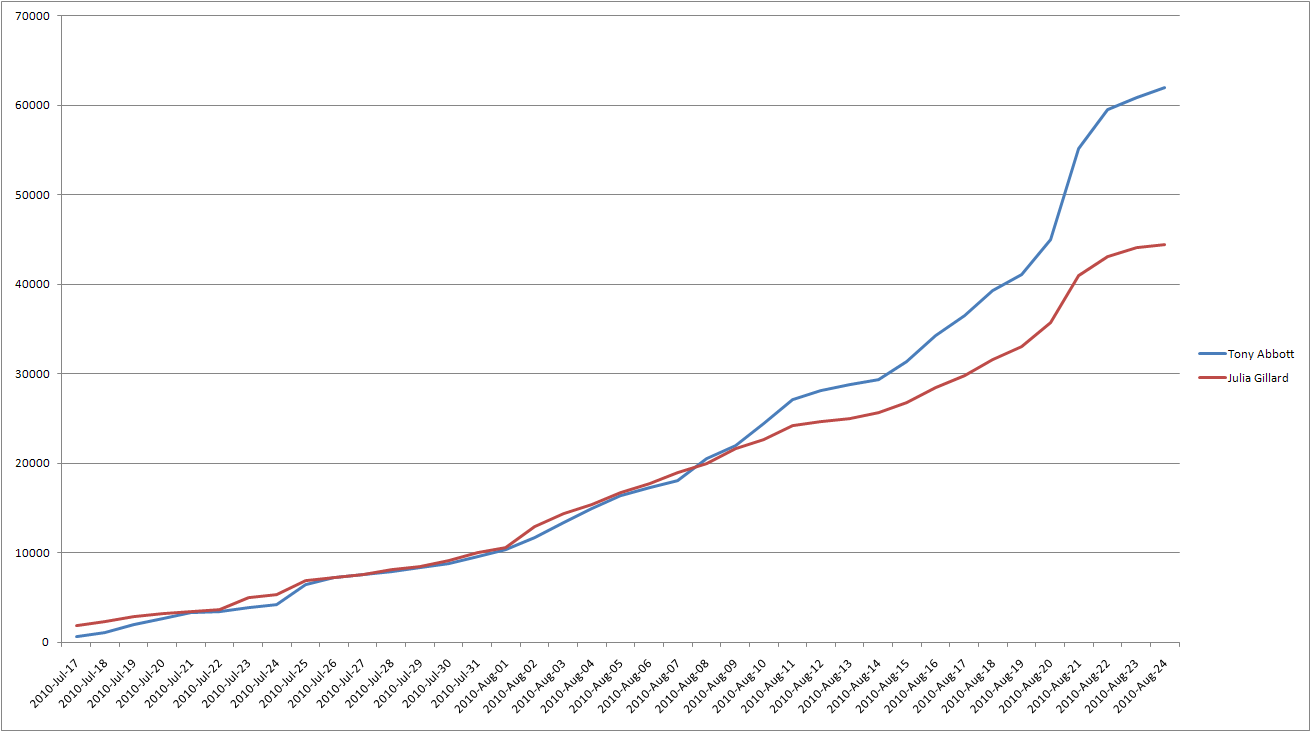
Gillard is ahead in total mentions, every so slightly, up until 7 August. Afterwards, Abbott pulls ahead – slowly at first, but more and more as the rest of the campaign unfolds. From 17 July to 24 August, the total tally is 61943:44441 in favour of Tony Abbott.
A small caveat at this point: counting mentions of both leaders in this way is necessarily a little messy. Abbott may be referred to as ‘Tony’, ‘Tony Abbott’, ‘TA’, ‘@tonyabbottmhr’ or ‘Abbott’ (as well as, more often than you’d expect, ‘Tony Abbot’), as well as through various nicknames (most recently, ‘Mr Rabbit’, picking up on Julia Gillard’s pronunciation of his name). Some of these are far from unambiguous: ‘Tony’ could refer to other Tonys (e.g. to Lateline host Tony Jones); ‘TA’ could simply mean ‘thank you’. Included in the stats above, therefore, are any tweets which mention either ‘Tony’ and/or ‘Abbot’ (one ‘t’, to capture misspellings), or either ‘Julia’ and/or ‘Gillard’ (which is not misspelt as much as ‘Abbott’), respectively – expressed as regular expression searches, (tony|abbot) and (julia|gillard). In other words, we’re ignoring both ‘TA’ and ‘JG’, and may be including false positives resulting from mentions of Tonys and Julias other than Abbott and Gillard. Perhaps the most problematic aspect of this is that mentions of Tony Jones (as the most prominent other Tony) could artificially boost Abbott’s numbers – but as I’ll show in the next post, a separate keyword analysis of tweets between 1 July and 25 August also shows mentions of ‘Abbott’ (two ‘t’s) to outstrip mentions of ‘Gillard’ by 37578:23942, so there’s a genuine lead for Abbott even if we considered only the leaders’ last names.
Comments are closed.